#262 / Editorial
Given the outbursts by the leader of France’s far-left political party LFI that punctuated the municipal election campaign, one might have expected a disqualifying effect during last Sunday’s municipal elections in France. After all, by playing on the phonetic ambiguity of a Jewish name before a roaring audience, Mélenchon made it painfully clear that, among […]
Given the outbursts by the leader of France’s far-left political party LFI that punctuated the municipal election campaign, one might have expected a disqualifying effect during last Sunday’s municipal elections in France. After all, by playing on the phonetic ambiguity of a Jewish name before a roaring audience, Mélenchon made it painfully clear that, among the factors galvanizing the ranks of La France Insoumise (LFI), antisemitism played a decisive role. In the past month, this acknowledgment has reached, even on the left, an unprecedented level of explicitness. Yet we cannot delude ourselves about the election results: the antisemitic left suffered no defeat, and no real punishment was imposed on it. From this observation, we must draw a conclusion: while for one part of the left, antisemitism is clearly disqualifying, for another, it has ceased to be so, becoming at most a source of discomfort and embarrassment. It is on this point that Bruno Karsenti draws our attention in “The Left, the Jews, and the Gangster,” shifting the focus from LFI to the generalized crisis of the left that makes its lasting establishment possible. For it is in a vast void that the politics of the worst take root—the void left by the decay of post-Shoah historical consciousness—as illustrated by this observed antisemitism, against which an authentically leftist discourse struggles to take shape.
Related articles

The Left, the Jews, and the Gangster
Where Do the Jews Come From? (And Where Are They Going?)
The Long Escape of the "Tehran Children": From Poland to Palestine
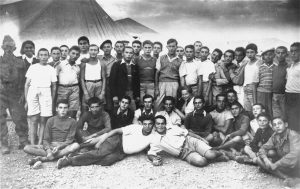
Regarding Iran and the complexity of its political history, we continue our exploration of the shifting dynamics between Jews and Iranians through the account of a little-known episode. For her book Tehran Children, Mikhal Dekel, whom Martine Benoit interviewed for K., investigated the traces of a story that is both personal and universal: that of her father, one of the many Polish Jews who, fleeing the Shoah, found refuge in Iran. Tracing this journey of survival – from Poland through the USSR, to the rescue operation that led them to Tehran and finally to Mandatory Palestine – Dekel examines the unique fate of these refugees forgotten by the memory and history of the Shoah. It is also an opportunity to revisit Iran’s political turning point during World War II, which was already addressed last week in the excerpts from the book by Stéphanie Roza and Amirpasha Tavakkoli , and this inaugural moment in Israeli-Iranian relations.
Jews are on the move. As Passover approaches, the question arises: where do they come from and where are they going? We see that, sometimes, they come from Poland, stop for a while in Iran, and arrive in Israel. But we know this is just one case among the multitude defined by the condition of exile, and that the narratives through which Jews recount this exile rarely have such precise coordinates. On the occasion of the second evening of K. on Stage at the Théâtre de la Concorde in Paris, this time under the theme of Jews of Europe: A Journey into the Unknown, Ruben Honigmann invited us to reflect on the inconsistency of these biblical journeys, where we no longer know where they start or where they end. This week we are publishing an expanded version of the text of his intervention, which raises the question of how they manage, despite everything, to find their way.