Where Do the Jews Come From? (And Where Are They Going?)
On the occasion of the second evening of K. On Stage at the Théâtre de la Concorde in Paris, under the theme of "Jews of Europe: A Journey into the Unknown", Ruben Honigmann invited us to reflect on the inconsistency of these biblical journeys, whose starting points and destinations are no longer clear. We are publishing the text of his talk, which asks whether, for Jews, the unreliability of the biblical GPS truly amounts to a condemnation to wandering.
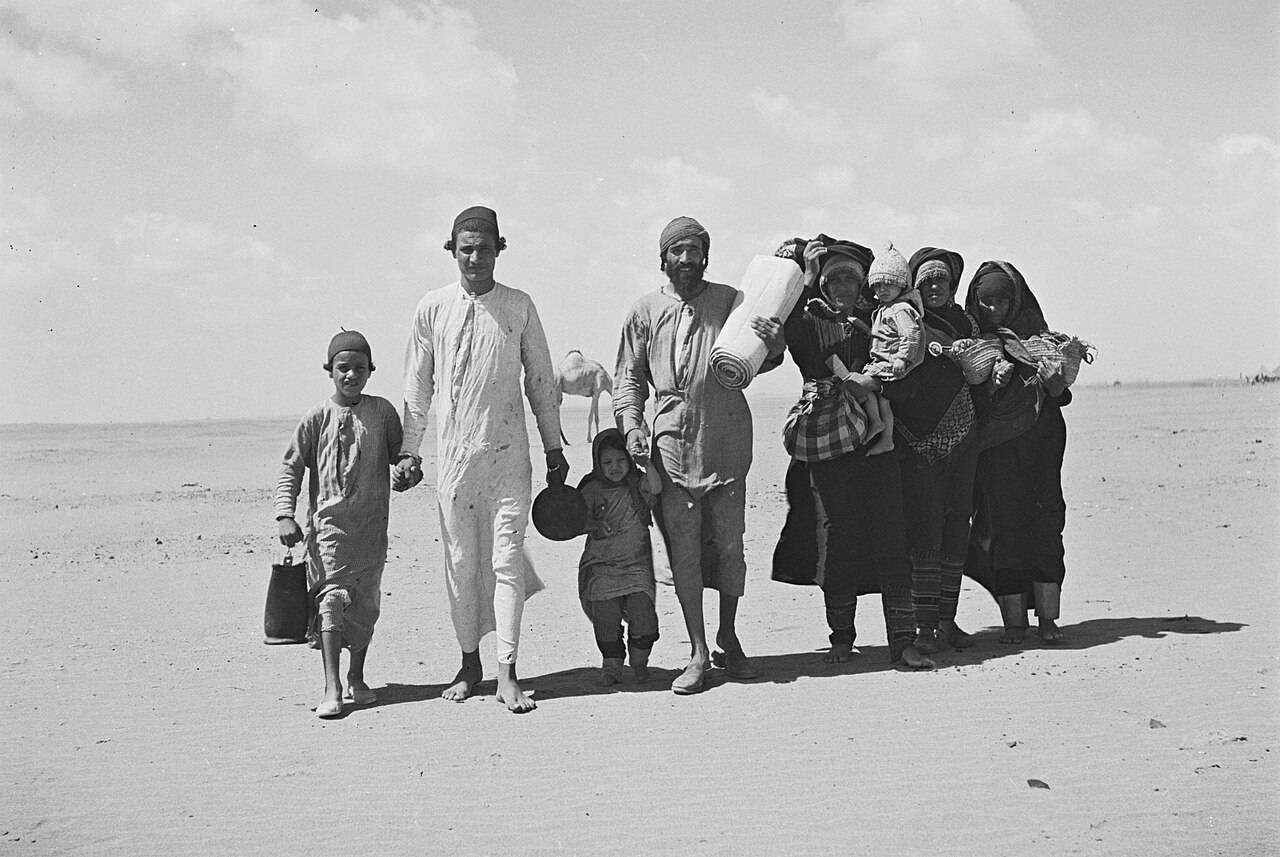
The evening of Pesach is framed by two questions: where do the Jews come from, and where are they going?
The Haggadah begins by exploring the origin: we come from elsewhere. Our ancestors were not natives; they came “from across the river.” The ceremony concludes by looking toward the destination: “Next year in Jerusalem.” Next year we will say the same, and we say it even if we are already there, in Jerusalem. Zion is always on the horizon.
Where, moreover, does this entire ritual come from? That is the question posed by three of the “four sons.” “In view of this,” they are told, pointing to the tray on which the commemorative items are arranged (unleavened bread, bitter herbs, lamb’s shank, wine). Origin and purpose are thus reversed: we do not commemorate the exodus from Egypt; we left Egypt in order to commemorate.
Another process of obscuring the origin is at work regarding the consumption of unleavened bread (matzah). The official reason, the one taught to children, is that the dough had not had time to rise during the hasty exodus from Egypt1, hence this flatbread. But right from the start, the Haggadah states that this “bread of affliction” was what the Hebrew slaves ate in Egypt, long before their liberation. Eating this bread is thus simultaneously a sign of alienation and emancipation; it places us both before and after the “big bang” of the Jewish condition.
The ceremony concludes by looking toward the destination: “Next year in Jerusalem.” Next year we will say the same, and we say it even if we are already there, in Jerusalem. Zion is always on the horizon.
Worse still, every effort is made during the Seder to keep the founding event at a distance—the starting point that justifies this evening and around which nearly all of Jewish life revolves. One would expect the Seder to consist simply of reading the chapters of Exodus that recount slavery and the Exodus from Egypt. But in the Haggadah, the narrative is constructed in a far more convoluted way: it is the story of a story. A long paraphrase of the speech that the Torah places in the mouth of the future Hebrew peasant who, once he arrives in the Promised Land, will have to recount how he got there, all the way from Egypt. On the evening of the Seder, we thus place three narratives (that of the Exodus, that of the peasant, and our own) between ourselves and the event, as if of the latter—forever inaccessible—we could perceive only the echo of an echo.
The origin is thus obscure, and the destination eludes us. And this holds true throughout the entire arc of Jewish history. It is well known that this history begins with a journey, that of Abraham, the first to be called a Hebrew.
You know that Jewish history begins with a journey, that of Abraham, the first to be called a Hebrew.
I don’t know why—perhaps because Jews would like to present themselves as more universalist than they are—but we often hear that “Hebrew” means “smuggler.” Yet that is not the case: the translation of “Hebrew” is not “smuggler,” but “passer,” or even “passenger,” whether clandestine or not.
A smuggler smuggles someone or something across; a passerby passes through on their own—they are both the object and the subject of their own movement.
And here’s why:
The common story is that Abraham left his homeland in Mesopotamia and went to the Land of Israel.
At first glance, the biblical account does indeed lend itself to this interpretation.
But the text is treacherous and does not see it that way. There is a glitch in the story, a disruption in the narrative.
At the time of departure, the text specifies that Abraham is 75 years old.2 Sometimes, in the Torah, the narrator specifies the age of the protagonists at this or that turning point in the story. This is useful for reconstructing the general chronology of the text.
But here’s the thing: sometimes this also complicates matters. Indeed, once he arrives in the Promised Land, God promises the childless Abraham numerous descendants and announces the exile of that very people. Barely settled, already preparing to leave.
The problem is: at that time it turns out that Abraham is 70 years.3 75 years old at departure, 70 upon arrival, he has thus become 5 years younger.
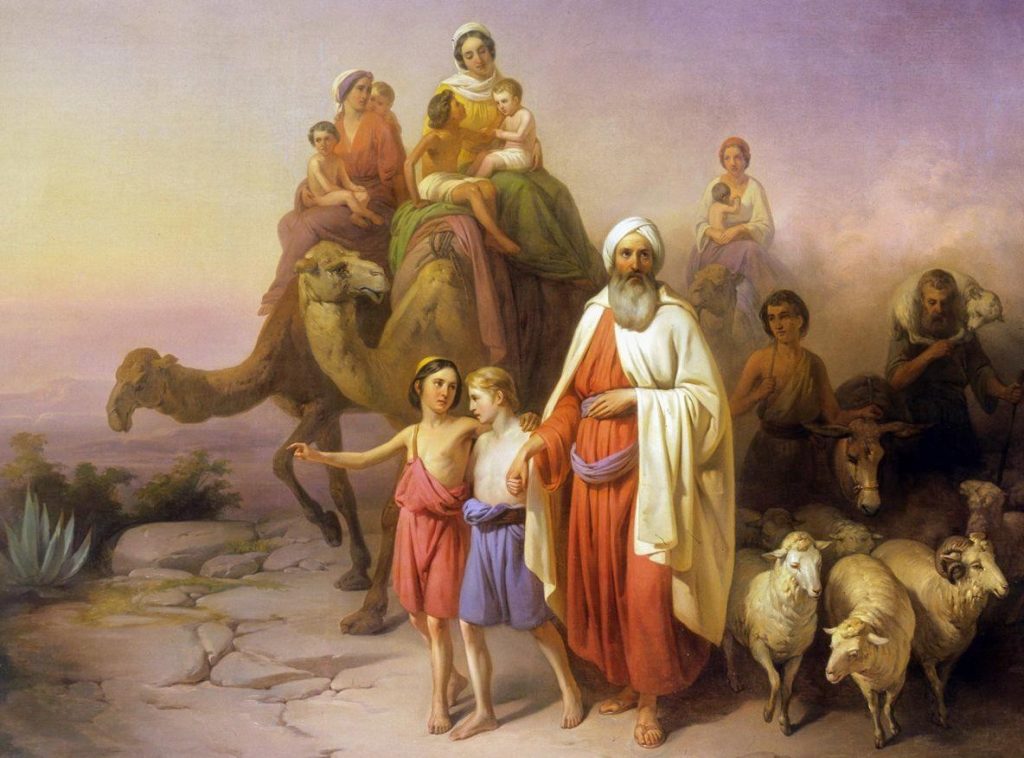
Two possibilities: either we consider that the journey provided him with a rejuvenating cure (generally, it’s rather the opposite—travel tires the body), or we must piece together the biblical puzzle differently.
To account for this discrepancy, we would have to put it this way: in fact, Abraham is not a Mesopotamian who went to Canaan; he is a Canaanite who went to Mesopotamia and returned, at age 75, to Canaan.
The famous “Go forth” would therefore not be a call to depart, but a call to return.
Religious Zionist interpretations, of course, love this option, according to which everything thus began and ended in the same land: that of present-day Israel.
The exile—in Mesopotamia—would therefore be nothing more than a detour, a hiccup along the way.
But if we embark on this path, we face another difficulty.
For the call to depart (or to return, depending on the interpretation) is completed by the phrase “to the land that I will show you.” The land in question is not named or located. It is therefore a land he does not know, one that remains to be discovered. It cannot, therefore, be his native land. Otherwise, he would have simply told him: go home.
We thus find ourselves at an exegetical impasse on both sides. As soon as we think we’ve got a hold of the text by one sleeve, it slips away from the other.
The absence of a fixed root, of a homeland, does not, however, make the Jews Luftmenschen, people without ties.
In truth, one need not choose between the “diasporic” reading (Abraham came from Mesopotamia) and the “Zionist” reading (Abraham came from Canaan).
If the text is vague, incoherent, contradictory, it is because Abraham’s trajectory is precisely untraceable, unpinnable. It is not an itinerary; it is a tension.
Mind you, this does not mean that “it is the journey that counts.” For that, there must still be a point of arrival and departure. Yet, in the biblical GPS, the journey is often made with coordinates that are explicitly and deliberately obscured.
Allow me a small detour—it is fitting to say so—to clarify the contours of the idea that is taking shape (literally before your eyes).
The descendants of Abraham himself will leave Egypt to return to Canaan.
Along the way, God pulls the same trick of the destination slipping away. Anticipating the construction of a future focal point, the Temple of Jerusalem, the text never names this place. It simply says: “The place I will choose” (just as in “the land I will show you”) .
The very word “Jerusalem” does not appear even once in the Pentateuch.
As if the object of the message were perpetually slipping from the grasp of its recipient.
Let’s drive the point home: you know that the leader of the Hebrews, and author of the Torah, Moses, does not enter the Promised Land. He is a man of the journey and dies in no man’s land, between Egypt and Canaan.
The text insists, as we reach the final verses of the Torah: no one knows the location of his grave. This is how the Midrash, the rabbinic commentary, renders it: where Moses is buried, there are two villages, one on the hill, the other in the valley. If you go to the hill, the inhabitants say his grave is in the valley, and vice versa. He is always where you are not.
But rest assured: the absence of fixed roots, of a homeland, does not make Jews Luftmentchen, people without ties. Being Jewish cannot be reduced to this image of the perpetual wanderer into which Christian anti-Judaism sought to confine them, or of the rootless cosmopolitan as portrayed by modern antisemitic figures.
Where, then, do the Jews come from, and where are they going? We’re not quite sure; the origin is unclear and the destination imprecise, but they are here, alive and vibrant, and they do possess a home, an anchor: the Text, their portable homeland, the one from which they can never be dislodged.
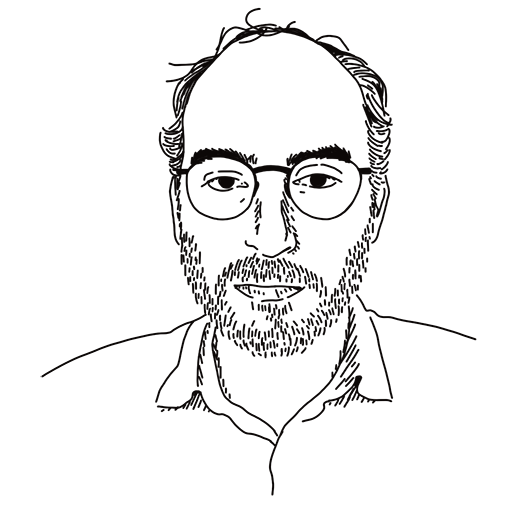
Ruben Honigmann
Born in 1983 in East Berlin, Ruben Honigmann grew up in Strasbourg. After studying at a yeshiva and completing a degree in history at university, he joined Akadem in 2008, where he now serves as editorial director.