#293 / Editorial
Yesterday, Israelis voted for the first time since October 7. Last week, Michael Walzer’s article in the French, Italian and Portuguese edition of K., outlined the divide in this election: on one side, the Zionist policy of a “state like any other state”; on the other, “exilic Judaism,” which unites the ultra-Orthodox and redemptionist activists. David Chemla, for his part, provided an overview of the political forces vying—both yesterday and today—to lead a country that has known no respite for the past three years.
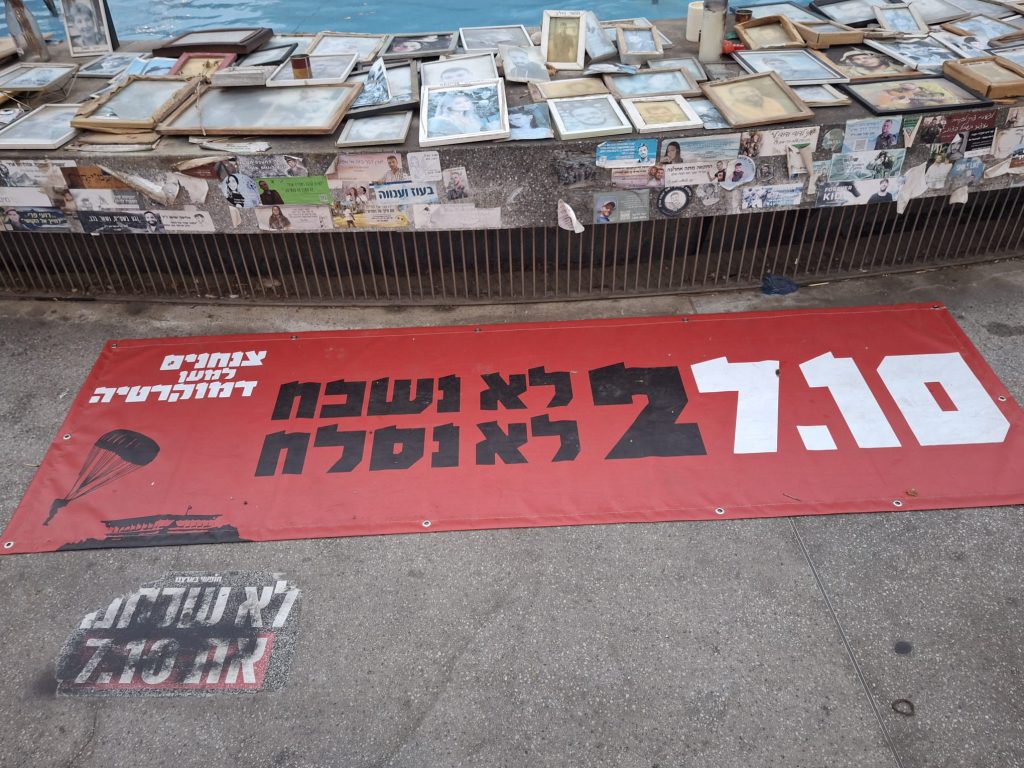
The hangover the day after the election is now a classic feature of Israeli politics, and this one has the taste of a deadlock: the outgoing coalition has lost its majority, while the “change bloc” has failed to form one of its own. Any coalition stumbles over two “sectors” that maintain a contentious relationship with the state: the Haredi parties, which brought down this government over the conscription law, and the Arab parties, without which no alternative to the nationalist right can govern—even as one of them, Ra’am, now recognizes the Jewish character of the state. Yet Israeli Jewish society does not seem ready to come to terms with this, and the slogan of the “Paratroopers for Democracy”—which adorns Dizengoff Square, now a popular memorial to the victims of October 7—says it all: “We will not forget, we will not forgive.” No event in the short history of this state has shaken the public consciousness so deeply, and as long as Netanyahu remains in power, October 7 will continue to weigh on the vote of an electorate that believes he alone is capable of navigating waters where every wave sounds like an existential threat. The president will attempt to foster national unity to avoid a return to the polls, but it’s hard to imagine the opposition allying with a Netanyahu who has perversely exploited very real external threats while simultaneously being the most destructive internal divider Israel has ever known. We’ll return to this in greater detail next week, once the final results are in.
Meanwhile, in France, current events are playing out in the streets, six months ahead of the presidential election: protests, high school students mobilizing in support of public education, and controversies arising from the unrest that occurred on the sidelines of the October 17 demonstrations. On the eve of the second phase of this mobilization, an attack struck the city of Trappes, killing a man targeted because of the color of his skin and wounding five other people, including a child. Bruno Karsenti analyzes the French president’s reaction and his slip of the tongue: what the president described as a “first” and a “turning point.” He examines how the far right has appropriated the discourse on national unity, how the radical left responds with the concept of the “new France,” and how the political center oscillates between the two. For Jews, this places them in a position that is by no means peripheral.
A taste of goulash in a Viennese café sends historian Johanna Lehr back to her grandfather’s Sunday table, and into a city that feels at once familiar and unsettlingly polished. Following the trail of the camps from which some 45,000 Viennese Jews were deported, she finds buildings that are lived in, schools and housing blocks, and memorials that are discreet, displaced, or missing. Drancy, a short train ride away in memory, becomes her point of comparison. What does a city remember, and where does it put what it would rather not see?
Lastly, we turn to an almost forgotten figure of the 20th century European art scene: Georges Kars. Also a friend of Kafka and Max Brod, the mahJ is dedicating its first Parisian exhibition since his death to him, running through March 14, 2027. We are publishing Paul Salmona’s preface and Pascale Samuel’s chapter on the painter’s final years. Having left Prague for Lyon, then secretly crossed into Switzerland with Chana Orloff and her son, he was interned there and barred from working. On February 5, 1945, as news of the liberated camps began to arrive, Kars threw himself from the fifth floor of a hotel in Geneva. Like Zweig three years earlier, he did not want the world that lay ahead.
Note from the editor: As the leaves are changing, after two and a half years so is the face behind the English edition of K. I am passing the torch to my colleague Élie Petit and look forward to joining you on the reader’s side.
– E.O.