The Ghosts of Vienna
A Journey to Vienna: An Assessment of Shoah Remembrance
In Vienna, Johanna Lehr, a historian specializing in the persecution of Jews in Paris, is first struck by the taste of goulash, which takes her back to her grandfather’s cooking, and then by the strangeness of a perfect, almost too-smooth city. Setting out in search of the “collection camps” from which more than 45,000 Viennese Jews were deported, she discovers haunted places, barely marked. From Kleine Sperlgasse to Drancy, she compares two ways of inscribing, or failing to inscribe, the memory of the Shoah in the city.
GOULASH. The first bite took me completely by surprise. Forget the typical dish every tourist is supposed to try in Vienna: in the flavor of the dish, I found the very essence of my childhood. The surprise left me speechless. To my knowledge, no episode in my Polish-German family history had ever taken place in Vienna. Yet my most intimate memories were encapsulated in this dish of meat in sauce. As I savored it amid the Art Deco decor of Café Prückel, the magic took hold and I traveled back in time; images buried deep within my childhood broke through the barrier of my memory. I chalked it up to chance. But the next day, the small sweet-and-salty potato salad that accompanied the schnitzel had the same effect on me. I had to resign myself to accepting the improbable: Vienna was, strangely enough, part of my history. Everything I tasted in the days that followed never ceased, through a curious ripple effect across time and space, to transport me back to my grandparents’ apartment in Strasbourg in the 1980s and 1990s. My grandfather, a Galizianer1 born in Munich in 1915 to parents from shtetls in southeastern Poland (Kolbuszowa and Zmigrod), loved only the typical dishes of an Austro-Hungarian Empire he himself had never known: Tafelspitz with horseradish (a thick slice of boiled beef served with vegetables), Apfelstrudel with candied apples and cinnamon, goulash with a thick, dark paprika sauce, and potato salad with a tangy yet sweet flavor… My grandmother served them to us in Alsace every Sunday; and every Sunday, my brother and I would chuckle to ourselves at these strange dishes—always too sweet—that Grandpa loved so much.
“I found in the majestic city a controlled face, stripped of the scars of its turbulent history, of an almost suspicious perfection.”
UNSETTLING STRANGENESS. The image of a granddaughter caught red-handed in a moment of culinary nostalgia might raise a smile, but what unfolded for me in this “return to Vienna” after those few bites went far beyond mere anecdote. The city, once foreign to me, suddenly became familiar; I felt attached to it. In my imagination, I now counted myself among the Jews who had walked the streets of this capital. So many “great” names have remained famous: Stefan Zweig, Sigmund Freud, Karl Popper, Theodor Herzl, Elias Canetti, Franz Werfel, Joseph Roth, Billy Wilder, Otto Preminger, Hedy Lamarr, Ruth Klüger, etc. But my sense of wonder at this city also stemmed in large part from the fact that its beauty impressed me. At the end of the war, the American bombings, which were mainly directed at industrial areas, had partially spared the palaces along the Ring. The decision to rebuild them exactly as they were also helped to preserve the city’s architectural harmony. In Vienna, unlike the German cities that were razed to the ground, the backdrop of the past is preserved. One can afford the absurd luxury of admiring the same view that Freud enjoyed while seated at Café Landtmann. For me, this topographical continuity fostered a sense of connection with those who had come before me. But there is a flip side to this coin: majestic as it was, the city was also terribly smooth. I found it to have a controlled face, stripped of the scars of its turbulent history, with an almost suspicious perfection. My unease thus echoed that felt by the Jewish survivors of Vienna during and after the Shoah. I felt, paradoxically, both close to and excluded from the city. “As soon as we set foot on the street, we were in enemy territory,”2 wrote Ruth Klüger about her childhood. She was seven years old in 1938. The city back then had closed in on its Jews like a gigantic trap, oozing its antisemitic hatred from the walls, in slogans, and in the shattered windows. After the war, as a survivor of Auschwitz, she would declare: “For me, the city is neither foreign nor familiar, which means, conversely, that it is both at once, familiarly unsettling.”3 Ruth Klüger is referring to the concept of the unsettling strangeness4, coined in 1919 in Vienna by her compatriot Sigmund Freud.
FREUD AND HIS SISTERS. By chance during my sightseeing, I visited Freud’s apartment-museum on my very first day. The moment I discovered, at 19 Berggasse, the tragic story of Sigmund Freud’s four sisters, who were trapped in Vienna after the Anschluss, then sent to Theresienstadt in the summer of 1942 and murdered5, I resolved to visit the sites where Jews were held before their deportation by the Nazi Central Office for Jewish Emigration (Zentralstelle für jüdische Auswanderung). I had the strange sensation of having stumbled upon the existence of such “collection camps” in the city. No travel guide mentions them. In Vienna, the official remembrance of the Shoah is embodied in other places: a large monument located in the heart of the old city, “The Nameless Library,” a work by artist Rachel Whiteread, commissioned by Simon Wiesenthal and erected in October 2000 in the middle of the famous Judenplatz. A must-see, all tourists come to admire it before – sometimes – taking a look at the nearby Jewish Museum. Less frequented, the Wall of Names, the culmination of fifteen years of effort by Yakov Tutter, was finally inaugurated on November 9, 2021, in a park on the outskirts of the 9th district.6 It consists of 160 granite stelae arranged in a semicircle, on which are engraved the names of 64,440 Austrian Jews identified as having been murdered during the Shoah. In both cases, these are “designated” monuments, built a posteriori as part of a public policy of remembrance. As part of my own research on sites of anti-Jewish persecution in Paris, I wanted to visit the “real” sites of the Shoah in Vienna. Armed with the addresses of four camps, I set off through the city toward Leopoldstadt, driven by the excitement of finding answers to my questions. How were these sites marked? What was written on the memorial plaques? Who had installed them? The veneer of perfection that covered this city would not be able to withstand the onslaught of my questions for long.
“Nothing during my stroll through this now-trendy neighborhood [Leopoldstadt] gave any hint of the institutionalized violence that had once taken place there. ”
LEOPOLDSTADT. Formerly the site of the Jewish ghetto from 1625 to 1670 (the date of the expulsion of the Jews from Vienna), this marshy area wedged between the Danube Canal and the river itself welcomed waves of Jewish immigrants from Eastern Europe in the early 20th century. In 1938, approximately 170,000 Jews lived in the Austrian capital. Leopoldstadt had become the main center of Jewish life in Vienna: small shopkeepers and artisans lived there alongside Hasidic Jews. Immediately following the Anschluss in March 1938, the Nazis targeted this district to make it the primary site for the process of segregation, “Aryanization,” concentration, and ultimately the deportation of Jews. It was here, in fact, that Jews were forced to scrub the streets with toothbrushes as a punitive measure in March 1938; here that the majority of Jewish-owned businesses and property were looted and then confiscated; and here again that the Nazis “concentrated ” the Jews of Vienna, expelled from their homes and ordered at the end of 1939 to move to Leopoldstadt into Sammelwohnungen, “group apartments,” where they literally starved to death; and finally, it was here that antisemitic violence erupted with unprecedented ferocity on November 9 and 10, 1938, during the pogrom known as Kristallnacht. To my great surprise, as I wandered through this now-trendy neighborhood, there was nothing to hint at the institutionalized violence it had once witnessed. Cafés and restaurants abound here, particularly kosher establishments, thanks to the arrival of Orthodox Jewish families. I came across only a few bronze plaques marking the sites of former synagogues that had been destroyed and a handful of memorial stones (Steine der Erinnerung, the Viennese version of the Stolpersteine launched in 2005)7 commemorating murdered Jews. To date, nearly 250 plaques are scattered throughout the district, honoring more than 3,000 victims. Across all districts, the city of Vienna has 900 such plaques. They are like ghosts floating in a setting rebuilt after the war, as the neighborhood had been heavily damaged by Allied bombing and fighting during the Soviet offensive. Another “ghost” is the former Leopoldstädter Tempel synagogue on Tempelgasse – the city’s largest, destroyed by fire during the pogrom – which has been symbolized since 1998 by four white pillars replicating its foundations in front of modern apartment buildings.
“None of these internment sites—which are still standing—has been turned into a museum: they are inhabited spaces.”
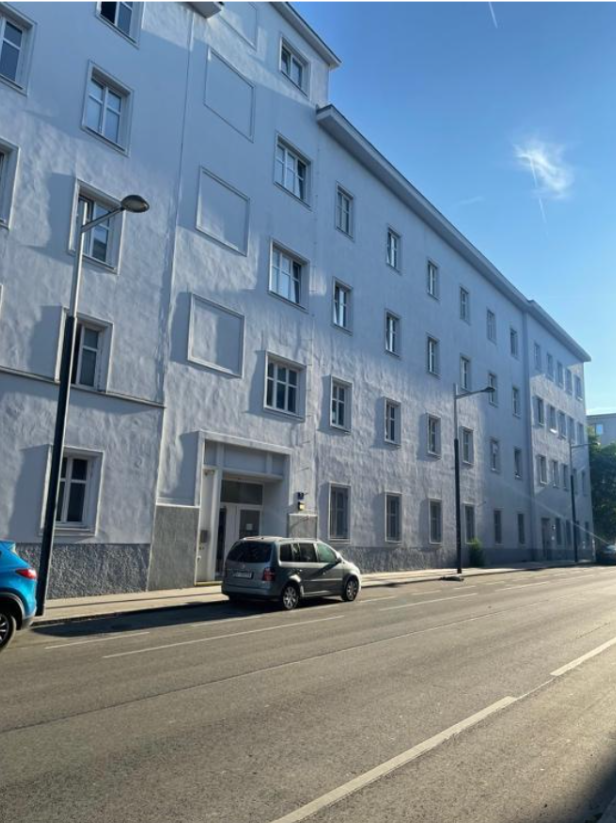
THE CAMPS. Despite their immediate proximity – Castellezgasse 35, Kleine Sperlgasse 2a, Malzgasse 7, and 16 are barely a kilometer apart – it took me some time to get my bearings regarding the layout of the four “collection camps” for Jews opened by the Central Office for Jewish Emigration between 1941 and 1943. The reason for this is the near-total invisibility in the public sphere of the special status of these buildings. None of these internment sites – which are still standing – has been converted into a museum: they are inhabited spaces. This choice mirrors France’s approach to its capital: the former Jewish internment camp in Drancy is currently a public housing complex; in 2012, the Shoah Memorial opened an educational museum across from the former camp. But in Vienna, no such facility exists. Under these circumstances, it is difficult to grasp the significance of these sites in Austrian history, let alone understand how they functioned as part of a network.
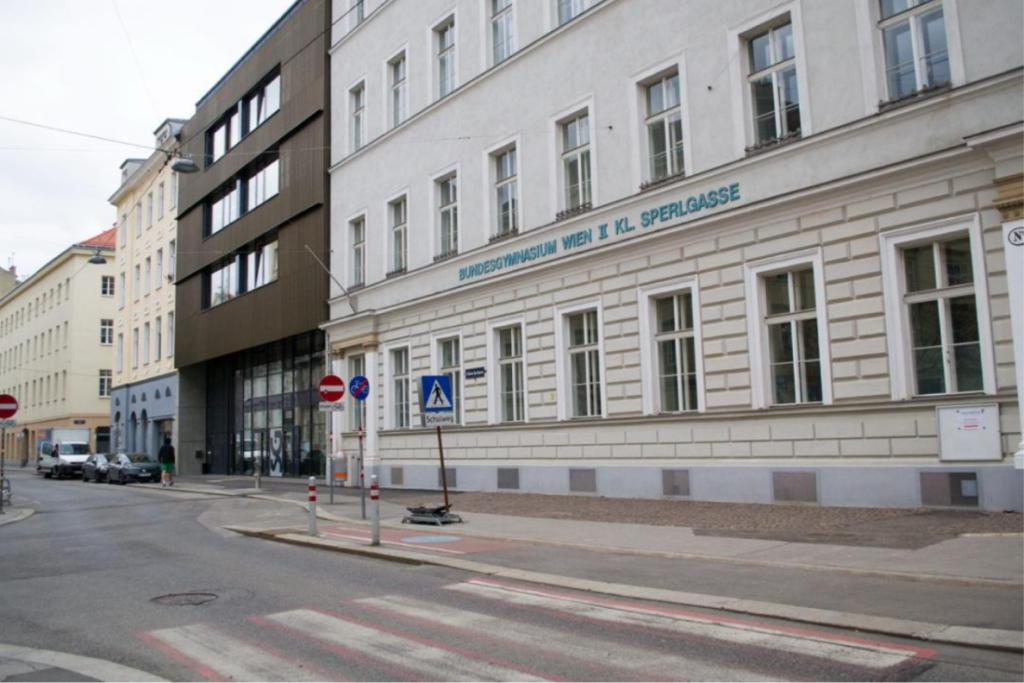
Kleine Sperlgasse. The camp located at number 2a – which today houses a public elementary school – must be considered the hub of deportations from Vienna. Researchers estimate that between February 1941 and October 1942, no fewer than 25,000 Jews were detained there prior to their deportation, representing more than half of the 45,451 Jews deported in total via 40 convoys. A plaque commemorating the “40,000 (sic) Jewish fellow citizens” detained in the building and deported – funded by the school and a local association – was installed in 1984, but I was unable to find it on site. Was it moved inside the school during recent work on its exterior facade? I remained troubled by the inadequacy of such a memorial given the significance of the site in Austrian history and the gravity of the events that took place there. The comparison with the French camp at Drancy, where more than 80,000 Jews were interned during the Occupation, was obvious. The Kleine Sperlgasse camp does indeed resemble in many ways the one in the Paris suburbs that opened in August 1941: the same conditions of confinement, the same goal of mass deportation, and the same heart-wrenching testimonies from survivors who passed through it. Alois Brunner, Eichmann’s deputy in charge of the Viennese camps, served as the link between the camps in the two capitals: transferred by Eichmann to Paris in June 1943, he applied the Austrian “best practices” there to streamline and accelerate the deportation of Jews from France. He thus sent nearly 24,000 of them to the death camps—almost as many as the victims who passed through Kleine Sperlgasse.
While Kleine Sperlgasse operated continuously as the epicenter of the system, the other three camps opened, closed, and reopened according to the fluctuating needs of the Nazi administration. Their commemoration more closely resembles that of the three Parisian satellite camps of Drancy – Austerlitz, Bassano, and Lévitan – which suffer from the same shortcomings.8
Castellezgasse 35. Formerly a school, the building served as a transit camp from February to March 1941 during the deportations from Vienna to Opole, Kielce, Modliborzyce, and Lagow/Opatow, which sent 5,031 people to their deaths. The site then reopened to send the next 19 convoys to Lodz, Kaunas, Minsk, Riga, Izbica, Wlodawa, and Maly Trostinec. Beginning on June 6, 1942, Castellezgasse 35 housed the perpetrators: Eichmann and his collaborators from the Central Office for Jewish Emigration until May 1943; followed by the Gestapo and its office for the administration of the “Mischlinge” (half-Jews); and finally the SD in 1944, along with the Aussenkommando Wien, which was tasked with overseeing the forced labor of 15,000 Hungarian Jews. Behind this bourgeois facade, nothing today hints at the tragedy that unfolded there.
Only a discreet memorial plaque, installed in December 2015 by the co-owners with the support of the National Fund of the Republic of Austria, alerts passersby that this site “was transformed into a collection camp for Viennese Jews.”
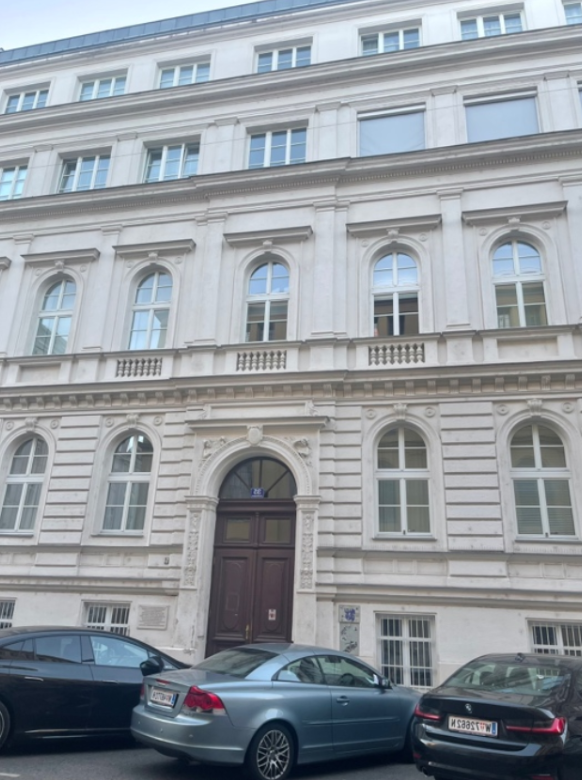
Finally, the two camps on Malzgasse. Beginning in June 1942, they shared the same objective: to concentrate the elderly Jewish population once their deportation had been scheduled (they had been exempted from deportation until that date). At number 16, the camp took over a retirement home established by the Jewish community in 1939, and from November 1942 onward housed the Rothschild Hospital, reserved for Jews. It was likely within these walls that Sigmund Freud’s sisters were held captive before their deportation to Theresienstadt in the summer of 1942. Today, the building houses a fortified Jewish elementary school: its facade is completely hidden from view, and a security guardhouse protects it. At number 7 stands an imposing complex of public housing typical of the postwar era: the “Theodor-Herzl-Hof.” Here, the camp replaced a boarding house for Jewish women that had opened in 1940. Of the four camps in Vienna, this was the one that remained in operation the longest, until deportations from Vienna ceased entirely in May 1943. Once again, it is impossible to grasp, simply by walking past the building, what took place there during World War II—even though in November 2000, the Jewish community of Vienna had a plaque installed on the walls of No. 7 in memory of the “men, women, and children” imprisoned in this “transit camp” and then “deported to the Reich’s extermination camps.”
“Memory wavers, caught in a new variation of this dialectic of the revealed and the hidden that shapes the streets of Vienna.”
REVEALED/HIDDEN. We can all agree on the following observation: these memorial installations are, to say the least, flawed – and at times even completely inadequate. Leaving Leopoldstadt, I ventured into the city’s outskirts to complete this exploration, searching for the first deportation camp – the one from which the 1,584 Jewish men sent by Eichmann to Nisko in October 1939 were taken.9 Gänsbacherstrasse 3: a shelter for the homeless, in an unattractive industrial neighborhood. The cancellation in November 1939 of the third transport to Nisko did not prevent those scheduled to depart from remaining detained within its walls until February 1940: nearly 750 Jews, including women and children, starving and terrified. After noting the absence of any markers, I turned back, returning to the pedestrian path running alongside the highway. My unease grew.
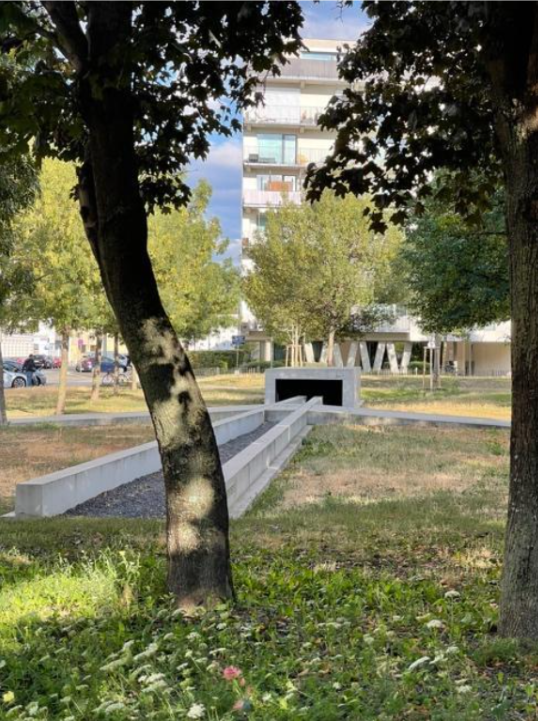
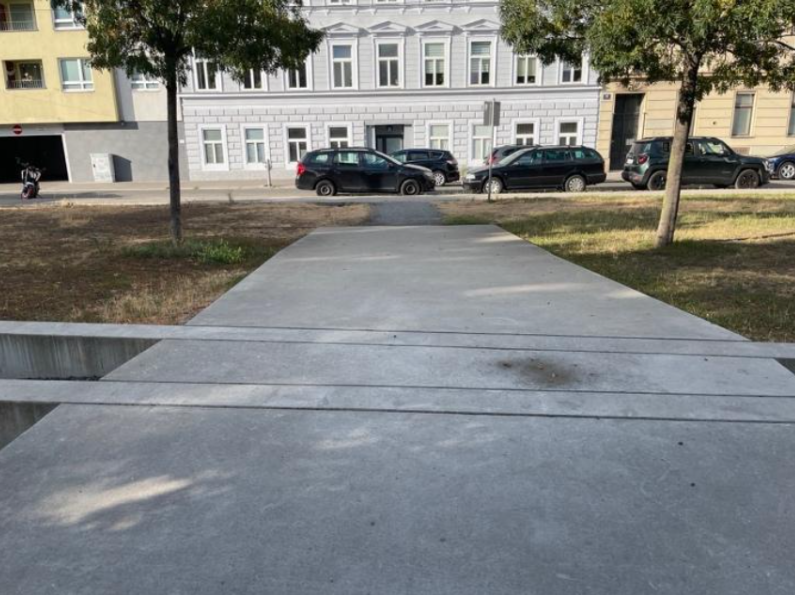
This does not, however, mean that there is any desire in Vienna to conceal the traces of the Shoah. In 2017, a memorial funded by the city was unveiled on the very site of the former Aspang deportation station, which was demolished in 1977.10 It pays tribute to the 47,035 Jews who were interned in the Leopoldstadt camps before being loaded onto trains at Aspang bound for the ghettos and death camps in Eastern Europe. Ceremonies attended by rabbis, students, and representatives of anti-fascist organizations are held there every year on the anniversary of the pogrom of November 9, 1938. I went there. My impressions were mixed. Far be it from me to expect to find there an equivalent to the museum that the city of Bobigny opened in 202311 on the former site from which nearly 22,500 Jews were deported between July 1943 and August 1944. After all, the site had lain abandoned for decades. But the Viennese memorial – a concrete platform from which railroad tracks emerge – has the peculiarity of blending into the gray backdrop of a small, modern, soulless neighborhood park, set apart from the historic city center. The 30-meter-long blocks recreating the railroad tracks now serve as a launch pad for skateboarders. Mothers walk their children, oblivious to the plaques dotted throughout the garden. The scorched grass amplifies the sense of desolation in the air. Standing in the center of this scene, I felt overcome by the sense of sadness and abandonment that the place exuded. Here, too, memory wavers, caught in yet another variation of this dialectic of the revealed and the hidden that shapes the streets of Vienna.
THE WALTZ OF THE PAST. Although I specialize in the history of the Shoah in Paris, I was struck during this trip to Vienna by my own gaps in knowledge regarding Austria’s past. For some thirty years, under the pressure of a series of events, Austria has been forced to abandon the grand national narrative forged in 1945. The international scandal sparked in 1986 by the Waldheim Affair – in which the former UN Secretary-General had concealed his past as a Wehrmacht officer in the Balkans – served as the catalyst.
Thus, in 1991, the myth of Austria as the “first victim” of Nazi Germany was officially abandoned. The French and Austrian cases, moreover, bear striking similarities in the way each country broke with its postwar founding myth. Yet these processes of self-reflection took place in isolation. In France, Jacques Chirac’s 1995 speech marked the end of the Gaullist and Mitterrandian thesis that portrayed Vichy as an illegitimate interlude for which France bore no responsibility (“Yes, the criminal madness of the occupier was aided by the French, by the French state. […] On that day, France committed the irreparable”)12; the speech by Social Democratic Chancellor Franz Vranitzky in 1991, at a time when Austria was treated as a pariah on the international stage, definitively turned the page on an Austria that had been forcibly annexed and remained passive (“We must admit that we were not only victims, but that we were also perpetrators”).13 In the wake of these speeches, a second wave of reparations and compensation for antisemitic persecution emerged almost simultaneously: the Commission for the Compensation of Victims of Spoliation was established in 1999, and the Austrian Compensation Fund in 2001. For various reasons, earlier mechanisms had functioned only imperfectly in the years immediately following the Liberation.14 In the field of historical research, a similar Copernican revolution took place: here as elsewhere, the state established a commission of historians15 who examined public and private archives, ushering in a new era of microhistorical studies of the Shoah. From the written word to stone, this revolution was accompanied by an ongoing process of memorialization, perhaps most dynamic in Paris, where memorial museums have been established at a steady pace since 2005: the CERCIL-Enfants du Vel d’Hiv in 2011, the Drancy camp in 2012, and the Bobigny train station in 2023. In Vienna, plans for the future Austrian National Shoah Museum remain under consideration, and despite the 2015 publication of the seminal work Topography of the Shoah: Sites of Memory in Jewish Vienna Destroyed—which maps the urban sites of persecution16—no changes to the memorial’s layout are currently planned at the Kleine Sperlgasse site.
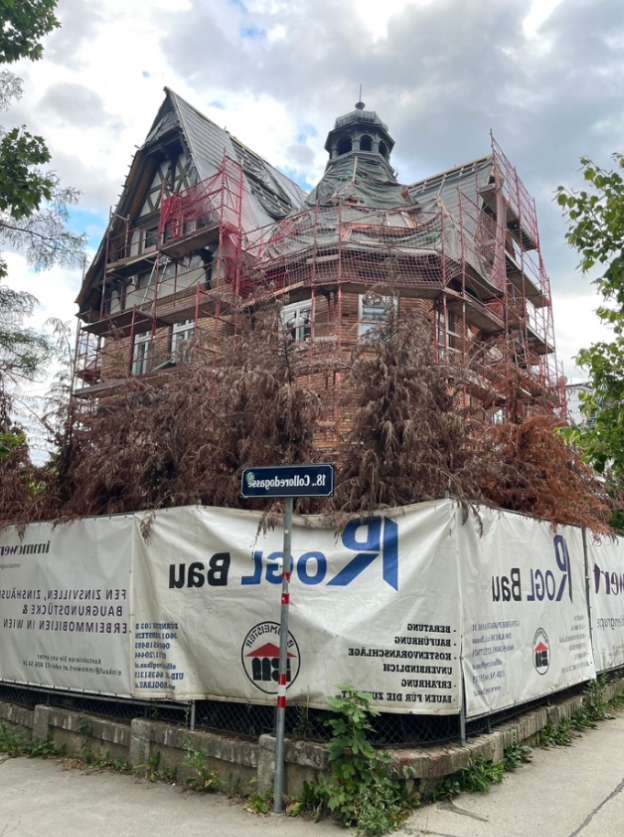
LAST GHOST. Prinz-Eugen-Strasse 20–22. The Rothschild Palace, where the Central Office for Jewish Emigration was headquartered until June 1942, was replaced in 1960 by a modernist building characteristic of the 1950s that houses the Arbeiterkammer [the Chamber of Labor]. The latest manifestation of the desire to reawaken the ghosts of the past: in September 2025, a permanent exhibition titled Schaltstelle des Terrors [the nerve center of terror] opened in its lobby.17 A powerful dissection of office life within this deadly organization, the exhibition sheds light on the thirty or so civil servants who rallied around their leader, Adolf Eichmann. Faces, names, careers: here we are introduced to the executioners, including two SS officers infamous in France, Theodor Dannecker and Alois Brunner. While browsing through the biographies, I discovered that a secretary, the young Austrian Anna Röder – a staunch Nazi who ended her career at the Hotel Metropol, headquarters of the Vienna Gestapo – had married her boss, Alois Brunner.18 Together, they moved in 1942 into a magnificent villa resembling a “gingerbread house,” seized from the family of factory director Robert Jonas, who had been deported. She lived there during her husband’s postings in Berlin, Thessaloniki, and then Paris beginning in June 1943. The house is located at 14 Gustav-Tschermak-Gasse, in the Cottageviertel—that sumptuous residential neighborhood in the city’s 19th district, designed in the late 19th century after the model of British garden cities for the upper middle class in search of nature. In an ironic twist of fate, I would end my stay facing the grimacing visage of a veritable haunted house, worthy of the darkest Grimm fairy tales.
- A Jew from Galicia, a province of the Austro-Hungarian Empire until 1918. In Vienna, the term was often used pejoratively to refer to Jews from the East. ↩︎
- Ruth Klüger, Refus de témoigner, Paris, Éditions Viviane Hamy, 1997, p. 8. ↩︎
- Ibid., p. 63. ↩︎
- Sigmund Freud, “Das Unheimliche,” Imago, vol. 5, 1919; French trans. “L’inquiétante étrangeté,” in L’Inquiétante Étrangeté et autres essais, trans. Bertrand Féron, Paris, Gallimard, “Folio essais,” 1985. ↩︎
- Exhibition at the Sigmund Freud Museum, October 24, 2025–November 9, 2026: “Documents of Injustice. The Case of Freud,” https://www.freud-museum.at/en/exhibitions-program/exhibition-details/articles/documents-of-injustice-the-case-of-freud ↩︎
- Shoah-Namensmauern-Gedenkstätte, in Ostarrichipark (Alsergrund). ↩︎
- Association Steine der Erinnerung, https://www.steinedererinnerung.net ↩︎
- Jean-Marc Dreyfus, Sarah Gensburger, Camps in Paris: Austerlitz, Lévitan, Bassano, July 1943–August 1944, Paris, Fayard, 2003. ↩︎
- In October 1939, Adolf Eichmann had Jews deported from Vienna, Moravská Ostrava, and Katowice to Nisko on the San River in occupied Poland to establish a Jewish “reserve” there. The project was abandoned in the spring of 1940. ↩︎
- Aspangbahnhof Memorial, a work by the artist duo PRINZpod (Brigitte Prinzgau and Wolfgang Podgorschek), unveiled on September 7, 2017, in Leon-Zelman-Park (3rd arrondissement). ↩︎
- As the owner of the passenger terminal building since 2005 and of the land transferred by the SNCF in 2011, the city of Bobigny opened the memorial site of the former deportation station to the public on January 18, 2023. ↩︎
- Speech delivered on July 16, 1995, during the commemoration of the Velodrome d’Hiver roundup. ↩︎
- Statement before the National Council (Nationalrat) on July 8, 1991. At the time, Austria had been isolated on the international stage since the election of Kurt Waldheim as federal president in 1986. ↩︎
- Ultimately, France dealt with a much larger volume of property confiscations but pursued a robust policy of physical restitution beginning in 1945, supplemented by large-scale financial compensation in 1999 through the CIVS. Austria, for its part, reported a respectable number of beneficiaries of the Compensation Fund in 2001 (more than 20,000 people), but these belated measures were primarily intended to rectify the deeply unjust and restrictive treatment imposed on survivors during the first wave. ↩︎
- In France, the study mission on the spoliation of French Jews, known as the Mattéoli Mission (1997–2000); in Austria, the Commission of Historians of the Republic of Austria (Historikerkommission der Republik Österreich, 1998–2003), tasked with studying spoliations and restitutions. ↩︎
- Dieter J. Hecht, Eleonore Lappin-Eppel, and Michaela Raggam-Blesch (eds.), Topography of the Shoah: Places of Remembrance of Destroyed Jewish Vienna, Vienna, Mandelbaum Verlag, 2015; Dieter J. Hecht, Eleonore Lappin-Eppel, and Michaela Raggam-Blesch (eds.), Letzte Orte. Die Wiener Sammellager und die Deportationen 1941/42, Vienna, Mandelbaum Verlag, 2019. ↩︎
- A memorial site conceived by historian Sophie Lillie and artist Arye Wachsmuth at the request of the Vienna Chamber of Labor (AK Wien), https://wien.arbeiterkammer.at/ueberuns/geschichte/ausstellung/Schaltstelle-des-Terrors.html ↩︎
- Theodor Dannecker (1913–1945) headed the Gestapo’s Jewish Affairs Division in Paris from 1940 to 1942 and organized the Vel’ d’Hiv roundup. Alois Brunner (1912–2001?), commander of the Drancy camp from June 1943 to August 1944, was convicted in absentia in France in 1954 and again in 2001; having fled to Syria, he is believed to have died there in 2001. ↩︎