#273 / Editorial
Moralists, both yesterday and today, are concerned with drawing red lines and ensuring that those who cross them are punished. Sometimes they claim to be engaging in politics, but for them, above all, it is a matter of public health. Yet, as everyone can see, the risk of infection is now associated with the name of Israel, and the recommendations of the high authorities of moral health are becoming more and more uncompromising and difficult to follow with each passing day. Among the recent cases of quarantine across Europe: The Jewish LGBTQ+ organization Keshet Italia was excluded from Rome Pride 2026 after refusing to fully endorse its political manifesto, specifically the part where the Israeli military operation in Gaza is defined as genocide—a condition set as mandatory for participating with a float in the parade, despite the association’s clear stance against the Israeli government. In France: Joann Sfar, one of France’s best-known comic book artists, most known for The Rabbi’s Cat, was boycotted in Marseille under the slogan “Zionists out of our city.” Barbara Butch, a DJ and lesbian activist, was the target of a boycott campaign for signing an editorial against antisemitism. The participation of Shie Mannor, an internationally renowned researcher in the field of artificial intelligence, was canceled from the Summer School at the École Polytechnique in Paris because he was found guilty of having performed mandatory military service in Israel twenty-five years earlier. The case of Israeli filmmaker Nadav Lapid certainly adds to the confusion regarding best practices. For if it is no longer enough to embrace the rhetoric of genocide in Gaza, to go into exile in France to mark one’s break with Israel, and to devote one’s filmography to criticizing Israeli society and government in order to be considered socially acceptable, then one might doubt the effectiveness of all preventive measures. One might then begin to suspect that, in the eyes of some, a certain identity prevents one, as a matter of principle, from having clean hands. Admittedly, this is only a suspicion, but one cannot shake the feeling that those being placed behind a cordon sanitaire are simply Jews… By a quirk of the calendar, we received a text from the philosopher Gérard Bensussan shortly before he was removed from the program of a conference on old age out of fear of the “current tense climate”—it is true that certain audiences are particularly at risk. It is a brief but incisive reflection on the extent of the deterioration in the political and intellectual situation we are witnessing: it begins when the vague impression arises that Jews and Israelis are, at heart, much the same thing.
Related articles
Have Jews become neo-Judeans?
Marc Bloch, Against Feigned Pretences
Between the Lines: Architecture as Memory
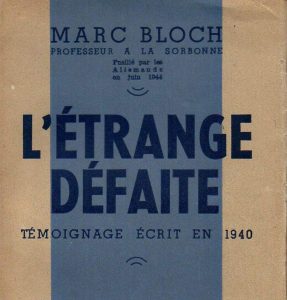
While some Jews are removed from the program, others are enshrined in the Panthéon: such are the vacillations of the European conscience. To mark Marc Bloch’s induction into the Panthéon on June 23, K. is dedicating a series of articles this month to the historian and Resistance fighter. To kick things off, Jean-Frédéric Schaub revisits Strange Defeat, striving to dust off the monument to restore the relevance of its critical power. In particular, he rediscovers a theory of the mechanics of disaster, in which the failure of the elites plays a decisive role. For someone who spoke out as both a historian and a citizen, intellectual detachment was just as untenable as ideological indoctrination. As we honor Bloch’s memory, let us keep alive the demand for the rationalist commitment to democratic life that was his own.
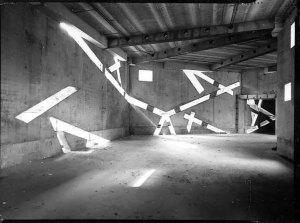
When Daniel Libeskind submitted his competition entry for the extension of the Berlin Museum in 1989, he refused the terms of the brief and proposed something far more unsettling: a building whose empty spaces — the voids — were not failures of design but its very core, architectural forms for what had been lost and could never be recovered. The result, now known simply as the Libeskind Building, has drawn visitors and architects from around the world for two and a half decades. On the occasion of the 25th anniversary of the museum, Miriam Goldmann returns to the origins of that achievement, presenting the models, drawings, and ideas that first brought it to life.