Marc Bloch, Against Feigned Pretences
What Does Strange Defeat Tell Us Today?
In this first text of a series that K. is dedicating this month to Marc Bloch – ahead of the historian’s induction into the Panthéon on June 23 – Jean-Frédéric Schaub re-examines Strange Defeat, not as a static monument, but as a critical tool for today. He finds in it a reflection on the debacle that rejects convenient explanations, questions the failure of the elites, contrasts scientific rigor with the allure of ideological obfuscation, and, far from a mere tribute to his legacy, reminds us that it is not enough to honor Marc Bloch. We must also listen to what he continues to ask of us.
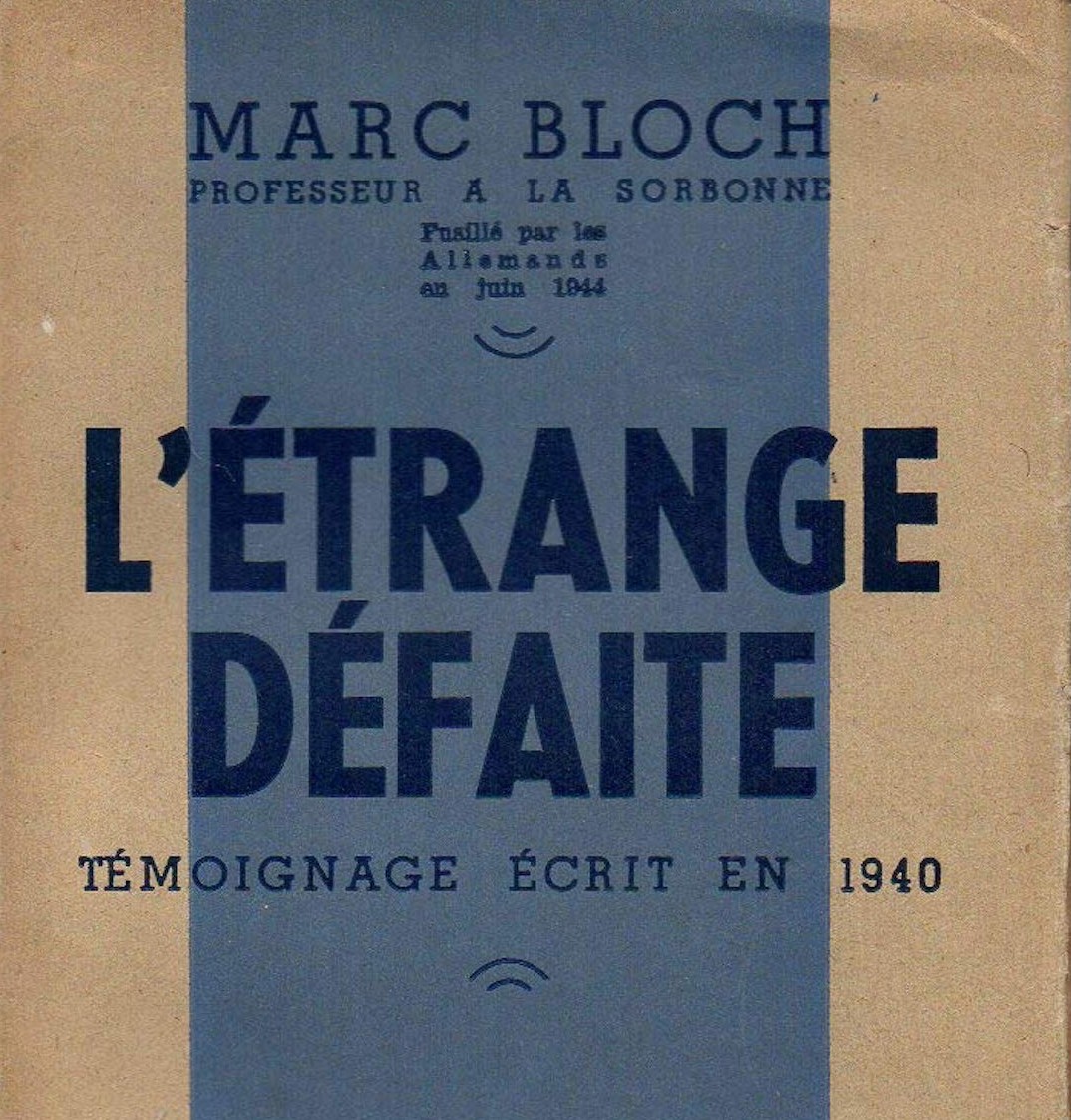
On the occasion of a series of lectures organized at the École des hautes études en sciences sociales in Paris this spring, I was asked to give a reading of Strange Defeat, alongside Judith Lyon-Caen and Gisèle Sapiro.
The book deals with the military defeat of June 1940, with France at that time, and with Marc Bloch.
On the first point, two styles of interpretation have clashed. Charles de Gaulle began writing his War Memoirs in 1946, the year of the posthumous publication of Bloch’s book. For the general, the defeat was primarily a matter of circumstances, or even bad luck. It was precisely this that allowed him to embody the advancing victory as early as June 18. He undoubtedly begins by describing the slide linking governmental dysfunction and flawed strategic theories. But, for the most part, de Gaulle explains that the high command gambled everything on the Battle of France. After his meeting with the Generalissimo, he notes: “General Gamelin struck me as a scientist, testing the reactions of his strategy in a laboratory. (…) It was with respect, but also some unease, that I left this great leader, preparing to suddenly assume an immense responsibility, staking everything on a plan I considered flawed.”
At the other extreme, Philippe Pétain’s speechwriters had him say on October 11: “Our defeat stemmed from our weaknesses. The laxity of our morals, the neglect of our duties, the love of money, the contempt for effort, the selfishness of some, the cowardice of others, have dug the chasm into which we have fallen.” The failure is thus that of a nation long since damaged. Charles Maurras rails that the downfall began in 1789.
The short-term failure of a high command caught in error versus the long-term decay of the Nation. Strange Defeat does not pit these two timeframes against each other; on the contrary, it intertwines them, as Bloch always did in his work as a historian: “They were only too ready to despair of the country they had been called upon to defend, and of the people who furnished the soldiers they commanded.
At this point I leave the purely military field. The roots of a misunderstanding so grave that we cannot but rank it among the main causes of our disaster, must be sought elsewhere and at a much deeper level.”
*
Our memories still echo with that troubled time from the Phoney War to the Montoire meeting. Like Bloch, we know full well that in 1939 a colonel of l’Action Française or a captain for the dioceses did not believe “that the Republic is the best regime on earth,” as Maurice Chevalier sang during his tours of the armies. Far from any jest, Strange Defeat does not indulge in morbid delight either. Nothing is more contrary to Bloch’s seriousness than the complacency, ranging from Marivaux-style banter to chic anti-semitism, presented in Jean Renoir’s The Rules of the Game, that other theater of collective collapse.
Here, the portrait of Bloch, citizen and scholar, respects the complexity of life, which he said was the very flesh of history. Regarding what would later be called “engagement,” his perspective shifted in the 1930s and cannot be simplified. “ “I belong to a generation with a guilty conscience,” he confesses. He laments the passivity of intellectuals, even though he himself, urged on by Lucien Febvre, was a signatory of the Appeal to Workers of March 5, 1934, which founded the Committee of Vigilance of Anti-Fascist Intellectuals. But he rejected any form of indoctrination, particularly affiliation with communist internationals.
In 1939, how far away seemed the golden age of the Dreyfus Affair, when the Protestant, Jewish, and Freemason bourgeoisie gave lessons in honesty and republicanism—combining the sword and the cross—yet stood shoulder to shoulder with Jean Jaurès. Bloch denounces the reversal that has taken place since then, when republican solidarity shattered out of fear of the financial consequences of the Popular Front’s decisions: “It would be difficult to exaggerate the sense of shock felt by the comfortable classes, and even by men who had a reputation for liberal-mindedness, at the coming of the Popular Front in 1936. All those who had a few pennies to bless themselves with smelled the rising wind of disaster, and the good housewife was, if anything, more terrified than her husband- It is the fashion to-day to say that the Jews were behind the Left-Wing movement. Poor Synagogue—always fated to act as scapegoat! I know, from what I saw with my own eyes, that it trembled even more violently than the Church. The same held true of the non-Catholic congregations. ‘The old Protestant employer’s a thing of the past’—I heard a writer say who had been brought up in Nonconformist circles. ‘At one time no one could have been more whole-heartedly concerned for the wellbeing of his people than he was, but now he is among the most rancorous of their critics.’” Words that would, alas, have been divine music to Jules Guesde’s ears.
This analysis can be compared to that of Emmanuel Mounier in the article he wrote on September 22, 1938, three days after France and the United Kingdom asked the Prague government to relinquish the Sudetenland: “One will understand nothing of the behavior of this faction of the French bourgeoisie unless one hears it murmur in a low voice: ‘Better Hitler than Blum.’ A bourgeoisie in dire straits; a faithless policy; a people worn down by disappointments and distractions—these are the causes of France’s capitulation,” read the October 1938 issue of Esprit.
Bloch laments the passivity of intellectuals, even though he himself, urged on by Lucien Febvre, was a signatory of the appeal To the Workers of March 5, 1934, which founded the Committee of Vigilance of Anti-Fascist Intellectuals. But he rejected any form of indoctrination, particularly affiliation with communist internationals.
But here lies the complexity of Bloch: whether the fear aroused by the workers’ upsurge of 1936 gave rise among the propertied classes to a fascist temptation or, at the very least, a fascination with authoritarian regimes, none of this absolves the political leadership of the Popular Front of its errors and failures: “It is no part of my intention to enter the lists as a champion of the Popular Front governments. They are dead now, and those who for a moment put their faith in them may, perhaps, be allowed to cast a handful of dust in pious memory on their graves. More than this they do not deserve. They fell without glory, and what makes it worse is that their adversaries had little to do with their overthrow. The movement failed mainly because of the follies of its supporters, or of those who claimed to be its supporters.” He undoubtedly means that the French Communist Party (PCF), in its utopian planning, supported the Popular Front like a rope supports a hanged man. The historian scoffs that those who refused to vote for the military budget were the same ones who demanded the shipment of cannons to aid Republican Spain.
Everyone gets a piece of his mind. A right wing incapable of fraternizing with the working classes, reformist and revolutionary parties unfit to govern. Faced with fascist unanimity, there is no republican unity.
*
Against degradation, the scientific spirit stands as a remedy, just as patriotism does. To put it this way is not to misuse Strange Defeat. Judge for yourself: “It does really seem that if ever our people are to be subjected to what Renan, after an earlier defeat, called an ‘intellectual and moral reform’, the first thing they will have to learn is that old axiom of classical logic—A is A: B is B: A is not B.” In his will, Bloch completes the proposition as follows: “Like one far greater than myself, I would gladly wish that, as my sole motto, these simple words be engraved on my tombstone: Dilexit veritatem.” It is Renan from the Tréguier speech (1884) whom he quotes here: “I want the following inscribed on my tomb: Veritatem dilexi. Yes, I loved the truth.” The call for truth and the guarantee offered by formal logic are the two conditions for the discipline of history to be conceived as a science.
Rationalism, therefore, as a bulwark for democratic society in the face of the fascist storm of his time. In this sense, the formula “A is A and A is not B,” published in 1946, predates George Orwell’s formula by three years: “Freedom is the freedom to say two plus two make four. If that is granted, all else will follow.” Democracy cannot be founded on the roll of the dice, on thought unbridled by any formal rigor, nor on a relativism that emancipates nothing and no one. Bloch is not among those who think that rationality is a straitjacket.
His reference to Renan makes it clear that he rejects neither the most rigorous philology nor even the methodical historical school. Along with Febvre, he mocked the naiveties arising from the anchoring of historical research to the framework of the nation-state and from the intoxication of storytelling at any cost. It is true that yesterday as today, some write history, but with affectation, from the comfort of university chairs, without daring, and rightly so, to risk becoming writers. However, as Strange Defeat demonstrates, an understanding of historical processes cannot be achieved by turning one’s back on the demands of the methodological school. Bloch and Febvre knew full well that Charles Seignobos was not the caricature he was made out to be, and that Henri Pirenne, though much admired, remained a positivist in search of comparativism and experimentation. The bond of esteem that Bloch and Ferdinand Lot maintained in peacetime and, a fortiori, under the Occupation, sufficiently illustrates how inaccurate it is to describe Bloch as simply breaking with the positivist legacy.
Democracy cannot be founded on the roll of the dice, on thought unbridled by any formal rigor, nor on a relativism that emancipates nothing and no one. Bloch is not among those who believe that rationality is a straitjacket.
Comparing to measure differences would have made it possible to approach the battles of 1940 without relying solely on the memory of the operations, admittedly victorious (but at what cost!), of the Great War. Hence this phrase we owe to Marc Bloch: the historian’s task is to examine “how and why yesterday differed from the day before.” A triangulation is required between yesterday and the day before yesterday and today, that is, with the social sciences of the time we are currently living through. At this price, history, to quote, is “in the truest sense, an experimental science, because, by studying real events, and by bringing intelligence to bear on problems of analytical comparison, it succeeds in discovering, with ever-increasing accuracy, the parallel movements of cause and effect.” Nothing here justifies articulating causes and effects in a haphazard manner or taking the liberty of arranging chains of causes and effects without formalization, merely on intuition, whim, guesswork, or whim. That is to say, in a quagmire of metaphorical statements that, in their folds, might conceal a grain of truth. Against bluffing, the scientific spirit.
*
Regarding Jewish identity, neither belonging nor denial, a lesson can be drawn. It concerns, in reality, antisemitism. Bloch requested and obtained the exemption provided for in Article 8 of the Law of October 3, 1940, on the Status of Jews: “By individual decree issued by the Council of State and duly justified, Jews who, in the literary, scientific, or artistic fields, have rendered exceptional services to the French State, may be exempted from the prohibitions provided for by this law.” Despite Minister Carcopino’s goodwill, this exceptional situation did not spare him from being subjected to Fliche’s antisemitism at the University of Montpellier, nor from having to withdraw from the Annales, nor from being barred from teaching after November 1942. He did not suffer the fate of those deported on racial grounds and was murdered by the Gestapo because of his resistance activities. His experience shows that individual accommodations and exceptional situations are the flip side of the racist structuring of the political sphere, when a society adopts norms that divide the national community into racial categories. Allow me to draw a connection here to my questions as a modernist. For centuries, devout Catholics of Jewish origin were made to confess that they were at fault because of the nature of the blood flowing through their veins. Many of them managed to escape persecution. But this in no way means that discrimination was moderated or systematically flouted. Exceptional regimes do not strip a racist system of its substance. The Bloch case illustrates this: one cannot understand the past without understanding the present.
*
I mentioned earlier that the book dealt with the mechanics of disaster, with France at that time, and with Marc Bloch. The Folio edition of Strange Defeat includes his will and articles contributed to the Resistance press. Therein lies a blueprint for reconstruction capable of correcting the routines that had so poorly prepared the country for adversity. At its heart: education and teaching. Since we are on the verge of calmly reflecting on what we want from a School of Social Sciences, I believe it is useful to read how Bloch defined the obstacles to an education designed for a democratic regime and a democratic society: “It will always be difficult to persuade teachers that the methods they have long and conscientiously practiced were perhaps not the best; to mature adults that their children will benefit from being raised differently than they themselves were; to alumni of the grandes écoles that these institutions, adorned with all the prestige of memory and camaraderie, must be abolished. (…) One word sums up one of the most pernicious flaws of our current system: cramming. Secondary education, universities, and the grandes écoles are all infected by it. In other words: an obsession with exams and rankings.”1
Have we even begun to follow Marc Bloch’s wise advice? One is permitted to doubt it. May his induction into the Panthéon bring his relevance to life, rather than simply enshrine it.
- The French Folio edition includes other texts by Bloch that are not included in the English edition. ↩︎