Have Jews become neo-Judeans?
The distinction between Jews and Israelis is becoming blurred, while the line between anti-Zionism and antisemitism is increasingly difficult to maintain in practice. This blurring is politically perilous: it exposes Jews to being regarded as foreigners in their own countries and held accountable for Israel. Based on this observation, Gérard Bensussan revisits an age-old question: how can we conceive of a Jewish existence divided between national citizenship, life in the diaspora, and ties to Israel? Have Jews become “neo-Judeans”?
Two concurrent, new, and striking phenomena seem to characterize the current situation of Jews in France, in Europe, and in the West — phenomena that are either insufficiently noted or too pervasive to be truly perceived. A dual erasure, undoubtedly relative and attributable to a multitude of factors that I do not address here, is taking place before our eyes. One may lament this, as it entails numerous risks. One may resign oneself to it. Some may secretly rejoice in it — who knows! In any case, an observation is in order regarding “the state of the Jews” today.
The difference between Jews and Israelis, while undeniably real, seems to be fading in the eyes of a general public that cares little for rigorous argumentation or universal truths, yet is attuned in its own way to the upheavals of the times, which it perceives with insight. The partial yet persistent impression held by many people is that, deep down, Jews are merely Israelis in exile and Israelis are Jews who have settled in a specific territory. As its name suggests, this impression may well be diffuse, widespread, somewhat vague, and fleeting. It persists, however, and spreads, disregarding the distinctions that contradict it, the facts, history, emancipation, politics, Zionism…
The partial yet persistent impression held by many people is that, deep down, Jews are merely Israelis in exile and Israelis are territorialized Jews.
The blurring of this distinction parallels, in its twists and turns, if I may say so, the growing conflation of anti-Zionism and antisemitism in their indistinguishable concrete practices and converging discourses. The necessity of distinguishing between them must certainly be maintained, but it is increasingly asserted in principle rather than in practice – it has become abstract. Sometimes its somewhat forced reiteration, under the guise of political or moral integrity, is nothing more than a self-serving contortion, ideologically overinvested. Jews and Israelis, antisemitic and anti-Zionists, all lumped together? One will contest the conflation because of its crudeness, one will cite a thousand exceptions, and one will be right. The thickness of the line does not prevent attention to what it depicts; on the contrary, as with the finger and the moon in the famous proverb.
The dual observation I note, I can only put forward as an intuition, without being able to strictly demonstrate the existence of what it observes. And without overlooking the political dangers that accompany it: if Jews are more or less Israelis, it is precisely because they have been foreigners since time immemorial in the countries where they reside, and antisemites will then be given a free pass; if they are jointly responsible for the actions of the various Israeli governments, we are justified in targeting them to better support the Palestinian cause, and this would give free rein to anti-Zionists. In any case, the assertion of civic equality between Jews and their fellow citizens, their distancing from Israel, and their political struggles in the countries of their nationality could be undermined as a result, and their situation jeopardized. But isn’t this already the prevailing reality? Shouldn’t we already see in the dual observation of relative erasure that I am making the revelation of a harsh truth that disturbs and upends the propriety and decorum of a supposedly peaceful relationship between “communities”? We must acknowledge, with a heavy heart, that attacks on Jewish community spaces—synagogues, centers, places of worship—or the brutalization of those wearing kippahs and other outward signs, or even the vandalism of Shoah memorials, serve as a legitimate form of protest for many who seek to express their outrage at the suffering inflicted on Palestinians.
If Jews are more or less Israelis, it is because they have always been foreigners in the countries where they reside, and this will give antisemites a free pass; if they are jointly responsible for the actions of various Israeli governments, it is justified to attack them in order to better support the Palestinian cause, and this will give anti-Zionists a free pass.
An interesting interplay illustrates the dual dynamic I am describing. The anti-Zionist left, on the whole, in its struggle against Israel, unwittingly falls back on the most hackneyed clichés of traditional antisemitism. The antisemitic right, especially Trumpists and MAGA supporters, once sobered from their evangelical-political enthusiasm for the State of Israel, spontaneously adopts the slogans of militant antizionism.
The erasure I am attempting to describe, however, unfolds against a backdrop that does not fade—far from it—and which may constitute the most consistent transhistorical constant of Jewish existence. The dyarchy of center/dispersion, State/exile, Israel/“host” countries, Promised Land/land of welcome has always formed the tightest fabric of Jewish lives, both emotional and practical. Its elastic extension might even reach as far as the traditional Jerusalem/Athens opposition, in its internal, Jewish refraction. This dual focus, this polarity in tension or ellipsis between the land and exile, the center and the world, the point and the line, as Hegel put it, forms a figure of the inhabiting of worldly time that neither hardline, nationalist Zionism nor exalted or exclusivist Diasporism will succeed in permanently abolishing.
During the 1897 controversy in Vienna1, in his response to Chief Rabbi Güdemann, who was hostile to any plan to establish a Jewish state “armed with cannons and bayonets” in Palestine or elsewhere, Theodor Herzl made a surprising point. The Jews, he explained, all have a homeland, Vaterland, of which they are citizens, if permitted, and where they live more or less in peace and with varying degrees of security. Zionism, according to this text by Herzl, does not intend to take this Vaterland away from them, or to assign them another one – but to give them, in addition, a motherland, Mutterland, the land of their ancestors, of their history, or of their national narrative. Zionism, that Zionism, adds; it neither takes away nor substitutes, for Jewish lives unfold within this “Binnenpolarität” of which Rosenzweig spoke, within this inalienable and internalized dynamic of the “Jewish” homeland and the land of the “external destinies” of the people of Israel.
This dual focus, this polarity in tension or ellipsis between the land and exile, the center and the world, the point and the line—as Hegel put it—forms a figure of the habitation of worldly time that neither hardline, national(ist) Zionism nor exalted or exclusivist Diasporism will succeed in permanently abolishing.
Nearly two thousand years ago, Philo – a native of Alexandria, a Greek-speaking author of a commentary on the Scriptures, and the foremost champion of the stubborn dream of reconciling reason and revelation – distinguished between Jerusalem, the mikropolis of the Jews, the ancient city of the ancestors, and the makropolis, Alexandria, where they lived out their own cosmopolitics, their universal and rational macropolitics. Between these two names for metropolises, each as irreducible or undecidable as the other, between the vast world and the small city, the Jewish destiny and mission seek to be fulfilled, not without unforeseen obstacles or inevitable detours. Like Philo, many “Judeans” could be citizens, or subjects, of, or within, the Roman Empire, like the inhabitants of Cisalpine Gaul or Illyria, and maintain an unbreakable bond with the Temple, the King, the Holy City – the motherland – without renouncing their vocation of global wandering or grand exile, but always caught between the two.
In the contemporary clash of great, rival imperial geotheologies, have the Jews not become—or returned to being—neo-Judeans grappling with a national citizenship, which is sometimes contested, and a loyalty to a motherland that spares them no hardship?
- D’une nation juive, ou non. Controverse, Vienne, 1897, Paris, Verdier, 2025. ↩︎
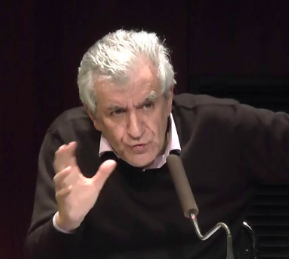
Gérard Bensussan
Gérard Bensussan is a philosopher, professor emeritus at the University of Strasbourg, and associate researcher at the Husserl Archives in Paris. He has taught all over the world and published some twenty books, many of which have been translated into several languages. His most recent works include: Mirrors in the Night: Hegel's Enlightenment (Cerf, 2022), The Transaction: Penser autrement la démocratie (PUF, 2023), Des sadiques au cœur pur. Sur l’antisionisme contemporain (Hermann, 2025) and Vieillir (Kimé, 2025).