#265 / Editorial
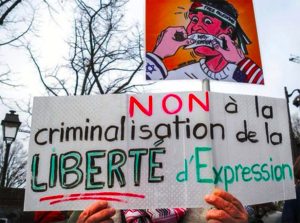
In November 2024, French MP Caroline Yadan proposed a law to strengthen penalties against antisemitism, including criminalizing speech that justifies terrorism or calls for the destruction of a state following the extreme rise in antisemitism in France after October 7. In the past week a petition has been launched to counter said bill, arguing that it presents “a real threat to freedom of expression by silencing any support for the Palestinian cause.” The petition reached more than 700 000 signatories. The law was finally withdrawn from the majority group at the Assemble this afternoon. This text, in reaction to the petition was written before the withdrawal.
Related articles
Petition Against the Yadan Law: How to avoid facing antisemitism

American Jews Caught in a Bind

Feature: After Orbán's Defeat
In just a few days, more than 700,000 people have signed the petition against the “Yadan Law”. That figure speaks volumes. Not about the law—the petition has rendered it unrecognizable—but about those who sign it. For what the petition accomplished, aside from its misleading presentation of the proposed law, is a sleight of hand that progressive France has now made its specialty: the defense of an abstract principle—freedom of expression—so as not to have to take a stand on what that principle actually protects here, namely a resurgent antisemitism that, in its resurgence, draws de facto from the wellspring of anti-Zionism.
It is one thing to judge that the proposed law was not the right way to address this. To dispute that the legislature’s intent is just in this instance—in that it aims to make expressions of this very real antisemitism punishable by law—is another matter entirely. Nothing of such an acknowledgment of the cause’s justice is discernible in what united the mass of signatures. For them, any defense of Israel’s right to exist can only come from the far right. Any attempt to link hatred of Israel with hatred of Jews, by conflating the two, only stokes antisemitism—as if antisemitism had been waiting for the Yadan law to burn synagogues in France in the name of the liberation of Palestine. And finally, any attempt to protect Jews only puts them in danger by fueling resentment toward these “privileges” that the state allegedly protects “especially.”
While it is clear that the petition’s signatories love Jews only if they acknowledge, on the one hand, that antisemitism is subsumed within racism, and on the other, that Israel should not be the state of the Jews, the far right, for its part, grants them its favor only to the extent that their defense potentially permits anti-Muslim policies. Caught between these two suitors who deprive them of their very selves, Jews must seek a way out. They must be able to defend themselves, free from any co-optation but also free from any denial of the realities they face, and they must do so within the framework of the law. This is what the Yadan law was attempting, albeit clumsily, to enable them to do. All that remains for French society is to prove to itself that such clumsiness is unnecessary. This week we revisit what the petition’s success is a symptom of.
Sébastien Levi observes this entrapment between camps from the United States. American Jews are caught in a vise between a far-left that demands they renounce Israel in order to have the right to live in peace, a far-right where nostalgia for Hitler is beginning to be voiced openly, and an Israeli government that scorns them as naive liberals on the path to assimilation. Their ideological space is shrinking rapidly. Peter Beinart, a leading figure in American Jewish anti-Zionism, has even just urged synagogues to disassociate themselves from Israel to avoid being targeted—advising them, in short, to protect themselves by fading into the background a bit. Here we recognize the perverse logic that the petition echoes in its own way: protecting Jews from what seeks to protect them, while allowing what threatens them to flourish.
We are taking advantage of current events—in this instance, the positive aspect—to feature this week a collection of texts that K. has devoted to Hungary. Orbán’s defeat in the last elections does not mark the end of an era—it serves as a reminder that what he methodically built over fifteen years—the systematic dismantling of institutions, the hollowing out of the rule of law through democratic means themselves—does not disappear with him. Several articles bear witness to this: they have tracked, from the inside, this European laboratory of illiberalism, from which certain lessons are far from having been learned. Other articles revisit Hungary’s trajectory within the history of 20th-century Europe.