#290 / Editorial

In three years, the National Library of Israel has managed to catalog 1,430 books about October 7. 1,430 books, at least 1,430 books separate us today from that traumatic event. 1,430 in three years – that’s nearly 480 per year, or, roughly speaking, between 9-10 per week. The phrase “work of remembrance” seems abstract until one imagines a collective subject, defined by the minimal requirement of having to come to terms with October 7, engaged in such book production.1 And that’s not even counting all the other media involved in this work, nor the incalculable volume of what is constantly being written on the Internet. For example, K. is republishing a dozen articles this week through which the journal has contributed to this labor, aimed at transforming the event into memory.

1,430 books on, has it gotten us anywhere? The sheer expanse of the bookshelves takes one’s breath away, giving the impression of a job well done. But wasn’t that already the case at 1,430, and won’t it always be so at 1,500? Does the work of coming to terms with the trauma ever end, or must the writing repeat itself in an eternal present? Will the Library be able to hold everything there is to write about the event and its consequences, or will it end up torn apart by what it sought to contain?
Three years later, it is from a Europe on the verge of relegating its traumas – and their lessons – to dusty shelves that we commemorate the dead of October 7, and that we question the lasting effects of such an event on the Israeli psyche. The film Naza provides us with an opportunity to do so, precisely because of its mixed reception: greeted with thunderous applause by the contemporary anti-Zionist movement, the film does not seem to have succeeded, despite its explicit intentions and certain merits, in fostering greater self-reflection within Israeli society regarding the war in Gaza. After watching Naza, philosopher Julia Christ reflected on the aporias of a critique that, in order to be heard, seeks to shock, without taking into account the psychological context of the collective subject to which it is addressed. Drawing on Critical Theory and psychoanalysis, she points out that in both criticism and therapy, attempting to break down the defenses of a traumatized subject has never produced anything but rejection.
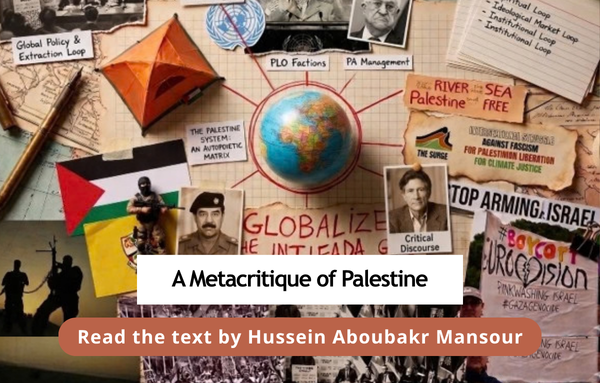
Regarding what, in the realm of criticism, separates the wheat from the chaff, we have chosen to publish a text whose ambition is as disproportionate as its length. We can only recommend it to readers who have time and mental space to spare, but to such readers we highly recommend it, as it is undoubtedly one of the most serious and honest essays of its kind. “A Metacritique of Palestine,” by Egyptian political analyst Hussein Aboubakr Mansour, presents itself as an attempt to analyze the symbolic and economic coordinates of the system within which all discourses on the Israeli-Palestinian conflict unfold today. In other words, it seeks to examine the strange capacity of this discursive economy to sustain itself in a constant competition for a certain form of value, which alienates every actor within the system, yet which no one seems able to do without. One cannot, therefore, emerge from this reading without having exposed oneself to the risk of losing something.
Finally, as chance would have it, this editorial is the last to be penned by the anonymous writer who has been writing them for the past three years. Dear reader, we have lived through many events together, and we have done our best not to let them take our breath away. It has been an honor to learn how to articulate for you what can be grasped from a collective and ever-shifting body of thought. I hope to see you soon.