American Jews Caught in a Bind
Caught between accusations of supporting genocide leveled by the far left, explicit antisemitism gaining ground within the Republican Party, and deep mistrust of the political path Israel is taking under the Netanyahu government, the “ideological space” for American Jews is shrinking rapidly. Sébastien Levi examines the political shifts that are squeezing them from both sides, as opposition to the war in Iran calls Israeli-American relations into question more than ever, and liberal Zionism has never faced such negative press.
A Red-Brown Axis?
After giving a lecture at Tel Aviv University, the anti-Zionist American Jewish intellectual Peter Beinart apologized for having “broken the rules of BDS,” and sparked a heated debate within the American Jewish community. This controversy comes as Israel’s central place in American public debate—sometimes a source of discomfort for American Jews—is now being challenged on both the right and the left, particularly since the start of the war with Iran.
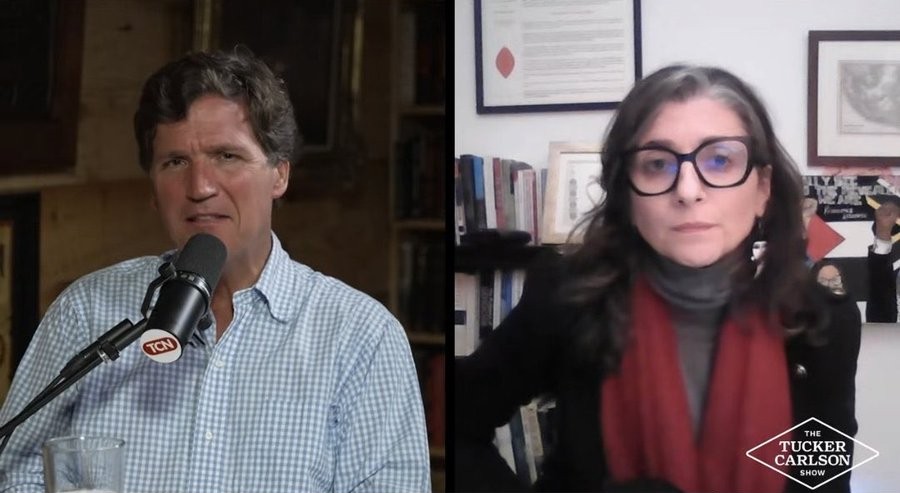
In recent months, Tucker Carlson, a far-right American pundit, hosted Francesca Albanese on his show, the UN Special Rapporteur on Palestine, a muse for Roger Waters, as well as Joe Kent, the former head of U.S. counterterrorism who recently resigned in a dramatic fashion after denouncing Israel’s role and “lies” in convincing Trump to go to war against Iran.
These two guests and Carlson share a single common ground: a radical rejection of Israel, not based on its policies—which are open to criticism—but on the very essence of the country. For Carlson and Kent, its disproportionate influence on American politics is at issue, and for Albanese, it is its “criminal” and even “genocidal” nature.
This meeting is symptomatic of Israel’s importance in the American public debate. While it is too early to speak of a red-brown axis on the subject, bridges certainly do exist. We have thus seen Marjorie Taylor Greene—a former Trumpist icon who has fallen from grace—take a stand against Israel’s influence in Congress, a move welcomed by the left wing of the Democratic Party, or Tucker Carlson applauding Mamdani’s campaign for New York City mayor for his refusal to bow to the “pro-Israel lobby.”
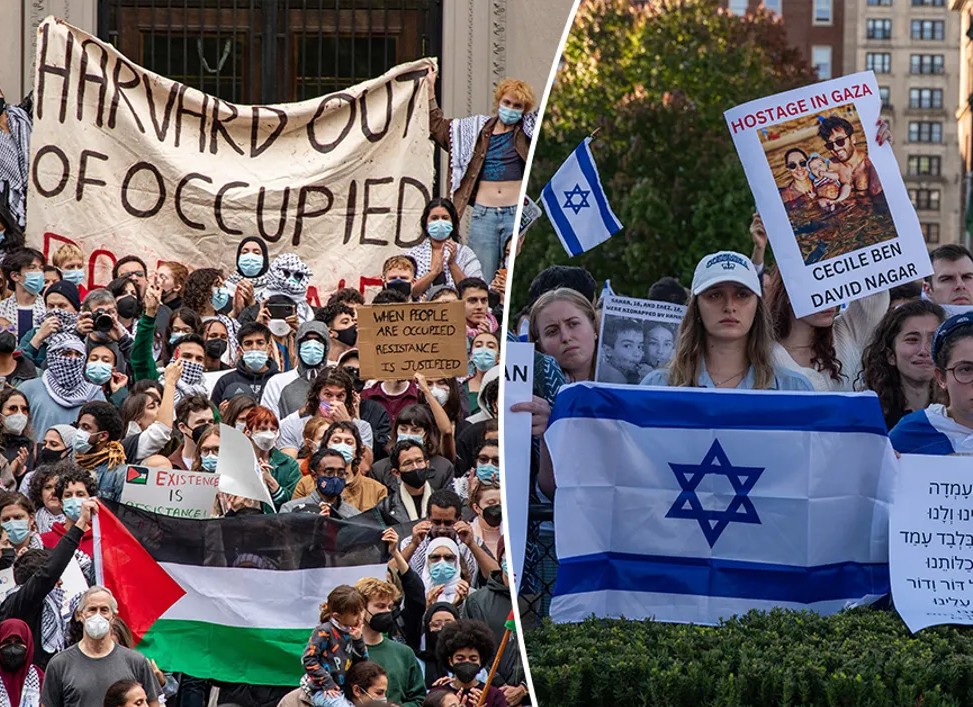
Israel is rejected by the far left through the lens of the dominant-dominated relationship, embodying the “colonizer” and “oppressor” model.
On the far right, it is the symbol of “cosmopolitanism,” foreign influence on American politics against the interests of the American people. In both cases, the same fantasy of undue and malevolent influence unites these forms of hatred, and the war in Iran, largely unpopular among the American public, has given new life to these criticisms.
This convergence illustrates the difficult situation facing American Jews since October 7, caught in a veritable vise between the extremes, with the center shrinking—a reflection of the polarization of American society. This vise also represents a major challenge for both parties on an issue that was long marginal but has (once again) become decisive.
Political Parties Confront the Challenge of Antisemitism
The Democratic Party was slow to grasp the extent of the upheaval on campuses after October 7 and to denounce the far left, which tended to conflate criticism of Israel with the ostracization of Jewish students who refused to renounce their support for Israel. It was difficult for the Democratic Party to appear opposed to academic freedom or freedom of expression and to disown part of its activist base, and some Jews found this period particularly difficult. In fact, it took Trump’s rise to power for campuses to fully grasp the scale of the phenomenon and address the issue, effectively highlighting the Democratic Party’s “slow start.”
This party must confront the reality that radical criticism of Israel fuels an anti-Zionism that can quickly veer into antisemitism. This delicate task has been made particularly urgent by Mamdani’s election as mayor of New York, who has moderated his rhetoric on economic issues but not on his anti-Zionism. Nevertheless, antisemitism, which Mamdani has clearly denounced, is—at least in theory—unanimously rejected by the Democratic Party, whereas the situation is more mixed within the Republican Party.
The latter is not antisemitic at the level of its leadership or its doctrine (however porous the latter may be since Trump’s systematic dismantling of it), but it is influenced by a militant base that may be susceptible to such views.
The glorification of Hitler itself is seen as a middle finger to political correctness, the absolute rejection of which is also a legacy of Trump among young conservatives.
Radical far-right influencers like Tucker Carlson or Nick Fuentes now have a considerable audience, with remarks that are sometimes openly antisemitic, or even nostalgic for Hitler, as we saw in a WhatsApp group of young Republican leaders. The defense of free speech has thus allowed JD Vance to justify intolerable remarks on this WhatsApp group, which would have resulted in the immediate expulsion of those responsible from the party 10 years ago. The glorification of Hitler itself is seen as a middle finger to political correctness, the outright rejection of which is also a legacy of Trump among young conservatives.
A recent poll showed that 37% of Republican voters believed the death toll of the Shoah was exaggerated. Trump’s obsessive conspiracy theories spare nothing—and certainly not Jews, either directly or indirectly. The mix of nationalism, conspiracy theories, and isolationism inevitably places Israel—and indirectly, Jews—at the center of the debate within the Republican Party. In fact, another poll, perhaps even more troubling, indicates that 45% of Republicans under the age of 45 believe that Jews pose a threat to the American way of life.
Some within the Party seem to be taking the problem seriously, with strong statements from Senators Ted Cruz and Rick Scott regarding the harmful influence of Carlson and Fuentes on the party, particularly among younger members.
This issue of antisemitism is resurfacing as the Israeli-American relationship is being called into question in Washington, across both parties, in an even more acute manner since the start of the war against Iran.
Bipartisan Disaffection Toward Israel
There is genuine disaffection toward Israel within both major U.S. parties, particularly among the activist base and among younger voters, for different yet converging reasons: Israel’s conduct regarding the occupation of Palestinian territories and the Gaza war for Democrats, and its financial burden for Republicans. Thus, 53% of Americans now have a negative view of Israel (69% of Democrats and 37% of Republicans), a figure that has been rising over the past three years in both parties. The AIPAC lobby, long considered bipartisan, is now under attack from both sides of the political spectrum. It is becoming impossible for a Democrat with national ambitions to claim its support, and, on the right wing of the Republican Party, its status is also being called into question.
Trump has opened a Pandora’s box regarding the questioning of U.S. foreign aid, which is generally perceived as too high. His obsession with NATO and the need for member countries to contribute to their own security fits into a broader framework. Israel has long believed that “America First,” Trump’s isolationist doctrine, contained an asterisk regarding it, thanks to its status in Washington. Yet Trump—and even more so JD Vance—seem to be removing that asterisk, especially as the deterioration of Israel’s image among Americans will complicate the maintenance of this Israeli exception.
While criticism of alignment with Israel currently comes mainly from Democrats, and is currently stifled within the Republican Party due to absolute loyalty to Trump, this silence may well not survive him, especially if JD Vance succeeds him.
In this regard, the war with Iran could mark a turning point. Unpopular, it is supported by only 40% of Americans, whereas support for the wars with Iraq stood at 80%. Netanyahu’s role in triggering this war is widely debated and fairly widely acknowledged, even if ultimate responsibility obviously lies with Trump. This “war for Israel”—at a time when gas prices are skyrocketing and Trump’s justifications have constantly shifted—is giving new substance to a profound reevaluation of the relationship with Israel within both parties. While criticism of alignment with Israel currently comes mainly from Democrats—and is currently stifled within the Republican Party due to absolute loyalty to Trump—this silence may well not survive him, especially if JD Vance succeeds him.
In an era of transactional isolationism for Republicans and heightened scrutiny of Israel’s policies by Democrats, it may well be in the Jewish state’s interest to maintain a lower profile on the American political scene. Without speaking of a rupture, Israel must face a new reality and build a new, more balanced relationship with the United States. Netanyahu himself has understood this, calling for an end to the ten-year aid plan for Israel, which has become a problematic fixation.
This new relationship with Israel is not only being questioned in Washington and does not concern only state-to-state relations. It also concerns the relationship between American Jews and the State of Israel.
The Stranglehold of Support for Israel
Polarization has not spared American Jews’ relationship with Israel. Caught between unconditional support and radical criticism that seeks to deny any legitimacy to the country’s existence, lucid support for Israel is becoming increasingly difficult for American Jews.
Nothing illustrates the difficulty of the moment better than the expulsion from Israel of two American Jewish activists, liberal Zionists, for having campaigned on behalf of the Palestinians, specifically to allow them to harvest their olives and protect them from attacks by violent settlers in the West Bank.
For Netanyahu and most members of his Israeli government, American Jews who are attached to Israel but critical of its government represent a danger. They prefer to caricature them as Jews on the path to assimilation, swayed by wokeness and hatred or indifference toward Israel. Netanyahu has consistently shown them hostility or contempt, preferring instead the evangelicals, who have long been united in their unqualified support for Israel under his leadership. In this polarized view, there must be only two camps: pro-Israel or anti-Israel, to prevent any challenge to his government’s policies.
Yet while American Jews’ attachment to Israel remains very real, it is being tested by the continuation of the occupation, settler violence, and the erosion of liberal democracy in Israel. This is all the more so because their very Jewishness is being called into question by the rabbinical authorities in Israel, who do not recognize liberal Judaism or Massortim Judaism—which is practiced by 80% of American Jews. The recent bill that has just passed its second reading in the Knesset, excluding these “bad Jews” from the Western Wall, is in this regard an unbearable affront.
In Netanyahu’s polarized vision, there must be only two camps: pro-Israel or anti-Israel, to prevent any challenge to his government’s policies.
When young American Jews, raised on heroic, one-sided, and simplistic narratives, discover not only that the reality of the country is (necessarily) more complex, but that they are not necessarily understood or welcome there, the shock can be severe. Given the disconnect between perception and reality, many young Jews may feel deceived and subsequently decide to turn their backs on Israel. This disconnect is therefore the best weapon for anti-Zionists today.
The same observation applies to young evangelicals, who are also gradually breaking ties with Israel, with notable figures. In three years, the negative view of Israel among Republicans under 50 has risen from 35% to 50%, due as much to images coming from Gaza as to the disconnect with the idealized image of Israel they were given in their churches or youth movements.
For Israel’s current government, despite this deterioration in the country’s image, these two deported young women, Rachel Beth Flamholz and Leila Stillman-Utterback, who love Israel, are in fact far more dangerous enemies and harder to counter than an anti-Zionist Jew who rejects the very legitimacy of Israel, such as Peter Beinart.
Why Peter Beinart Is a Symbolic Case
A columnist for the New York Times, Peter Beinart has long been the archetype of the liberal Zionist American Jew, a critical defender of Israel. It was in 2020 that he crossed a threshold by first professing his abandonment of belief in the two-state solution, which would lead him to define himself as anti-Zionist.
Initially a pragmatic shift, it subsequently became ideological, as he now denies the very legitimacy of a Jewish state in Palestine/Eretz Israel. His—legitimate—quest for civic equality has led him to advocate today for an unapologetic anti-Zionism, presenting Zionism as inherently unequal and unjust.
For all these reasons, his personality and his political-ideological evolution make him the ideal symbol for the Israeli government, led by Netanyahu, and along with them the cohort of “hasbarists”. Their argument is essentially that any criticism of Israel inevitably leads to questioning the state’s legitimacy, and that there is a continuum between liberal Zionists and anti-Zionists, which Peter Beinart embodies.
For them, he thus represents an ideal adversary, the ultimate embodiment of that despised liberal American Jew ready to abandon them, in contrast to the “good” conservative Jews (and traditional evangelicals) ready to defend Israel, all of Israel, and above all its policies.
This is the head-to-head confrontation the Israeli government seeks with the anti-Zionists alone—its sole opposition—to pressure Israel’s defenders into taking sides with it in a binary, unnuanced manner. This demand could well be the best gift offered to the anti-Zionists.
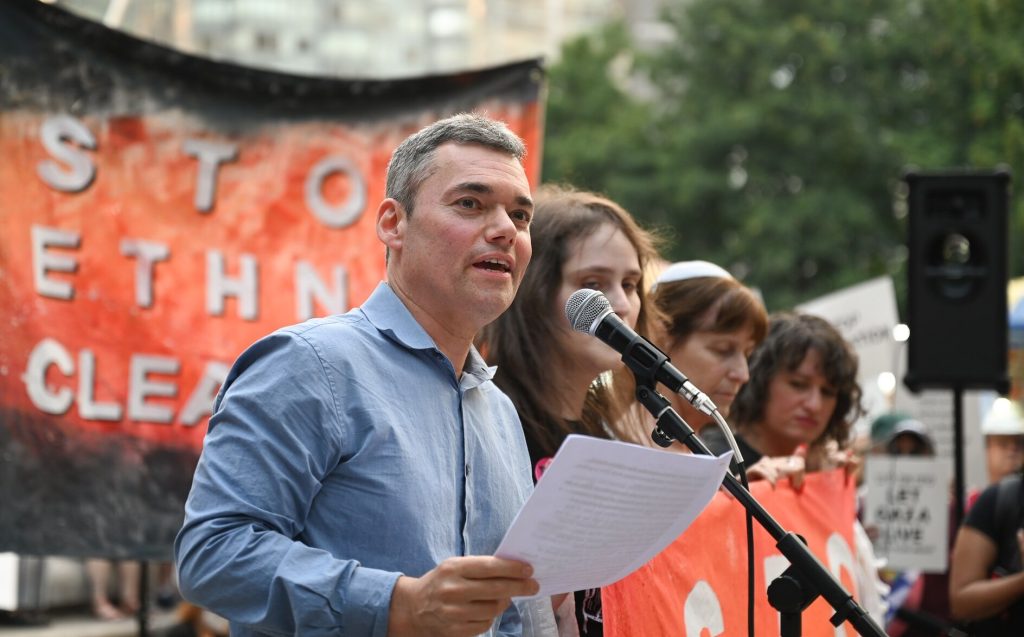
Beinart is not a “self-hating Jew,” but a fairly observant Jew who openly identifies as an anti-Zionist, having broken with Zionism. His anti-Zionism can therefore in no way be confused with antisemitism. The same complexity applies to the alliance between Mamdani and the Satmar, a very powerful ultra-Orthodox anti-Zionist sect in New York, which has thus allowed Mamdani to whitewash his anti-Zionism with men in black…
Anti-Zionism is normalized, made kosher, so to speak. Yet while anti-Zionism is not always antisemitism, the blurred lines between the two concepts harbor grave dangers, including the undermining of an ideology shared by approximately 75% of American Jews, and the potential for antisemitic acts committed under the guise of anti-Zionism. This campaign of normalization and delegitimization is bearing fruit in the United States, including among Jews. Thus, 37% of American Jews identify as Zionists, but 90% support the idea of Israel as a Jewish and democratic state, making them de facto Zionists even when they are reluctant to define themselves as de jure ones.
Beyond the First Amendment, which makes it impossible to criminalize certain speech, it is illusory and undoubtedly counterproductive to seek to equate anti-Zionism with antisemitism outright in order to ban it. The solution lies rather in the battle over the word “Zionism,” the defense of this idea, and its joyful and unashamed reappropriation. This battle should be the priority of pro-Israel Jewish organizations, rather than the hunt for anti-Zionist speech and its criminalization. It should be waged in particular among young American Jews, and primarily against the definition of Zionism promoted and legitimized by anti-Zionist Jews, of whom Beinart is the figurehead.
The Existential Conflict Between Liberal Zionists and Anti-Zionists
Beinart indeed embodies the conflict between liberal Zionists and anti-Zionists, particularly in the United States. For the latter, liberal Zionists are in fact their primary target, far more so than the right.
This focus on liberal Zionists stems primarily from their desire to “atone” for their own past convictions, as many of them, like Beinart, come from this school of thought. Having “discovered” that Zionism is inherently evil, they must constantly prove the sincerity of their “conversion to BDS” by apologizing for their past “sins,” but also for any current deviations, as was the case with Beinart’s speech at Tel Aviv University.
Beinart’s apologies serve as yet another reminder that the quest for “ideological purity” drives anti-Zionist Jews toward extremes that align with those of the far right, in their shared rejection of an Israel that is both Jewish and democratic.
It is illusory and undoubtedly counterproductive to seek to equate anti-Zionism with antisemitism outright in order to banish it. The solution lies rather in the battle over the word “Zionism,” the defense of this idea, and its joyful and unashamed reappropriation.
Their anger toward liberal Zionists stems mainly from the fact that they perceive them as hypocrites and whitewashers of Israel’s “evil” nature. Like the Israeli far right, anti-Zionists effectively erase the Green Line, seeing a continuity between Israel’s occupation of the West Bank—with its differential treatment of Jews and Palestinians—and Israel’s flaws within the Green Line, which nevertheless remain within a framework of civic equality between Palestinian and Jewish citizens of Israel.
The more the State of Israel renders the two-state solution impossible and delegitimizes even the mere mention of the occupation or the name “West Bank”—with the active support of a segment of American Republicans—the more emboldened the anti-Zionists become. This allows them to conflate the occupation of the West Bank with Zionism itself. They can then label Israel an “apartheid state” and Zionism a harmful doctrine.
Liberal Zionism is, for them, an absurdity, even an abomination, and thus becomes the enemy to be fought relentlessly, with the United States as the epicenter of this battle. In a country where 40% of Jews (and 50% of young Jews) believe that Israel committed “genocide” in Gaza, but where approximately 75% nevertheless consider Israel’s existence essential for the Jewish people, Beinart and his allies seek to exploit the understandable outrage felt by many over the war in Gaza to delegitimize not only the Israeli government, but the very nature of Israel and Zionism, primarily among American Jews, who find themselves caught in a vise more than ever before.
A triple vise tightening in an anxiety-inducing context for American Jews
In a statement that aptly summarizes the nature of the vise for American Jews, Peter Beinart has just urged American synagogues to disassociate themselves from the State of Israel to avoid being targeted, thereby asking them to renounce their support for or identification with Israel in order to regain their peace of mind and tranquility. In this view, today’s Zionists are, in a sense, to anti-Zionist Jews what Eastern European Jews were to the Jewish community in 1930s France—troublemakers disrupting their security…
In fact, American Jews are rejected as “stateless Jews” by the far right, as “genocidal Zionists” by the far left, and as “naive liberals” by the Israeli government, against a backdrop of rising antisemitism and current events—such as the Epstein case and the war in Iran—that reinforce the worst antisemitic prejudices. Their “ideological space” is thus shrinking rapidly, and their physical safety is being undermined a little more each day.
In 1790, George Washington, the first U.S. president, wrote a letter in which he affirmed that Jews would not simply be “tolerated,” but would be “fully equal citizens in the new nation.” As the United States celebrates the 250th anniversary of this nation in 2026, the uncertainties surrounding the fate of American Jews make this commitment by the father of the American nation resonate painfully.

Sébastien Lévi
Sébastien Levi is the correspondent for Radio J and librejournal.fr in the United States. He also regularly appears on i24 and Kan to comment on American news and Israel–U.S. relations. He is also an occasional contributor to the English-language Israeli newspaper The Jerusalem Post.