From Historian to Polemicist: What Went Wrong with Omer Bartov
Omer Bartov, who accuses Israel of committing genocide in Gaza, presents in "Israel: What Went Wrong" a more general critique of the Jewish state, its history, and its relationship to the memory of the Holocaust. Jeffrey Herf responds to him head-on here. A historian of Nazism and antisemitism himself, Herf not only challenges Bartov’s conclusions but also questions his methodology, his use of his authority as a Holocaust historian, and what he considers to be the insufficiency of the evidence presented to support such a serious accusation. In his review of Bartov’s latest book, Herf examines what he considers to be the omissions, generalizations, and oversimplifications of a historian turned polemicist.
Within weeks of the Hamas attack of October 7, 2023, the historian Omer Bartov joined several other scholars of the Holocaust to warn that Israel was about to engage in genocide in Gaza. In subsequent months, in articles in The New York Times, The New York Review of Books, and The Guardian; in TV and radio interviews; and at academic conferences and public talks, he concluded that Israel was indeed committing genocide in Gaza. Bartov’s leading works focus on the German army on the Eastern Front in World War II, and on the fate of the Jews of the East Galician hamlet Buczacz, from which his mother, Yehudit (née Szimer), hailed.1 His father, Hanoch Bartov, was one of Israel’s most celebrated writers. The novels about the Jewish Brigade in World War II and the formative experiences of the “Palmach generation” by Bartov the elder were bestsellers.

Omer Bartov was born on Kibbutz Ein HaHoresh and raised in Tel Aviv. In the 1980s, he decided to leave for the United States, where, since 2000, he has been a professor of history at Brown University. His pioneering research on the role of ordinary soldiers, local populations, and the social mechanisms of violence in the Holocaust helped reshape the way in which historians understand the interaction between Nazi ideology, military structures, and personal agency.
Over the years, Bartov has also written essays about genocide, but those texts, which have received favorable mention in the liberal press, do not rest on the painstaking archival work evident in his writings on events in wartime Europe. Though he never published any books on the history of Israel based on the kind of archival research that is de rigueur for those engaged in the historian’s craft, Bartov has been successful in presenting himself as an authority on Israeli policies and especially on Israel’s war in Gaza. To achieve that, he has relied on transferred prestige grounded on his prior meticulous historical research to lend credibility to his opinions about Israel and the war in Gaza. Prestige transfer is an old and sorry phenomenon in modern intellectual history, whereby persons who have displayed achievements in one area claim that, for example, “as a historian” (and in this case a historian of the Holocaust), they have insight into ongoing events unavailable to others.
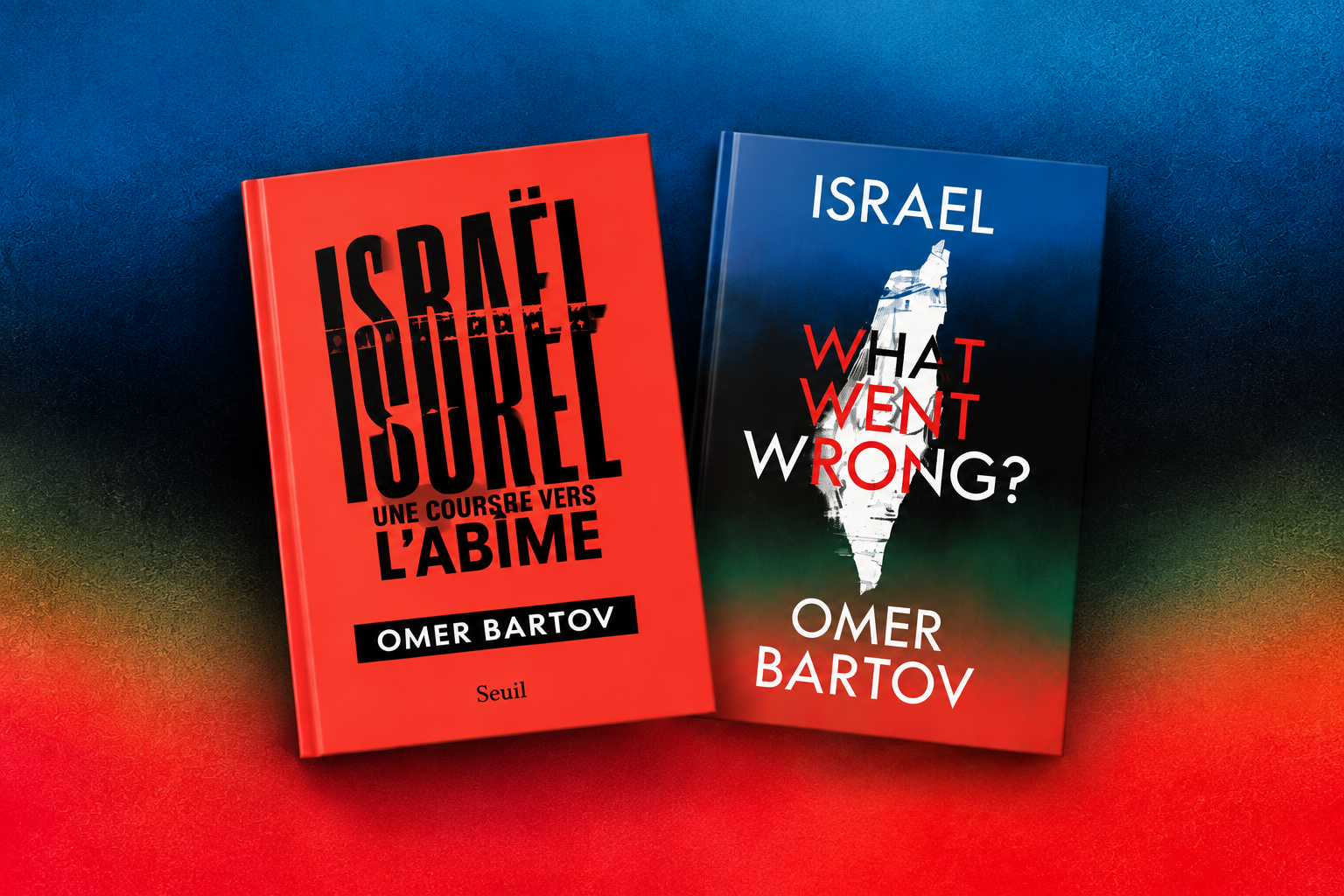
Bartov’s latest book, Israel: What Went Wrong, released in April, is an example of that problem. Anyone, and certainly a scholar who makes the grave accusation of genocide, faces a heavy burden of providing evidence and causal reasoning. Yet Bartov does not provide a single footnote to support his claims, nor does he bother addressing the evidence and arguments that would challenge them. The reader is pushed into the position of accepting his claims based solely on the say-so of a prestige-transferring author, as well as the reputation of his publisher—one of America’s finest—Farrar, Straus and Giroux. He has dispensed with the bothersome details of notes and sources, because he believes that what he is writing is so obviously true and morally unassailable that those who disagree are either in denial about the facts or have lost their moral compass.
Bartov has relied on transferred prestige grounded on his prior meticulous historical research to lend credibility to his opinions about Israel and the war in Gaza.
The central argument of the book is as follows: Immediately after the October 7 Hamas assault on Israel, which he describes inadequately and laconically, “Israel declared its intention and then engaged in an attempt to destroy the Palestinian people living in Gaza, in whole or in part, as such, thereby reaching the high bar of the Genocide Convention” (pp. 22–23). The evidence for this claim is angry—and selectively quoted—statements about the inhumanity of the Hamas killers on October 7 made by Israeli leaders, but Bartov cannot offer any official statement by the prime minister or official government spokesman that it intends to “destroy the Palestinian people,” because there are no such statements. Israel declared war to defeat Hamas, a fact Bartov represses.
A core element of Bartov’s polemic, and an important reason why it has struck a chord in the intellectual world, is his claim that Israel misuses the memory of the Holocaust, and that this misused memory has itself become a justification for its unjust, indeed, evil policies. He writes: “Since the Hamas massacre was constantly portrayed as genocidal and Hamas described in Israeli media as a Nazi organization … the lessons learned from the Holocaust” called for the war in Gaza to “be implemented as an unavoidably ruthless measure to prevent the repetition of another Auschwitz” (p. 104). He writes as if the genocidal essence of the attack of October 7 had not already been described in excruciating detail in numerous accounts in the press, and in studies such as the 7 October Parliamentary Commission Report.2 As anyone who has read the Hamas Charter or Hamas statements in recent years knows very well, there are actual lineages between Nazi ideology and Islamist ideology, both during the Holocaust and in the Islamist long war to destroy the State of Israel. It is a historical fact that enthusiasm for Hitler and the antisemitic conspiracy theories of Nazi Germany have been a factor in the ideology of Hamas.
As a historian of the German army on the Eastern Front during World War II, Bartov is very familiar with the actions of the Nazi Einsatzgruppen. The Israeli scholar Michael Milshtein, drawing partly on interviews with captured Hamas terrorists, examined the ideology and organization of the Nukhba units created by Hamas. Milshtein pointed out the similarities to the Einsatzgruppen. Yet Bartov does not acknowledge the connection between ideologically driven mass murder in Nazi Germany and Hamas’s attack.3 He refuses to address the reality that Hamas posed an existential threat to Israel’s existence, and that it was thus fighting for its very survival.
Bartov argues that the misuse of Holocaust memory was there from Israel’s very founding. The nation’s 1948 War of Independence, waged in response to a civil war launched by the Arab Higher Committee led by the Nazi collaborator Amin al-Husseini and then to an invasion by five Arab countries, only appeared to be “an act of supreme justice.” Instead, he writes that the newborn Jewish State “became entangled in an act of injustice from its very inception,” namely, “the expulsion of 750,000 Palestinians from what became the State of Israel and the refusal to let them return” (pp. 105–06). Because that was “carried out by Jews only recently displaced from Europe, these two events, the Shoah and the Nakba, became inextricably entangled”. Yet “the respective victims … have insistently rejected the stark reality of this entanglement” (p. 106).
Bartov writes as if the Israeli historians of 1948, whether Benny Morris, Ephraim Karsh, or others, had not demonstrated convincingly that there was no “expulsion” of 750,000 Palestinians. Rather, there was a war that the Palestinian leaders initiated, the Arab states escalated, and that both lost. In the course of the fighting, thousands of Palestinians were indeed displaced, as happens in many wars, but the Zionists’ purpose was not to expel “750,000” people but to establish a state on the basis of the United Nations resolution that called for both a Jewish and an Arab state on the territory of the former British Mandate in Palestine. In Bartov’s polemic, there is no Arab or Palestinian agency, no resort to arms to reject the UN resolution, no Arab or Palestinian Arab racism, no antisemitism, and no Arab rejection of immigrants seeking entry to a region that already had numerous Arab states. Hence, he suggests a causal connection between the Holocaust—the mass murder of six million Jews in Europe—and what Palestinian writers began to call the “Nakba”—the loss of a war from which the vast majority of Palestinian Arabs emerged alive, though defeated. It is a terrible thing to lose a war, but the Palestinians’ defeat was not in any way comparable to the Holocaust, and losing a war that one’s leaders started is not an act of injustice on the part of the victor.
Bartov’s rage at Israel reaches a fever pitch when he discusses the apparent misuse of the memory of the Holocaust: “Eventually the catastrophe of the Holocaust became, for most Israelis, a vast fig leaf, its lamentable effort to combine self-victimization and self-pity with self-righteousness, hubris, and the euphoria of power, with one side of the equation justifying the other … .Ethical concern and moral qualms were brushed aside as either marginal or distracting in the face of the ultimate cataclysm that is the genocide of the Jews” (p. 106). Bartov finds “most Israelis” disgusting; there is no other way to put it. He asserts that the misuse of the memory of the Holocaust amounts to a national psychosis that is the primary cause of Israeli immorality. Gone is Bartov the historian of the Eastern Front. Enter Bartov as a new expert offering a psychoanalytic account of how “most Israelis” descend into base immorality.
Bartov writes as though Israel faces no threats to its existence that are not the fault of its own unjust policies. The readers of his polemic will learn nothing about the wars of secular Arab nationalist states in 1967 and 1973, of the equally long campaign of Palestinian terrorist organizations under the umbrella of Yasser Arafat’s PLO, nor of the religiously inspired antagonism of the Islamic Republic of Iran, Hezbollah, and Hamas. There is no discussion of the thousands of Israelis killed and wounded in these wars and terrorist campaigns, and hence nothing of the very legitimate fears for their lives that Israelis endure—fears that have nothing at all to do with memories of the Holocaust. These fears were not and are not the result of paranoia about non-existent threats or of memories of the Holocaust in the past. They are responses to real bombs and bullets, and real threats from real governments and organizations.
Bartov finds “most Israelis” disgusting; there is no other way to put it. He asserts that the misuse of the memory of the Holocaust amounts to a national psychosis that is the primary cause of Israeli immorality.
Bartov, the historian of the Holocaust, has forgotten his own insights, written in 2004 in The New Republic. There he understood the echoes of Nazism in the Hamas Charter and that the leaders of that organization, like Hitler, meant what they said, in their case when in 1988 they declared war on the Jews and the State of Israel.4 The soldiers of the IDF did not invent copies of Mein Kampf and the Protocols of the Elders of Zion that they found in homes in Gaza, nor did they fabricate the kitchens and bedrooms riddled with bullets that remained after the October 7 assault; Bartov refrains from mentioning those details.
He claims that one result of this mistaken and unfortunate preoccupation with the memory of the Holocaust has been a “persistent silence over the crimes committed by the State of Israel.” Bartov cites the historian Norman Goda and me as examples of this severe shortcoming, pointing to an essay we wrote for The Washington Post in June 2025.5 According to Bartov, our views “reflected a larger trend that threatens to accelerate the marginalization of this field of inquiry, eventually leading to a reversion to its origins in the immediate aftermath of 1945 as a purely Jewish pursuit of remembrance and identity, hermetically sealed by choice and focus from the rest of the world” (p. 114).
The problem with Bartov’s comments is that he does not address the substance of our essay regarding the use and misuse of the genocide accusation and our arguments and evidence regarding the link between Hamas’s ideology and policy of mass murder, the difficulties of a counter-terrorism war against Hamas, the need for skepticism toward claims made by Hamas about numbers and identities of the dead and wounded, and the difference between Israel, which has tried to reduce civilian casualties while fighting Hamas, and Hamas, whose aim was to maximize civilian deaths. Our effort to bring scholarship into the public sphere does not contribute to the “marginalization” of a field of inquiry; rather, it enables serious and informed debate.
Prof. Goda and I, who both happen to be Jewish, are very pleased to be part of an international community of scholars that includes Jews and non-Jews and look back with gratitude to the Jewish and non-Jewish scholars of the post-1945 decades who bravely, brilliantly, and eloquently conducted foundational research on the Holocaust long before it was popular to do so. Bartov’s reference to their efforts as a “purely Jewish pursuit of remembrance and identity, hermetically sealed off from the rest of the world” is an insult to the mixture of particularism and cosmopolitanism that distinguished the generations of historians on whose shoulders we—and Bartov—stand. Whatever his intentions, these statements have the effect of making Bartov the good Jew, a member of the wider world, as opposed to the bad Jews, Goda and Herf, who supposedly retreat into parochialism and even an intellectual ghetto. This, too, is the anger of a polemicist, not a practitioner of the historian’s craft.
Bartov gives short shrift to Hamas’s intentions as a cause of the war. Since publication of their charter in 1988, and in numerous statements before and after October 7, the leaders of Hamas declared their intention to destroy the State of Israel through war. Their beliefs were public and a source of pride and political identity. Though he does not justify the attack, he does say that “it would be impossible to ignore the occupation and oppression of millions for fifty-six years and the siege of Gaza for sixteen years without consequences,” which “exploded in our faces on October 7” (p. 34). Yet time and again Hamas has made clear since 1988 that its opposition is not to Israeli policy on the West Bank or in Gaza. Its opposition is to the very existence of Israel as a result of its victory in the war of 1948. He refers to the “siege” of Gaza as if Hamas had not established a small dictatorship in 2007 and crushed its opponents in the Palestinian Authority, yet nevertheless received hundreds of millions of dollars in economic assistance from Qatar via Israel, and the United Nations. The siege was so porous that Hamas was able to build the most formidable underground tunnel system in modern military history and receive weapons and construction materials through smuggling tunnels on the border with Egypt.
For Bartov, an important aspect of what went wrong with Israel lies with the Israelis themselves. He refers to the “utter inability of Israeli society to feel any empathy for the population of Gaza” during the weeks and months of Israel’s war against Hamas. “The majority” of Israelis, “it seemed, did not even want to know what was happening in Gaza, and this desire was reflected in TV coverage” (p. 44). He writes as if thousands of Israelis had not gathered in weekly demonstrations to criticize the Israeli government’s conduct of the war while also urging the return of the hostages seized by Hamas, and as if the decidedly left-leaning flagship of Israeli opinion, Haaretz, and its unremitting criticism of the Netanyahu government did not exist. Surely, those gathering in protests in Tel Aviv and elsewhere every Saturday must have had access to uncensored media reports that led them to protest.
His intemperate language about a nation’s “addiction to violence and oppression” may wind up being cited by antisemites who are delighted to find one more Israeli-born professor willing to say such things and a prestigious New York publishing house willing to attach its name to them.
Bartov rejects those, such as President Joe Biden, who warned of the spread of antisemitism in the wake of October 7. Biden, according to Bartov, had “endorsed the false analogy between criticisms of Israel’s indefensible policy of indiscriminate—and as it eventually turned out, deliberate—destruction of lives and property in the Gaza Strip, and antisemitism, an abhorrent sentiment that has been shown to be rarely present in the multiple protests by students and others around the world” (p. 59). It would have taken a historian, but not a polemicist, many pages, numerous footnotes, and careful causal reasoning to make the charge of an “indiscriminate” and “deliberate destruction of lives and property in the Gaza Strip.” A conscientious scholar would address the issue of whether calls to support the destruction of the state of Israel constituted a form of antisemitism.
Not Bartov. He simply asserts that the allegations of antisemitism were overblown, and that those of “indiscriminate” destruction were an obvious truth and only the morally dense or politically cynical could disagree. In so doing, he ignores Israel’s efforts at distinguishing between combatants and civilians. He omits mention of the Israeli military’s thousands of phone calls and text messages to civilians in Gaza instructing them to leave areas where there would be military operations against Hamas, even though that meant losing the element of surprise that is so important for success in war.6 Bartov might have looked no further than Syria’s government under Bashir Assad for an example of what indiscriminate war against civilians looks like, but he does not mention it and obscures the difference.
Bartov also ignores the analysis of military and security experts, whether from Israel or abroad, who address the terrible difficulty of fighting against a terrorist organization that deploys from an underground fortress, uses civilians as human shields, builds no shelters for them, and wages war in or beneath hospitals, schools, mosques, and private homes. Though trading on his past work on the German and Axis armies in Eastern Europe in World War II, his polemic is notable for the absence of any examination of the realities of war in an urban setting. He ignores Hamas’s own publicly discussed strategy of warfare, which cynically embraces the likelihood of civilian deaths in order to win a propaganda war against Israel.7
To be sure, Bartov does, sparingly, include some pages about the history of antisemitism, but they offer nothing that is not available in numerous other works. He rejects the view that antisemitism was evident in the demonstrations denouncing Israel after October 7. He writes that the vast majority of protestors in the US “have not condoned the crimes of Hamas but rather condemned the ongoing massive destruction of Gaza by the IDF using American-made aircraft and bombs” (p. 60). In actual fact, however, “the vast majority” of those building encampments on American university campuses and participating in protests were chanting “Free Palestine from the river to the sea!”8 To chant that slogan in that context was an unmistakable expression of support for the goals Hamas had expressed—not merely to compel Israel to end its policies on the West Bank and to cease engaging in hostilities against Hamas, but also to destroy the State of Israel by force. Had it been successful, such a war would have led to the deaths of hundreds of thousands of Israelis, not 1,200. If chanting in support of such a war is not a form of antisemitism, then the term is devoid of any meaning.
Bartov writes as if the small country of Israel has the power or intent to “ram” a definition of a word “down the throats” of other governments.
Bartov objects to the International Holocaust Remembrance Alliance (IHRA) definition of antisemitism. In his opinion, it is “deeply erroneous” in suggesting that “opposition to Zionism, even to the destructive, racist, Jewish-supremacist Zionism represented by Prime Minister Benjamin Netanyahu and his extremist government was equivalent to antisemitism” (p. 60). In fact, the primary author of the definition was the late, distinguished and liberal historian of the Holocaust, Yehuda Bauer, not Benjamin Netanyahu.9 Bartov disdainfully refers to Israel’s “efforts to ram the IHRA definition down the throats of other governments” and associates it with Israel’s tendency to “collaborate” with right-wing governments in Hungary, Russia, India, the MAGA wing of the Republican Party, France’s National Rally, Germany’s Alternative für Deutschland (AfD), and President Donald Trump himself.
Bartov writes as if the small country of Israel has the power or intent to “ram” a definition of a word “down the throats” of other governments. He does not mention that as of July 2025—long before his book was published—forty democracies, including, among many others, Australia, Canada, Britain, France, Germany, the Netherlands, Poland, and the US, had agreed to adopt the IHRA definition.10 It declared that efforts to deny Jews the right to self-determination in the form of the existence of the State of Israel were indeed a form of antisemitism. Bartov does not inform his readers that around the world, many well-informed politicians and government officials in liberal democracies agreed with Bauer.
Bartov rejects the IHRA definition, in part, because of his animus toward the Jewish State. Though Israel aspired to be a secure home for the Jews, instead it “has become the most unsafe spot for Jews anywhere on the globe, with the desire of Palestinians to return to their homes, and Israel’s adamant refusal to share the land, at the core of the violence.”11 Israel is “now the best excuse for antisemites everywhere, a nation whose addiction to violence and oppression, reliance on great power and financial clout and constant harping on the horrors of the Holocaust as an excuse for untethered violence against Palestinians are making even some of its erstwhile supporters shrink from it in discomfort, or horror and disgust” (p. 78).
There are readers who will take those sentences as a justification for antisemitism, and there may be Jews who think that if it weren’t for Israel, their lives would be untroubled by antisemitic threats. In these passages, Bartov implicitly accepts as legitimate the Palestinians’ desire to “return to their homes,” as if they had not repeatedly rejected offers of a state of their own, and as if there were no consequences for launching and losing a war of aggression against the new state of Israel in 1948. These are complex issues about which many historians have written important works. Bartov the polemicist sees the “core of the violence” as due to Israel’s “adamant refusal to share the land” (p. 78). His intemperate language about a nation’s “addiction to violence and oppression” may wind up being cited by antisemites who are delighted to find one more Israeli-born professor willing to say such things and a prestigious New York publishing house willing to attach its name to them.
Bartov demonstrates that it is possible to write about the Holocaust and genocide but not be familiar with the scholarship about antisemitism. His lack of knowledge is demonstrated in his comments about the issue. He writes, for example, that the rise of parties such as the AfD in Germany “belies the assertion that the current rise in antisemitism is coming primarily from immigrants, especially from Arab and Muslim countries, as well as from the Left. The roots of antisemitism have always been in the Right … first and foremost with extremist right, racist and white supremacist elements” (p. 102). Here Bartov counts on the ignorance of his readers. The “roots of antisemitism” have, of course, been on the right, but not “always” and certainly not only so. In fact, there is a tradition of leftist antisemitism from Voltaire and Marx to Stalin, which pejoratively associated the Jews with a despised capitalism. In Stalin’s “anti-cosmopolitan” purges during the Cold War, “Zionists” were accused of being part of an American-imperialist conspiracy to overthrow Communist governments. Those accusations led to the arrests and executions of Jews, followed by decades of Soviet-bloc anti-Zionist and antisemitic propaganda spread around the world.12 Bartov is silent as well about the brief chapter of Soviet and Communist support for the establishment of the State of Israel.13
Bartov demonstrates that it is possible to write about the Holocaust and genocide but not be familiar with the scholarship about antisemitism.
There is significant scholarship now on antisemitic views expressed by some Muslim refugees in Europe,14 which Bartov ignores. He also ignores the very prodigious scholarship on Islamic and Islamist forms of antisemitism that emerged in Egypt with the formation of the Muslim Brotherhood in the 1930s. He writes as if famous Jew-haters such as Haj Amin al-Husseini, Sayyid Qutb, Ayatollah Khomeini, Yussef Qaradawi, and Ayatollah Khamenei, and the numerous statements of Hamas, Hezbollah, and the Islamic Republic of Iran, did not exist.15 All serious historians of antisemitism now know that the hatred comes in right, left, and Islamist forms, and if they don’t know that, they have not been keeping up with their field. Bartov ignores that body of work.
Bartov makes claims about the historian’s craft that are untrue? true. In a chapter entitled “The ‘Never Again’ Syndrome,” he asserts that there is a “scholarly consensus” (p. 91) that “puts the Nazi mass murder of the Jews within the context of a series of modern genocides starting perhaps as early as the extermination of the Herrero and Nama population of German South West Africa,” and thus demonstrates that the Holocaust is not unique but should be seen in “larger historical context” of colonialism and anti-colonial history. In fact, there is no such scholarly consensus. There are those who have made such claims for decades, but most historians of the Holocaust dispute the hypothesis that the origins of the plan to annihilate European Jewry are to be found in colonialism. To be sure, Nazi policy in Eastern Europe during World War II was a form of racial, continental imperialism, one that sought to replace peoples of Eastern Europe with German colonists. But the overwhelming consensus of historians of the Holocaust—the “Final Solution of the Jewish Question in Europe”—is that this policy was the result of the radicalization of centuries-long anti-Jewish hatred in Germany and elsewhere in Europe combined with its secularization in the form of racialized theories of antisemitism since the nineteenth century, and political extremism that emerged in the political and economic crisis of post-World War I Germany. Moreover, the consensus of historians of the Holocaust has been to oppose the efforts, widespread both on the far right and far left, to obscure the roots of the Holocaust in German and European history. Yet many, probably most, of Bartov’s readers, and the sympathetic journalists who repeat his assertions, are unfamiliar with that scholarship.
In a chapter evocatively entitled “On the Slaughter of Children,” Bartov denounces “the extraordinary indifference of Israeli citizens to the months-long mass slaughter of Palestinian civilians, including thousands of children, in Gaza,” an indifference he claims is due to “constant calls for revenge promoted by government officials and army generals, and whipped up by the media” (p. 120). I cannot speak to the content of the dominant Hebrew-language press and media, but such indifference is not apparent in the pages of the English edition of Haaretz, The Jerusalem Post, or The Times of Israel. Again, the polemicist offers insufficient and anecdotal evidence to support his accusation of “extraordinary indifference” of the generalized noun “Israeli citizens.” A historian ascribing to “American,” “British,” “German,” or any other national group of citizens any sort of collective guilt would be very cautious; Bartov throws caution to the wind. Israeli leaders certainly declared war with the purpose of defeating Hamas and ending its ability, as its leaders proclaimed, to attack Israel yet again. That is not, however, a call for revenge. The proper term is self-defense, a policy that any state that cared for the life of its citizens would have to adopt.
In summer 2025, the Begin-Sadat Center for Strategic Studies at Bar Ilan University published a 300 -page study entitled Debunking the Genocide Allegations: A Reexamination of the Israel–Hamas War from October 7, 2023 to June 1, 2025, by scholars from Hebrew University, Tel Aviv University, Shalem College, and a lawyer with expertise in international human rights law.16 The authors challenged the genocide accusation, as well as charges of starvation and the disproportionate use of force, and raised the issue of the credibility of facts and statistics offered by the Hamas health ministry. A historian leveling the accusation of genocide would be obligated to address a study such as this. Such a historian would also be obligated to address the arguments made by Israel’s lawyers before the International Criminal Court in response to the accusations brought by South Africa.17 Bartov does neither.
Bartov’s betrayal of the craft of history is apparent in a deficiency of evidence and causal reasoning. Bartov has abandoned the historian’s craft in favor of polemics.
Indeed, when it comes to attacking Israelis, Bartov pulls out the rhetorical heavy artillery. The “inability of Israeli commentators, journalists, and the public more generally to imagine Palestinian children being torn to shreds by US-made bombs” recalls Hannah Arendt’s comments on Adolf Eichmann that “modern genocide is, ultimately, the product of a failure of imagination” (p. 131). According to Bartov, the “Israeli imagination remained squarely focused on the massacre of October 7 and its imaginary connection to the Holocaust, whereas the horrors inflicted on Gaza were literally censored by the media and deliberately blocked from the public imagination. In that sense, Israeli indifference to the killing of Palestinian children is also the product of an overwrought, self-indulgent, pornographic preoccupation with one’s own pain and suffering” (p. 131). These words are written by someone who grasps neither the gravity of the interrupted genocide of October 7 nor the extent to which the conduct of the war in Gaza became a matter of intense debate within Israel.
Bartov claims insight into something he calls “the Israeli imagination,” a stereotypical unitary mindset that is meant to apply to all or most Israelis. He refers to Israelis’ “overwrought, self-indulgent, pornographic preoccupation” (p. 131). Only a polemicist who refuses to grasp the gravity of what Hamas did to Israelis, the intimate sadism of murdering whole families in their homes, often of children and parents in front of one another, of a gangsterism inflamed with pleasure and proudly circulating videos of their own heinous crimes, could write such heartless and callous lines. But then, Bartov is not the first to criticize Jews for paying too much attention to the murders of their fellow Jews.
Bartov’s betrayal of the craft of history is apparent in a deficiency of evidence and causal reasoning. He refers to the “genocidal intentions openly expressed by Israel politicians and senior military officials” as if this was a proven fact. Nowhere in this book is there a discussion of the details of Israeli military operations, of the battle for specific towns or areas in Gaza, or of how various Israeli units conducted themselves. Yet Bartov claims that “the pattern of operations by the IDF” in Gaza, which he has not examined, leads him to conclude “that these [genocidal] intentions were put into practice.” Attacks on civilian infrastructure, hospitals, schools, water supplies, and electricity grids “went far beyond military necessity … . All of this was not accidental, but part of a strategy to destroy Gaza as a livable space for Palestinians. Even if there was no formal order for genocide, military logic show that genocide was the consequence.” It was “no longer a coincidence” but was “a deliberately pursued policy” (pp. 193-194).
Bartov fails both to establish that a genocide occurred and, even on that assumption, to provide evidence or a causal account of it as a “deliberately pursued policy.” This is a shocking conclusion for an historian of Nazi Germany to advance. As readers familiar with the works of Yehuda Bauer, Richard Breitman, Christopher Browning, Lucy Dawidowicz, Raul Hilberg, Saul Friedländer, Ian Kershaw, Peter Longerich, and many others know very well, the effort to establish the causal connections between Hitler’s ideology and the decision-making that led to the Final Solution has consumed thousands of pages, tens of thousands of footnotes, years of research in archives, careful examination of the dates and sequence of statements, meetings and orders to the Einsatzgruppen, and the construction and operation of the death camps. Yet Bartov, without access to Israeli archives and having made no serious examination of the public record of Israeli decision-making confidently asserts the existence of a “deliberately pursued policy.” There is no reason to take this conclusion seriously. Here again, Bartov has abandoned the historian’s craft in favor of polemics.
The problem with Bartov’s argument is not that it is wrong because it is antisemitic; it is wrong because it is false. Yet the repeated circulation of such falsehoods against the Jews—and now against Israel—inevitably fuels antisemitism, intensifying hatred of Jews around the world, and deepening the growing hostility toward Israel.
Bartov the polemicist concludes with an accusation of collective guilt against Israelis. “How,” he asks, “How do we come to terms with the obliteration of Gaza? Will Israel ever face justice for its genocidal actions?” (p. 201). The long-term consequence of “this travesty may, however, be that the genocide in Gaza will finally liberate Israel of its status as a unique state rooted in a unique Holocaust.” The “license that Israel, the land of the victim, has long enjoyed and abused may be expiring. The sons and daughters of the next generation will be free to rethink their own lives and their future, beyond the memory of the Holocaust; they will also have to pay for the sins of their parents and bear the burden of the genocide perpetrated in their name” (p. 203).
So having written a book of unsubstantiated accusations, Bartov plays judge and jury declaring the accused guilty. Israel will “not be viable,” will become a “pariah state … isolated from its allies and the Jewish diaspora,” and eventually “Israeli apartheid will implode, as happened in South Africa under the pressure of mass protests, violence an arms embargo and economic sanctions by the international community” (206). An alternative to that is the replacement of the existing state of Israel with some form of confederation of Israelis and Palestinians that replaces the Zionist project.
Bartov has written a book that combines a paucity of evidence and a compelling causal argument with a writing style that is likely to appeal to journalists and political activists and even academics eager to read an Israeli-born historian of the Holocaust who eloquently reinforces their increasingly antagonistic views not only of the State of Israel but also of the Israelis as people. The question is not whether Bartov is an antisemite, though it is clear that he thoroughly rejects Zionism. The issue is whether, in Israel: What Went Wrong, he advances arguments that are true or false—and, if false, whether the book recycles and skillfully refurbishes the oldest and most enduring accusation at the core of antisemitic ideology: namely, that the Jews, since the time of the Crucifixion, through the Koranic stories of Jews killing the prophets, to the blood libels and modern conspiracy theories blaming them for wars, are a people uniquely inclined by habit, tradition, and character toward the murder of the innocent. This calumny lay at the heart of centuries of anti-Jewish persecution and culminated in the Holocaust, when the Nazis propagated the idea of international Jewry bent on the “extermination” of the German people.
The charge of genocide against the State of Israel should be understood within this long history of antisemitic libels. Like the calumnies that preceded it, it transmutes claims supported by little or no evidence into articles of faith and passionately held convictions. The problem with Bartov’s argument is not that it is wrong because it is antisemitic; it is wrong because it is false. Yet the repeated circulation of such falsehoods against the Jews—and now against Israel—inevitably fuels antisemitism, intensifying hatred of Jews around the world, and deepening the growing hostility toward Israel.
Bartov’s tome is likely to contribute to the ongoing effort to make hatred of Israel respectable in the faculty lounge, the editorial office, the think tank, and in many political parties. I hope that in this case, the strategy of prestige transfer fails and that more discerning readers will ponder the question “What went wrong with Omer Bartov?” The book does not represent the standards expected from professional historians nor from what we should expect from a distinguished publisher such as Farrar, Straus, and Giroux. Nevertheless, initial responses indicate that it may be a successful polemic and a commercial success. Its lack of scholarly distinction will not diminish its contribution to the global campaign to undermine the legitimacy of the State of Israel. If so, it will not be the first time that a very bad book has an outsized impact on public and published opinion.
This essay was first published in The Israel Journal of Foreign Affairs, June 28, 2026.
- The most noteworthy of these are Anatomy of a Genocide: The Life and Death of a Town Called Buczacz (New York, 2018) War in a Jewish Borderland: Occupations and Identities in Eastern Galicia, 1914–1918 (Bloomington, 2007) Germany’s War and the Holocaust: Disputed Histories (Ithaca, 2003) Murder in Our Midst: The Holocaust, Industrial Killing, and Representation (New York, 1996) Hitler’s Army: Soldiers, Nazis, and War in the Third Reich (New York, 1992). ↩︎
- All Parliamentary Group UK-Israel, Chaired by Lord Andrew Roberts, 7 October Parliamentary Commission Report (London: March 2025), https://www.7octparliamentarycommission.co.uk/ ; and All Parliamentary Group UK-Israel, Chaired by Lord Andrew Roberts, The Second Edition, 7 October Parliamentary Commission Report (London: March 2026), https://www.7octparliamentarycommission.co.uk/second-edition. ↩︎
- Michael Milshtein, “The Nazis had the SS, Hamas has the Nukhba: Sinwar’s diabolical unit,” Ynet Global, April 27, 2024, https://www.ynetnews.com/magazine/article/bk4g6u5b0. ↩︎
- Omer Bartov, The New Republic, “He Meant What He Said: Did Hitlerism die with Hitler,” The New Republic, February 2, 2004, https://newrepublic.com/article/96369/hitler-wwii-middle-east-islam. ↩︎
- Norman Goda and Jeffrey Herf, “Why it’s wrong to call Israel’s war in Gaza a ‘genocide,’” The Washington Post, June 3, 2025, https://www.washingtonpost.com/opinions/2025/06/03/israel-gaza-genocide-allegations/. ↩︎
- Steven Erlanger and Fares Akram, “Israel Warns Gaza Targets by Phone and Leaflet,” The New York Times, July 8, 2014, https://www. nytimes.com/2014/07/09/world/middleeast/by-phone-and-leaflet-israeli-attackers-warn-gazans.html?mcubz=1. ↩︎
- Andrew Fox and Salo Aisenberg, Hamas Human Shields Strategy in Gaza, April 2025, Henry Jackson Societey, Centre for a New Middle East, chrome-extension://efaidnbmnnnibpcajpcglclefindmkaj/https://henryjacksonsociety.org/wp-content/uploads/2025/05/HJS-Hamass-Human-Shield-Strategy-in-Gaza-Report-WEB.pdf; James Pamment, et al., Hybrid Threats: Hamas Use of Human Shields in Gaza, June 6, 2019, NATO Strategic Communications Centre of Excellence, https://stratcomcoe.org/publications/hybrid-threats-hamas-use-of-human-shields-in-gaza/87; Douglas Feith, “Hamas Strategy of Human Sacrifice,” The Free Press, October 16, 2023, https://www.thefp.com/p/hamass-strategy-of-human-sacrifice. ↩︎
- Some were openly celebrating the Hamas war. See Jeffrey Herf, “Springtime for Sinwar: Notes on the Pro-Hamas Left and Its Antecedents,” May 2, 2024, https://quillette.com/2024/05/02/springtime-for-sinwar-hamas-israel-gaza-campus-protests/. ↩︎
- On his contribution to such thought, see Yehuda Bauer, “Liberals, Illiberals, and Waverers: The Struggle of Our Time,” Israel Journal of Foreign Affairs, XV:2 (2021), 245–55, https://www.tandfonline.com/doi/full/10 .1080/25785648.2021.2020473?scroll=top&needAccess=true ; and Dina Porat and Mark Weitzman, “Yehuda Bauer and the International Holocaust Remembrance Alliance IIHRA),” Journal of Holocaust Research XXXVI (2022), 24–29: https://www.tandfonline.com/doi/abs/10.1080/25785648.2021.2020473. ↩︎
- American Jewish Committee, “Adoption of the Working Definition,” https://www.ajc.org/adoption-of-the-working-definition. By July 2025, the full list of those countries that had adopted the IHRA definition included: Albania, Argentina, Australia, Austria, Belgium, Bosnia, Bulgaria, Canada, Colombia, Costa Rica, Croatia, Cyprus, Czech Republic, Denmark, Estonia, Finland, France, Germany, Greece, Guatemala, Hungary, Ireland, Israel, Italy, Kosovo, Latvia, Lithuania, Luxembourg, Moldova, The Netherlands, North Macedonia, Panama, Philippines, Poland, Portugal, Romania, Serbia, Slovakia, Slovenia, South Korea, Spain, Sweden, Switzerland, United Kingdom, United States and Uruguay. ↩︎
- In 2000, Israeli Prime Minister Ehud Barak agreed to accept a Palestinian on 90 to 95 percent of the West Bank and 100 percent of Gaza with part of Jerusalem as its capital. Yassir Arafat, the head of the Palestinian Authority rejected it. On that and previous Palestinian rejections, see Benny Morris, One State, Two States: Resolving the Israel/Palestine Conflict (New Haven, 2009). On the issue of the right of return, see Adi Schwartz and Einat Wilf, The War of Return: How Western Indulgence of the Palestinian Dream has Obstructed the Path to Peace (New York, 2020). ↩︎
- From a large and growing literature, see for example Anne Applebaum, Iron Curtain: The Crushing of Eastern Europe (New York, 2012); Jonathan Brent, Stalin’s Last Crime: The Plot against the Jewish Doctors (New York 2012); Jeffrey Herf, Undeclared Wars with Israel: East Germany and the West German Far Left, 1967–1989 (Cambridge, 2016); and recent essays by Izabella Taborvosky including “The Language of Soviet Propaganda,” Quillette, January 11, 2024, https://quillette.com/2024/01/11/the-language-of-soviet-propaganda/. See also Robert Wistrich, “The Anti-Zionist Mythology of the Left” Israel Journal of Foreign Affairs, IX:2 (2015), 189-201, https://www.tandfonline.com/doi/full/10.1080/23739770.2015.1037579. ↩︎
- On that see my Israel’s Moment: International Support for and Opposition to Establishing the State of Israel, 1945–1949 (Cambridge, 2022). ↩︎
- See, for example, Gunther Jikeli, “Memory and Displacement. Syrian-Kurdish Refugees Navigating the Middle East, Israel, and the Holocaust,” Ethnicities, XXV:2 (October 1, 2024), 255–74, https://journals.sagepub.com/doi/abs/10.1177/14687968241288254#core-versions ; and his, with Joëlle Allouche-Benayoun, Perceptions of the Holocaust in Europe and Muslim Communities. Sources, Comparisons and Educational Challenges (Dordrecht, 2013). ↩︎
- See, for example, Paul Berman, Terror and Liberalism (New York: 2004); Jeffrey Herf, Nazi Propaganda for the Arab World (New Haven, 2009); Matthias Küntzel, Jihad and Jew-Hatred: Nazism, Islamism and the Roots of 9–11 (New York, 2007); Bassam Tibi, Islamism and Islam (New Haven, 2012). ↩︎
- See, in particular, Jonathan Boxman, Jonathan Braverman, Yagil Henkin, and Danny Orbach, Debunking the Genocide Allegations: A Reexamination of the Israel-Hamas War from October 7, 2023 to June 1, 2025, https://besacenter.org/debunking-the-genocide-allegationsa-reexamination-of-the-israel-hamas-war-2023-2025/. ↩︎
- “Opening Statement of the MFA [Israel Ministry of Foreign Affairs] Legal Adviser Dr. Tal Becker at the International Court of Justice Proceedings,” (December 29, 2023), https://www.gov.il/en/pages/opening-statement-of-mfa-legal-advisor-tal-becker-at-icj-proceedings-12-jan-2024. ↩︎

Jeffrey Herf
Jeffrey Herf is Distinguished University Professor Emeritus of History at the University of Maryland, College Park, and has written extensively on topics such as Nazi ideology, the Holocaust, and the role of antisemitism in both right-wing and left-wing political traditions. His scholarship often focuses on the intersection of political ideology, propaganda, and historical memory in twentieth-century Europe. Among his books are "Three Faces of Antisemitism: Right, Left, and Islamist" (2016), "Undeclared Wars with Israel: East Germany and the West German Far Left", 1967–1989 (2016), and "Nazi Propaganda for the Arab World" (2009).