Violence in the West Bank: The “protective presence” of Bnei Avraham
Interview with Dvir Warshavski
There are between 80 and 100 religious activists—Masorti and Haredi—who travel every week to Palestinian villages in the West Bank to accompany farmers on their land, physically block settlers, and spend Shabbat in homes opened to them by their hosts. Bnei Avraham calls this the “protective presence.” Dvir Warshavski, one of its founders, presents it as a religious response to the political idolatry of his time. Since October 7, he has observed on the ground the growing blurring of lines between settlers and soldiers, the erosion of institutional safeguards, and the acceleration of evictions. What he still wants to believe is that the fragile bridges built during this time will matter when political conditions change.
Bnei Avraham seems to have a two-part history: an original group active in Hebron in the 2000s, which disbanded, followed by a revival around 2022. Is that how you would describe this history? And if so, what happened between the two generations, and what made the revival necessary at that precise moment?
The first period lasted about five years and ended with the partial dissolution of the core group of activists, mainly into two more structured organizations that became established at that time: Ta’ayush and Breaking the Silence. The current generation emerged around the rise of the present government, a gap of almost a generation. We are a generation that grew up through a continuous succession of right-wing governments, that spent its childhood during the Second Intifada, that lost friends and family members, and that in fact never really experienced political or historical optimism. The feeling was that the worst was still ahead of us, and that the optimistic descriptions of redemption gradually being realized, which were spoken of in the yeshiva, were a mirror image of reality. These were cracks that developed over years, and reached a boiling point in the lead-up to the rise of the current government.
You describe the origins of this new generation of Bnei Avraham as stemming from late-night study sessions among friends, from which a sense emerged that concrete action needed to follow. It’s an unusual path to political activism. What has this origin in study given Bnei Avraham that other activist groups lack?
Bnei Avraham is an activist community, but for us this is an act with religious meaning. Activist practice is, for us, a great mitzvah, the alternative to the idolatry of our generation: lust for control and power, and a consciousness of supremacy. The moral and religious repair we seek to advance comes out of the Beit Midrash, and takes place by virtue of it.

In practical terms, what does a typical week of activities at Bnei Avraham look like today? Who are the volunteers, where do they come from, and how is your presence organized in the various communities you work with?
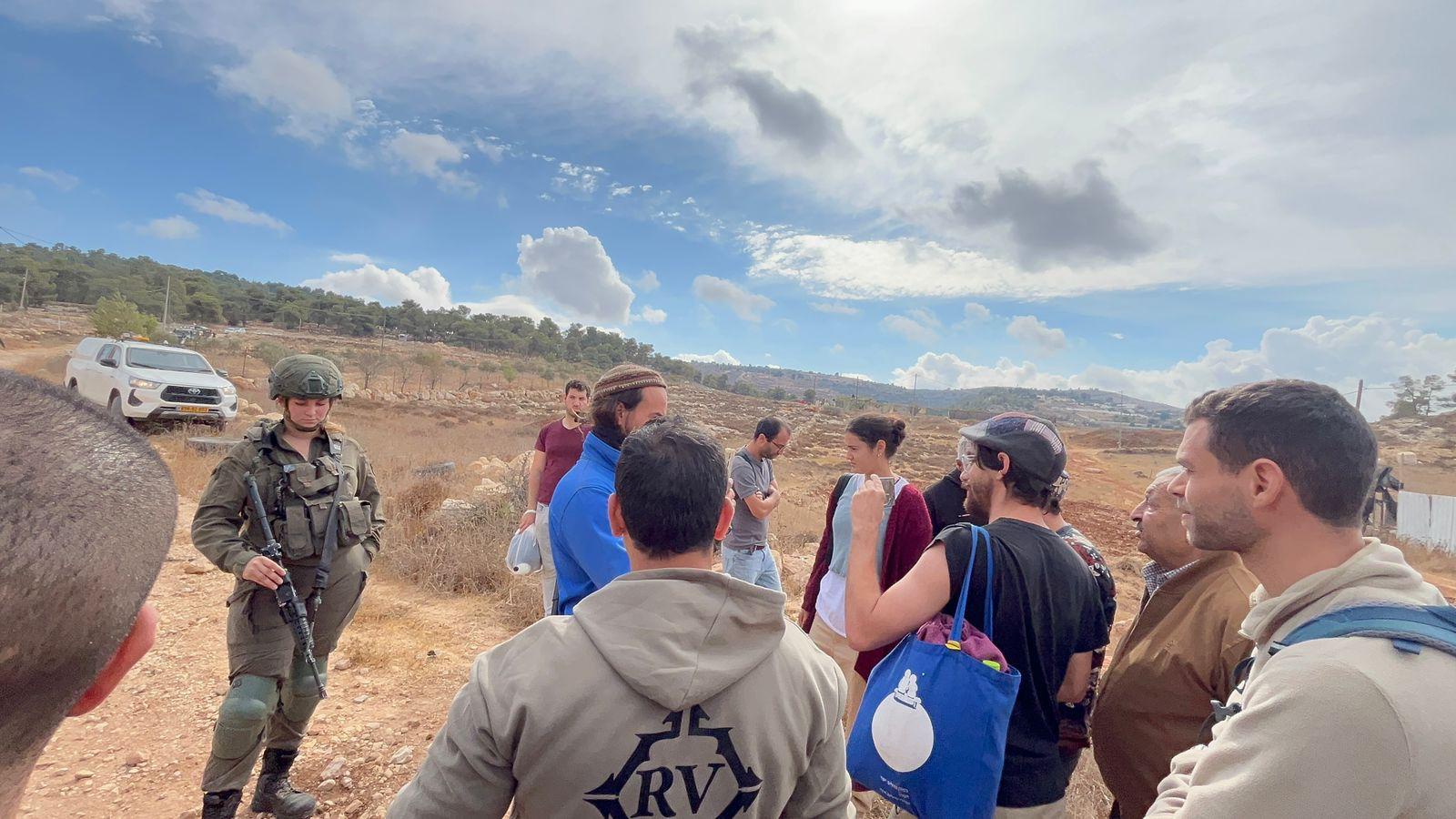
The group numbers about 80 to 100 activists, and it is diverse; it is composed mainly of religious, Masorti, and Haredi activists. Because the leading circle is connected to many Palestinian communities, the communities usually approach us to ask for help, and we try to assist as much as possible. We are currently active on a regular basis in about 12 Palestinian communities, mainly in the Bethlehem and Hebron areas.
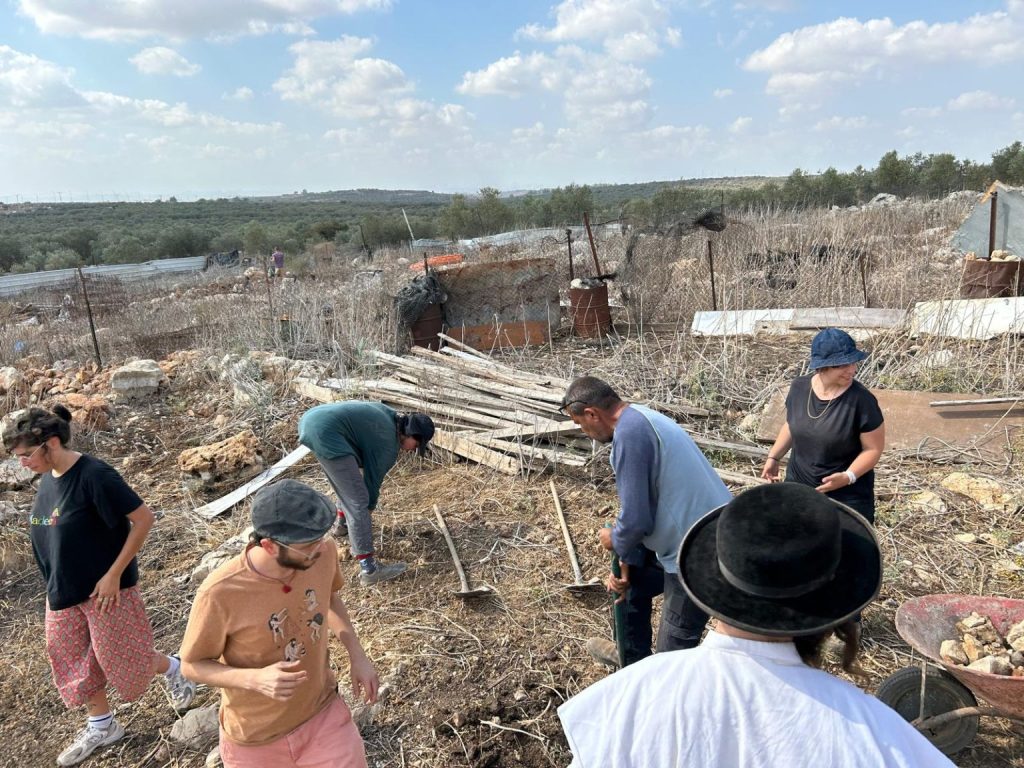
A typical week includes one or two midweek actions by a group of activists (20–30 people) who join Palestinian farmers and walk with them to their lands, which are often dangerous or impossible to reach because of violence by the army, by settlers from a nearby farm outpost, and usually by both. On successful days we manage to reach the lands and enable the farmers to work them, while documenting and restraining violence from the settlers and the army. On less successful days, the violence endangers us and the farmers, and we are forced to withdraw. After the action, we sit down to unwind with the Palestinian farmers, drink tea, and enjoy being together. In addition, we hold “protective presence Shabbats” – we spend an entire Shabbat in a house in a Palestinian village that the villagers provide for us, with a Plata, kosher food, meals, Divrei Torah, and prayers. Palestinians from the area join us throughout the Shabbat and eat with us, and if settlers invade homes in the village, we go and physically block them. The past few weeks have been especially intense. There is a growing circle of activists who understand the urgency of the situation and step in to help.
We are a generation that grew up through a continuous succession of right-wing governments, that spent its childhood during the Second Intifada, that lost friends and family members, and that in fact never really experienced political or historical optimism.
The “protective presence”—accompanying Palestinians in their fields or on their land to deter settler violence—is based on a hypothesis: that the presence of religious Israeli Jews changes the behavior of settlers or soldiers. Does this hypothesis hold true in practice? And when it fails, what happens?
The effectiveness of our presence varies from place to place, and in many places it has indeed eroded. At the same time, in most cases the treatment of Palestinians is still far worse, and in all the communities we assist, Palestinian farmers currently cannot walk to their lands without activist presence.
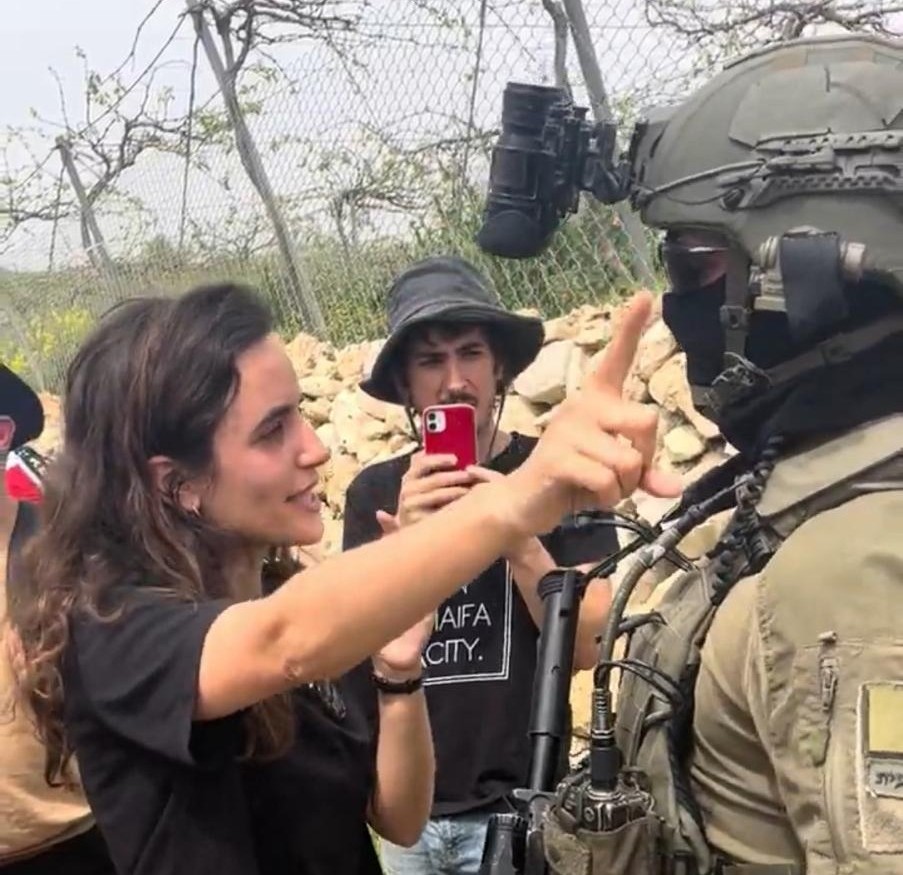
Reports indicate that in some villages, residents who regularly visit their land accompanied by Israeli activists have noticed a decrease in violence from soldiers or settlers. Do you recognize this pattern from your own experience? And if so, how do you feel about the limits of what this actually changes in terms of the underlying situation?
This is definitely a pattern, although, as noted, we are witnessing its erosion. In places where it works, it does indeed expose the oppressive power relations in the space. In this context, the principled point is that we feel committed to using our privileges, because the Palestinian farmers made the decision to use this mode of action and therefore turned to us. In general, we are careful that every decision-making process be led by the Palestinian farmers and that the agency remain with them.
Since the Oslo Accords, the West Bank has been divided into three zones with very different statuses: Area A, under Palestinian civil and security control; Area B, under Palestinian civil control but Israeli security control; and Area C, under full Israeli civil and military control, which accounts for approximately 60% of the territory. Bnei Avraham operates in several of these zones. Does this division have a practical impact on your work? And you mentioned that a settler outpost was recently established in Area B—which is supposedly legally impossible even under Israeli law. What does this say about the actual state of these categories today?
We operate in places that suffer from settler and army violence, and since the violence is not confined to only one area, neither is our activity, which tries to prevent it. The division between areas has some impact on our activity, because in Area B, for example, the police usually refuse to come, even more than to Area C. That means that we are more vulnerable there.
The change is dramatic, and perhaps its most distilled aspect is the blurring of the categories of “soldier” and “settler”. Settlers in uniform take an active part in the expulsion of many communities in the West Bank.
Regarding the establishment of the outposts in Area B – this is yet another step by the settlement movement aimed at sabotaging the chance of an Israeli-Palestinian peace agreement, and advancing the annexation of the entire West Bank. The slogan now common in settler circles is that “we don’t know English: A B C means nothing to us, it’s all the Land of Israel.” So these categories are indeed dissolving, and for the time being it does not seem that the world understands the destructive significance of this for the lives of Jews and Palestinians in this land. This deliberate refusal to recognize legal categories is an obvious component of the movement’s stated colonial intent: the complete annexation of Palestinian territory.
You say that since October 7, there has been a dramatic shift in what is happening on the ground: both an increasingly clear convergence between settlers and soldiers, and a acceleration of the expulsion process. And you also mention that this is reflected in the attitude of the Palestinian communities themselves?
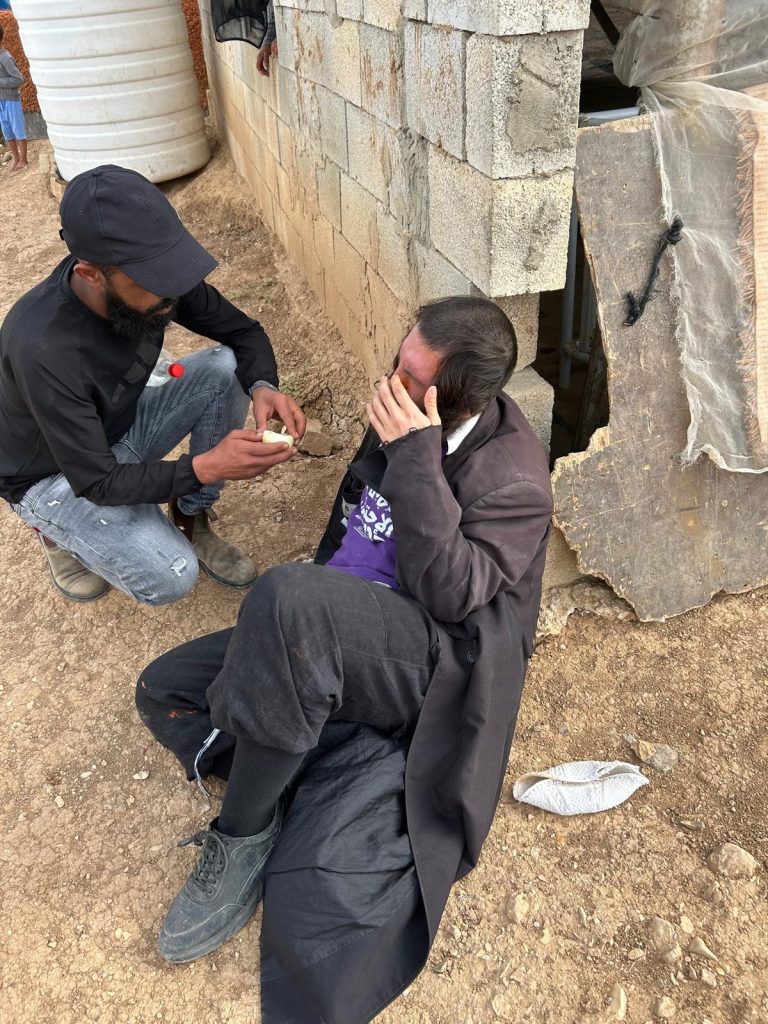
The change is dramatic, and perhaps its most distilled aspect is the blurring of the categories of “soldier” and “settler”. Settlers in uniform take an active part in the expulsion of many communities in the West Bank, and the separation between institutional violence and anti-institutional violence is more artificial than ever. In Tarkumiya, for example, soldiers prevented Palestinians from reaching their lands in Area B, in accordance with instructions they received from the nearby settlement. A similar pattern can be observed in most of the communities we work with.
Entire communities are gradually being surrounded, roads are being closed off to them, and outposts are popping up in Area B—which is normally under Palestinian authority. Do you feel like you are witnessing something new, or the acceleration of an old pattern? And on the ground, does that distinction even matter?
This is the same old logic, but on a scale we had not known before. At the same time, there are several substantial differences: in the past, the model of takeover and expulsion was based on both a territorial and a demographic struggle: maximum settlers on maximum land. Because this strategy has not managed to gain momentum for several years now, the new strategy is to establish farms with enormous grazing areas, where the logic is minimum settlers on maximum land. This makes territorial expansion much faster. Beyond that, it is important to note the change that has taken place in the restraining mechanisms on the settlements: whereas in the past the judicial system, international pressure, the police, and the army operated mechanisms that made it possible to oppose violence and dispossession (even if only in a very limited way), today these mechanisms have almost completely eroded and have surrendered to the agenda of the current government. Beyond the activists on the ground, no one answers the farmers’ pleas for protection and rescue from violence and expulsion.
We too offer a model of connection to the Holy Land, like the settlers. But for us this connection is more repaired, because it passes through the relationship with the Palestinians who live in the land and the desperate attempt to protect them.
This government and the settlers who represent it on the ground also claim to follow Jewish tradition. What does it mean to find yourself facing people who draw on the same sources as you to justify the exact opposite of what you are doing?
At the intra-communal level, this sharpens for us the fact that our Torah can be either an elixir of life or an elixir of death, and that the decision to interpret the Torah in a way that will bring justice and life into the world is an active choice with which we are constantly contending against the forces that did not choose it. Looking outward, this makes our project confusing for the settlers; sometimes it causes them to become more violent and venomous, because they perceive our practice as “betrayal from within,” but sometimes it causes less violent soldiers and settlers to listen to us. Like the settlers, we too offer a model of connection to the Holy Land, but for us this connection is more repaired, because it passes through the relationship with the Palestinians who live in the land and the desperate attempt to protect them. Therefore, it may not be surprising that there are several former settlers who were part of the farm-outpost project, crossed over, and became activists in Bnei Avraham.
You said that after October 7, the first comments you heard around you were religious ones. Which ones? How did you resume your fieldwork after October 7? Was there a break, and if so, what prompted you to resume?
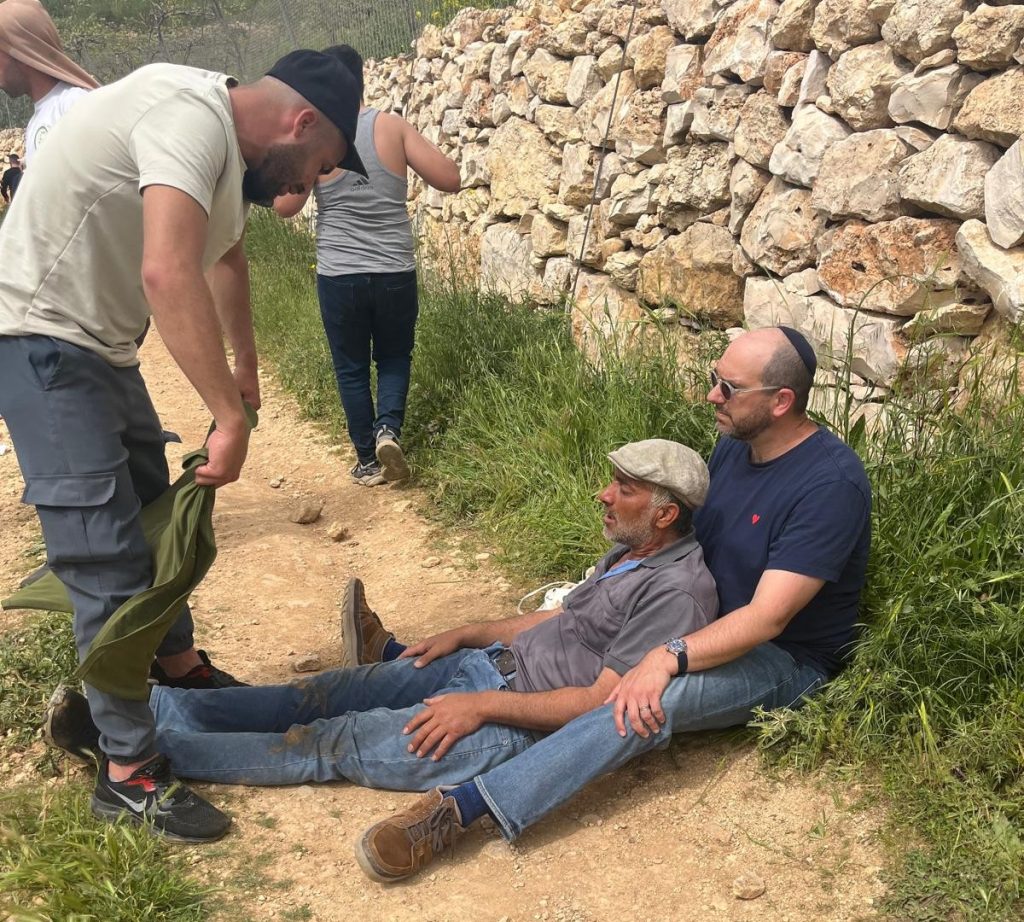
I returned to activity a week after October 7. In the days after the massacre, I first worried about all the people I know who are close to me, Jews and Palestinians. One of the Palestinians, a veteran activist from the West Bank, wrote to me that his whole neighborhood had been under curfew for a week and asked us to smuggle in bread and dry legumes. I went there at night with several other activists, and not far from his house, soldiers caught us. They forced us onto the ground; for long minutes, a masked soldier pressed the barrel of a loaded rifle against my back and interrogated me. I told them various stories, and in the end they expelled us from the area. In fact, we returned to activity fairly quickly, but we also learned on our own flesh that the reality on the ground had changed beyond recognition.
Since October 7, you have been saying that the work “feels different—more urgent.” Why, and in what way?
Although these are plans that existed even before the war, the settlers are using October 7 as a justification for their acts of wrongdoing. The legitimacy of a rhetoric of revenge and conquest has received unprecedented momentum and legitimacy, both in scale and in institutionalization. Hence also the sense of urgency: whereas before we would operate in communities knowing that our presence somewhat eased the burden of the occupation, now no matter where we set foot, we are operating in a community that can be expelled at any moment. This may be the home of a poor Bedouin family in an unrecognized village, or of a Christian family with American citizenship; at the moment no one is protected, and no place is safe.
Torah can be an elixir of life or an elixir of death.
Bnei Avraham’s explicit goal is to “keep very fragile bridges alive”—and to ensure that Palestinian communities remember that there were religious Jews who “saw them, who cared about them, even back then.” That’s a statement that says something about the very narrow scope of what you think is possible. What do you hope these bridges will ultimately enable?
In the long term, sustainable bridges of solidarity that have stood the test of reality are a necessary condition (even if not a sufficient one) in order to make it possible for some form of Palestinian-Jewish constellation or another to grow and become established one day, when the structure of political opportunities allows it.
Your work is not widely known outside of Israel. What is it that the Jewish diaspora fails to understand about what is happening in the West Bank, yet you, being on the ground, see clearly?
I do not know what the media channels read by Jewish communities are saying about the ethnic cleansing in the West Bank, but this is a crime against Palestinians and Jews that in fact it is one of the gravest security dangers to the inhabitants of the Land of Israel–Palestine. It is important to me to testify that for the last two years I have been moving throughout the West Bank and speaking with thousands of Palestinians. The desire for Jewish-Palestinian partnership is present everywhere, despite everything that has happened in the last two years, and despite the active effort of the settlers to make Palestinians hate Jews. Whoever lives in this land and belongs to it does not have the privilege to lose hope in the Palestinian-Jewish partnership, and the growing number of Palestinians and Jews joining shared initiatives in this dark period attests to that.
The issue of the diaspora has many dimensions. There is what the diaspora says—public debate, statements of position, petitions. And there is what it does, or could do in practical terms. What form of engagement by the diaspora do you think would be useful, or even necessary? And what form do you think is, at best, useless, and at worst, harmful?
Useful form of intervention: visiting here and joining one of the groups active in the West Bank in order to bear witness to what is happening here, creating media resonance, providing financial support for protective-presence efforts, connecting our activity here to coalitions in other places that can help. Many of the existing means no longer work as they once did, so this is the time for creative ideas.

Dvir Warshavski
Dvir Warshavski is one of the founders and leaders of Smol HaEmuni (the Believing Left) and a central figure in Bnei Avraham, a religious action group that organizes a protective presence alongside Palestinian communities in the West Bank. He holds a master’s degree in public policy and a bachelor’s degree in sociology, and in addition to his activism, he studies and teaches Jewish texts, notably as part of a dissertation on the ethics of Rabbi Yitzhak Arama at Tel Aviv University. He grew up in Yeruham, in the Negev, and now lives in Jerusalem.
Julia Christ
Julia Christ is a philosopher and research fellow at the CNRS. A specialist in critical theory, she works on the transformations of universalism and liberalism in dialogue with European Jewish history. Part of her research focuses on the place of Jews in modern political constructions, antisemitism, and the ways in which the Jewish perspective challenges classical categories of political thought.

Elie Petit
Elie Petit is a journalist and deputy editor-in-chief of Revue K. He collaborates with numerous international media outlets, including The Washington Post, NBC, and the BBC.