The Jews, Creditors of a Vanished West
In Alentours du nom juif [Around the Name Jew], Jean-Claude Milner analyses the break with the moral and political order of the post-Shoah era. Excerpt.
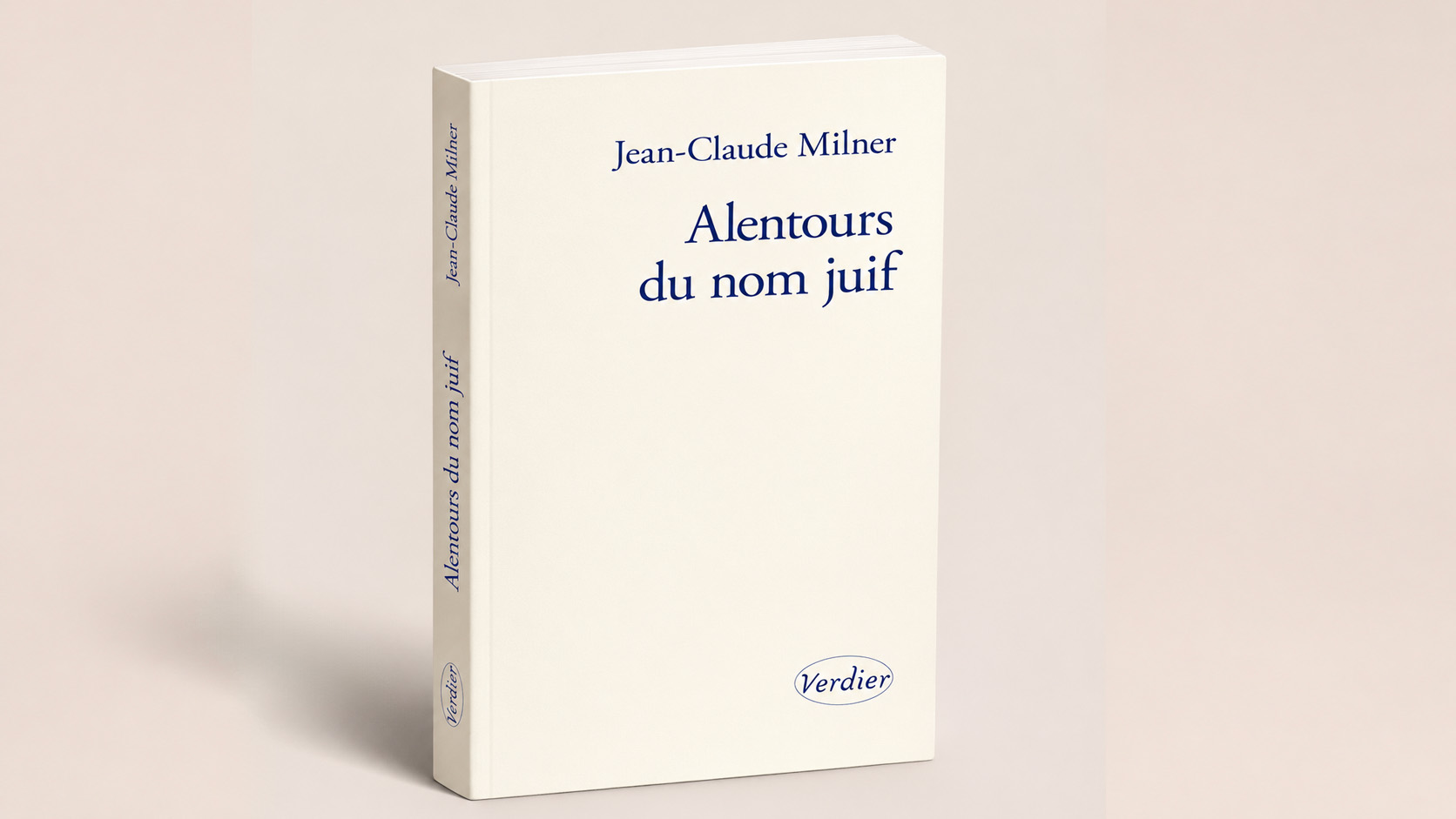
Alentours du nom juif [Around the Name Jew], published by Verdier, pursues Jean-Claude Milner’s inquiry into Jewish self-affirmation and the forces that seek to efface it. Asking in particular what remains of the debt that the West acknowledged towards the Jews after the Shoah, Milner argues that it has been extinguished, and delivers a radical diagnosis of the rupture of a political and moral order inherited from 1945. In his view, ‘anti-antisemitism’, which constituted the last remnant of the post-Shoah debt, has lost its self-evidence. He concludes, darkly, that the name Jew is once again under threat. Excerpt.
Introduction :
Since Les Penchants criminels de l’Europe démocratique [The Criminal Penchants of Democratic Europe] (2003), Jean-Claude Milner has questioned the persistence of anti-Jewish hatred at the very heart of Europe’s promises of emancipation. In that book, which mattered to many readers, his thesis was radical: by treating Jewish existence as a ‘problem’ to be solved once and for all, Europe developed a logic of effacement of which Nazism cannot be regarded as an accident external to the history of the West. Milner then examined what, of that logic, remained at work in democratic Europe. Le Juif de savoir [The Jew of Knowledge] (2006), then L’Arrogance du présent [The Arrogance of the Present] (2009), pursued this inquiry on the side of knowledge, on the one hand (what did the idea of universal knowledge represent for European Jews?), and of revolutionary commitment, on the other. Returning in particular to his own Maoist experience, Milner asked what Jews had sought in the Revolution. Alentours du nom juif takes up questions that run through these three books, in texts written over nearly twenty years (including in K.), several of which have been reworked or extended. Two figures occupy a decisive place in it: Benny Lévy, whose path opens a reflection on study and transmission; and Claude Lanzmann, whose films transformed, for Milner, the knowledge of the destruction of the European Jews. Their presence gives the collection a personal dimension, since his encounters with these two men allowed him to affirm a name that had long remained silent in his own family history. The afterword from which the excerpt published by K. this week is taken gives a very dark coda to the whole of his Jewish corpus. In it, Milner returns to the meaning of the warnings he has issued since 2003. At the time, he reproached Western countries for invoking the memory of the Shoah while failing in the obligations they had drawn from it: to combat antisemitism and to guarantee the existence of Israel. But reminding them of these commitments presupposed that they still acknowledged a particular responsibility towards the Jews. In his view, this is no longer the case. The rift between Europe and the United States, 7 October and the war in Gaza have, he argues, completed this rupture. His diagnosis therefore changes in scope: he no longer merely denounces betrayed commitments, but asserts that the very reasons for keeping them have ceased to be compelling. It is this shift that gives the book’s conclusion its gravity. – The Editors
*
Confronted with its own record, continental Western Europe acknowledged [after 1945] that it had contracted a debt towards the name Jew. The destruction of the Jews, the brute fact that it had taken place, the detail of how it was carried out, the number of its victims: all these facts together shook the values that the European name was supposed to sum up. History’s irony would have it that those values had never ceased to be discussed during the short peace that ended in 1939. The mass graves of the First World War had called them into question once already; people had exhausted themselves restoring them, without having to modify them much. The memory of those discussions stood in painful contrast with the reality of the deeds.
To save what was essential, then, it was necessary to go beyond the earlier attempt. The restoration of values could no longer content itself with listing a few principles; it called for pragmatic measures and tangible results bearing on the world order. On this point Jews and non-Jews, intellectuals and politicians agreed, even if they did not always see eye to eye on the list and the hierarchy of the values themselves.
But the new restoration could not be accomplished without a ceaseless reminder of what had made it necessary. Never forget what had taken place, the better to prevent its repetition; in order not to forget, do not hesitate to recall the past: such was the programme. From this perspective, the death camps and the gas chambers determined the vanishing point. Thought was never to neglect them in its reflections; politics was never to omit them from its calculations. On this foundation was built a system of representations and decision-making that was to constrain not only governments but individuals too. I call it the debt schema.
That no one could bring the name Jew into play without acknowledging a debt: such was the obligation. It began to operate with the Nuremberg trial, which ran from 1945 to 1946. It held, though growing progressively lighter, until the first decades of the twenty-first century. I maintain that it was extinguished in 2025, three quarters of a century after it was first instituted.
Strictly speaking, the debt ought to have concerned the European continent to the exclusion of the other parts of the world. For some time, moreover, public opinion in the United States and in Britain hesitated to bear its weight. After the war, however, the self-evidence of the facts prevailed. In order to give the destruction of the European Jews a legal characterisation and to establish the Nuremberg military tribunal in law, the London Charter defined crimes against humanity on 8 August 1945. Without perhaps realising it at once, the United States thereby took upon itself, in the name of humanity, the bulk of continental Europe’s debt. Once the position of the United States became known, most of the English-speaking countries adopted it. Proud of its unflinching stand in 1940, Britain balked, but eventually fell into line. France was only too happy to join the victors’ camp. The other nations of Western Europe did likewise. As soon as the division of Germany took effect, the Federal Republic was intent, above all else, on placing itself in the front rank of the debtors.
EXERGUE : The debt cannot fall on continental Europe alone, but on the West as a whole, convinced that it is the armed wing of humanity. Humanity can and must repair the consequences of a crime committed against itself; to do so, it will act through its representatives, the nations united in the United Nations.
Despite the Marshall Plan, despite NATO, despite the trade agreements, the political nature of the renewed West remained blurred. Descriptively, it oscillated between two extremes: confederation and empire. Until Donald Trump’s second term, the confederal conception broadly prevailed, even if one can observe, in the behaviour of the United States towards this or that ally on this or that occasion, various flare-ups of the imperial itch. From 1950 to 2025, the uncertainty nonetheless persisted. For want of political or legal clarity, the true principle of the West’s unity, it was claimed, lay not in military or trade treaties but in a charter of shared values. Except that, unlike what had happened with the League of Nations in the 1930s, this Western charter was to be fulfilled in political action. Into it were piled, pell-mell, the exaltation of electoral democracy, the defence of free enterprise, respect for international organisations, the proclamation of peace as the supreme ideal, and so on. Each of these values is meant to be recognised universally, so that the West becomes, in its own eyes at least, the standard-bearer of humanity as a whole. Since it had resolved to break with the impotent moralism of the 1930s, its self-proclaimed responsibility imposed a programme of action upon it.
Now, the Western charter adopts the doctrine of the Nuremberg trial. The trial had established that the destruction of the European Jews constituted a crime against humanity. The debt, consequently, cannot fall on continental Europe alone, but on the West as a whole, convinced that it is the armed wing of humanity. Humanity can and must repair the consequences of a crime committed against itself; to do so, it will act through its representatives, the nations united in the United Nations. Since the debt requires not only words and symbolic acts, since it requires material decisions, those decisions must be taken in the name of humanity by the UN, by majority vote.
Consequently, humanity, represented by the UN, will be called upon to recognise the existence of a Jewish state situated on the lands that modern diplomacy called Palestine. In 1947 the UN adopted a resolution to that effect. In 1948 the creation of the State of Israel was proclaimed, in the form of a Declaration of Independence. In the eyes of the West, this sequence conformed to its fundamental expectations. At that moment, the creation and protection of Israel were not merely a matter of the foreign policy of the various Western countries; they contributed decisively to the ethical definition of the West and to the self-fulfilment of humanity.
Western Europe, more than any other region of the world, could be satisfied with the configuration that was taking shape. It had managed to offload part of its debt onto the rest of the world, or at least onto the West. It still had to furnish every necessary proof of its own Westernness: ideologically, it had to combat antisemitism relentlessly; materially, it had to safeguard the existence of Israel on the soil of former Palestine, within ‘secure and recognized boundaries’. The former colonial powers (France and Britain) still nursed Arab dreams: in the new configuration, these were never to prevail over the Western obligation. Deeply attached to their past grandeur, the two nations took time to accept all the consequences of what they perceived as a renunciation. France, constrained by its history and its geography, has never entirely managed it.
Despite these marginal reservations, one may posit that for three quarters of a century the debt schema dominated the charter of Western values. Belonging to what might be called metapolitics, it took material form in three rules constraining politics proper:
(I) among the historical facts that determine the ideological horizon of the West, the destruction of the European Jews occupies one of the foremost places;
(II) the existence of the State of Israel, within ‘secure and recognized boundaries’, constitutes an axiom of Western foreign policy: no nation can claim to belong to the West if it equivocates on this point;
(III) the fate of the non-Jewish Palestinians, in the Near and Middle East, may matter to this or that Western nation, provided that this interest does not go so far as to contradict rule II. Indeed, the fate of the non-Jewish Palestinians is not an axiom of common Western foreign policy: a nation may take no interest in it without ceasing to belong to the West. A major example of this indifference: the United States.
Barely formulated and accepted, however, each of the three theses began silently to lose some of its self-evidence. As a result, the debt schema never stopped crumbling. From the mid-twentieth century until the eve of 7 October 2023, the various Western governments still invoked it, it is true. Their actions, on the other hand, broke free of it less and less discreetly. In Western Europe in particular, the split grew sharper day by day: insistence on the debt in the mouths of decision-makers and communicators; indifference to the debt in the actual choices of those who governed, but also in the opinion of the governed.
In 2025 one can state that spontaneous anti-antisemitism has disappeared from the places where it existed. To which must be added, in Europe, the places where it had never existed.
I have tried, as far as my means allowed, to draw attention to the rise of this intrinsically perverse arrangement. My first attempt took the form of a book, Les Penchants criminels de l’Europe démocratique [The Criminal Penchants of Democratic Europe], published in 2003. I then pursued my efforts in articles, several of which are collected here. They were written during the two decades that preceded the fracture of 2025. They denounce the attempts to efface the debt in fact while proclaiming it in words.
In this light, one can locate precisely the frame of reference within which the first parts of the present collection are set. There is no need for Hegelo-Marxist dialectics to grasp a very simple fact: the attempts to efface the debt presupposed that the debt schema still functioned. The aim was to loosen its grip, but precisely because that grip could still be felt. One seeks to rid oneself only of what encumbers; now, encumbrance is a massive form of existence. Although I did on occasion point to the schema’s decline, I had to assume, moreover, that it still retained a shadow of effectiveness. It was in its name that I took up my pen.
I was well aware that my warnings made sense only if they were heard, however faintly. But for them to be heard, the name Jew had to arouse a semblance of attention. For that semblance to persist, the debt had to remain acknowledged, even if it was written in an ever more invisible ink, on an ever more fragile medium.
Indeed, sociologists had noted that French opinion still agreed on one minimal theme: anti-antisemitism. As late as 2020, a young social scientist could write that anti-antisemitism ‘seemed to belong to dominant opinion’. In purely descriptive terms, the characteristic feature of this anti-antisemitism came down to this: it went without saying. It belonged to spontaneous ideology, the kind that goes by the name of ‘self-evidence’. I now take the liberty of reinterpreting this observation in my own terminology: spontaneous and therefore unreflective, taken for granted and therefore ill-informed, anti-antisemitism gave concrete form to what then remained in France of the debt schema. It showed both how far the schema had weakened and how far, despite everything, it continued to function. The finest minds judged that its effacement had thus reached its final stage. It would go no further. Reduced to a mute acknowledgement, the debt would last as long as the fundamental values of the West lasted.
I believed none of these vain hopes. Since 2003, my argument had amounted to issuing two warnings, not one. The first concerned the present: ‘if all that remains of the debt is anti-antisemitism, then almost nothing remains of it’; the second concerned the future: ‘anti-antisemitism will vanish at the first breath of the storm’. But I formed no hypothesis either about the nature of the storm or about its origin.
Today, in any case, the time for warnings is past. The storm has blown, the vanishing has taken place. In 2025 one can state that spontaneous anti-antisemitism has disappeared from the places where it existed. To which must be added, in Europe, the places where it had never existed. To keep to the European Union, who can really believe that the countries of former Eastern Europe ever subscribed to it? All things considered, the debt schema in Europe has passed from almost nothing to nothing. The beautiful souls will object that ‘serious’ decision-makers tirelessly multiply declarations against antisemitism. The argument does not hold. This insistence proves the opposite of what it is supposed to prove. If it must be repeated so loudly and so often that France has no lessons to learn from anyone in the fight against antisemitism, that is precisely because anti-antisemitism has lost its immediate self-evidence there.
The residual West may well pride itself on upholding the defining values of the West of 1950, yet its foreign policy departs from them on one decisive point: it is no longer true that the destruction of the Jews constitutes a landmark of major importance there.
Of course, laws have defined offences and crimes; for the moment, Western states still apply the laws that punish antisemitic acts and statements, but since one has to go through the law, the realm of self-evidence has been left behind. Moreover, one can already glimpse the sophistications by which legal texts can be circumvented or even, if need be, contradicted. If one turns to French youth, the hope of the optimists, spontaneous anti-antisemitism repels it. Handed down by hoary boomers, it must give way before the impassioned Judeophobia of the banlieues and the ratiocinating antisemitism of the universities.
How did this transformation come about?
A first factor quite simply concerns the world order: the West of 1950 has ultimately ceased to exist. Consider the three theses that summed up the hard core of its charter. In 2025 each of them is being called into question; on the name Jew, so diametrical an opposition divides the West that one may suppose it has broken in two. Contrary to the first thesis, several Western nations no longer regard the destruction of the European Jews as a major event in History. Contrary to the second thesis, several Western nations (not necessarily the same ones) still concede, grudgingly, that the present existence of the State of Israel remains an axiom, but assert that it matters less than the future existence of the Palestinian state. Contrary to the third thesis, the creation of a Palestinian state becomes, for these nations, the principal axiom of Western foreign policy.
Among the nations that adopt this new doctrine, openly or discreetly, are several European nations, whereas the United States remains faithful to its earlier policy. The West is therefore divided not only over Israel but over the name Jew itself, since the first point of the new doctrine goes far beyond the question of two states.
At all events, the United States seems to be losing interest in the West as it had been defined in the 1950s. The slogan Make America Great Again means that the United States now determines its domination on the scale of the whole world, and no longer merely on the scale of the West. It is set to behave as a MAGA empire, with the members of the former Western confederation as its vassals and, as its partners, two other empires, themselves surrounded by vassals. To which must be added, notably in the mouth of Vice-President Vance, a culture war to be waged against so-called Western values. This war is being fought on American soil, but it was extended from the outset to Europe. Europe, indeed, stands accused of having manufactured these values and of having imposed them on the United States by trading on its prestige. What is more, it has the effrontery to want to preserve them.
Indeed, Europe aspires to become, in the face of the MAGA empire, a kind of residual West. Western values will continue to reign there; they are already beginning to define an autonomous foreign policy. The cultivated observer thinks of the Byzantine Empire, which presented itself as the continuation of the Roman Empire when it was merely its stump. If one accepts the comparison, it does not promise success, for the Byzantine stump was destined to wither slowly.
Israel is now deemed to have betrayed its own raison d’être. This self-betrayal reveals a propensity for crime of which no Jew can believe himself innocent. What is happening in Gaza proves right those who lamented: ‘The Jews must have done something to unleash so much hatred.’ In short, the debt schema has lost all efficacy in Europe.
Whatever the future holds, the residual West may well pride itself on upholding the defining values of the West of 1950, yet its foreign policy departs from them on one decisive point: it is no longer true that the destruction of the Jews constitutes a landmark of major importance there; it is no longer true that the existence of the State of Israel outweighs the future existence of a Palestinian state; the existence of the latter has the rank of an axiom. What is more, the downgrading of Israel to the rank of a rogue state and of the Jews to the rank of a genocidal people is pronounced in the name of Western values. Israel, once perceived as the herald of those values within the Orient, yet secretly held to be barbaric and cruel, is now deemed to have betrayed its own raison d’être. This self-betrayal reveals a propensity for crime of which no Jew can believe himself innocent. What is happening in Gaza proves right those who lamented: ‘The Jews must have done something to unleash so much hatred.’ In short, the debt schema has lost all efficacy in Europe.
The MAGA empire takes positions exactly contrary to those of the residual West, which it regards as a league of vassals ready to concede everything to it. But neither does it invoke the debt, a European invention. On the contrary, it considers that the United States has no reason to take it into account. It supports Israel and combats antisemitism, whether on American soil or in the residual West. But the debt plays no part either in that support or in that combat. One must rather turn to the evangelical current, which has been and remains important within the MAGA apparatus. Its discourse is well known: the Jews must witness, in the places where Jesus preached, the return of Christ, which will seal their ultimate defeat and their conversion.
Honesty compels one to add that anti-MAGA progressivism in the United States reaches analogous conclusions by opposite routes: a refusal to privilege the destruction of the European Jews among the massacres that punctuate world history; support for Israel, but on condition that this Jewish state respect the rules laid down by white, Anglo-Saxon, Protestant Americans. In 2022, in his film The Fabelmans, Steven Spielberg made himself the herald of this programme. It can be summed up as follows: far from the United States having to continue to shoulder towards the Jews a debt that is not its own but continental Europe’s, the Jews must acknowledge their own debt: the one they have contracted towards the United States and towards the blond, athletic, generous American.
A rupture has thus occurred within the West inherited from 1950. It has a material dimension, but it also has an ideological one: the extinction of the debt that humanity, according to the Westerners of that time, had contracted towards the Jews as Jews. It is true that a movement of effacement had begun its advance long before. Hence, in French opinion in particular, the nihil obstat eventually granted, in the period 2018-2024, to the twofold rebirth of antisemitism and Judeophobia. But the pace was slow. It could have continued without a jolt. It was accelerated by the events of the Israeli-Palestinian war. One may accept that a turning point came in the course of 2025.
When one considers the residual West, the conclusion is inescapable: (…) no form of response would have been deemed admissible by right-thinking people. In response to even the most limited military riposte, the accusation of genocide would in any case have been levelled.
Conversely, the military events saw their resonance amplified because the debt schema had already withered. For, after all, the Israeli-Palestinian war had never definitively ceased. It had known periods in which its intensity diminished, but also periods of high intensity. One need only think of Sabra and Shatila. Yet that event has, in practice, been forgotten by world opinion. Because the debt schema still had enough force for the PLO to reorient its programme: in 1989, Yasser Arafat declared caduque (null and void) the demand that the Israeli state cease to exist. The term had been suggested to him by François Mitterrand, it seems. Had the latter informed him that, by definition, caducous (that is, deciduous) foliage grows back when the season allows?
I do not rule out that in the twenty-first century things will go quite otherwise than in the twentieth. Unless Hamas or other similar organisations multiply to excess, in the years to come, operations inspired by 7 October 2023, the rupture between the residual West and the State of Israel is complete: the former is persuading itself that the latter can continue to exist only by violating all the values that humanity must respect. The latter notes that its existence, supposed to protect the Jews of the whole world, on the contrary endangers them. But it has reasons to suppose that its disappearance or its weakening would entail graver dangers. Convinced that the debt has been extinguished in the minds that once acknowledged it, it has nothing more to expect from world opinion. What does ‘credibility’ matter, compared with the support of the United States, the objective neutrality of Russia and the indifference of China?
If my intuition proves correct, the future of the State of Israel is not alone at stake. Its isolation is growing, its internal contradictions are sharpening; its government and its warlike policy are blamed for this. I believe nothing of the sort: any Israeli government, including the most left-wing, would have been put in the dock had it taken any action against Hamas. When one considers the residual West, the conclusion is inescapable: short of passive acceptance of the massacres of 7 October, short of a nation’s mute grief and furtive funerals, short of buying back the hostages for their weight in gold, no form of response would have been deemed admissible by right-thinking people. In response to even the most limited military riposte, the accusation of genocide would in any case have been levelled.
Now that it has been launched, it is liable to remain indelible, as the accusation of deicide had been among Christians for centuries. If so, it will make it possible to write off all memory of the destruction of the European Jews: the movement had already begun; it will become definitive. Consequently, anti-antisemitism will have joined, and has perhaps already joined, the jumble sale of obsolete ideologies. It will have been replaced by a spontaneous Judeophobia which, if need be, will turn to antisemitism to enrich its vocabulary and its behaviour.
In other words, the page has been turned since the events in Gaza, and will remain turned once they have been forgotten. The future of the name Jew itself is now under threat, beyond the Israeli question. It is threatened by those who combine with the social struggle Palestine today and, tomorrow, every variant of Judeophobia; it is no less threatened by those who, in the name of the Second Coming of Christ, defend the existence of an Israeli people while hating the Jewish people at the bottom of their hearts. If precedent is any guide, the two-state solution will soon come down to the question: which will destroy the other? Unless both disappear. Much vaunted by a few dreamers, the disappearance of Israel and the diasporic form will not save the name Jew. Should world opinion let itself be swept along by the dominant currents, no Jewish state and no Jewish diaspora will escape persecution.