#257 / Editorial
20 years ago Ilan Halimi, a young French Jew, was kidnapped, held for ransom, tortured over 24 days, until the “Gang of Barbarians” that was behind this heinous plan, left him to die on the side of a road. The unique antisemitic nature of this crime is what made the horrific course of events even more poignant, with the kidnappers believing that “all Jews are rich” and that the family and Jewish community should simply pay up. At the time of the police investigation and court proceedings, the police refused to deem this a crime of antisemitic nature, which may have ultimately also cost Ilan his life, as he wasn’t found in time.
Related articles

Towards a new exile?
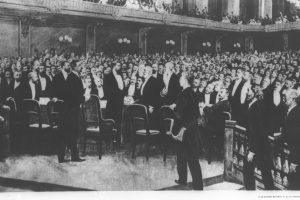
The rabbi, the Zionist, and the “men in the shadows”
Kafka’s Sirens (Revisiting a Jewish Generation)
The commemoration at the Élysée Palace of the 20th anniversary of Ilan Halimi’s murder served as a reminder of the persistent increase in extreme violence targeting Jews over the past few decades. Torture, child murders, rape, face-to-face executions: it is violence of this type, of this extreme nature, that this group, the Jews, has been the victim of in European societies, and specifically in France. In this regard, it is important to note the comfort we feel following French president Emmanuel Macron’s speech looking back on these twenty years, and his diagnosis of the peak we have seen over the last two years, calling on every French citizen to take responsibility in the face of this challenge. It should be noted that this contrasts with the often ambiguous positions taken by the President shortly after October 7, as well as with the Jewish isolation felt during the demonstrations of 2006 and since.
However, the fact that this isolation has been broken does not mean that we should not question the political realignments at work and the future that lies ahead. In this regard, Emmanuel Macron’s discourse, firmly rooted in the sound principles of republicanism, which distances itself both from the opportunistic proposal made by the far right to Jews for a new security alliance and from the anti-Zionist temptation that is proliferating on the left while accommodating, and sometimes conveying unambiguous antisemitism, does not abolish all uncertainties, far from it. For one thing is clear, and it remains suspended in the air as we listen to this discourse. We can no longer be satisfied with statements that merely recall, in a panic, the use of old solutions that have, in fact, not worked. If republicanism, in this case, can be invoked, it is on condition that it is thoroughly rethought and renewed in the face of the unprecedented constraints weighing on the real societies in which we live.
This week we are publishing a speech by Jean-Claude Milner at the EHESS seminar “The Jews and Europe“, offering a diagnosis which, while darker than K.‘s position, is nonetheless thought-provoking. The distinction he makes between Judeophobia and antisemitism—suggesting that passionate hatred of Jews is regaining its footing over the appearance of rationality that modernity had given it—calls into question the solidity of the barriers we believed to be firmly established, yet which we are now experiencing overflowing. As European modernity, with its offer of integration to Jews, appears increasingly challenged, both from outside and within, Milner questions its ability to protect Jews from a “new exile.”
On the subject of solutions found in the past, and the twists and turns that history has imposed on them, Éditions Verdier has published D’une nation juive, ou non. Controverse, Vienne, 1897 (Of a Jewish Nation, or Not: Controversy, Vienna, 1897). In it, Johannes Honigmann translates and presents the public controversy between Theodor Herzl and Max Nordeau on the one hand, and the Chief Rabbi of Vienna, Moritz Güdemann, and the Polish rabbi Benjamin Ripnner on the other. In the contradictions raised by these early Jewish anti-Zionists to the project of the Jewish State, we recognize certain arguments that are still used today, notably that of a Jewish “mission” irrevocably linked to the existence of the diaspora. Yvan Segré’s review of this controversy draws our attention to its underlying class issue, as it appears in Herzl’s response: “The Jewish ‘mission’ has something satiated, comfortable, and wealthy about it.” Bourgeois anti-Zionism, committed to defending its successful integration, versus Zionism, concerned with the fate of the Jewish masses: from the perspective of current debates, this inaugural polemic seems very distant. But might there not be something to be gained from its distorted echo?
While contemplating the state and belonging of European Jewry, we look back at the piece “Kafka’s Sirens”. Bruno Karsenti explores the significance of the work of the author of The Castle for the younger generation of German Jews who took it up with fervor in the 1910s and 1920s. What dimension of the modern European Jewish experience did they recognize, refracted through his work?