The rabbi, the Zionist, and the “men in the shadows”
About the new book “Of a Jewish Nation, or Not: Controversy, Vienna, 1897” (Verdier, 2025).
On the occasion of the recent publication in France by Verdier of the book “D’une nation juive, ou non. Controverse, Vienne, 1897” (ET: Of a Jewish Nation, or Not: Controversy, Vienna, 1897), Ivan Segré revisits the public debate between Theodor Herzl and Max Nordau on the one hand, and the Chief Rabbi of Vienna, Moritz Güdemann, on the other. Behind the apparent contradiction posed by Jewish anti-Zionism attached to the universal mission of the diaspora, Segré identifies, within the text itself, a class opposition: that of a Jewish bourgeoisie seeking to defend its respectability against a Zionism concerned with the fate of the Jewish masses.
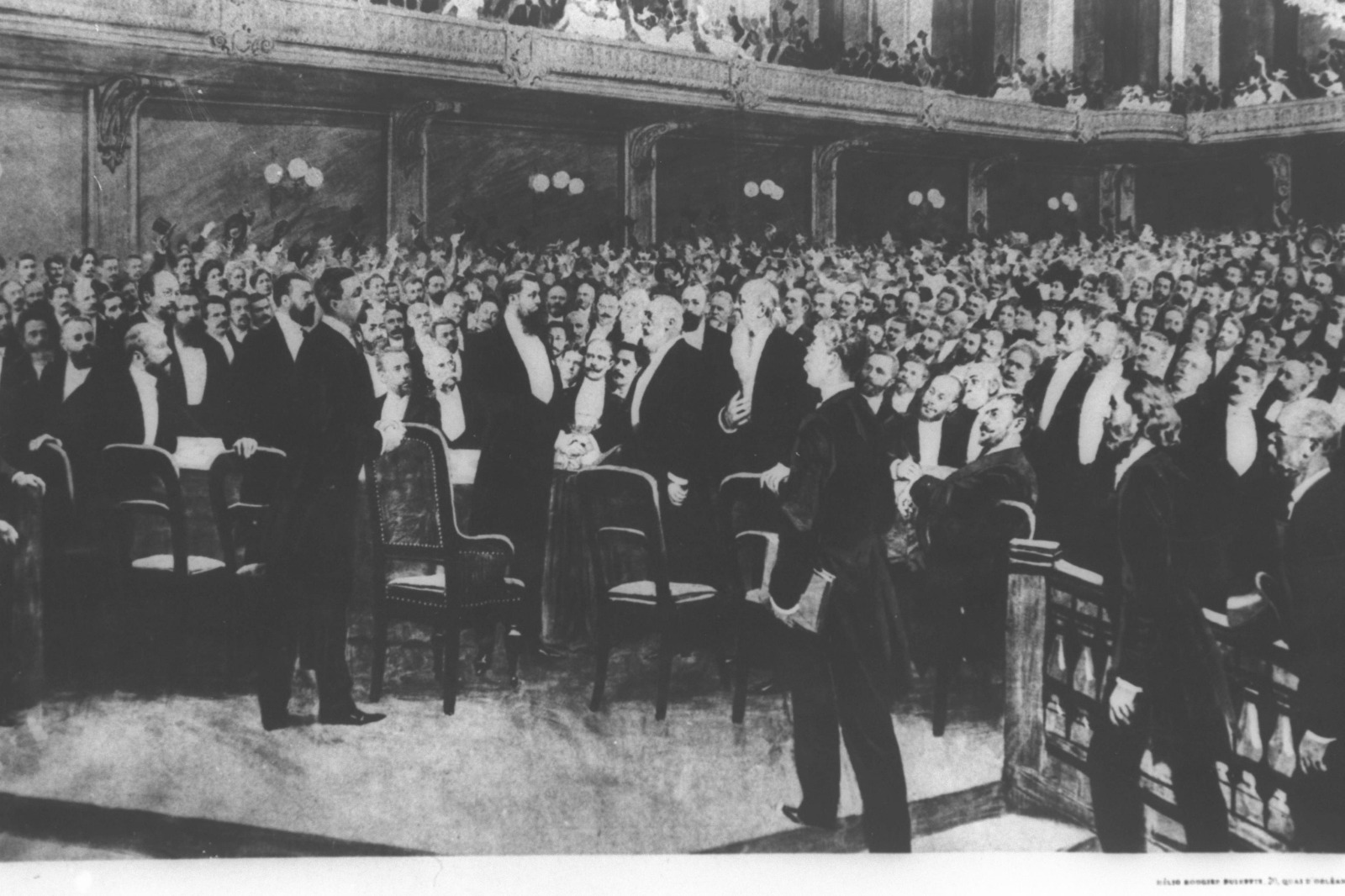
Just a few months after the publication of Theodor Herzl’s The Jewish State, the Chief Rabbi of Vienna, Moritz Güdemann, published a short essay in which he argued against “Jewish nationalism”; Herzl immediately responded in a Jewish magazine published in Vienna; a Prussian rabbi, Benjamin Rippner, then supported Güdemann’s position in a subsequent issue of the same magazine; finally, Max Nordau intervened to defend the Zionist cause in the second issue of Die Welt, the magazine that Herzl had just founded. These are the four writings translated and presented by Johannes Honigmann for Éditions Verdier, summarizing the terms of the controversy: “Of a Jewish Nation, or Not.”
Güdemann versus Herzl: Vienna, 1897
The essence of Güdemann’s anti-Zionist argument consists in rejecting the national form that Herzl, in his book, strives to confer on Judaism; according to the Chief Rabbi of Vienna, this amounts to obscuring the historical uniqueness of Israel: “Unlike other peoples of antiquity, Israel never claimed to be indigenous or aboriginal. The arrogance of the indigenous toward the foreigner did not exist in Israel” (p. 28). Contrasting the prophetic universalism of the Bible with the political prosaism of the nation-state, he further asserts that “Judaism’s historical mission is not to support the centrifugal nationalist passions or fantasies of peoples, and even less to indulge in them itself, but rather to abolish the individualism of nations and work toward the union of all humanity into a single family” (p. 41). Güdemann’s position is apparently clear-cut: a “Jewish” or “for the Jews” nation-state would not be a liberation, but a fundamental mistake, the pitfalls of which the rabbi already anticipates:
“For even powerful states rely on military budgets that exhaust all their fiscal capacities in order to assert themselves. However, a Judaism armed with cannons and bayonets would reverse the roles of David and Goliath and be a parody of itself. If pursuing and imposing our restoration as a nation—even under conditions where the Powers cede and guarantee Palestine to us—leads us to deny the spirit of our religion, we would thereby validate the judgment of those who consider our two-thousand-year diaspora as a sign of our rejection. Which it is not […]” (p. 44).
Against a nationalized and state-controlled Judaism, Güdemann calls for the lofty spirit of an exilic Judaism faithful to its prophetic “mission,” and while he does not dispute the fervor of European antisemitism, he asserts that Jews can overcome the ordeal:
“The diaspora is indeed one of the most glorious parts of the history of Judaism, insofar as it has proven its indestructibility during this period and shown that it is more than a national entity, that it is not tied to any particular time or place, which is why it can expect to have the last word, just as it once had the first. The current hostile trend may strengthen Jews in this awareness and hope, rather than causing them to waver, because without going so far as to praise martyrdom, it is nevertheless clear that the greater the goal, the greater the difficulties, and that there is no victory without struggle” (ibid.).
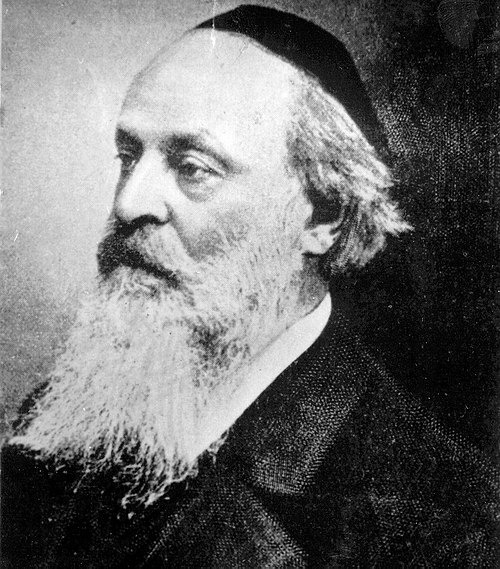
Güdemann thus outlines what has long been the anti-Zionist doctrinal position of the main orthodox current of European Judaism, except that his conception of Israel’s “mission” is therefore informed by a universalism that serves to highlight, by contrast, the narrow-mindedness of the Zionist project:
“One can only wish and hope for a prosperous future for the Jewish colonies [jüdische Kolonien], wherever they may be now or in the future, whether in the Holy Land or elsewhere, but it is absolutely wrong and contrary to the spirit of Judaism and its history to conflate this colonizing activity [Kolonisationstätigkeit], which in itself is worthy of the highest recognition, with national aspirations and to present it as the fulfillment of prophetic promises. No, it is not and never will be. […]. To reach the heights that national Jews reserve for Judaism, it would first have to descend very low to learn the national slogan; it would first have to forget everything, its Torah, its prophets, its psalms, its history, all of which paint a future completely different from that which its national rehabilitation could offer it, a future that is at the same time that of all humanity.” (p. 45).
Güdemann’s anti-Zionist argument is therefore, at first glance, clear and distinct: reducing Judaism to a national aspiration amounts to betraying Israel’s prophetic vocation. While in some respects his criticism is in line with certain currents of contemporary anti-Zionism, at least in its Jewish universalist modalities, it nevertheless differs from it with regard to the colonial fact: in 1897, the Chief Rabbi of Vienna, like the European ruling classes, saw nothing problematic in “colonial activity” as such, “whether in the Holy Land or elsewhere.” Rabbi Benjamin Rippner, supporting Güdemann’s anti-Zionist thesis, reiterated that Judaism is a “religion,” not a “nationality,” but he also put forward another argument: “In our opinion, Palestine will never be ceded in its entirety to the Jews; if a Jewish nation state were to be established there temporarily, as one might establish a stock exchange, it would not survive for long in the face of the jealousy of the Christian peoples” (pp. 70-71).
In addition to the devaluation of the Jewish identity that the establishment of a “Jewish nation-state” represents in his eyes, comparable to the founding of a “stock exchange,” the precariousness of the Zionist project would therefore lie in its unacceptability in the eyes of “Christian peoples.” According to him, far from Herzl’s Zionism being a remedy for the virulent anti-Judaism suffered by Jews in Christian lands, it is doomed to failure precisely because of this hostility, because Jewish state sovereignty would contradict the necessary submission of the Jews—the murderers of Christ—to Christian hegemony. The problem posed by Zionism in the eyes of the two rabbis in 1897 is therefore twofold: it reduces Judaism to a national fact, and moreover, its aspiration is illusory because of “the jealousy of Christian peoples.”
London (1917): the anti-Zionism of the notables
The criticism of a “decolonial” reader, one might guess, will focus on the absence, or even the repression, of the existence of the “colonized,” about whom the two rabbis, in fact, say nothing. However, it would be hasty to imagine that the anti-Zionism of the ruling classes of European Judaism at that time consistently ignored the problem posed by a Jewish national aspiration based on “colonial activity .” Indeed, in his History of Zionism, Walter Laqueur reports that the main opposition Haim Weizmann encountered in London when he was trying to obtain the famous declaration from Lord Balfour came from the leaders of the English Jewish community. He refers to an article published in The Times on May 24, 1917, entitled “Palestine and Zionism: The Views of the English Jewish Community,” written by David Alexander and Claude Montefior, respectively presidents of the Board of Deputies of British Jews and the Anglo-Jewish Association, two very influential Jewish community institutions in London:
“The two leaders renewed their protest against the Zionist theory of a nationality without a homeland, which, if accepted by all, would have the effect of turning Jews into strangers in their native country. A Jewish political nationality was an anachronism; the only certain criterion was religion. The signatories of the letter also said that it would be catastrophic to see Jewish settlers in Palestine obtain special rights comparable to political privileges or economic preferences. This would be contrary to the principle of equal rights for all. It would endanger Jews in all countries where they had obtained equal rights and would engage Palestinian Jews in deadly struggles with their neighbors of other races.”1
The anti-Zionist arguments of these “leaders” of the English Jewish community essentially converge with those of Güdemann and Rippner: the Jewish ‘religion’ is not a “political nationality.” But their remarks also seem to anticipate those of the contemporary anti-Zionist left, since they challenge “the Zionist theory of a nation without a homeland” and the legitimacy of a Jewish national home in Palestine. Furthermore, they invoke the “principle of equal rights for all” in a context that, at first glance, appears to be an objection to the claims of “colonial activity.” Does this mean that in 1917, in London, the “leaders” of the Jewish community were the precursors of “decolonial” thinking? Such an interpretation would be naively anachronistic. For it is also certain that these notables shared the same colonial ideology as the English and European leaders. And on closer reading, Laqueur’s account of Alexander and Montefior’s article reveals the ideological driving force behind their anti-Zionist activism: the defense of very concrete and specific interests under the guise of universal rhetoric. This is why their argument is characteristic of “bourgeois” discourse in general, its signature being recognizable as follows: 1) speaking on behalf of “the English Jewish community”; 2) defending, under this pretext, their own class interests, in particular the bourgeois respectability that a Jew could only acquire at great expense and with great difficulty, and which Zionist activism risked compromising by giving concrete form to the old accusation of “dual allegiance,” hence their fear that Jews would henceforth be perceived as “strangers in their own country”; 3) to disguise these particular economic and social interests under a universalist and egalitarian rhetoric that was all the more cynical given that a) the risk in question concerned only themselves, and not the popular majority of the English Jewish community, b) these notables are, since Zionism is not at issue, convinced colonialists, bourgeois respectability obliges, and finally c) through this argument, they demonstrate their profound disinterest in all Jews, particularly those from Central and Eastern Europe, who are in fact “strangers in their native land” – and whose present and future are very bleak…
Herzl and Nordau: shifting the focus to social issues
This detour via Alexander and Montefior’s article allows us to re-read Güdemann’s anti-Zionist argument with fresh eyes: those of Herzl and Nordau, to be precise. At first glance, the Chief Rabbi of Vienna sticks to defending the religious or prophetic dimension of Judaism against its national secularization. However, Herzl dismisses this argument at the outset of his response, pointing out that Güdemann had seen the proofs of his book and that his first impression was not the one he subsequently made public:
“Dr. Güdemann was familiar with my writing before the letter, and when he wrote to me on February 2, 1896, after studying the proofs: ‘I have read everything and found nothing to criticize ,“ it was a relief to my conscience. I will quote only this one remark from among all those that can be extracted from his letter, which was full of enthusiasm for the cause and benevolent opinions about my intention” (pp. 51-52).

Once we have established that Güdemann initially “found nothing to criticize,” we must probe between the lines for the reasons behind his sudden public stance against Herzl’s book. Indeed, if it were simply a matter of rejecting the Jewish national aspiration for a state because it contradicts Israel’s prophetic vocation, the Chief Rabbi of Vienna would have denounced it from the moment he first read it as an attempt to instill a “national slogan” in the Jews. It was therefore because Herzl’s book provoked reactions that Güdemann had not initially anticipated that he changed his mind after the fact. At least, that is the conviction of Herzl and Nordau. And that is what explains their counteroffensive: it was obvious to them that, if Güdemann could now argue, with regard to “the current hostile trend” affecting European Jews, that it was necessary to “strengthen the Jews in this awareness and hope” of a prophetic destiny for Judaism rather than “stoop low to learn the national slogan,” and that “without, of course, going so far as to praise martyrdom, it is nevertheless obvious that the greater the goal, the greater the difficulties, and that there is no victory without struggle,“ it was not out of strength of character, but because he had undertaken to guarantee the comfort enjoyed by a minority of bourgeois Jews, even if it meant that the Jewish masses would continue to suffer “martyrdom.” Herzl therefore launches his attack with the necessary irony:
”The Chief Rabbi is in such an independent position that one cannot imagine, for example, that he would defend, as some others do, the cause of the rich against the poor.
Only internal reasons can have led him to speak out publicly. But although we note this with respect, we also note with regret that he has passed over in silence the strongest reasons underlying his current opinion. The reasons he presents in his writing are weak” (p. 53).
Herzl’s response, therefore, does not consist primarily of discussing the arguments put forward by the rabbi, not only because he is incompetent in this area, that of knowledge of biblical and rabbinical Judaism, but above all because this is not the real issue at stake in the controversy. Herzl insists on this point: “On the surface, [Güdemann] protects religion against the nation” (p. 58). However, it is precisely not a question of stopping at appearances, as the real contradiction lies elsewhere, not in the biblical or religious sphere, but in the social sphere:
“Judaism does not seek to proselytize, I am certain of this: it was in fact Dr. Güdemann himself who taught me this. The Jewish ‘mission’ has something satiated, comfortable, and well-to-do about it. I have long been in the habit of examining people who talk only of this ‘mission’ when I point out to them the growing misery of our poor. All these missionaries are doing very well for themselves” (ibid.).
Herzl is convinced that if the good Rabbi Güdemann changed his mind, it was because schemers were at work, sensing the danger that Zionist activism represented for a small minority of settled Jews who, like Alexander and Montefior in London, feared that their bourgeois respectability would be jeopardized and hid their sordid selfishness behind the name of “religion.” It is therefore to these “men in the shadows” that he ultimately directs his harshest blows, even if it means spreading a stench of sulfur:
“I believe that he has been debonairly misled by men in the shadows whose hour will come one day. These people have misunderstood the moderation that Zionism has shown so far and will continue to show if it is not exasperated and poisoned by perfidy. These people, whom we hear about constantly, sometimes because of scandals involving their mistresses, sometimes because of the triumphs of their racehorses, sometimes because of the stock market maneuvers by which they transform the middle class of the stock exchange into the proletariat, sometimes because of the corruption they spread around like a pestilential breath; these people whom we see everywhere except where Jews have to fight hard, these people should be wary, in case a second popular movement rises up against them behind their backs, a movement that is numerically weaker but for that very reason more desperate than the first” (p. 60).
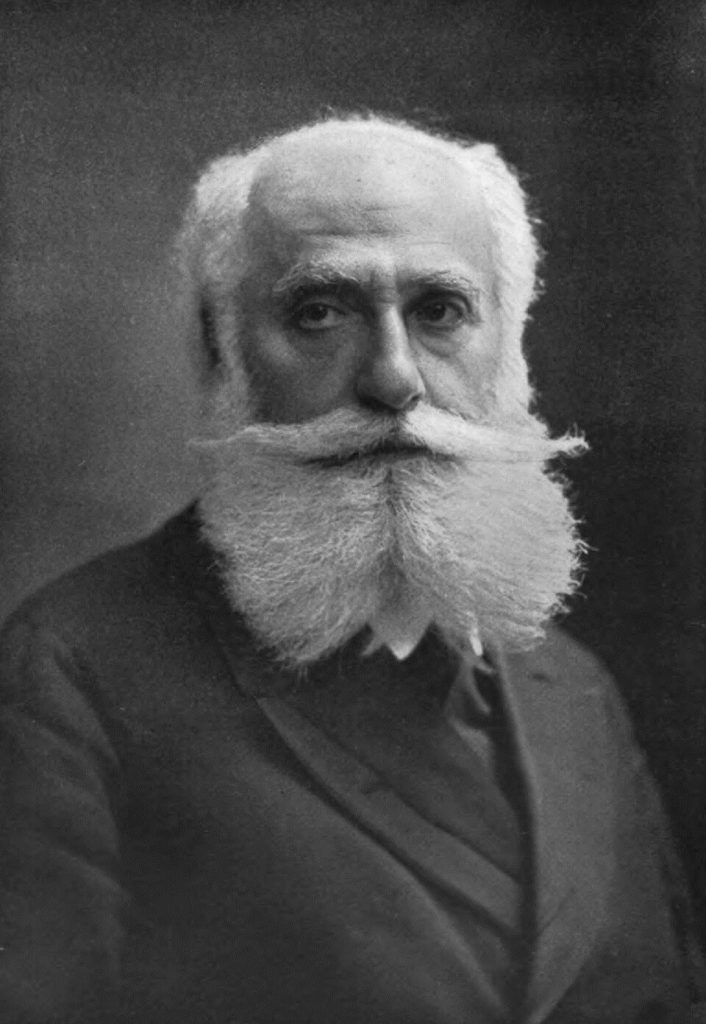
Herzl is therefore not fooled: his opponent in this controversy is not an old and venerable rabbi attached to the prophetic tradition and dreaming of messianic emancipation, but a selfish, scheming, wealthy bourgeois and willing stock market speculator, ready to sacrifice the fate of the Jewish masses if that is the price to pay to keep his own material, social, and mental comfort intact: “Ah yes, these gentlemen are also quite adept at freeing themselves personally from antisemitism: through services, money, and the sacrifice of their convictions—the latter being what costs them the least” (p. 60). Max Nordau shares Herzl’s assessment of the situation of the Jewish masses in exile: “Antisemitism makes the physical existence of penniless Jews difficult, even threatening them with extermination in some places” (p. 79). And no less lucid, in turn, beyond the venerable rabbi, he identifies the same “men in the shadows”:
“Only one category of Jews is hostile to Zionism: the selfish ones who fear that the Zionist movement may have some unknown, distant, unfortunate consequence for them, […], in short, the occupants of the boat who strike with axes at the hands of the shipwrecked clinging to the edge of the boat because they fear that this boat, too full, will become dangerous for themselves” (pp. 90-91).
In addition to the writings that make up this volume, it should be noted that, following Herzl and Nordau, Bernard Lazare, a year later in France, in an article entitled “Jewish Nationalism” (1898), identified the same opponents and dealt with them in a similar, if not even more radical, manner:
“Thus, it is obvious that the so-called upper class among Western Jews, and mainly in France, is in a state of advanced decay. It is no longer Jewish, it is not Christian, and it is incapable of substituting a philosophy, let alone a free morality, for the creed it no longer has. While the Christian bourgeoisie remains standing thanks to the corset of its dogmas, traditions, morals, and conventional principles, the Jewish bourgeoisie, deprived of its secular supports, poisons the Jewish nation with its rot. It will poison other nations as long as it does not decide — which we cannot urge it to do strongly enough — to adhere to the Christianity of the ruling classes, and thus rid itself of Judaism.”2
From this controversy, fortunately rescued from oblivion by Éditions Verdier, the discerning reader can draw important historical and political lessons. Let us distinguish three:
1) Jewish prophecy, as found in the Bible, is not nationalism, and cannot be so without betrayal, which is why the wind of nationalist religiosity that seems to be sweeping Zionism today is indeed fascism, and certainly not “messianism”;
b) The driving force behind the political activism of Herzl, Nordau, Lazare, and Pinsker at the very end of the 19th century was, in the final analysis, not so much national as social, because it was the present situation of the proletarianized Jewish masses that, in their eyes, not only justified but also founded the Zionist project.
c) Nevertheless, their perspective was strictly Eurocentric: fighting the anti-Zionist Jewish bourgeoisie on one side and “the jealousy of the European peoples” on the other. Another adversity was soon to come to light, this time consisting of two sides that were completely different; for while the “jealousy” of the Arab peoples is largely analogous to that of the European peoples, the Palestinian adversity, on the other hand, is of unquestionable legitimacy, even from the point of view of the founders of Zionism. Unless one is prepared to take the position of “occupiers of the boat who strike the shipwrecked with an axe…”

Ivan Segré
Ivan Segré, né à Paris, est un philosophe et talmudiste franco-israélien. Il est l'auteur d'une dizaine d'ouvrages dont Qu'appelle-t-on penser Auschwitz? (Lignes, 2009), Le manteau de Spinoza. Pour une éthique hors la Loi (La Fabrique, 2014), Les Pingouins de l'universel. Antijudaïsme, antisémitisme, antisionisme (Lignes 2017), La trique, le pétrole et l'opium (Libertalia, 2019), Misère de l'antisionisme (L'éclat, 2020) et La souveraineté adamique. Une mystique révolutionnaire (Amsterdam, 2022). Outre sa collaboration à la revue K, il est également l'auteur de dizaines d'articles, notamment en accès libre sur le site Academia ainsi que sur le site Lundimatin.