# 252 / Editorial
As international attention turns to Iran, where the people are rising up and repression is rampant, a familiar refrain is once again being heard in the prevailing discourse. We heard it last June, during the Israeli bombing of Iranian nuclear sites, when German Chancellor Friedrich Merz, for example, claimed that Israel was doing “the dirty work for all of us”. While Trump openly acts in his own interests, is the Western world in crisis expecting the State of Israel to act with self-sacrifice, or even a certain willingness to make sacrifices? The text by Noémie Issan-Benchimol and Elie Beressi questions the Christian roots of this representation of Israel as an outpost, or even a henchman, of the West, tracing it back to the figure of the sacred executioner who carries out “necessary” violence and allows others to keep their hands clean. Above all, the authors invite Israelis and their supporters to free themselves from this injunction, which forces them to take on a perilous role and prevents their political and military actions from being evaluated according to their own normative criteria.
Related articles

Lanzmann: holding on to the present
A German-Israeli meeting post-Gaza

Israel as the West’s “Dirty Worker”: The Return of the Sacred Executioner Myth
One hundred years after the birth of Claude Lanzmann, Guillaume Ribot’s film All I Had Was Nothingness has just been released, based on 270 hours of rushes from Shoah that were not used in the final cut, while an exhibition at the Berlin Jewish Museum and at the Mémorial de la Shoah in Paris presents previously unheard audio recordings from the documentary filmmaker’s preparatory work. This is an opportunity for Danny Trom to revisit the way in which Lanzmann sought to inscribe the genocide in an unassailable present, and the tension inherent in this project, as time passes and generations change. It is also an opportunity to ask what remains of Lanzmann’s legacy, particularly the French literary Magazine Les Temps Modernes, which has not found a successor since his death. It is possible that Temps will continue to exist, but it seems to have strayed far from its founding principles.
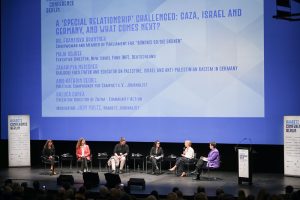
Last November, a conference organized by the Heinrich Böll Foundation and Haaretz was held in Berlin to examine “the aftermath”. What are Germans capable of saying about Israel, particularly on the issue of settlement in the West Bank, and to what extent can this kind of meeting lead them to clarify their position? Conversely, to what extent is the most critical wing of the Israeli left held back by the Germans’ heightened sense of responsibility towards Israel? Paul Bernard-Nouraud’s report reflects this subtle balance of tensions and reciprocal influences, questioning the awkward moments and shifts that punctuated the conference, which we would have liked to see clarify that Israel’s security, as a German “raison d’état”, requires the easing of tensions with the Palestinians.