A German-Israeli meeting post-Gaza
Haaretz Conference – Heinrich Böll Foundation, Berlin, November 2025
In Berlin in November 2025, the Israeli daily newspaper Haaretz and the Heinrich Böll Foundation brought together journalists, politicians, researchers, and artists at the Haus der Berliner Festspiele to discuss the “aftermath”: Israel, Gaza, and Germany. From questioning the political impasse in Israel to debates on boycotts, disinformation, and humanitarian law, the day also served as a mirror for Germany: how can it reconcile its historical responsibility towards the Jewish people and Israel with the requirements of international law, without turning caution into blindness?
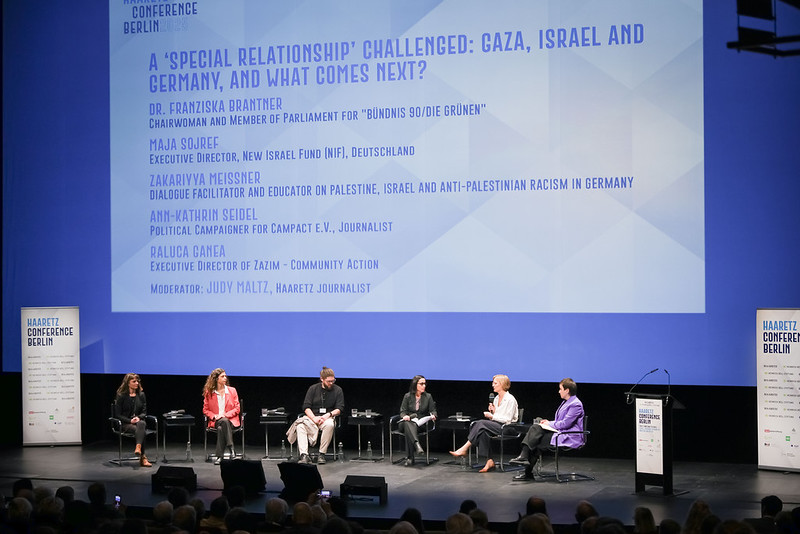
Lively exchanges, mutual respect so evident that it needed no display, widely shared fears and hopes—such was the general impression at the end of the conference held on November 6 in Berlin. A high-level meeting on the theme “Israel, Gaza, and Germany in Times of War and After”, co-organized by the center-left Israeli newspaper Haaretz and the Heinrich Böll Foundation, which is close to the Green Party [See here for the presentation and list of participants].
Like its counterparts affiliated with other German political parties, the Heinrich Böll Foundation, which employs a number of researchers and experts, fulfills a civic role in Germany, while also conducting advocacy work in the thirty or so countries where it has offices. According to Ofer Waldmann, who heads the Tel Aviv office, the current role of the Heinrich Böll Foundation is to “be a meeting point for liberal democratic forces working for human rights” in a context where “the forces threatening democracy in Israel, Europe, the United States, and elsewhere are highly interconnected.”
Historically, awareness of the Shoah has informed the foundation’s national and international engagement, although the current dangers summarized by Ofer Waldmann largely fueled the discussions in Berlin. Initially, these focused mainly on the political situation in Israel, and later on Germany’s position on the ongoing conflict. From early afternoon to early evening, around thirty guests were interviewed by journalists from the Israeli daily newspaper on a whole range of topics that the terrorist massacre of October 7, 2023, has more than amplified: German-Israeli relations, relations between Israelis and Palestinians, the situation of journalists in Gaza and the West Bank, and the different positions of artists on the conflict.
Netanyahu, elections, responsibility: the Israeli knot
The speeches, regularly interrupted by applause, gave rise to some unexpected moments, such as when Arab-Israeli MP Ayman Odeh, regularly removed by force from the Knesset podium, spoke of the importance of Berlin Rabbi Joachim Prinz’s speech, which preceded Martin Luther King’s speech in Washington in 1963, in his own intellectual and political development. Or when former Prime Minister Ehud Olmert, in dialogue with former Palestinian Foreign Minister Nasser al-Kidwa, revealed himself to be “a true human rights activist”, as noted, not without malice, by human rights lawyer Michael Sfard, who followed him on stage.
Sfard was one of the few speakers to question the responsibility of Israeli society as a whole for the current situation, whereas all the other speakers—and the audience with them—agreed that the situation would remain deadlocked as long as Benjamin Netanyahu—his government, for some, his regime for others—remained in power.
Many speakers, including former Israeli National Security Council member Eran Etzion, even expressed their fears about whether or not the next elections would be held. This was a prospect that sociologist Eva Illouz had previously deemed unlikely, but perhaps desirable insofar as their possible cancellation would provoke a public outcry that would reach a real “tipping point” and could then remobilize Israeli society.
For Michael Sfard, this question of collective responsibility—which he says he has found very difficult to articulate because it has become inseparable from “a crisis of personal identity”—arose precisely from the political demobilization of his compatriots since October 7. Teachers’ unions have not condemned the systematic destruction of the Gaza school system, he gave as an example, nor have doctors’ associations condemned the destruction of the health system. In this respect, as in many others, society therefore bears an overwhelming collective responsibility, according to the criminal lawyer, who believes that if not recognized and addressed, will permanently undermine the possibility of justice being served. Michael Sfard also asserts that justice cannot be served by the Israeli judicial system as it currently functions, or rather malfunctions. Ayman Odeh also called for justice, as both men are aware that without it, no security will be possible in the absence or pending a process of reconciliation, while injustice, in the words of the Israeli lawyer, “does not evaporate: it remains and contaminates everything .”
Michel Sfard was one of the few speakers to question the responsibility of Israeli society as a whole for the current situation, whereas everyone else agreed—and the audience with them—that this situation would remain deadlocked as long as Benjamin Netanyahu remained in power.
However, the lawyer was keen to point out that society’s responsibility in accepting the injustice and crimes committed in its name by its political leaders does not amount to complicity with them.
While it is doubtful that this distinction can be fully applied in Michael Sfard’s field of law, the concept of the “implicated subject”, theorized in literary studies by Michael Rothberg in The Implicated Subject: Beyond Victims and Perpetrators (Stanford University Press, 2019), could nevertheless shed light on his own distinction between responsibility and complicity. The implicated subject is not an accomplice, Michael Rothberg also explains. He is even less a “perpetrator” in the English sense of the word, but because he is implicated in both the past and the present, he can, if he fails to admit his involvement, become a “perpetuator” of injustice. It is this feeling, both personal and political, of not being a perpetrator while refusing to become a perpetuator, that seems to have motivated most of the Israeli speakers to speak out on these issues, and undoubtedly part of the audience to pay attention to them.
Nevertheless, it appears that in order for this feeling to spread, in order to extract the majority of the Israeli population from the untenable position in which it finds itself, which would have all Gazans be complicit in the massacres of October 7 and, on the other hand, Israelis not be accountable for the massacres perpetrated in retaliation—“in revenge,” as several speakers corrected—for such a reaction to occur, external pressure would have to be exerted on Israel, given the state of shock and fear that continues to prevail within the country. Of course, as Eva Illouz pointed out, the current government would then have no trouble attributing the unspoken motive for this type of pressure to antisemitism. But while the “military battle” may have been won, this “ideological battle”, observes the sociologist, has already been lost internationally, and could well be lost at the level of national opinion, which could indeed turn against Israel if the pressure increases.
Boycott: moral impasse or last resort
On the German side of the conference organizers, the option of a boycott was ruled out from the outset by the president of the Heinrich Böll Foundation, Jan Philipp Albrecht, expressing a position that was immediately endorsed by Eva Illouz, herself a victim of ostracism on both sides of the political spectrum, and which was also taken up by most of the participants following her lead, for the simple reason that “it is difficult to talk to those you boycott”, as Ofer Waldman pointed out, arguing in particular that artistic exchanges should not be affected by such measures.
Nadav Lapid, who was directly affected, was the only other speaker to consider the boycott morally justified and potentially politically effective. The director of Yes, which he had just presented the day before in Berlin, at the same time as he made the decision not to allow his film to be sold in Russia, felt that such a measure was also necessary in the Israeli case. Like Michael Sfard, Nadav Lapid argued that artists in his country had failed to react, being more quick to denounce boycotts against themselves than to engage in lucid soul-searching about what they had not done, until now, to denounce the crimes committed in their name.
Nadav Lapid considered that, in this light, the distinction between the Israeli “government” and ‘society’ is ultimately “artificial”. Faced with disagreement from a member of the audience—the only one to express their opinion verbally that day—and from Berlin music producer Katja Lucker, who was in conversation with him, Nadav Lapid nevertheless admitted that boycotting artists was never an ideal solution or a priority measure, and that for this reason it should only be used as a last resort, once political and economic sanctions had been taken. With these still pending, the director noted that he nevertheless believed that the normalization of artistic relations with Israel ultimately contributed to the impunity enjoyed by the country on the international stage, at least according to the attitude of most Western democracies towards it.
Germany and the law: the “Staatsräson” in question
On this subject, many participants criticized Germany’s position. Significantly, their criticism was not based on historical or symbolic grounds—as it might have been in France, arguing that there is a disconnect between the abstract promotion of human rights and their concrete defense—but on technical and legal grounds. Until now, Germany had always been at the forefront of the issue of respect for international humanitarian law; in the case of Israel, this leadership had clearly been weakened.
Some commentators saw this as an exception motivated by a special relationship adorned with the trappings of “reason of state” (“Staatsräson”) that was as absolving as it was misunderstood since Angela Merkel had stated before the Knesset in 2008 that Israel’s security was linked to the “reason” of the German state—not without first insisting on the need for a Palestinian state, recalled Daniel Gerlach, a journalist specializing in the Middle East and director of the Candid Foundation.
In this regard, he regretted that the German government, like many media outlets in Germany, had been receptive to the rhetoric of its Israeli counterpart and to various disinformation campaigns, whether government-sponsored or not, concerning the situation in Gaza and the West Bank. It is likely, suggested Daniel Gerlach, that if a meeting such as the one he was attending in Berlin had been organized by a German political or media institution, it would have succumbed to more or less friendly pressure from the Israeli embassy, for example by encouraging the organizers to also invite one of their representatives in order to “rebalance” the panels.
Many participants criticized Germany’s position. Some commentators saw it as an exception motivated by a special relationship adorned with the trappings of a “reason of state” (“Staatsräson”) that was as absolving as it was misunderstood.
According to Daniel Gerlach, this biased way of restoring a form of objectivity by calling for “both points of view” on a reality that would in fact only allow for one had the perverse effect of providing a convenient pretext for many German commentators to be overly cautious when commenting on the reality of the crimes committed in the Palestinian territories. The annexation of the West Bank, which has been regularly denounced, is not the result of more or less isolated individual initiatives, as all the conference participants were keen to repeat, contrary to what a certain opinion seeks to accredit, but is in fact the result of a concerted “military project”, as described by Haaretz journalist Hagar Shefaz, who devotes most of her reporting to the violence committed by Israeli settlers against Palestinian residents.
The reason for the German authorities’ timidity in condemning these abuses, and even more so in recognizing their systemic and planned nature, cannot be summed up as their fear of being accused of antisemitism, which traps them in a dead-end dilemma between solidarity with the Jewish people in Israel and respect for international law, as Ofer Waldman summarized. In other words, this very real and well-founded fear has contributed to structuring a certain vision of Israel and, by extension, of Germany as two ideal-typical entities that nothing can touch without, precisely, undermining the ideal that has presided over their respective political physiognomies and, ultimately, both their raison d’être and the “raison d’État” that binds them.
Memory, guilt, recognition: the European debate
An essay published in Germany in 2022 may shed further light on this view, as its author seeks to defend it rather than criticize it. In Conflicting Memories: Focal Points of the Holocaust and Colonialism (Fluchtpunkte der Erinnerung: Über die Gegenwart von Holocaust und Kolonialismus), sociologist Natan Sznaider thus proceeds to an ideal-typical reduction of the State of Israel that is quite widespread in Germany. In his writing, it is as if its history ended with its creation in 1948, that is, at the moment when its right to exist could no longer be contested by Western democracies in general and by the Federal Republic of Germany in particular.
With this suspension of historicity established once and for all, the right to criticize the way Israel exists as a state—in other words, to criticize the way it governs its own population and the Palestinian population, the way in which this mode of government perpetuates or does not perpetuate an unthought colonialism, and any other historical-critical consideration—is ipso facto considered a challenge to its very right to exist. To a certain extent, the FRG accommodated this dehistoricization, not to say that it allowed it to lose interest in the Israeli-Palestinian question by opting, if not automatically, at least systematically, to defend Israel’s security. Adding one problem to another, Nathan Sznaider believes that this defense was also widely accepted at the time of the FRG, where he was born in 1954, due to the homogeneity—“particularly ethnic”, he writes—of its population.
Also widespread in France, this insinuation, which is in the process of becoming a veritable ideological thesis, according to which the return of antisemitism, under the guise of anti-Zionism, coincides with the arrival of foreign and Muslim populations in Europe—neither verified by facts nor demonstrated intellectually—has been refuted by several speakers who, like Ofer Waldman, have simply reiterated the obvious. Namely, that Germany did not wait to welcome foreigners onto its soil for antisemitism to grow and flourish shamelessly there—the country’s supposed, since fantasized, “ethnic homogeneity” having been the best catalyst for it.
This was confirmed by his compatriot Meron Mendel, director of the Anne Frank Center in Frankfurt, who pointed out that the “philosemitism” opportunistically claimed by Alternative for Germany (AfD) is only temporary and tactical, and that it is motivated solely by the fact that the hatred proclaimed by its leaders for Muslims exceeds – for the time being – that which they do not yet dare to admit towards Jews. Moreover, Meron Mendel also insisted that the idea, also based on a dehistoricized substrate, that Jews have enjoyed a peaceful existence in Germany from 1945 until recent years is historically counterfactual; the arrival of Jews from the former Eastern Bloc, for example, has partly masked the departure of many German Jews who were subjected to varying degrees of hostility.
The insinuation, which is in the process of becoming a veritable ideological thesis, that the return of antisemitism, under the guise of anti-Zionism, coincides with the arrival of foreign and Muslim populations in Europe—being neither verified by facts nor demonstrated intellectually—has been refuted.
In this case, hostility can go hand in hand with a form of benevolence that is clumsy to say the least, as when, following a previous public speech, Meron Mendel reported that a woman climbed onto the stage to kiss him, declaring how much he was, in her eyes, “a gift to Germany”; a “gift“ as a Jew. It is unclear what word this person used for ”gift“, which Meron Mendel translated into English as ‘present’ instead of ”gift“, which also means ”poison” in German. In any case, during the conference, the slightly embarrassed laughter that the anecdote provoked turned a few hours later into embarrassment accompanied by more laughter when this time the journalist Netta Ahituv, moderating a discussion between Michal Sella, director of the NGO Givat Haviva, and her friend Nasreen Haddad Haj Yahya, herself co-director of the New Israel Fund, very seriously addressed the latter, an Arab-Israeli, to tell her that she was “a gift to Israel”, referring to the compliment that Meron Mendel had received. This misunderstanding and misuse had less of an effect on the audience than a false note, but rather that of a piece of music that was a little too old-fashioned to be played in public without provoking sighs of consternation.
But the real shock that Meron Mendel had also identified as generational occurred at another level of German society. He sums it up in a slogan he heard and read on Frankfurt campuses: “Free Palestine from German Guilt.” Its eminently provocative nature—it is a slogan, after all—is nevertheless consistent with the diagnosis made by most of the observers invited to the Berlin conference: this sense of guilt, in the sense of moral guilt as theorized by Karl Jaspers—whether sincere or strategically invoked—hinders critical reflection on Israel. It would also compromise Germany’s recognition of a Palestinian state, which Ayman Odeh called for at the end of his speech, as if such recognition amounted to disavowing Israel’s existence as a state.
However, the only truly lasting guarantee in this regard, argued Bente Scheller, director of the Middle East and North Africa division at the Heinrich Böll Foundation, is, on the contrary, the existence not only of a Palestinian state, but also of sovereign and democratic neighboring states. For Bente Scheller, as for many other analysts invited to comment on these issues in France (notably researcher Karim Émile Bitar, professor at Saint Joseph University in Beirut), the threat posed by Hezbollah, for example, is proportional to the weakening of the Lebanese state, so that weakening its Syrian counterpart, as Benjamin Netanyahu aspires to do, would only increase this threat.
However, the strategy adopted by the Israeli prime minister amounts to perpetuating the perception and reality of the threat on a daily basis, according to Eran Etzion. According to him, since entering politics in the early 1990s, Benjamin Netanyahu has pursued a two-pronged agenda: eliminating the two-state solution and replacing Israel’s liberal elites with a conservative elite. An agenda that, in order to be carried out, requires perpetuating a situation of permanent war, which the so-called “Trump plan” is unlikely to end, Eran Etzion pointed out, since neither the Israeli government nor Hamas has officially approved it, with both sides merely signing a formal agreement. But because the plan in question does offer a respite, it must be converted into a real window of opportunity, according to Swiss researcher Hiba Qasas, a native of Nablus, who is behind the “United for a Shared Future” coalition. i.e., to ensure that the room for maneuver left by the “Trump plan” (some would say the “vagueness” that characterizes it) is collectively exploited to lay the foundations for a two-state solution.
The task is all the more difficult given that the window of opportunity that opened last October could, as we know, close at any moment. In the opinion of the various participants, the possibility of turning this window into a real bridge—to abuse a metaphor that they inevitably resorted to—depends less on the mobilization of Israeli society itself, even though it could wake up without warning, as one might wake up abruptly from a nightmare, than on that of the international community. Under these circumstances, one might be tempted to add that it is the mobilization of public opinion outside Israel that must continue, in that democratic states cannot ignore it forever.
Without prejudging the state of the debate across the Rhine, we know how much the debate on these issues has become heated in France. Speaking on an international scale, but not ignoring the French context, Eva Illouz referred to the “pathology of the public sphere”, highlighting the difficulty of expressing oneself publicly and speaking frankly, that is, freeing oneself from what she calls “a priori affiliations”. If the Berlin conference were to have no other concrete effect than to prove that the public sphere is not totally contaminated, that those who speak out in it are perfectly capable of expressing views that differ from their own, then this conference will have had some significance. All that remains, in order to take concrete action, is to win the elections in Israel, proclaimed Eva Illouz, Eran Etzion, and Ehud Olmert in unison, albeit from a distance, while Nasser al-Kidwa insisted that the orphans of Gaza must be taken care of and helped to rebuild their lives, reminding everyone that this conference was being held not only on political rubble, but above a veritable field of ruins.
See, on the Heinrich Böll Foundation website: Haaretz Conference in Berlin: What future for Israel and Germany after the Gaza war?
Paul Bernard-Nouraud
Paul Bernard-Nouraud est historien, théoricien et critique d'art, et membre de l'AICA.