Family Reunification in Jerusalem
How Netanyahu Enlists Herzl in an Alternative History of Zionism
On August 5, 2026, the remains of Shimon and Rivka Herzl, Theodor Herzl’s grandparents, were transferred from Belgrade to Jerusalem. Behind this final “family reunification”—which went almost unnoticed—lies a battle over the meaning of Zionism. By presenting Herzl as the heir to an age-old religious and territorial aspiration, the official narrative obscures the true meaning of his project: the creation of a refuge-state intended to protect Jews, founded on law, equality, and coexistence. Danny Trom shows how the relocation of the dead sheds light on the political conflict currently dividing Israel.
The Herzl Family Reunited in Jerusalem
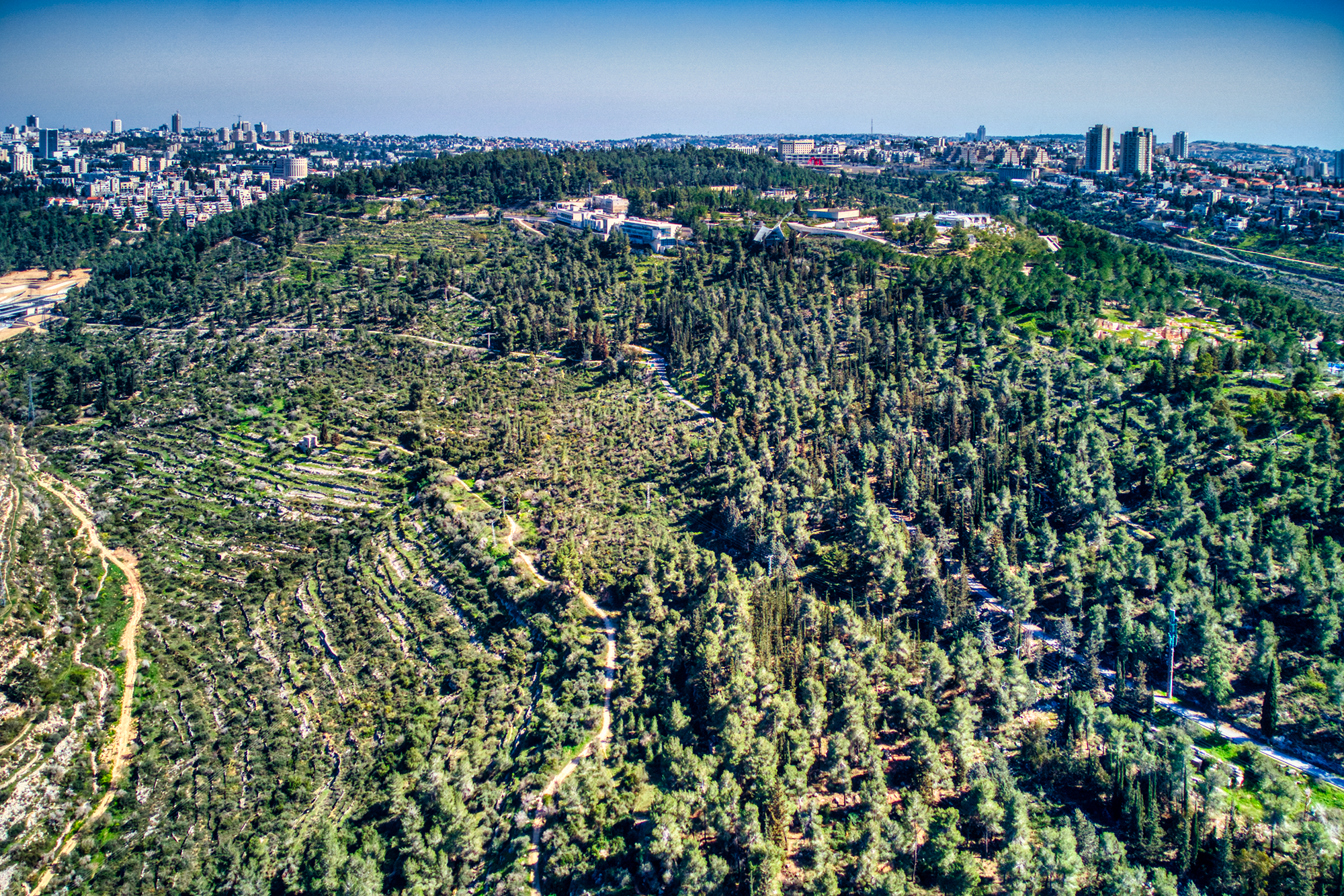
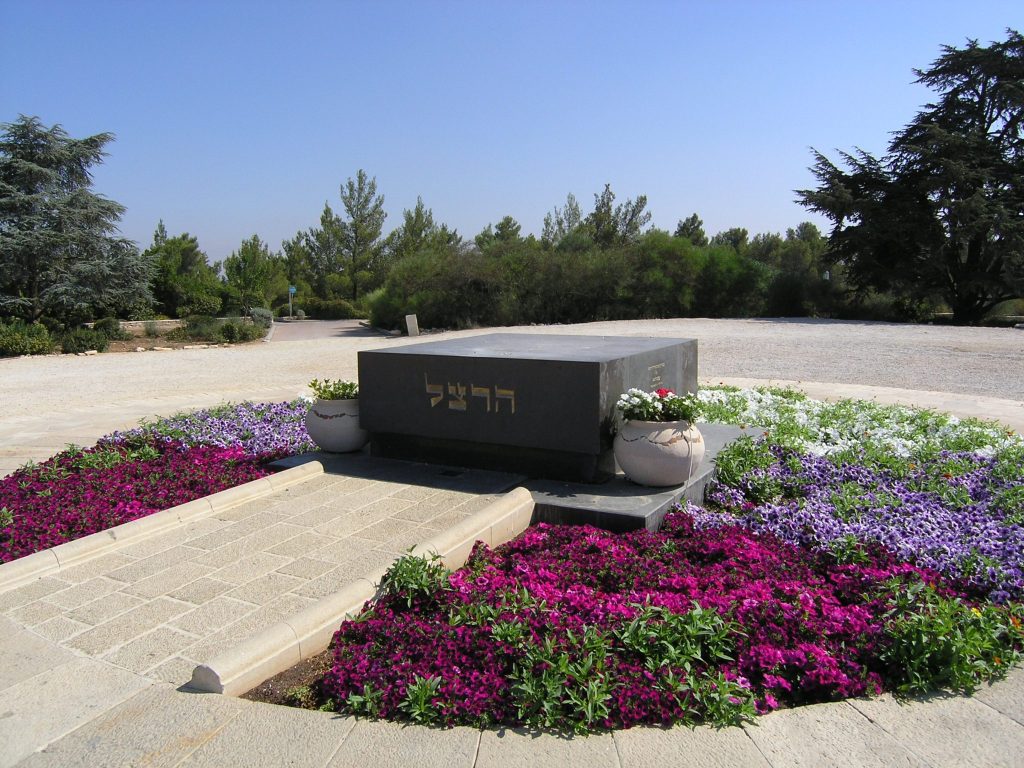
As the election campaign rages in Israel—more heated and more crucial than ever before— a ceremony that was as official as it was consensual took place in Jerusalem, in the height of summer, on August 5. It was held to mark the transfer of the remains of Shimon and Rivka Herzl, Theodor Herzl’s grandparents, from the Jewish cemetery in Belgrade to the final resting place of the father of the Jewish state. Herzl’s remains—he himself died of illness in 1904, at the age of 44—had been transferred in 1949 from the Jewish cemetery in Vienna to Jerusalem, one year after the proclamation of the State of Israel. Theodor Herzl was immediately followed there by his parents, Jacob and Jeanette Herzl—who were also buried in Vienna—and by his sister, who was buried in the Jewish cemetery in Budapest. Then, in 2006, two of Theodor’s three children, Pauline, his eldest daughter, who suffered from depression and died by heroin overdose in 1930 in France at the age of 40, and his younger brother Hans, whom his parents, who were in the process of assimilating, decided not to circumcise and who led a troubled life in England, converting first to Baptism and then to Catholicism before drawing closer to liberal Judaism, and who also took his own life, by gunshot, the day after his sister’s funeral, left their cemetery in Bordeaux to join their father in Jerusalem. But Herzl’s wife, who was otherwise unenthusiastic about her husband’s Zionist endearment, died of illness in 1907—three years after him—and was cremated in Vienna, and the Herzls’ youngest daughter, Trude—who was deported to Theresienstadt and burned in 1943—are missing from the list, as no identifiable remains were found. The only surviving descendant was Trude’s son, Stephen Theodor Neumann, Theodor’s only grandson, who was brought to safety in England in 1935, where he attended university, and who, in 1946, after learning of his parents’ murder, took his own life by jumping off a bridge in Washington, D.C., and was finally laid to rest alongside his grandfather in 2007 on Mount Herzl.
Now, on August 5, 2026, with the transfer of Herzl’s grandparents’ remains, it is likely that this strange process of family reunification in Jerusalem—which Theodor had wished for—will be complete, although family histories sometimes hold surprises.
The significance of these serial reburials lies in the national narrative: the State of Israel continues to claim, as it always has, the authorship of the famous pamphlet Der Judenstaat, published in 1896, which served as the catalyst for the First Zionist Congress convened in Basel in 1897, where his program of action was approved. This is how the State of Israel narrates its own genesis: the State is the finished or semi-finished product of Zionism, of which Herzl was the architect and engineer at the very end of the 19th century, in the heart of Europe. This conventional wisdom is all the more compelling because Herzl himself worked throughout his life to build his legendary legacy, constantly anticipating how future generations would view a project that his contemporaries deemed harmful, or at best far-fetched: “Today, in Basel, I have created the Jewish state. If I were to say that publicly today, it would provoke universal laughter. In five years perhaps, in fifty surely, everyone will understand,” he noted in his Journal on the evening the congress closed, held in the hall of the Basel Casino, after all the Jewish communities in the major cities of Germany and Austria had refused to host it. Herzl, almost unanimously criticized and mocked by the Jewish world of the time—from rabbinical authorities of all denominations to liberal leaders—acted in the face of adversity. By predicting that his creation, still entirely abstract, almost invisible to the overwhelming majority—amounting at the time to nothing more than an embryonic organization and a program deemed unreasonable by all—would emerge 50 years later as a concrete reality, he attained the status of a demiurge. Through his illocutionary words—discovered upon the publication of his Diary in 1922—and with the help of a few effective hagiographers, Herzl’s posthumous fate was sealed. A tireless political entrepreneur and inspired prophet, with a clear penchant for self-heroization, who at times even doubted his own sanity because his vision seemed so crazy to him, he became that indisputably accepted figure—who died young yet remains ageless—standing above the internal divisions of the Zionist organization, to become an unrivaled national icon when the State of Israel was established in 1948. The Herzl family’s regular reburials have become so routine that they often go unreported in Israel, to the point where they no longer stand out as significant events.
By throwing himself body and soul into the endeavor of bringing what he suddenly called “his people” to safety in a state dedicated to them, Herzl sparked a revolution.
The figure of Herzl, thus imbued with his aura, nevertheless embodies a far more prosaic profile that is worth recalling: an assimilated Jew, ignorant of tradition, a moderately successful playwright on the Austrian stage, and a renowned political journalist at the major liberal Viennese daily Neue Freie Presse, he was, in the last decade of the 19th century, on the verge of converting to Catholicism—which he saw as the only solution to the problem of rising anti-Semitism—before making an abrupt about-face, bringing the assimilationist path begun by his parents—who had left Budapest for Vienna—to an abrupt halt. By throwing himself body and soul into the endeavor of bringing what he suddenly called “his people” to safety in a state dedicated to them, he initiated a revolution. Every gathering of Herzl’s remaining family members— those of his parents, his sister, and two generations of his descendants in Jerusalem, seems to indicate that the State of Israel regularly acknowledges that it emerged from the tragic history of European Jewry, from the torments of thwarted integration and blocked assimilation. It was first and foremost a way out of the European stranglehold that Herzl foresaw would continue to tighten until it led to a catastrophe—a prediction that his contemporaries attributed to his pathological anxiety, but which proved to be accurate.
A Law of Refuge, Not of Return
It should be noted that these solemn reburials are not “repatriations,” if viewed in the light of Herzl’s own vision. He was, in fact, seeking any territory whatsoever to provide shelter for the Jews, with Palestine appearing at the time as one possibility among other opportunities that might arise: hence the famous debate surrounding the so-called “Uganda” option, proposed by Great Britain and promoted by Herzl, but which tore the Zionist organization apart in 1903, to the point that he abandoned it. It was with the rejection of this plan in 1905, a year after Herzl’s death, that the Zionist Organization became “Zion Zionists,” pushing those known as the “territorialists ” to the margins and then out. The fact that the State of Israel, located in Palestine, is now the refuge Herzl envisioned is reflected in the misnamed “Law of Return,” passed by the Knesset in 1950: a quintessential political law of the State of Israel, it was designed to allow Jews from around the world to find shelter in a state created for them, and not to facilitate a return move. Certainly, then, not to be “repatriated,” since “return” presupposes the existence of a homeland of which one is a citizen, and at the very least a traditional definition of a Jew—and even then, this remains highly controversial, including within religious Zionism. On the contrary, the “Law of Return”—which is in reality a law of refuge—targets a conceptual figure without rigid boundaries, as exemplified precisely by the Herzl family: a Jew without any specific identity—a point the religious party would unsuccessfully attempt to amend during the 1950 parliamentary debate. As evidenced—since we are discussing reburial here—by the Knesset debate surrounding the reburial of Pauline and Hans Herzl in 2006, in which the religious parties contested this possibility but were clearly outvoted: the State of Israel officially sets itself the mission of providing a home for every Jew, wherever they may reside, regardless of their circumstances, whether they are compelled or eager to join it, whether they are assimilated or not recognized as Jewish by halakha, whether they are drug-addicted like Pauline Herzl or momentarily converted out of opportunism or misguidedness like Hans Herzl, or whether they discover they are Jewish the face of persecution. Through Herzl’s life story and the misfortune that befell his descendants (to whom he evidently passed on a touch of madness), the State of Israel repeatedly reaffirms a historical understanding of the Jewish people in the post-emancipatory era, with all its twists and dead ends.
The “Law of Return,” which is in reality a law of refuge, targets a conceptual figure without rigid contours—one that the Herzl family precisely exemplifies—a Jew without any specific identity, something the religious party would unsuccessfully attempt to amend during the 1950 parliamentary debate.
For Israeli society, absorbed this summer by the grinding war on multiple fronts, and the election campaign now in full swing, the significance of the August 5 ceremony—at which Herzl’s grandparents were reburied—seemed quite incidental, almost folkloric. This relative indifference comes as no surprise. Indeed, it increasingly cements itself at every stage of the Herzlian family reunification process. This transpires in the very approximate spelling on the street signs along Herzl Street in Tel Aviv (“Herzel” or “Hertsel”), a comical oversight that a European Jew might be tempted to interpret as a sign of Israelis’ tenuous connection to the literary founder of their state. Today, the name Herzl first brings to mind a bustling street in Tel Aviv or a hill in Jerusalem—perhaps not even the city of Herzliya, named after him, and certainly not the city of Tel Aviv, named after the title of the Hebrew translation of his utopian novel Altneuland, published in 1902.
Herzl certainly remains a familiar figure to all, an iconic character whom the eye immediately recognizes by his square beard—that of a bourgeois citizen of the Dual Monarchy—adorned on ceremonial occasions or a banknote; yet when it comes to questioning what the State of Israel is and what it should be—understood as Judenstaat, as a state for the Jews, his image has become blurred. Perhaps this is simply the consequence of the institutional translation of his vision into the so-called Law of Return, which, despite a few amendments, has remained, if not unchanged, at least preserved in spirit. The State of Israel is, in fact, not substantially Jewish; although its symbolism draws on the Zionist epic, it is a state conceived for the Jewish people.
The Grandfather Who Rewrites the Genealogy of Zionism
Isn’t the transfer this summer of the remains of the grandparents Shimon and Rivka from Belgrade—which takes us back to the first quarter of the 19th century—out of step with the logic of previous reburials? Isn’t it being treated this time as an act of repatriation? Wouldn’t this then signal to the Israeli public that the State is not merely a modern solution born of the degraded political condition of European Jews—as indicated by the subtitle of Der Judenstaat, “Versuch eine Lösung der jüdischen Frage” (an attempt to resolve the Jewish question)—but a state that redeems exile, absorbs it without a trace, and thus, ideally, leaves no remains to be repatriated? Does this mean, then, that the August 5 ceremony stands apart from previous family reunifications, implying that Zionism has no historical limits? It would seem so, if one is to believe the official rhetoric of the ceremony’s presiders—the President of the State and the Prime Minister—which was echoed by the Israeli press without prompting any commentary: through this gesture, it is said, continuity is restored. Is it Theodor’s family history that is being completed here by tracing back through the generations, or is it the portrait of Herzl himself that is being altered? During the ceremony, President Herzog limited himself to referring to the restoration of a family continuity and the passing down of a “dream” through the generations, but Prime Minister Netanyahu, after recalling the figure of Theodor Herzl as a “builder,” offered a particularly questionable interpretation of this latest reburial: “But now our gaze focuses on the foundations of the building: Judaism – as the basis for Zionism. The Torah and the entire Tanakh – as the cornerstone of identity. The chain of generations – as the anchor of values and heritage.” From this, he draws the following conclusion: “This is Herzl’s uniqueness, from our perspective: because the prayers that were traditionally recited by his grandfather Shimon Leib and his grandmother Rivka in the Diaspora – ‘And may our eyes behold Your return to Zion in mercy’ – these prayers and dreams were transformed by their grandson into a practical action plan that changed the course of Jewish history.”1 From this perspective, then, Herzl did nothing more—after the ball had been passed from generation to generation—than “convert the try,” as a sports reporter might say. But what evidence is there that Herzl received the pass directly, aside from the traditional prayer recited by his grandparents—a prayer that Theodor himself did not recite? Herein lies precisely the distinctive feature of Shimon Herzl of Belgrade, who associated with and admired Rabbi Yehuda Alkalaj, whom classical historiography counts among the “proto-Zionists.” Here we can see more clearly the foundations upon which a certain misguided understanding of Zionism—underlying the policies of the current government of the State of Israel—is based.
The State of Israel is, in fact, not substantially Jewish; although its symbolism draws on the Zionist epic, it is a state designed for Jews.
Born in 1798 in Sarajevo, located in the Ottoman Balkans, into a family originally from Thessaloniki, Alkalaj became, in 1825, the rabbi of the community in Zemun, a small town situated across the Danube from Belgrade. It was at the synagogue where Alkalaj officiated and taught that Grandfather Shimon attended services, although this is pure conjecture. In his first pamphlet, dated 1834, Listen, Israel, written in Ladino (all his subsequent publications would be written in Hebrew), the young Sephardic rabbi Alkalaj overturned classical rabbinic doctrine by asserting that the redemption of the people would result from their voluntary settlement in the Promised Land and not from their passive endurance while awaiting the Messiah. Viewed from Ottoman Europe, during this period of intensifying means of communication, the Promised Land appeared more tangible, closer, and more accessible, against a backdrop where the resurgence of nationalism was shaking Greece and Serbia, rendering the region’s political map fluid and uncertain. These geopolitical transformations influenced Alkalaj’s exegesis, leading him to believe that the principle of nationalities might apply to the Jews as well, and that this wave of demands actually heralded the end of their exile—provided they took action. In doing so, he angered all the rabbinical authorities of the time, the dissident rabbi responded and persisted, encouraged by the Damascus Affair that erupted in 1840, when Jews were accused of the ritual murder of Christian children, followed by the coordinated intervention of Sir Montefiore and Adolphe Crémieux to urge the Sultan to intervene and save the large Jewish community in Damascus. Finding new support in current events—the rise of antisemitism and the ability of Jews to act effectively in a European public sphere that was taking shape—he published in 1843 a eulogy entitled Minḥat Yehudah (The Sacrifice of Judah) in honor of the two heroes who saved the Jews of Damascus. Then, in 1857, he published Goral la-Adonaj (A Destiny for the Lord), in which he reiterated the reversal of the order of precedence that had until then prevailed in the world of tradition: first, the voluntary gathering of the Jews in their Land, without divine intervention but with the Sultan’s express authorization—the people performing their own part of the work toward redemption. Alkalaj accompanied this theodicy with a concrete action plan to promote accessibility and improve the agricultural condition of Palestine, within the framework of a restoration treaty concluded with the Sultan, who would serve as the guardian of a Jewish entity within a territory subject to the Ottoman Empire, modeled after the government of the Danube Confederation.
This, in summary, is what Grandfather Shimon is said to have conceived at the synagogue in Zemun, where Rabbi Alkalaj served as rabbi for decades—a vision he certainly would not have passed on to his son, but which his grandson Theodor is said to have absorbed through some unexplained means. This blend of unorthodox exegesis and activism—as Rabbi Alkalaj traveled throughout Europe to promote his plans for agrarian colonization of Palestine, though his influence remained negligible and his initiatives came to nothing, culminating in his move to Jerusalem, where he lived out his days in 1878 at the age of 80— his grandson Theodor is said to have taken him in without even realizing it. In fact, Theodor Herzl mentions Grandfather Shimon only once in his Diary, in connection with his physical resemblance to a rabbi from Sofia whom he encountered—which is a rather tenuous connection. The thesis of continuity, presented as self-evident in the speeches during the August 5 ceremony and which the Israeli press generally merely echoed, could be formulated as follows: although Theodor’s parents broke with the traditional way of life, moving to Budapest in a desire to emancipate themselves by becoming full-fledged citizens of the Empire, and although their son Theodor retained only a vague memory of his bar mitzvah from Jewish tradition, the essence was passed down. This thesis seems all the more improbable given that at the time of the publication of Der Judenstaat, Herzl was not even aware of Leon Pinsker’s seminal Zionist essay Self-Emancipation, published in 1882, nor of the still modest but very concrete achievements of the Hibat Tsyon movement, which, from its center in Odessa, had already been organizing the first wave of young agricultural pioneers migrating to Palestine since the 1880s. There is no material evidence here to substantiate an intellectual connection, and everything, on the contrary, suggests that this thesis is pure fiction; yet the similarities between Rabbi Alkalaj’s and Theodor Herzl’s projects are striking enough that any connection cannot be refuted with certainty without leaving even the slightest doubt.
Isn’t this summer’s transfer of the remains of the great -parents Shimon and Rivka from Belgrade this summer treated as an act of repatriation? Wouldn’t this then signal to the Israeli public that the State is not merely a modern solution born of the degraded political condition of European Jews, but a State that redeems exile, absorbs it without a trace, and thus, ideally, leaves no remains to repatriate?
So the question arises: how is it that this baseless thesis has gained such irresistible traction? Why is it that it does not even need to be fiercely defended against all evidence, but is simply accepted without scrutiny, like an innocent little story of no consequence whatsoever? What makes it possible to bring back the remains of Shimon and Rivka under the guise of repatriation? What is certain is that we can draw a lesson from this regarding a mindset among the Israeli public that, evidently, fails to grasp the stakes involved. And yet, if continuity is established, then we can no longer credit Theodor Herzl with having introduced that modern rupture into the contemporary Jewish world—the Zionism he embodies. If he inherited it from his grandfather via Rabbi Alkalaj, then the Judenstaat is not that comet that tore through the sky of a modern, post-emancipatory Jewish world. With Shimon’s reburial, Herzl would certainly not be rejected, but he would be dethroned from his status as a revolutionary, appearing only as a relatively minor innovator, inheriting ancient trends that he merely adapted to his era, leading him to that posthumous success that only a retrospective view can fully gauge. Such is the message—not subliminal but very explicit, and yet unperceived—that can be drawn from Prime Minister Netanyahu’s remarks at the August 5 ceremony: Herzl, in short, is not as modern as we thought; or perhaps it is the State of Israel that is not.
Altneuland versus the indigenous myth
With the ideological slope thus set amid general indifference, The Jerusalem Post did not hesitate to ride all the way down it, with this account of the August 5 ceremony2: “This latest Herzl return, 77 years after Theodor Herzl’s 1949 reburial, reflects Zionism’s redemptive benefits and embodies Herzl’s altneuland, old-new land. It reaffirms Zionism’s epic achievement in indigeneity renewal – reassembling the once-forcibly-scattered Jewish people in Israel, their aboriginal homeland.”3 However, reading the utopian novel Altneuland as the herald of the Jews’ indigenization on their ancestral land is a feat entirely driven by a political agenda that disregards all rigor. For Altneuland is not a novel that nullifies or supersedes the essay Der Judenstaat; but rather reflects one facet of the vision of the writer Herzl, who—in what appears to us today as a Robinsonade—gives free rein to his imagination, this time describing not a state (Staat), of which he had merely outlined the framework in 1896, but a “country” (Land), which is presented as a large, decentralized association of cooperatives—a self-governing, multicultural society. In accordance with Herzl’s migration program, Jews from Europe are by no means portrayed as indigenous people in the Old-New Country: they are emancipated Jews who have moved there to form a new European society, free from the dross of the European state, but set against an ancient backdrop—hence the title Old-New Country. What is new is the ideal society; what is old is the setting for its experiment. Only the Arab inhabitants and the devout Jews who make up the old yishuv are indigenous; they are already blended into the landscape. Yet all—both the newcomers and those who already inhabit the land—coexist peacefully in an Altneuland organized to maximize individual freedom, social and economic equality, and a tolerance toward religious communities worthy of a peaceful empire. While the Judenstaat centers on the idea of a refuge-state, Altneuland sidesteps it, as if the state were dispensable, with the idyll overcoming all of Europe’s political, social, and economic contradictions, offering a sort of social-democratic synthesis tinged with anarchism, all enveloped in a spirit of tolerance toward traditional ways of life—Jewish, Muslim, and Christian—with advances in science and technology benefiting everyone.
Therefore, Herzl’s work must be read as a whole: when it comes to finding a refuge, the theme of the state dominates—both to make a lasting impression and because the form of the state provides the framework for maximum protection, even though Herzl himself would use only the word Heimstätte (home)—as did all subsequent spokespeople for the Zionist organization. And when the theme of Jerusalem or the Promised Land arises—whose power of attraction Herzl recognized, for Jews still immersed in or close to the world of tradition, but above all for the “Christian” colonial powers he sought to win over in order to enlist them in his project—it is an ideal society drawn from modern critiques of European societies that fills his enchanted political vision. In both cases, the notion of the Jews’ supposed indigenousness in the land of Israel is completely foreign to him. Moreover, when he reflects on those within the Zionist organization who advocate for a revival of the Hebrew language in Israel, he remarks ironically, wondering who would be able to buy a train ticket in that obsolete language. For Herzl’s perspective is shaped by a different reality: faced with European antisemitism deemed incurable, he seeks the least bad solution possible for the Jews. He derives it from a bleak political assessment of the situation of European Jews, and he calls this solution a “state,” which is nothing more than a framework capable of accommodating the Jews who will leave Europe. But when his gaze turns to Palestine, Jerusalem emerges as the symbol of European dreams of justice, forged since the Enlightenment. In this tension lies Herzl’s legacy.
Such is the message—not subliminal but very explicit, and yet unperceived—that can be drawn from Prime Minister Netanyahu’s remarks at the August 5 ceremony: Herzl, in short, is not as modern as we thought; or perhaps it is the State of Israel that is not.
It is now clearer how the August 5 ceremony, as framed by the Prime Minister, distorts Herzl’s vision. it is not modern primarily because he adapted an ancestral framework to his era—sufficiently adjusted and effective so that, carried by the tide of geopolitical upheavals, the project could succeed. Herzl is modern in the sense that he oscillates, explores, and weighs options, and carries with him, within his project, the full range of European values to a space outside Europe where they would find a real expression. By celebrating Herzl, the State of Israel thus objectively places itself within the thwarted legacy of emancipated European Jews. The Promised Land is by no means a place to be conquered, to be reclaimed as something lost and then recovered, but something to be made one’s own by building a just society there in cooperation with all the inhabitants of the land. The question of historical precedence—which today manifests as a claim to Jewish indigenity—is, in Herzl’s vision, superseded by a political project that transcends it.
The claim to indigenous status is therefore incompatible with Herzl’s national vision. Does this mean, then, that there is no continuity between Herzl and Grandfather Shimon? That is not the case, and in any event, it matters little through which channels it passes. Herzl does not directly inherit the legacy of Alkalaj, whose proto-Zionism stems directly from the world of tradition. Moreover, tradition itself, when it comes to exile, remains subject to endless controversy. Even religious Zionism—a very small faction within the Zionist movement that can indeed claim a direct lineage from Rabbi Alkalaj— this movement, which seeks to impose the idea that the State of Israel is the vehicle for the redemption of Jews who have once again become “indigenous people,” still struggles to gloss over the fact that the Promised Land is conditional—and thus excludes any notion of indigenous status—with the return taking on, first and foremost, the meaning of conformity to the law rather than a natural attachment to a territory. But that matters little here, for Theodor Herzl no longer has any roots in the world of tradition. He is a citizen of the Austro-Hungarian Empire; his experience does not stem from exegesis, but in the journey of emancipation of European Jews, from within which Jerusalem does indeed emerge—but is immediately transfigured into an ideal place for the realization of modern freedom, individual fulfillment, progress, and the peaceful coexistence of social groups, economic solidarity, and tolerance toward all minorities.
Two Israels Facing Herzl’s Legacy
The reburial of Shimon and Rivka Herzl thus takes us straight to the heart of the central issue in the Israeli election campaign, whether the citizens of that state are clearly aware of it or not. Two visions of the State of Israel have been clashing since the judicial reform crisis, a polarization that subsequently shifted to other issues, such as the handling of the hostage crisis after October 7. At the risk of oversimplifying, one might say that the camp supporting the government refuses to acknowledge the European heritage of Zionism. Here, Grandfather Shimon allows for a shortcut with disastrous consequences. It asserts that the State of Israel emerged from the depths of a mythical history, like a phoenix rising from its ashes. This narrative blends the Jewish tradition—which is ultimately understood as entirely oriented toward the active, immediate quest for redemption on its land—with the reclamation of a historical asset possessed since time immemorial by virtue of a continuous presence, each feeding into the other to form the ideological bloc endorsed by the current coalition (with the exception of the Orthodox parties) . The State of Israel’s claim to indigenousness is what fuels the ideological engine of the most extremist “Zionist” factions within the current government, of which Likud—once a national-liberal party, but now having fully drifted from its original course—is the pivotal party. It is this perspective that fuels the violence in the West Bank, and it is this perspective that prevents Israeli authorities from suppressing it. It is this perspective that underlies the refusal to engage in any future territorial compromise with the Palestinians—not on the basis of a security imperative, which would be perfectly legitimate as long as the conditions are not met, but by virtue of a natural bond that Jews share with this land—a land that is not only inhabited and cultivated but also sanctified. It is this perspective that drives an agonistic confrontation with the Palestinians, in a zero-sum game, since indigenousness is, by definition, an exclusive value. That the Palestinian national movement adopts this stance symmetrically does not carry the same meaning, for, after all, it has no choice but to conform to the logic of the right of colonized peoples to liberate themselves, even though neither Herzl’s project, nor the early Zionist endeavors, nor the State of Israel in the form it took in 1948, were aimed at their dispossession and subjugation. The demands weighing on each side to reach a solution are therefore not the same: the Palestinians will have to concede on the boundaries drawn based on their claimed indigenous status, while the State of Israel will have to redefine itself as a modern political project whose territorial basis is certainly not irrelevant, but secondary.
The State of Israel’s claim to indigenous status is what fuels the ideological engine of the most extremist “Zionist” factions within the current government, of which Likud—once a national-liberal party, but now having fully strayed from its original course—is the linchpin.
For Zionism has relied on other resources—resources that are not only available but immediately actionable, as they are enshrined in the Herzlian framework, which lies at the heart of the State of Israel’s self-understanding. It would be unfair to say that the Israeli public is unaware of this: in the raging political and cultural war, the opposition camp knows how to navigate its course, as the erosion of historical consciousness affecting it is only partial. Admittedly, the younger generations of Israelis lack the foundations needed to understand the State of Israel through the history of European Jewry, which is undoubtedly attributable to a failing and overly heterogeneous educational system, for which reform of the common civic foundation appears to be urgent. For it is in the rediscovery of what Zionism truly was—in empirical terms, a comprehension that all too often fragmented—that the perspective of the opposition to this government takes shape (here too, at the risk of a necessary simplification). It is directly rooted in Herzl’s vision, and that is why it claims for itself, with reason, the “Zionist” label, in its dual dimension of the Judenstaat and Altneuland mentioned above. The state is, by definition, a state governed by the rule of law, while society is shaped by a commitment to equality and tolerance, one building upon the other. This cycle emerges from the history of European Jews, who learned the hard way the value of the rule of law by experiencing its fragility. The Jewish character of the State of Israel is rooted in this experience. After all, its Declaration of Independence evokes the traditional hope of a return to Jerusalem—a nod to that underlying thread that secretly unites Shimon and Theodor, simply indicating the direction of a gaze. It then sets forth with the utmost clarity the set of principles upon which the new state is founded—a safe haven for Jews, the relative nature of the relationship to the land, the rights of minorities, and the pursuit of peace with neighboring states—principles that Theodor Herzl, that modern European Jew, never ceased to dream of.
Danny Trom
Danny Trom is a political sociologist and Director of Research at the CNRS. His work combines the sociology of political experience with reflections on Jewish life in Europe, exile, and the State of Israel. His research focuses in particular on the persistence of Jewish existence, minority conditions in Europe, and the reconfiguration of relationships between diaspora, nation-states, and Israel.