Morocco Through the Lens of Its Jewish Heritage (1)
A Legacy for Which Community?
Once the largest in the Arab world, Morocco’s Jewish community now numbers only a very small number of members. At the same time, the government is restoring synagogues, cemeteries, and former Jewish quarters, while new museums showcase this history. For whom is this memory intended? Drawing on the testimonies of Jews who remained in or returned to Morocco, Chiara Lutteri contrasts the official narrative with the memories, practices, and expectations of a dispersed community.
From the “Hebraic influence” to the Jews of Morocco
For more than 50 years, identity pluralism remained a controversial, forgotten, and at times suppressed subject in Morocco. The country’s first Constitution, promulgated six years after Moroccan independence in 1962, defined national identity as exclusively Arab-Muslim. In the context of the anti-colonial struggle and Morocco’s integration into the Arab-Muslim world, this very narrow definition of national identity did not shock the majority. Nevertheless, Moroccan pluralism is ubiquitous—linguistic, cultural, ethnic, and religious. It was not until 2011, following the protests led by the February 20 Movement in the streets of Morocco, against the backdrop of the “Arab Spring,” that the Constitution was amended and its preamble adopted a pluralistic definition of Moroccan identity.
“A sovereign Muslim state, committed to its national unity and territorial integrity, the Kingdom of Morocco intends to preserve, in its fullness and diversity, its single and indivisible national identity. Its unity, forged by the convergence of its Arab-Islamic, Amazigh, and Saharan-Hassani components, has been nourished and enriched by its African, Andalusian, Hebraic, and Mediterranean influences.”1
While the recognition of Amazigh culture, language, and identity responds to a community demand as old as the country itself, it is Judaism that has been the focus of a new process of valorization. Represented at the constitutional level—albeit under the more consensual term “Hebraism”—Moroccan Judaism nevertheless remains difficult to portray in its human manifestations. Who, really, are the Jews of Morocco?
At its peak in 1949, Morocco’s Jewish community numbered nearly 300,000 members. At the time, it constituted more than 3% of the Moroccan population.
The Moroccan Jewish community was—and remains—the largest in the Arab world.
At its peak, in 1949, Morocco’s Jewish community numbered nearly 300,000 members, living primarily in coastal cities such as Casablanca, Rabat, Tangier, Essaouira, and Fez. At the time, it constituted more than 3% of Morocco’s population. However, before Jews migrated to the cities—centers of commerce—significant communities had formed in most of Morocco’s villages. In the Atlas Mountains, the Rif, and the Moroccan oases, one can still find dilapidated synagogues, ruined Jewish cemeteries, and houses that villagers recall as having once belonged to Jewish families. Those who have seen the latest documentary film by Kamal Hachkar, a Franco-Moroccan director, about an Israeli artist couple returning to their native village in the Toubkal Valley, will recall the moving scene in which Amit Hai Cohen is guided by a group of children up the slopes of the hill surrounding Tizgui to mark off, using makeshift ropes, the village’s former Jewish cemetery.2
Now gone from the villages, Morocco’s Jews are mainly settled in Casablanca. Small communities survive in Marrakesh (about 80 people), Fez, Rabat, and Tangier. Casablanca is home to the largest part of Morocco’s Jewish community, as well as its religious institutions (the Council of Jewish Communities of Morocco, the rabbinical court) and community organizations (recreational centers, clubs, kosher restaurants).
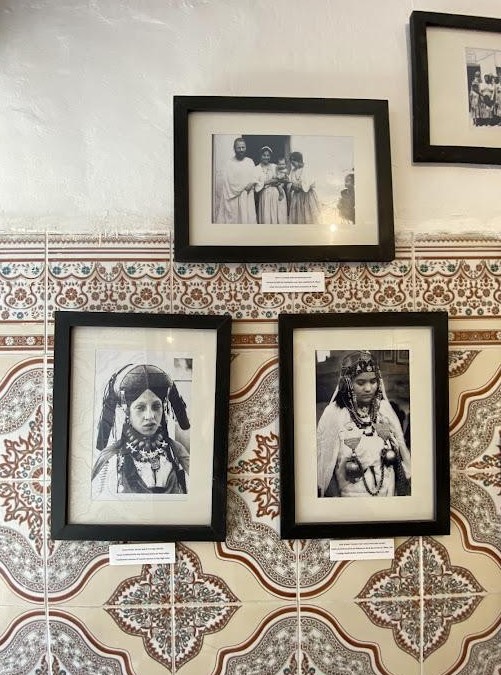
What about the others? Most of Morocco’s Jews emigrated between the 1950s and 1980s to Israel, but also to France, Canada, and the United States. While some Jewish families originally from Morocco occasionally visit, many young people of Moroccan Jewish heritage have never set foot in Morocco. As children of the diaspora, they hold an image of their country of origin that is at times catastrophic, at times romanticized. Some, like their parents, travel to Morocco on pilgrimage for the hillulot of the many Moroccan Jewish saints. Others, particularly those from Israel, used to visit Morocco and the cities of their ancestors before October 7, 2023. Most have forgotten, in a generational effort to integrate into their countries of the diaspora, Darija, the Moroccan dialect, or Tamazight—languages their grandparents had mastered. The reasons for these departures are varied and subject to debate. One reason is independent Morocco’s international alignment with the political ideology of Pan-Arabism and its non-recognition of Israel. Growing insecurity—both economically and within the community—also drove many Moroccan Jews to seek a future elsewhere. Contributing to these mass departures abroad were propaganda and the activities of Zionist movements, which promoted the dream of untapped land in Israel against the backdrop of a highly fragile Moroccan economy. The end of the French Protectorate—which had made “Jewish subjects” the primary beneficiaries of its civilizing mission—by establishing a school system that had undoubtedly brought many Jews closer to French culture—played a role in the decision to leave for metropolitan France.
Staying, Returning, Leaving
Depicting this multiplicity of contexts—both diasporic and local—is no easy task. The constitutional recognition of the “Hebraic component” of Moroccan identity seems insufficient in light of the rich and diverse history embodied by the Jews of Morocco. And it seems even less sufficient with regard to the Jewish community that decided to remain in the country, not without difficulties. Why did they choose to stay? That is the question I asked myself during field research for my graduation thesis, which led me to speak with several Jewish people who remained in Morocco.
As a teenager, she joined a Zionist movement in Casablanca that organized the departure of Jews to Israel. “My role was to accompany them to the port and to cry. Everyone was crying—those who were leaving and those who were staying. They knew they were leaving forever.”
It was in this context that I met Ms. F., one evening in October 2021, in Casablanca. Ms. F. was born in the Casablanca medina in 1944, the eldest of a large family. But, like many of her fellow Jews, she has not always lived in Morocco. It was not until 1993 that she returned there with her daughter, D., who has settled with her own family in Marrakesh.
As a teenager, she joined a Zionist movement in Casablanca that organized the departure of Jews to Israel. “My role was to accompany them to the port and cry. Everyone was crying—those who were leaving and those who were staying. They knew they were leaving forever,” she says, sipping orange juice. In 1967, she decided to move to a kibbutz in Israel, where she experienced the Six-Day War from a trench: “I thought I was going to die. The Zionists told us that the Arabs and Nasser were going to devour us alive. […] I also came to understand what Zionism was: a colonial project for the Jewish people,” she confides to me. So she emigrated to Paris, where she was active in communist and anti-Zionist movements and collaborated with André Azoulay on the socialist-oriented magazine *Combat de la diaspora*.
When I ask her to tell me about the departure of Jews from Morocco, Ms. F. tells me it was “a population transfer.” Those who stayed, like her parents, are heroes to her. “It’s thanks to them that I was able to return,” she says without hesitation. Her parents remained in independent Morocco, even though it offered little security for Moroccan Jews. Ms. F.’s father—whom she notes, however, followed the Zionist congresses—decided to stay because he feared that economic and social life in Israel would be monopolized by Europeans. “They,” he said, “will rule us in Israel just as the French ruled us here.”
Ms. F.’s anti-Zionism, however, is not shared by all the Jews who remained in Morocco. My neighbor, on Boulevard de Paris in Casablanca, is at least 80 years old. I haven’t asked her her age, and she doesn’t tell me. She asks me to call her Mrs. A. , and offers me tea prepared by Fatima, the woman who has been helping her around the house for over twenty years. Mrs. A. has another answer to my question: Why did you stay? She hesitates a little, and then she says, “When I was young, the Arabs were mean to us. Today, they’re kind. They help me with my shopping; I have porters; they bring me what I need. You just have to know how to talk to them, you know: here, we say ‘shukran’ to say thank you. But if you say to them, ‘Allah yrham al-walidin,’3 they’re much happier.”
“I used to have this illusion—that I could always continue living a Jewish life in Morocco while coexisting with Muslims, a peaceful coexistence that would make tolerance an intrinsic part of that encounter. But it’s an illusion, because there are no more encounters—there are no more Jews. ”
As with many other Jewish people I meet who have stayed in Morocco, things seem to go without saying. Some have returned after stays in France, Canada, or Israel to care for their elderly parents. Others have returned to start a business in Morocco or to take over family businesses.
The fact is that they have returned to—or remained in—a country where, until 2011, their identity—their history, their culture, their religion—was not recognized as part of Morocco’s national identity.
And where their community, once the largest in the Arab world, has dwindled to just a few individuals, many of whom are considering leaving Morocco soon. With a touch of nostalgia, S., principal of the Lycée Maïmonide in Casablanca, aptly sums up this sense that the history of Morocco’s Jews is coming to an end—a sentiment I encounter among many of the people I speak with. “I had this illusion that we would always be able to continue Jewish life in Morocco while living alongside Muslims—a peaceful coexistence that would make tolerance an intrinsic part of that encounter. But it’s an illusion, because there is no longer any encounter; there are no longer any Jews. ”
In light of this small, ever-shrinking community, what, then, does the recent constitutional recognition imply? Does it mean that the state acknowledges the Jewish community’s historical contribution to the construction of Moroccan identity? Does it mean that “Hebraism ” is a shared legacy of identity that all Moroccans possess, as claimed by a growing number of young people who hold a secular view of national identity?
Jewish heritage under the king’s patronage
Since 2011, Judaism has gained an increasingly important place not only in the Constitution but, above all, in cultural projects led by King Mohammed VI, in collaboration with representatives of the country’s Jewish institutions.
One of the most significant expressions of the promotion of Judaism through cultural policies is undoubtedly the restoration of the Kingdom’s Jewish cemeteries. Under the King’s auspices, this project to renovate Jewish cemeteries involved 167 “houses of the living ,” as they are called in Hebrew, out of the 200 cemeteries that exist today in Morocco, between 2010 and 2014. The restoration of these sites was the subject of a conference held at the Arab World Institute (IMA) in Paris in February 2015, attended by Serge Berdugo, Secretary General of the Council of Jewish Communities of Morocco, and Ahmed Taoufiq, Minister of Islamic Affairs. The IMA, a Parisian museum and think tank, has a special connection with Morocco, the country of origin for many of the Institute’s patrons, who wield significant diplomatic influence over the museum’s decisions.4 Exhibitions dedicated to Morocco have been a staple of the Institute’s program since its inception, and the conference on the renovations is part of an effort to highlight Morocco as a model of interfaith coexistence. “ Morocco, an exceptional country, deserves an exceptional relationship with the Arab World Institute,”5 reaffirmed Jack Lang, then president of the IMA, in 2021. These cooperation projects are made possible by the historic ties between Morocco and the Paris-based Institute, strengthened by the significant participation of Moroccan stakeholders in the exhibition “Jews of the East: A History Spanning Millennia.” Judaism plays a prominent role in relations between Moroccan and French cultural circles. This exhibition, for which Jack Lang directly reached out to Morocco and the National Foundation of Moroccan Museums, served as an opportunity to reaffirm the central role that Morocco’s management of Jewish religious affairs plays on the international stage. In February 2021, the Institute’s president emphasized Morocco’s exceptional status: “Morocco is an exception in that it claims […] its Hebrew heritage.”6
The restoration projects discussed at the 2015 conference held at the IMA involved not only Jewish cemeteries but also the mellahs—the neighborhoods where Morocco’s Jewish community once lived—and the Kingdom’s synagogues. On May 10, 2023, the Meier Toledano di Tanja Synagogue was inaugurated by the Jewish community, under the leadership of Serge Berdugo, in Meknes. This is just the latest in a long list of holy sites that have been restored to become small museums dedicated to the history of the city’s Jewish community. In Casablanca, the Ettedgui Synagogue now houses a photographic collection that tells the story of Casablanca’s large Jewish community.
In Marrakesh, the mellah has been restored. Since 2017, the main entrance gate to the Jewish quarter, located just a stone’s throw from the majestic Bahia Palace, signals to visitors that they are entering the Hay al-Mellah, the mellah district, which was renamed the as-Salam7 neighborhood about twenty years ago. The pedestrian alleys of the herb and spice souq have been entirely paved with white slabs and covered with a wooden structure. The facades of the shops and houses facing the mellah’s shopping street have been renovated and standardized, and the shop doors have been refurbished with wood and wrought iron. Four of the mellah’s 140 fondouks8 have been renovated, and countless dilapidated houses have been completely rebuilt.
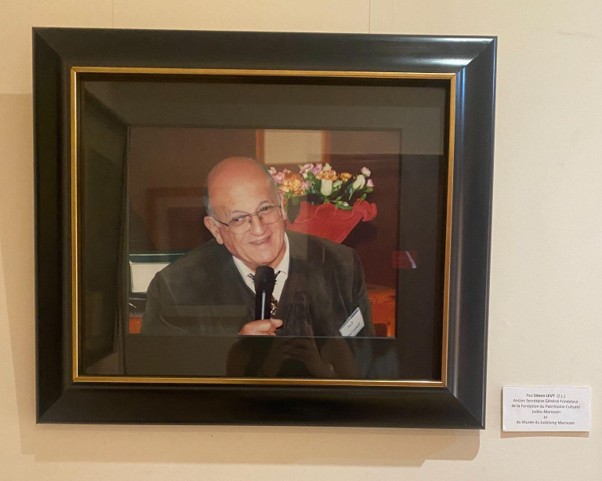
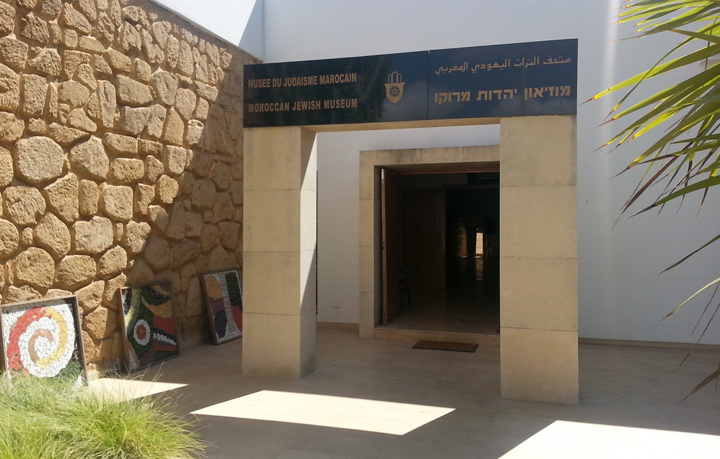
Closely linked to these restoration policies, four museums dedicated to Judaism have been established in the Kingdom. The oldest, the Museum of Moroccan Judaism in Casablanca, opened its doors in 1998, thanks to the efforts of Simon Lévy, a socialist activist, anthropologist, and Jewish-Moroccan writer.9 This 600-square-meter museum is located in the residential neighborhood of L’Oasis in Casablanca. Most visitors arrive by private taxi, as the majority of Casablanca’s small-taxi drivers are unfamiliar with the Museum of Moroccan Judaism. The site chosen for this museum formerly housed a Jewish orphanage, the Murdoch Bengio Home, founded in 1948 by Célia Bengio with the support of the American Jewish charity, the Joint Distribution Committee. It was converted into a yeshiva in 1966. In the museum’s entrance courtyard, a sign reading “Bengio Home” in French and Arabic survived the orphanage’s renovation in 1994 –1995 by architect Aimé Kakon. As the first museum of Judaism in the Arab world, this space has received an enthusiastic international reception.
André Azoulay describes Essaouira as “unique because of this intimacy, this closeness, this porosity, this interconnection between Islam and Judaism in the land of Islam.”
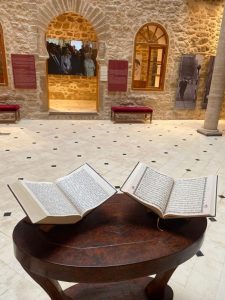
Some 350 kilometers south of Casablanca, in January 2020, King Mohammed VI inaugurated the Bayt Dakira cultural center—the “house of memory”—in Essaouira. This complex includes the renovated Slat Attia Synagogue, dating from 1899, an exhibition space, a theater, and a cultural center. Many synagogues have since disappeared from the city, which once had thirty-seven.10 This project was supported by André Azoulay, a royal advisor of the Jewish faith who, like his wife, is originally from the city of Essaouira. The museum welcomes visitors with a large sign bearing the name “Bayt Dakira” written in Arabic, followed by Latin script, Tamazight, and Hebrew. The message to visitors reads: “Shalom Alaykoum, Salam Lekoulam,” in a linguistic blend that symbolizes what André Azoulay defines as “a true social, philosophical, moral, and spiritual bond” between the Jews and Muslims of Essaouira. The museum’s educational materials emphasize the unique character of the city of Essaouira: “Essaouira-Mogador likes to do things its own way,” as stated on the introductory panel. Azoulay describes Essaouira as “unique because of this intimacy, this closeness, this interpenetration, this deep-rooted connection between Islam and Judaism in an Islamic land.” He continues: “I know of no other place where this has been so enduring, so long-standing, and so… responsible and mature.”11
In addition to these two exhibition spaces, other venues have opened: a museum was inaugurated in the Lazama Synagogue in Marrakesh in 2023, and a Museum of Jewish Culture, fully funded by the Ministry of Culture, is set to open its doors in Fez.
Museums for Which Audiences?
While these projects have drawn praise from Morocco’s long-standing allies, such as France and the United States, how has the Moroccan Jewish community received them? Most members of the Jewish community I’ve had the opportunity to meet have never visited these museums, even though they sometimes have a connection to these spaces.
When I spoke with D., the owner of a private tennis club in Casablanca, he told me he had visited the city’s Jewish museum perhaps once, a long time ago. However, he explains to me, his father was the caretaker of a synagogue, and upon his death, the objects it contained were donated to the museum so they could be preserved. For D., the museum isn’t a place for the community: “ “It’s touching,” he remarks, “when Muslims want to learn more about Jewish culture. I like that.” Like him, my neighbor, Mrs. A., is surprised when I ask her about her relationship with the Casablanca Jewish Museum: “What would I go there for? There’s nothing for me to see. But you should go—tourists really like it .” In fact, Jewish museums attract only a very limited audience. Simon Lévy, founder of the Casablanca Museum of Jewish History, intended the museum specifically for young Moroccan Muslims, so they could see “the Jewish component of the national civilization,” but this goal seems to have been only partially achieved.
My Jewish neighbor is surprised when I ask her what her relationship is with the Casablanca Museum of Judaism: “What would I go there for? There’s nothing for me to see there. But you should go—tourists really like it.”
The museum does, however, welcome a growing number of Moroccan students studying Islamic studies. Some of them study Hebrew as part of their university curriculum, and their professors advise them to visit the museum. The current director of the Casablanca museum, Ms. Rehihil, tells me that she is often contacted by professors from these departments, who ask her to arrange museum tours for their students. She says she always receives warm thanks from them, who tell her that the students are completely transformed by their visit to the museum. On Wednesdays, days set aside for school groups, certain classes from public and private schools also visit the museum, at the teachers’ initiative. The Jewish high school Maïmonide has established a partnership with the Wafae School and Lyautey High School centered on the theme of tolerance: every year, teachers bring their classes to the museum. During one of my first visits to the museum, young women wearing the jilbab were taking photos of the museum’s artifacts before leaving and thanking the custodian.
They are, however, in the minority. The signs are written in English and French—not in Arabic or Hebrew. Most visitors are foreigners. A significant portion of them are Moroccan Jews living in France or Israel; they stop by the museum when they visit Morocco, often during the holidays. Another significant portion of the museum’s visitors consists of Jews from Iraq, Iran, Syria, and Yemen. They explain to me that they now live in Israel and have come to visit Morocco, since they cannot return to their countries of origin. They warmly thank Ms. Rehihil, the museum’s current director, in English before continuing their tour of Morocco. Finally, Ashkenazi Jews—particularly Americans, French, and Israelis—come to visit the museum: it is a stop on their trip to Morocco, and the museum is often recommended to them by kosher restaurant owners in Casablanca, where they sample wonderful Moroccan-Jewish dishes. The museum is closed on Saturdays and for Jewish holidays, in a way that is tailored to the audience it serves today.
S. is the principal of the Lycée Maïmonide in Casablanca. He was one of the first people I met during my research stay, and he was of great help to me. He is a connoisseur of both ancient and contemporary Moroccan-Jewish history. He views these museum spaces through a different lens. When he met Ms. Rehihil, he made a point of telling her: “Madam, you may not realize it, but you’re gathering points of reference. Every object here has meaning. There is a lived experience behind these objects. It is that lived experience that ensures these objects are not mere symbols.” According to S., the museum deserves credit for gathering points of reference for a community that today struggles to find them in Morocco—due to its small size, the loss of legitimacy among its community’s political representatives, and the government’s whitewashing of its history. The museum’s objects are therefore not important for the history they tell, but because they bear witness to lived experiences—sometimes painful, sometimes peaceful. What matters to S. is that these objects do not become static symbols. Yet they tend to do so, as they come to symbolize the tolerance and harmony that are said to have always characterized Moroccan history—and that Morocco seeks to highlight.
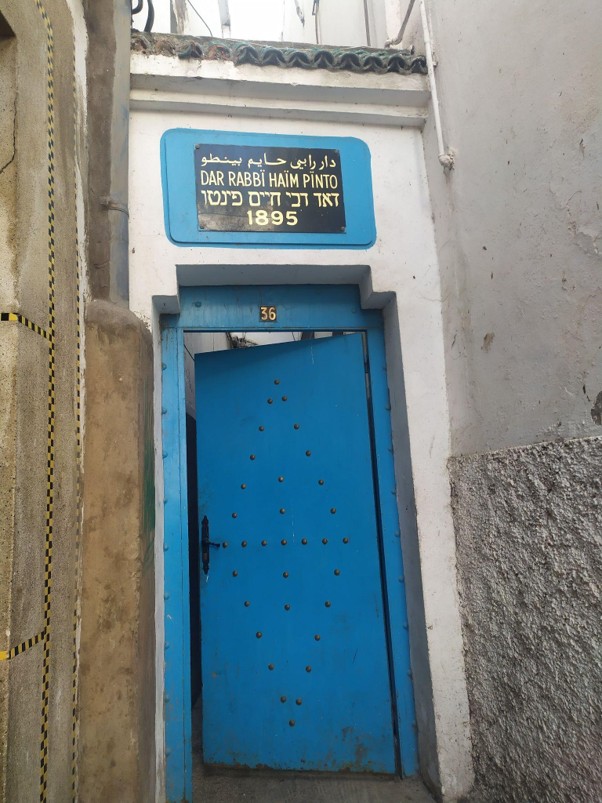
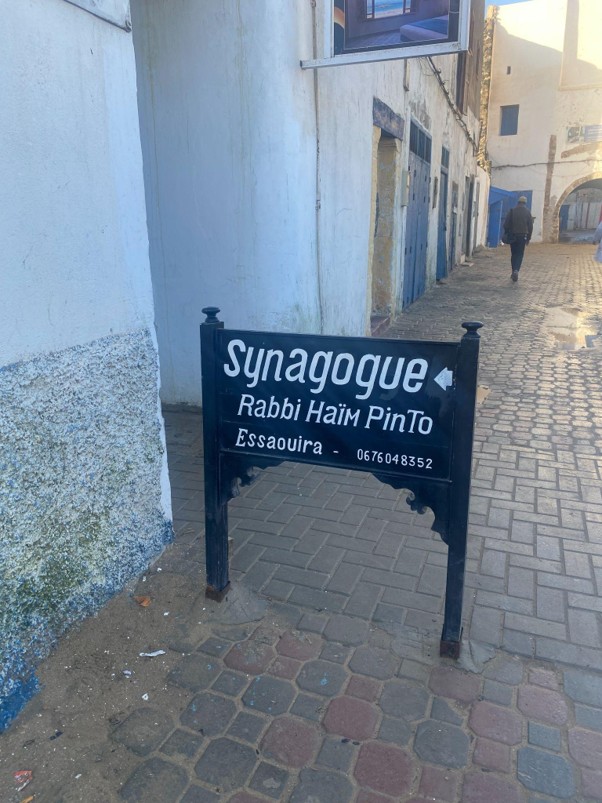
There are, however, other ways of presenting Moroccan Judaism within this heritage ecosystem, characterized by a “bottom-up” approach and existing on the margins of high-profile projects led by community and national institutions. It was while meeting Haïm Pinto, in the home of his grandfather, Rabbi Haïm Pinto Hakatan, that I discovered the the existence of a heritage that continues to thrive through a dual approach of preservation and the active, living practice of the place. Haïm, whom I met several times between 2021 and 2025, is the last descendant of one of Essaouira’s most revered saints—Rabbi Haïm Pinto Hagadol—and of his grandson, Rabbi Haïm Pinto Hakatan, who is buried in Casablanca. After emigrating to Canada at the age of 13 and having worked there as an accountant for several decades, he returned to Casablanca upon the death of his uncles to care for the home of Rabbi Haim Pinto—a place of devotion for Casablanca’s Jewish community that houses the artifacts of the saint from Essaouira, Haim’s great-grandfather.
Haïm Pinto installed a plaque at this house, called “Dar Rabbi Haïm Pinto,” located in the old mellah of Casablanca. Worshippers and visitors there read the names of those who helped renovate the Dar, which had been in ruins for about ten years. Haïm shows me the letter he sent from Canada, where he was living, to prominent Jewish families settled in North America, Europe, and Morocco. That is how, he explains, he was able to raise a substantial sum of money, which he used to completely renovate the saint’s house. He adds, proudly, that the names listed on the plaque are not exhaustive: many more families and individuals from the diaspora contributed financially, but not all the names could be included.
This place remains a site of religious practice for the city’s Jewish community, which does not seem to envision it being incorporated into a heritage initiative similar to those undertaken in other sites. Although many tourists visit this house, and it has been included in several tourist itineraries organized by both local associations and travel agencies, the Casablanca community—composed mainly of elderly people—continues to view Dar Rabbi Haïm Pinto through a religious lens. As in the case study of Tunisia’s Ghriba, presented by researcher Afef Mbarek, the Dar is, for the Jewish community, “the foundation of religious practice, worship, and communal memory.”12 Touching the rabbi’s jellaba, lighting a candle, asking for the saint’s protection or help, and leaving an offering for the upkeep of the house are practices to which the Casablanca community attaches traditional significance. These practices coexist with tourist activities, such as signing one’s first name in a guestbook or paying a fee—which, for non-believers, is the only way to access this hybrid space. The caretaker, Haïm, makes it clear that this place is not a museum and is not intended for tourists—or at least not exclusively: it is a historic site of the Jewish community in Casablanca, and it will continue to be so after he is gone. Thus, while all these actors are invested in the preservation of this heritage, there is no shared definition of what constitutes heritage. And, through this, the definition of what “Moroccan identity” is also deserves to be discussed, both within and outside the Jewish community.
- Preamble to the Constitution of the Kingdom of Morocco, 2011. ↩︎
- Kamal Hachkar, Dans tes yeux, je vois mon pays, Maroc-France, 2019. ↩︎
- This expression literally means “May God have mercy on your parents,” and is often used in place of “please” or “thank you.” ↩︎
- In 2019, for example, the Sahrawi singer Aziza Brahim was scheduled to perform at the IMA. Pressure from Moroccan diplomats and patrons led the Institute to cancel the concert. RFI, Under Pressure, the Arab World Institute Cancels a Sahrawi Singer’s Performance, March 2019. ↩︎
- Le Courrier de l’Atlas, L’Institut du Monde Arabe et la Fondation nationale des Musées du Maroc, de grands projets en vue, September 2021. ↩︎
- Bladi, L’Institut du Monde Arabe sollicite le Maroc pour une exposition sur le judaïsme, February 2021. ↩︎
- As-Salam means “Peace.” ↩︎
- Old inns and warehouses. ↩︎
- A Moroccan Jew and anti-Zionist, Simon Lévy became active in the Moroccan Communist Party. He withdrew from politics when he decided to devote himself to the Foundation for Moroccan Jewish Heritage and the Museum of Moroccan Judaism in Casablanca in 1999. For his full profile, see: Telquel, Simon Lévy, the Death of a Symbol, February 2012. ↩︎
- Built at the behest of Mima Attia in memory of her husband, a wealthy merchant who died while traveling in Liberia, the Attia Synagogue was designed by Mr. Koffman of Manchester, who made it the city’s only synagogue in the English style; as a result, it was already enjoying international recognition and appreciation by the end of the 19th century. The Jewish Chronicle’s correspondent in Essaouira praised its qualities and beauty, as well as the participation of the city’s entire community in its dedication, in an article published in 1899.
↩︎ - Medi1TV Afrique, André Azoulay : Bayt Dakira exprime la singularité d’Essaouira, January 2020. ↩︎
- Afef Mbarek, « Entre classement et patrimonialisation : les usages du patrimoine judéo-tunisien », L’année du Maghreb, 2018. ↩︎

Chiara Lutteri
Chiara Lutteri is a doctoral candidate in contemporary history at the Telemme Research Laboratory at Aix-Marseille University. She has lived in Rabat and Casablanca, where she also worked as a teacher. Her research focuses on the political role of Jewish heritage in Morocco, examining museums and heritage sites as spaces for institutional interaction, the negotiation of memory, and the staging of evolving identities.