Israel, an Irish Obsession
From Belfast to Dublin: Anti-Zionism as the Dark Heart of Irish Nationalism
In ‘Ulysses’ (1922), one of James Joyce's characters makes this quip: Ireland never persecuted the Jews because it never let them in. A little over a century later, in November 2025, the Northern Ireland Assembly nearly collapsed because a minister had visited Israel, in connection with a conflict 1,500 kilometers away over which it has no control. Cillian McGrattan does not view this episode as a passing fad. He sees it as a symptom of a phenomenon that is both deeper and older. Why does Israel occupy such a prominent place in the Irish political imagination? How has hatred of Israel become such a central defining feature of Irish nationalism?
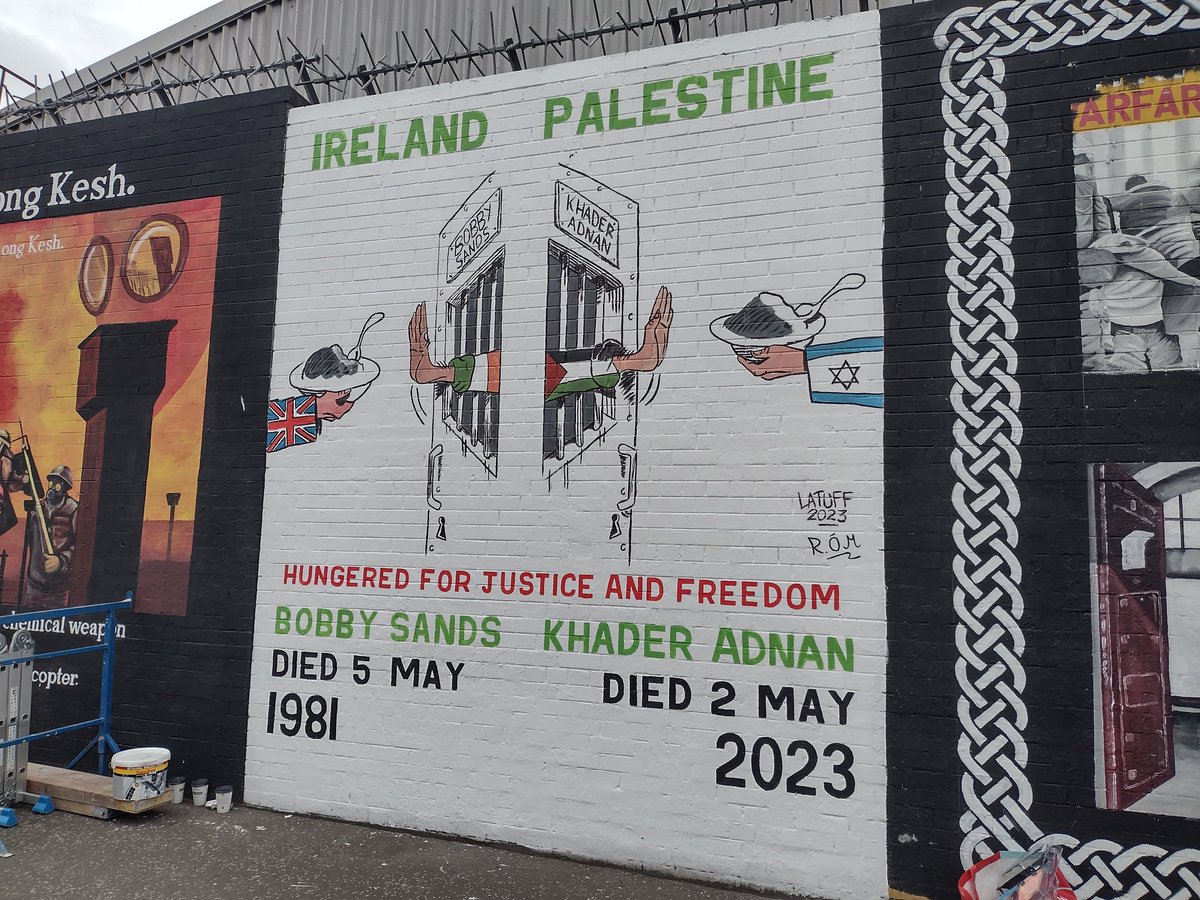
Between the end of October and mid-November 2025, the Northern Ireland Assembly faced collapse because of a motion of no confidence in the Education Minister because he (with other elected representatives) visited and voiced support for Israel. At the beginning of 2026, meanwhile, a damning, and much publicized, survey demonstrated substantial levels of Irish ignorance – particularly among young people – regarding basic facts about the Holocaust. Not surprisingly, unfortunately, antisemitic attacks are on the rise. More recently, during a debate on a report into the use of Irish Republican Army informers by the British security forces (and the apparent willingness of the latter to countenance murder, rape and child abuse by the former) in the Irish parliament, a comparison between the Northern Irish ‘Troubles’ and ‘the genocide we have witnessed in Gaza’ was allowed to stand uncontested. I wish to suggest that the obsession of the Irish political classes with Israel – north and south of the Irish border – reveals two points worthy of note and further study: a.) antisemitism is an intrinsic, foundational and definitional element of Irish nationalism; and b.) the Irish nationalist fixation on Israel demonstrates how antisemitism itself works from and around a ‘lack’.
Northern Ireland and Israel
Northern Ireland is governed by a power-sharing executive made up of elected representatives of the two main ethno-religious blocs – Ulster Unionists and Irish Nationalists (or Irish Republicans) – along with a cross-community party, Alliance. Israel/Palestine has symbolized those divisions for many years. Until the identification of the left with Palestine became ubiquitous throughout western Europe, visitors to Belfast might have been surprised to see the ethno-religious geography of Catholic/Nationalist areas and Protestant/Unionist ones demarcated by the flying of these flags. Northern Ireland’s Catholics tend to be Nationalist in political orientation – that is, they favour ending partition on the island of Ireland – and Irish in cultural outlook. They make up a bit more than 40% of Northern Ireland’s population. Protestants tend to favour maintaining the constitutional Union with the rest of the UK and are largely British in cultural orientation. They make up a bit less than 40% of the population. Until Brexit destabilized the Catholic bourgeoisie, there was an implicit consensus on maintaining the constitutional link – though opinion polls consistently indicate that while voters wish to keep the status quo, this is primarily due to concerns about the healthcare system and the cost-of-living crisis..
The visit of the Education Minister to Israel at the end of October 2025 might have passed with some condemnation by nationalist politicians had not Gerry Carroll – of the far-left People Before Profit party) – introduced a no-confidence motion. In reality, the motion was always bound to fail because it would require cross-community support within the Northern Irish Assembly: Nationalists and the Alliance Party voted for censure, while Unionist representatives voted against. For it to be effective, such a motion requires either a collapse of the institutions or a change of procedures – the latter has been initiated.
Certainly, there is an element of demagogy at play in calling for a vote of no-confidence; however, if the aim was merely to create political theatre then other mechanisms could have been triggered (ministerial questions or requests for debating time, for instance). Indeed, much of what constitutes the Irish fixation with Palestine (North and South of the border) can be filed under the heading of localized politics by proxy. But the very fact that Carroll was willing to risk pulling down the Assembly over Israel reveals something more than ordinary demagogy.
Irish Nationalism and Antisemitism
The fixation on Israel in Belfast and Dublin isn’t just down to everyday or ephemeral concerns. Writing in the Irish Times, Ed Abrahamson, a paediatrician, argued that Irish nationalism responded to the conflict with Hamas by having ‘demonised and dehumanised an entire nation’. The anti-Israel ‘rhetoric’, for Abrahamson, ‘goes beyond strong criticism or sanction – it has been inflammatory, and sometimes hateful’.
However, this ‘McCarthyite fervour’ is not simply a sort of passing collective illness. The anti-Israel position is now a central ideological tenet for Irish identity and belonging: To be an Irish nationalist is to be anti-Israel; to think of oneself as belonging to an Irish nation means thinking of oneself as being against Israel. That is what is unveiled in the fact that the power sharing Assembly – arguably, the key institution of the Irish peace process – can be threatened over a conflict in which it has zero influence a thousand miles away. In other words, being anti-Israel in nationalist Ireland isn’t something merely symbolic or performative; it is existential, profound and exclusionary of alternatives.
The tropes of antisemitism/anti-Zionism recur in this Irish discourse – and the terms of the ‘new left’ identity politics fit seamlessly into the Irish nationalist version of history based as it is on claims of victimhood, oppression and imperial injustice. But the reproduction of old and new blood libels (killing children, ‘genocide’, the conspiring, untrustworthy and powerful Jews) within that narrative are now more easily detectable. The lack of historical or political comprehension is reinforced by never having to explain. A prominent example is the case of the member of the Irish republican supporting rap group Kneecap who waved a Hezbollah flag at one or shouted ‘Up Hamas’ at another one and who chose to not defend his views in Court but sought get his terrorism charges dismissed on the technicality that they fell outside of a legal timeline. (UK prosecutors are, at the time of writing, continuing to pursue this case.)
This absence in court exemplifies a distinctive feature of contemporary antisemitism, particularly evident in Ireland. It is a lack: a lack of explanation, a lack of public acknowledgment of the political objectives these slogans actually point to, and a lack of open discussion of the threats they implicitly contain. This absence seems to be inherent in the rhetoric of anti-Israeli demonization, which hurls accusations to stir up mobilization but systematically shields them from the court of reason. The self-righteous accusers then feign surprise when some people draw practical conclusions from their rhetoric and act accordingly. But what should one do, once the Devil has been identified?
It takes a special kind of mendacity for Irish academics to pretend to be unaware of the history of assassinations and the deliberate targeting of families, farms and businesses along the Irish border but write blithely about ethnic cleansing in Gaza and complain about a Jewish state as if nationality and religion are not the basis of the political institutions on both sides of the border – or indeed, as if religion had nothing to do with nationality as a mode of state-building.1 A few weeks after the October 7th massacre, 600 Irish academics put their names in an open letter to the Irish Times. They called on their universities ‘to immediately [sic] severe … partnerships or affiliations with Israeli institutions’ and to ‘suspend’ links ‘until the occupation of Palestinian territory is ended, the Palestinian rights to equality and self-determination are vindicated, and the right of Palestinian refugees to return is facilitated’.
No doubt that some of the academics put their names to the letter of shame out of a sense of self-importance and others out of fear (it has become costly to find oneself on the “wrong” side of this issue…), but all of them contributed to the ambient antisemitism by leaving the question as to what would follow unanswered. If it is two-statism the academics had in mind, then they ought to have said so and said how the continued existence of Hamas within a Palestinian state, would have permitted the continued existence of Israel; if it was one-statism, then they should have said how that would have allowed the continued existence of Jews in the region. This type of political inconsistency – which, in my view, borders on antisemitism – is clear across not only swathes of Irish academia but has also colonized Irish political culture to such an extent that it is impossible to be an Irish nationalist without being anti-Israel. It is impossible to find a single nationalist politician offering anything approaching a considered answer to those fundamental questions: their position always rests on a void, which takes the form of a halt in the discourse just as it would need to address what this implies for the future of the Jews.
Proxy Wars
This almost banal kind of antisemitism, or (most certainly) normalized, stands in contrast to the prevalent argument that Jewishness (and latterly Israel) have been depicted and used as proxies for debating Irishness. The cynical joke at the beginning of Joyce’s Ulysses that Ireland never persecuted the Jews because it didn’t let them in, for instance, resonates with the idea that antisemitism was explicable because the Irish historical experience is predicated on the idea that Irish nationalists – and not the Jews – are ‘the Most Oppressed People Ever’. This MOPE-ism (a term coined by the Irish economic historian Liam Kennedy) has also been used to explain why Irish nationalists tend to identify with the Palestinians; the flying of Palestinian flags in Nationalist areas seemingly prompting Ulster Unionists to fly Israel flags in theirs.2
The identification of Irishness with an anti-Israel stance or with a pro-Palestinian was not always the case. Indeed, up to the 1970s and 1980s the opposite affiliation was much more common – Irish nationalism drew commonalities with Israel as a fellow nation-building enterprise that had also recently escaped from British control.3 For Marie-Violane Louvet, the ideological shift occurred within the context of a reassertion of more traditionalist nationalist beliefs after a period of questioning of the relationship between Irish nationalism and violence following the outbreak of the ‘Troubles’ in the late-1960s. The rapid escalation of violence occurred in the early years of the 1970s and eventually saw over 3,500 people killed across three decades until the 1998 Belfast/Good Friday Agreement. During that time Irish republican terrorists killed just under 60% of people, Ulster loyalist terror groups killed just under 30% and state forces – the police and the British army – accounted for about 10%.
Following a period of reappraising in the 1970s and 1980sy of Irish nationalist ideology, due to its central role in republican terror, a rehabilitation of nationalism began in the late-1980s – coinciding with the repositioning of Israel as an idée fixe of Irish nationalist consciousness. Louvet describes the outcome:
Some of the domestic readings enclose the Middle East in an Irish framing that tends to iron out the differences and to overlook the specificities of dissimilar geopolitical situations to favour the reign of comparison. Comparison involves an identification with the Israeli or Palestinian causes in Ireland, with some activists deploying markedly Irish reading-grids to analyse the situation in Palestine/Israel.4
The deployment of imaginary geographies worked to invert the earlier identification with Israel across Irish nationalism. The physical force fundamentalists within Irish republican circles had long drawn on Fanon and Marxian inspired ideas about de-colonization; but, as Louvet demonstrates, trade unions, charities and the political class north and south of the border all began to develop affinities with the Palestinian cause. No doubt the new Palestinianism flourished on fertile ground – the incipient antisemitism alluded to by Joyce was evident in an anti-Jewish boycott in Limerick city the same year as Ulysses was set, 1904. As one of the key historians of Ireland’s small Jewish community, Dermot Keogh, rightly points out much of the antisemitism experienced was low-level antagonism and Othering.5 Although, Louvet mapped the growing obsession within Irish politics and civil society that general pattern of being a marginal issue that occasionally breached the Overton Window of public attention was, arguably, the case until quite recently.
But by the 2010s an anti-Israelism had become a reflexive aspect of Nationalist politics. For the journalist and activist David Collier, it pervaded Irish nationalism and was shared by both the political elites and the general public in the Irish Republic. As Collier argues in an in-depth survey of Irish nationalism (published in 2021), politicians and the media reserve the term ‘antisemitism’ for the far right, while describing their own Israel-hatred as anti-Zionism. Collier correctly predicted that the rise of the extremist nationalist party Sinn Féin (‘We ourselves’, or ‘Ourselves Alone’ as his opponents have translated it) would fuel what was already widespread and ‘virulent’ antisemitism. The party, which is the Opposition in the Republic and the largest party in Northern Ireland, was linked to republican terrorism during the conflict and remains controlled by a secretive eight-member committee, five of whom are from Northern Ireland. It has a long history of antisemitism6, including – if one considers his ties to the pre-split IRA of 1969 – an episode of collaboration with the Nazis.
Ends/Means
As Abrahamson has averred in relation to the Irish Republic, Israel-hate in Northern Ireland has the characteristic of a collective passion. But to dismiss it as a fervour (as per what the subeditor gave to the heading of his piece in the Irish Times) mistakes the symptoms of a passing fad – or a fever – with the underlying pathology. This is an easy mistake to make because the symptoms tend to mask the problem. According to the basic anti-Zionist argument, Zionism is the issue – Israel is an apartheid state because it prioritizes Jewishness: ‘Is not the very concept of a Jewish state the ultimate in discrimination? By definition the creation of a state based on religion and ethnicity in an inhabited land can only be achieved by a degree of ethnic cleansing’.7 This understanding creates a binary opposition between antisemitism and anti-Zionism that nationalist Northern Irish parties have exploited.
There is, of course, a doublethink involved in recognizing the existence of Israel while disavowing its legitimacy – let alone, the hypocrisy involved in proclaiming an ideology of self-determination for (nationalist) Ireland while denying that to Jews. But the contradictions that arise from this—and which could only be resolved through a consistent development of the argument—are most often masked by a refusal, or an inability, to follow through on the argument. The antisemitism that pervades Irish public debate is always linked to this shortcoming, to this tendency to back down (at least in public) from the consequences of what is being argued.
The failure to articulate an answer to the question of what follows means that the link between antisemitism and anti-Zionism gets occluded. As such, it is easy to miss how Israel-hatred has moved on in Ireland. Thus, for academic authors such as Louvet, or journalistic authors such as Collier, Irish antisemitism is a product of factors such as the influence of violent republicanism within more moderate constitutional nationalist circles; or it is associated with the real or residual influence of the Catholic Church. However, with activists such as Carroll and the PBP pulling the discourse towards a much more extreme place, antisemitism is no longer the means to an end. In other words, it is no longer a tool to be utilized in the pursuit of Irish unity; it is the central mechanism operating what it means to be Irish and how Irishness comes to be understood through it.
The migration of Israel to the centre of the political debate is, of course, not unique to Ireland. But its grounding at the heart of ideology and identity is something new in Irish nationalism. The no-confidence motion introduced by Carroll emblematizes and enacts that movement. Although I taught Gerry at undergraduate level and have welcomed his support on cold and wet union pickets, I am unsure if he is well versed in the Trotskyite tradition from which his party originates. A key tactic of that approach is entryism – namely, the attempt to change the culture of groups or institutions by bringing in members who embody the ideological perspective to be promoted. Highlighting specific issues to win victories on to gain political capital and move forward is a tried-and-trusted strategy of this tradition. The party made significant progress on issues such as water rates in the Dublin but has struggled to gain traction in Northern Ireland. The Israeli response to the orgy of rape and murder by Hamas provided Carroll with a political opportunity.
Carroll’s party is a mixture of bourgeois academics and students. It struggles to gain many working-class votes (which tend to go to the Democratic Unionist Party and Sinn Féin in Northern Ireland). As such, Carroll’s Israel-hatred echoes another twentieth-century ‘ism’ – one that Trotsky himself located in the alienation and apathy of the petite bourgeoisie – that also obsessed about Jews.
It does not take long to identify Carroll’s particular obsession with Israel. Aside from his social media presence, his performance in the Assembly is clear. He has tabled 11 motions since the October 7 attacks, three have been about Israel – not including his latest. He has submitted numerous ‘matters of the day’ requests, which allow a Member to make a statement to the Assembly on an issue they deem important or that ‘directly affects the people of Northern Ireland’. These have included speaking about the aforementioned Kneecap member’s arrest for allegedly supporting Hezbollah and Hamas; Israeli airstrikes in Lebanon; and Israeli businesses and banking.
Infamously, and obscenely, Carroll cheered Hamas on to ‘victory’ in an X post on the 7th October itself. But he has continually tried to frame his position as anti-Zionist rather than antisemitic. Carroll plainly desires the end of the Israeli state – there is nothing else that ‘victory’ to Palestinian terror can mean. As such, it is unsurprising that he selectively quotes material on antisemitism and anti-Zionism to suit his claim to be non-racist and not antisemitic. Thus, Carroll cites a small phrase in the Jerusalem declaration on antisemitism that there is a categorical difference between antisemitism and anti-Zionism to substantiate his contention that the IHRA definition is inadequate. Carroll ignores the very next line that clarifies that anti-Zionism can be antisemitic. He must have missed point 10, which explains where anti-Zionism and antisemitism overlap: ‘Denying the right of Jews in the State of Israel to exist and flourish, collectively and individually, as Jews, in accordance with the principle of equality’.
Wherever Carroll’s party gains representation, it pushes an anti-Israeli line. In January 2025, for example, a local government councillor made a proposal for his council to ask the Irish government – that is, the government of a separate jurisdiction – to reject the IHRA definition. The minutes note that the councillor made what seems to have been a rambling speech before stating that
the Irish Government were to legislate for the International Holocaust Remembrance Alliance’s definition of anti-Semitism. He noted that [the] definition of Anti-Semitism equated to anti-Zionism, the opposition to Israel and the ethnic cleansing and genocide of Palestinians in Gaza. He believed that it was disgraceful that this was one of the Irish Governments’ priorities.
Of course, the irony is that Carroll’s party complain about the definition of antisemitism being a governmental priority when Israel is their consuming passion – the reference to Gaza in beginning to address a report on an aspect of the legacy of the Troubles, cited at the top of this paper, is from a PBP representative.
Antisemites Alone
At the beginning of his essay on antisemitism, Sartre states that you can’t be an antisemite alone – the antisemite needs a group to protest too and needs a group (the Jews) to protest about. He goes on to map how antisemitism spreads like a cancer: It is ‘more than a mere “opinion” about the Jews … it involves the entire personality’. The case of Irish nationalism demonstrates how this occurs because of rather than despite the substitution of the postcolonial notion of anti-Zionism. It is because anti-Zionism works to occlude that it (re)produces antisemitism. The apparent confusion caused by that occlusion does not negate responsibility for the implications despite what its users believe. It does not exonerate; its open-endedness demands resolution. The paradox of the lack is that that resolution remains suspended. The modus vivendi of the nationalist antisemite is the denial of resolution; it is the foreclosure of an answer to the question of what lies beyond the virtuous pose; it is the culture of the threat of othering.
The refusal by Irish nationalists to explicate what follows from their Israel-fixation is denotive of antisemitism precisely because of what it connotes – the evocation of the destruction of Israel and the conjuring of eradication of a Jewish presence in the region. The lack of an explanation, which Irish nationalism now proceeds from, is not simply ignorance – it is the point of the ideology. For decades8, Irish nationalism has, of course, ignored the collective Unionist trauma: one could argue that Israel is now the place where this “willful ignorance” has taken root. This is not just about the academics who signed the letter, nor the politicians who are unable to follow through on their words, but about the Irish people as they ask themselves who they are. It is not only the horror of the annihilation of the Jews that prevents these academics and politicians from saying the unspeakable, but the fact that the stability of their national identity depends on a dark and blind spot that must above all not be investigated.
If to be an Irish nationalist is to be an antisemite, the reverse is, of course, not the case. What the Irish example illustrates is that antisemitism generally stems from a deficiency: it is recognizable by the silence of reason following the ostentatious display of virtuous platitudes. This void lies at the point where moral passion encounters otherness – in the courtroom or in public debate – and where one must therefore take responsibility for what one says: as such, it is rife with hatred and denial. A recent Freedom of Information request revealed that in discussion about the Sinn Féin Economy Minister’s decision to ban her department from developing trade with Israel, consultation or information were de trop: ‘Minister stated that she did not require briefing on the level of trade with Israel and her stance is a moral one’.
- Kenneth Funston et Cillian McGrattan, The Northern Ireland Conflict on the Margins of History: Protestant Memory on the Border, Brooklyn (NY), Berghahn, 2025.
↩︎ - A counter, but ultimately correlative, argument could be made that in Israel’s case, the material threat attending to Jewishness is not of the same order as what the Irish political scientist Benedict Anderson famously termed the ‘imagined communities’ of many nationalisms. ↩︎
- Stephen Howe, Ireland and Empire: Colonial Legacies in Irish History and Culture (Oxford: Oxford University Press, 2002). ↩︎
- Marie-Violaine Louvet, Civil Society, Post-Colonialism and Transnational Solidarity: The Irish and the Middle East Conflict (London: Palgrave Macmillan, 2016), p. 7. ↩︎
- Dermot Keogh, Jews in Twentieth-Century Ireland: Refugees, Anti-Semitism and the Holocaust (Cork: Cork University Press, 1998). ↩︎
- O’Riordan Manus: The Sinn Féin Tradition of Anti-Semitism. From Arthur Griffith to Sean South. In: O’Riordan Manus; Pat Feeley: The Rise and Fall of Irish Anti-Semitism. Dublin 1984. ↩︎
- Dawoud El-Alami in The Palestine-Israeli Conflict, Dan Cohn-Sherbok and Dawoud El-Alami (Oxford: Oneworld, 2022). ↩︎
- Kenneth Funston and Cillian McGrattan, The Northern Ireland Conflict on the Margins of History: Protestant Memory on the Border (Brooklyn, NY: Berghahn, 2025). ↩︎