The De-Judaization of Treblinka: A Question
In Treblinka, the struggle to preserve memory is not only about the past, but also about the current attempts to erase it. In a letter addressed to Havi Dreifuss, president of the International Treblinka Council, researcher Elżbieta Janicka warns of the site’s gradual Polonization and de-Judaization. Havi Dreifuss responds by acknowledging the seriousness of the problem, while defending the need for rigorous institutional work. This feature, introduced by Jean-Charles Szurek, presents a pivotal exchange on historical truth, the ethics of commemoration, and the place of Jewish victims in the memory of the Shoah.
Introduction
On two occasions over the past year and a half (December 11, 2024, and September 30, 2025), K. review has conveyed to its readers alarming news from Poland, namely the rise of the campaign of Polonization and Christianization that is increasingly affecting the site of the Treblinka camp, where nearly 900,000 Jews perished. This is what young Belgian Jews denounced 40 years ago regarding the same phenomenon surrounding the Auschwitz museum – who does not remember the Carmelite convent and its nuns? It took them ten years to leave it, and even then: only at the behest of Pope John Paul II! — it is now representatives of the new Polish school of Shoah history who are attempting to alert the world to the nationalist takeover of Treblinka. It must be noted that the current authorities, led by Donald Tusk, who succeeded in ousting the PiS government (the Law and Justice Party led by Jarosław Kaczyński) in the last elections, are doing little to alter their predecessors’ memorial policy, clearly preferring to address other violations of the rule of law: restoring the judiciary to a democratic path, building closer ties with the European Union, etc.
However, regarding the Treblinka site, a small glimmer of hope has emerged since July 11, 2025: a new International Council of Treblinka has been established, chaired by Israeli historian Havi Dreifuss, a specialist in the Shoah in Poland.
The letter addressed to Havi Dreifuss in the Polish newspaper Gazeta Wyborcza (April 19, 2026), by Polish researcher Elżbieta Janicka, conveys the struggle she is waging, alongside historian Jan Grabowski (University of Ottawa) and other stakeholders, to counter the insidious influence of Polish nationalism at the site.
And this letter had an impact. Havi Dreifuss responded in the same newspaper (May 4, 2026), expressing agreement with Elżbieta Janicka on key points. It appears that the Ministry of Culture and this new Council are expecting significant changes, and one can assume that their influence carries far more weight than the isolated voice of a single researcher.
This situation therefore marks a turning point. But this Council will have its work cut out for it, as the policy of fait accompli practiced by the museum’s administration has continued since its creation. This is evidenced by a memorial stone in memory of the “victims of unknown nationality and religion” erected in October 2025 (see below the letter from Elżbieta Janicka) as well as panels installed in early May 2026 that illustrate “the aid provided by Poles to Jews” while, in Treblinka, Jews died in the most excruciating solitude.
This policy of fait accompli is thus intensifying. Will the new Council be able to make its voice heard? Through its president, it is calling for patience, time to have its new proposals accepted. But how long must we wait to stem this insidious campaign of de-Judaization? For years, the protests of Elżbieta Janicka and Jan Grabowski have met with silence from the authorities. Will it be the same now?
Perhaps it is time for those whose consciences are sensitive to the reality of the Treblinka extermination camp (let us recall Claude Lanzmann’s film Shoah, whose most powerful scenes concern this camp) to begin to be moved and outraged.
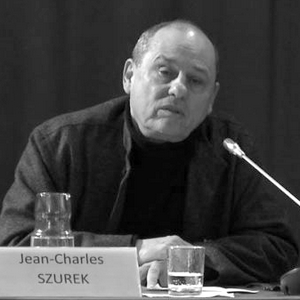
Jean-Charles Szurek
Letter from Elżbieta Janicka to Havi Dreifuss (April 2026)
Professor Havi Dreifuss
President of the International Treblinka Council
Warsaw, April 13, 2026
Dear Professor Dreifuss,
Since you have become the chairperson of the International Treblinka Council not one antisemitic artefact was removed from the site under the administration of the Treblinka Museum.
Not only do the names of Jedwabne, Radziłów, Goniądz, Kleszczele, Grajewo1 and the like remain carved on the stones at Treblinka II but also all the artefacts I have listed in three memoranda to the Polish Ministry of Culture and National Heritage (of May 8th, 2024; January 18th, 2025; April 19th, 2025) that I took the liberty of forwarding to you at the beginning of your mandate are still standing.
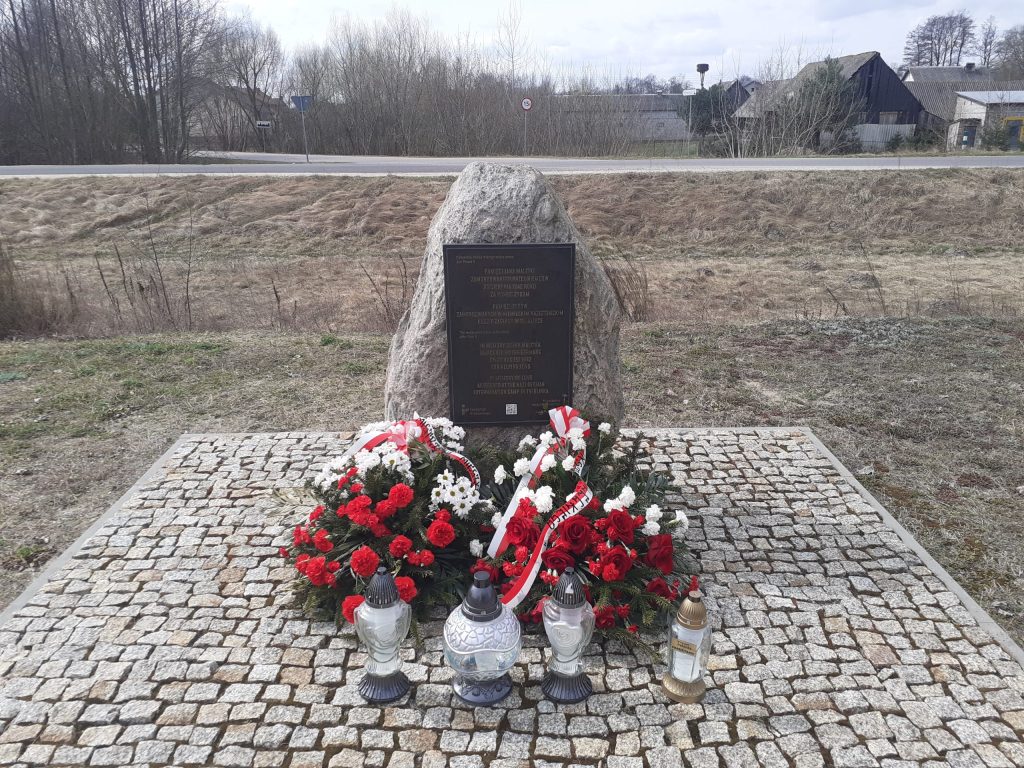
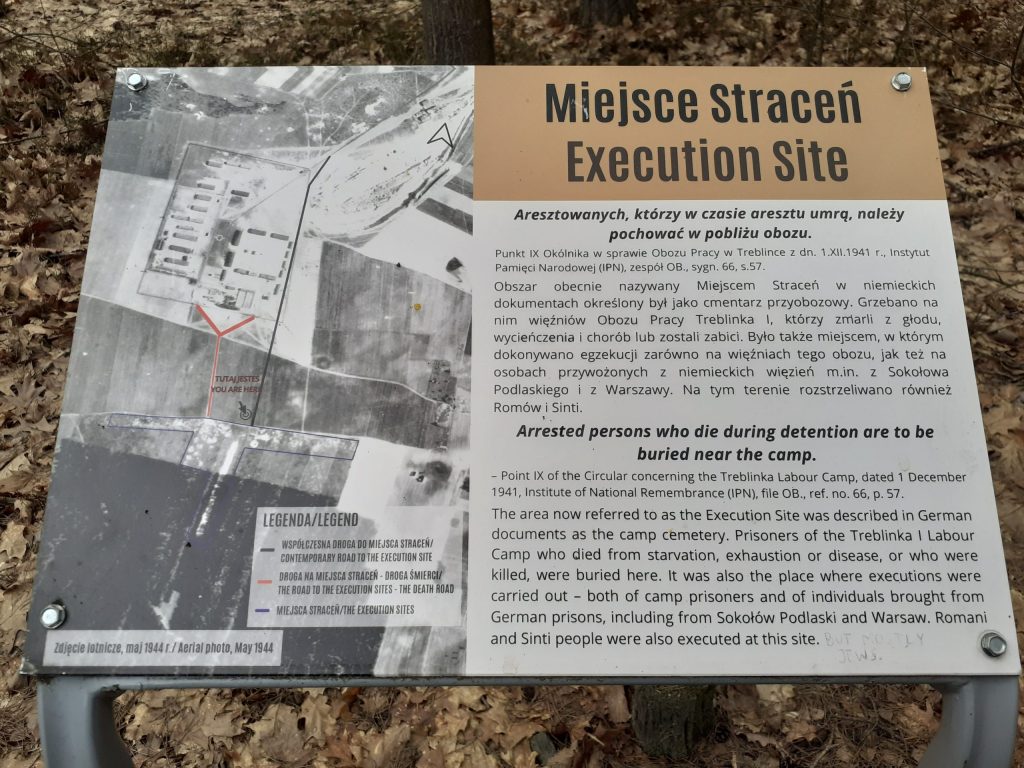
A multitude of crosses dominates the graves of Jewish victims and religious Catholic celebrations – such as the Way of the Cross – keep taking place at the Execution Site of the former Treblinka I camp. The monument honoring a Polish profiteer as a Righteous Pole at the former railway station in Treblinka the village continues to stand and be worshiped. In the attached picture 1 you can see it surrounded by grave lights and white-and-red wreaths. The inscription on one of the grave lights reads: “Treblinka Museum – We Remember”. At the same time the two remaining historical buildings and the historical well at the former railway station continue to fall apart. Similarly nothing has been done in order to identify a dozen of pits located there and one major pit situated in the nearby village of Wólka Okrąglik.
What is more: the above-mentioned denialist policy keeps expanding in terms of both quantity and quality.
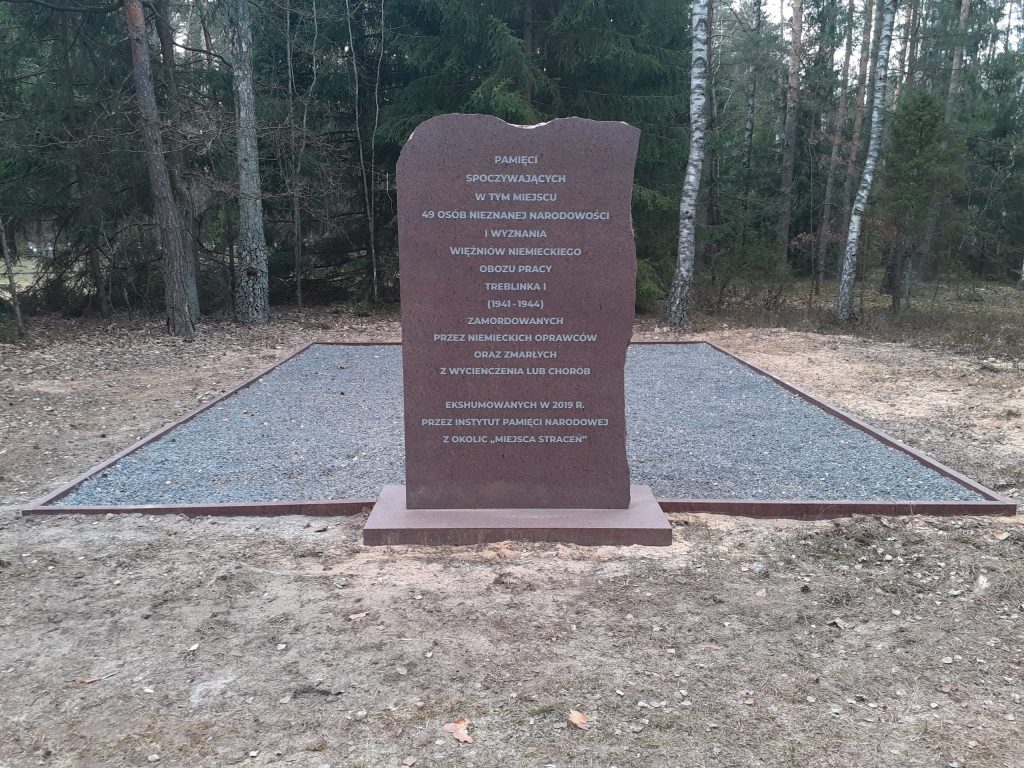
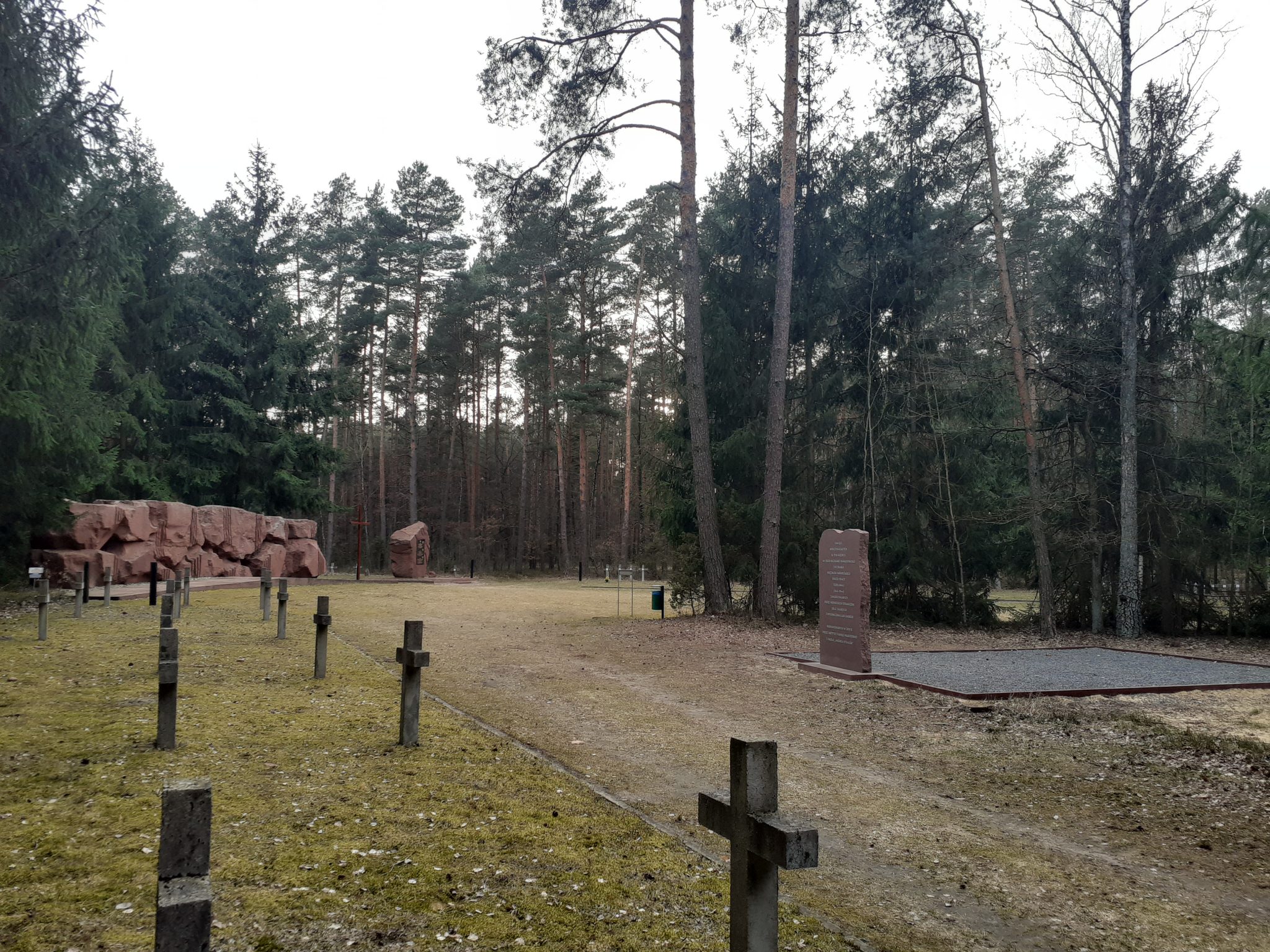
A new, third monument has been erected at the Execution Site of the former Treblinka I camp (cf. pictures 2-4). The inscription on it reads: “In memory of the 49 people of unknown nationality and religion buried here – prisoners of the German Treblinka I labor camp (1941–1944) who were murdered by their German tormentors or died of exhaustion or disease, and whose remains were exhumed in 2019 by the Institute of National Remembrance from the vicinity of ‘Execution Site’.”
This new monument establishes a new narrative pattern that is as perfidious as the ones already applied, specifically:
a) presenting the events as their opposite,
b) the Jedwabne lie,2
c) a false symmetry of Polish and Jewish fates,
d) the removal of Jewish victims from the narrative.
The new narrative pattern constitutes a new way of de-Judaizing Treblinka I and, potentially, other sites of the Holocaust. Treblinka I had previously been de-Judaized by the Treblinka Museum by means of removing any mention of Jews:
a) from the official description of the Execution Site on the ground;
b) through erecting an additional, second monument, renaming the initial monument and further manipulations3.
The newest method of denial is more refined. It makes the victims themselves “accountable” for the removal procedure. The first step is an exhumation, the second an objective scientific assessment that the nationality and denomination of the exhumed remains cannot be determined. For the time being, this is how the “problem” of some 10-12 thousand Jewish victims of Treblinka I is being “solved”. However, if this procedure is not immediately suppressed, it will be applied in other places such as the pits that are spread all over Poland to name but one possibility.
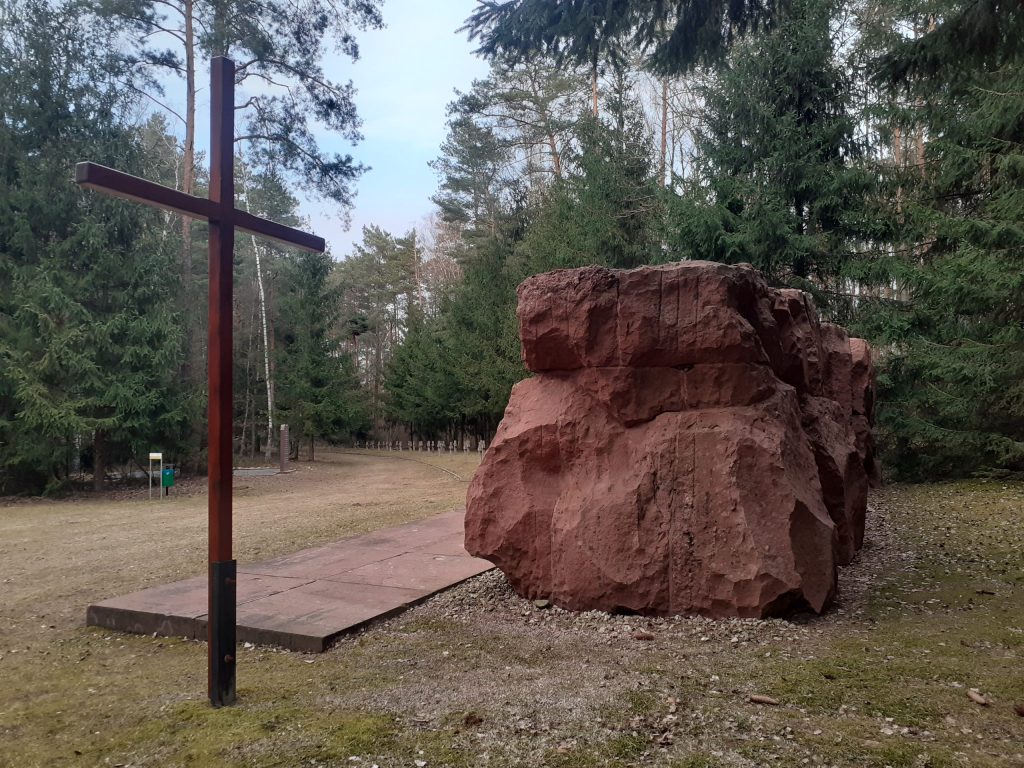
The 1964 Treblinka memorial – encompassing the two camps, the gravel pit, the Black Road and the concrete road together with the road strip (where a big crucifix has been built illegally at a later time) – was classified as a historical monument (cf. Rejestr zabytków,decision nr A-406/757 of March 22nd, 1966). Nothing can be added to the original 1964 design. Nevertheless since the 1990s we have to do with the exact opposite. The design by Duszeńko, Haupt and Strynkiewicz – an artistic achievement on a worldwide scale – progressively ceases to resemble itself.
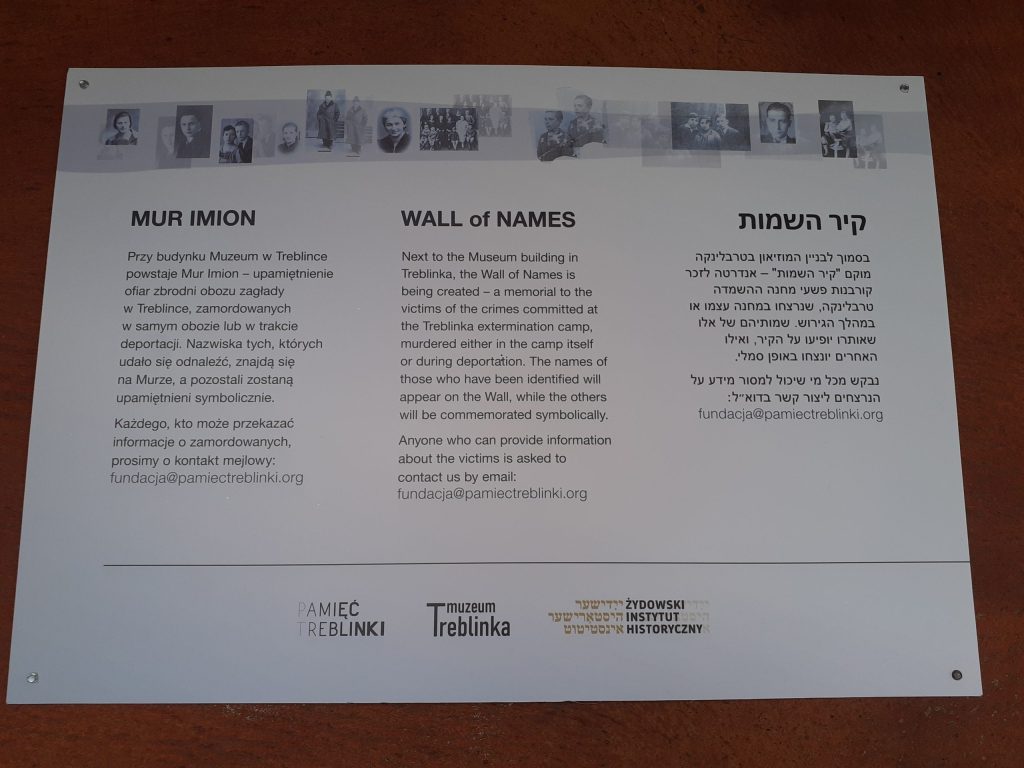
The establishment of the so-called Wall of Names of Treblinka Jewish victims. As you know as a historian, such a list cannot be established concerning the Jews of Poland, the largest category of Treblinka victims owing to the lack of wartime documents, the trace number of survivors on Polish soil, the Polish postwar conspiracy of silence, the failure of Polish postwar justice regarding the August trials4. This most elementary self-evidence closes all discussion. Despite this fact the endeavor is being pursued, endorsed and promoted by the Treblinka Museum (cf. picture 6 from the Treblinka Museum parking lot).
We have to do here with a double – historical and moral – scandal since the undertaking in question nullifies the Polish share of responsibility for the fate of those Jews of Poland who were eventually killed by Germans – outside Treblinka, during the deportations and afterwards – because Poles prevented them from fleeing or hunted them down and turned them in to Germans. Some were killed directly by Poles without German participation. These were not isolated cases. These victims are today about to be declared Treblinka victims.
*
Today the sites under the administration of the Treblinka Museum illustrate Walter Benjamin’s observation: “Even the dead will not be safe if the enemy wins. And this enemy hasn’t ceased to be victorious.”
Historical truth and Holocaust scholarship have already been damaged enough by the existing Polish bottom up and top down denialist and witewash strategies. It is time to fight back against those strategies as well as the newest varieties of lies.
The lack of protest by the International Treblinka Council would be tantamount to a legitimization of the current state of affairs. I call on you to openly condemn the described developments and demand an immediate removal of the above-mentioned and other post-1964 elements the list of which is in the possession of the Polish Ministry of Culture and National Heritage.
Respectfully,
Elżbieta Janicka
Response from Havi Dreifuss (May 2026)
The history of the Treblinka extermination camp remains one of the most painful and complex chapters of the Holocaust. Between 1942 and 1943, approximately 900,000 Jews were murdered there, alongside thousands of Roma and Sinti. Today, the site stands not only as a place of memory, but as a cemetery, one that demands historical accuracy, ethical sensitivity, and responsibility.
Alongside the duty to honor the victims lies an equally urgent obligation: to safeguard historical truth from distortion, politicization, and the erosion of context. Recent public interventions regarding the Treblinka memorial site raise important and legitimate questions about historical accuracy, representation, and the ethics of commemoration. These questions deserve serious consideration within a professional and scholarly framework. While the urgency of these issues is undeniable, so too is the need for responsible engagement.
The controversy surrounding the Treblinka memorials: decisions that call for careful consideration
The concerns themselves are not new. Many have been known, debated, and documented for years. Since the establishment of the International Treblinka Council in late 2025, initial steps have been taken to address them. Treblinka is not a site where change can be imposed quickly or unilaterally. It is a place of mass graves, a site of mourning, and a complex institutional environment. Decisions here require coordination across multiple authorities, rigorous scholarly grounding, and deep sensitivity to the site’s physical and symbolic integrity.
The absence of immediate change is not inaction; it reflects the complexity of ensuring that any intervention is legally sound, historically accurate, and sustainable. This is not hesitation; it is responsibility. And meaningful change is already underway.
The Wall must make absence visible, conveying not only the names that are known, but also the countless victims who will remain unnamed.
One such issue concerns the so-called “community stones.” The 1964 memorial commemorates the destruction of Jewish communities deported to Treblinka through approximately 17,000 stones, several hundred bearing names. In the 1990s, additional names, including Jedwabne and Radziłów, were added at the request of Jewish organizations, at a time when historical knowledge was incomplete. It is now well established that these communities were not deported to Treblinka but were murdered in pogroms carried out by local populations in the summer of 1941. Their presence at the site is therefore historically inaccurate. The Council has addressed this directly. A formal decision, endorsed at the ministerial level, has been taken to remove these names, and we expect to see this implemented.
At the same time, Treblinka was not only a site of communal destruction but also of profound individual loss: the loss of men and women, children and the elderly. This dimension is central to the emerging Wall of Names, which will include over 100,000 identified victims, less than one-eighth of those murdered at the site. This gap is not a failure; it reflects the historical reality. The challenge is therefore not whether to name, but how to do so responsibly. Visitors must understand both the significance and the limitations of such an endeavor. The Wall must make absence visible, conveying not only the names that are known, but also the countless victims who will remain unnamed. It must also be accompanied by clear contextualization, including the fact that while most of those commemorated were murdered at Treblinka, others perished during deportations or escape attempts. Memory and commemoration are inherently complex, requiring both precision and humility.
The lack of commemoration of the murdered Roma and Sinti is striking.
Another central issue concerns the representation of victims. The current commemorative landscape reflects certain aspects of the past while obscuring others. The absence of Roma and Sinti victims at Treblinka II – despite the murder of thousands – is striking. At the same time, at Treblinka I, the presence of crosses has made visible the Polish victims, while the Jewish majority, more than 10,000 victims, remains largely unmarked. This imbalance resonates with a broader phenomenon in Holocaust memory: the de-Judaization of the Holocaust, in which the event is transformed into a generalized narrative of suffering, detached from the concrete identity of its Jewish victims and the specificity of the perpetrators. Yet the recognition of this problem cannot justify imprecision. On the contrary, it demands a more careful and historically grounded response, one that restores complexity without creating new distortions.
Each victim deserves to be remembered as who they were, for why they were targeted, and in what way they lived and died. To subsume these distinct trajectories into generalized or indeterminate historical categories is not an act of caution, but a form of erasure.
Commemorative responsibility requires clarity on two distinct yet interconnected levels. First, it necessitates a precise distinction between the fundamentally different functions of Treblinka I and Treblinka II: the former a penal labour camp marked by forced labour, executions, and mass death, the latter a systematic extermination centre established for mass murder. Any attempt to blur the boundaries between them or to create a false symmetry undermines the historical truth. Second, it requires attentiveness to the internal composition of victims within Treblinka I itself. While the camp claimed the lives of Poles, as well as Roma and Sinti, Jews constituted the overwhelming majority of those murdered there.
To blur either of these distinctions, between the two camps, or among the victims within one of them, is to risk replacing historical understanding with false symmetry. Honouring victims is not only a matter of remembrance, but of contextualization: each victim deserves to be remembered as who they were, for why they were targeted, and in what way they lived and died. To subsume these distinct trajectories into generalized or indeterminate historical categories is not an act of caution, but a form of erasure. Memory without specificity is not a more inclusive memory; it is a hollow memory.
Addressing these issues requires historical integrity and ethical precision. The absence of Roma and Sinti victims at Treblinka II must be addressed, but without compromising the integrity of the site as a burial ground. The Jewish victims of Treblinka I must be made visible, but without erasing existing commemorative layers, including the crosses. This is not a simple task. It is, however, an essential one.
We reject the narrative that justifies the existence of the Jan Maletka monument.
The case of the Maletka monument at the Treblinka railway station further illustrates the need for scholarly rigor. Following a detailed review of the materials presented, the Council identified substantial inconsistencies and rejected the narrative supporting this monument. Moreover, in a site where hundreds of thousands suffered, the commemoration of a single individual, particularly when based on insufficient evidence, raises serious ethical concerns. A society committed to Holocaust remembrance cannot allow central memorial sites to be shaped by misleading narratives or politicized agendas.
At the same time, Treblinka is not a static site. Its future must be shaped proactively. The Council has therefore supports the development of the former railway station area as an educational and civic space. This includes plans to transform it into a center for education and volunteer engagement, serving both local and regional communities. Crucially, the local community must be an integral part of this process. A memorial site detached from its surroundings is vulnerable, to neglect, misunderstanding, and distortion. Dialogue, transparency, and shared responsibility are therefore essential.
None of these challenges lend themselves to simple solutions. They require sustained scholarly engagement, institutional cooperation, and the willingness to confront difficult truths. They also require patience. Public debate has an important role to play, but it carries responsibility. Historical truth is not preserved through polemics alone, but through careful, evidence-based work.
Treblinka remains one of the most significant sites of the Holocaust. Its integrity, historical, ethical, and commemorative, must be safeguarded with care, grounded in scholarship, responsibility, and respect for the victims. The task before us is not only to remember, but to remember responsibly.
Havi Dreifuss
President of the International Treblinka Council, historian, director of the Institute for the History of Polish Jews and Polish-Israeli Relations at Tel Aviv University, and director of the Polish Center for Shoah Studies at Yad Vashem.
(The subheadings were taken from Gazeta Wyborcza)
- Towns in eastern Poland where not only did the Germans kill and deport Jews, but Polish neighbors also participated in the massacre of Jews. ↩︎
- In Jedwabne, on July 10, 1941, the Jewish population was exterminated by their Polish neighbors. The “Jedwabne lie” is the claim that the Germans committed this crime. ↩︎
- See Janicka, “Denialism Polish style: The case of the Treblinka site,” K. Review, December 11, 2024 ↩︎
- See Andrew Kornbluth, The August Trials. The Holocaust and postwar justice in Poland, Harvard University Press, Cambridge, MA & London, England 2021.
↩︎

Elżbieta Janicka
Elżbieta Janicka is a researcher specializing in antisemitism and the Shoah, and a professor at the Institute of Slavic Studies of the Polish Academy of Sciences. She is the author of “Festung Warschau” (2011), co-author of “Philo-Semitic Violence” (2021) and “This Was Not America” (2022). She dedicated her study “Herbarium Polonorum” (2020) to Treblinka, as well as a series of seminars titled “Treblinka and Its Contexts – Past and Present” at the YIVO Institute for Jewish Research in New York (2023). She is a member of the Program Council of the Association Against Antisemitism and Xenophobia “The Open Republic.”

Havi Dreifuss
Havi Dreifuss is a professor of history at Tel Aviv University and director of the Center for Research on the Shoah in Poland at Yad Vashem. She specializes in Polish-Jewish relations during World War II. Since October 2025, she has chaired the new International Council of Treblinka. Her publications include: “Relations between Jews and Poles during the Holocaust: The Jewish Perspective,” Yad Vashem, 2017.
Jean-Charles Szurek
Jean-Charles Szurek is a research director emeritus at the CNRS and a specialist in Jewish-Polish relations. Major works: ‘La Pologne, les Juifs et le communisme’ (Poland, the Jews, and Communism), Michel Houdiard, 2012; ‘The Poles and the Shoah: A New School of History,’ co-edited with A. Kichelewski, J. Lyon-Caen, and A. Wieviorka, CNRS Éditions, 2019; “Łuków County” in Jan Grabowski and Barbara Engelking, ‘Night without End: The Fate of Jews in German-Occupied Poland,’ Indiana University Press, 2022. Latest book: ‘Gabriel Ersler, from the International Brigades to Soviet Prisons: The Other Red Orchestra’, Hermann Publishing, 2023.