Pay for Your Dead
A film by Carine Ruszniewski Dredging up family history comes at a price—just like the entrance fee to the Jewish cemetery in Warsaw. “Pay for Your Dead” is producer Carine Ruszniewski’s directorial debut. While searching for an ancestor’s grave in Warsaw’s Jewish cemetery, she films her family with her cell phone as they wander through the labyrinth of disorderly paths, much like the labyrinth of family memories.
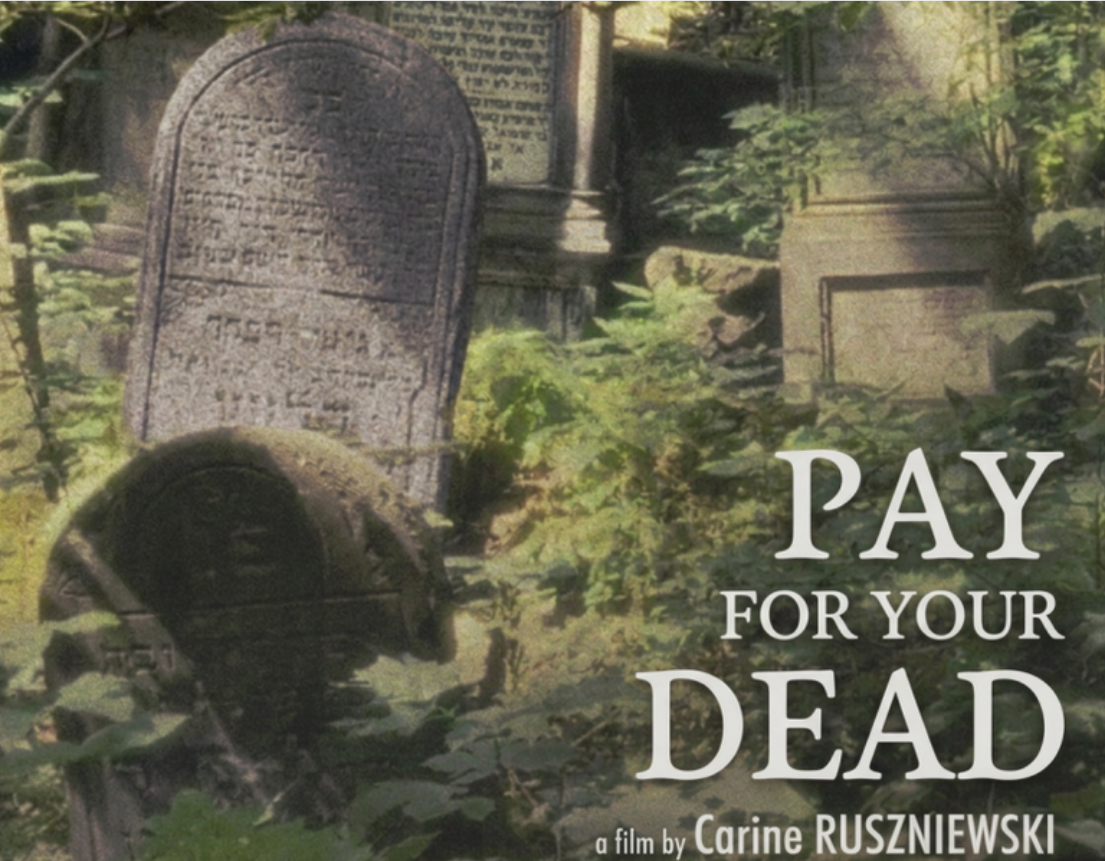
The journey to the East is a journey into a time that is still close to us—and to everyone—as long as our historical consciousness manages to hold onto it. Having become a ritual, we attempt it by piecing things together, usually just once in a lifetime, to catch a fleeting glimpse, searching for a trace—however faint—of the life that has been swallowed up. Each of us carries our own family narrative, made up of fragments of knowledge, passed down by chance, composed of small, isolated elements—like irregular shards that form part of a vast, shapeless fresco, so terrifying that the mind turns away from it. This journey into the past was made possible by the breach in the Iron Curtain, which lifted the veil on the remnants of a way of life that had been obliterated. Eastern Europe then presented itself as a balcony from which one could take in a reality that had been almost completely erased, of which only ruins remained in a decaying landscape, still visible beneath the grayness of communism. Since then, anyone can head in that direction, waiting for the right moment without knowing what defines it, hesitating for a long time before taking the plunge, only to finally resolve to do so—often without pinpointing exactly what triggered it. This arbitrary decision is laughable, as we well know; we speak of it with a wry smile. And yet it is irresistible, driven by the wind of a History that has swept us away from this world. So, in the jungle of the Warsaw cemetery—in this lush forest dotted with weathered graves, stones dancing in an ocean of ivy, in this silent world saturated with the shrill chirping of birds—the Ruszniewski family’s treasure hunt unfolds in a spirit of genuine good humor. As if everyone were aware that the search for the family grave, hidden away in a verdant setting, was merely a charade from which one doesn’t quite know what to expect. As if it were a given that the past, once and for all, eludes us. In the labyrinth through which the family wanders, losing their way, we, too, lose our bearings. Along with the cemetery administration—which charges for access and whose help is sought to identify the elusive grave—we encounter the deafening indifference laced with hostility of the caretaker, this local determined to profit from a treasure he knows nothing about. Suddenly, the farcical scenes of the family scouring the aisles come to an abrupt halt. The object is finally found when the clearly legible Hebrew letters on the stone signal that the goal has been reached. The family immediately dreams of leaving this desolate place, their minds already on the plane to Paris. Then, around the treasure, a Yiddish song rises along with stifled sobs, and we, the viewers—who know just as well as they do that this tiny victory is in vain—feel a tear welling up uncontrollably. Even as, through the window the director has opened, we catch a glimpse of the immensity of the boundless fresco that commands us to remain cautious. —
Danny Trom

Carine Ruszniewski
As the founder of GoGoGo Films, Carine Ruszniewski has built her career as a producer around creative documentary filmmaking. She supports works rooted in reality, memory, and rare archival footage, and champions both emerging voices and established filmmakers, bringing films to festivals such as Cannes, Sundance, and Berlin. "Pay for Your Dead" is her first short film as a director.
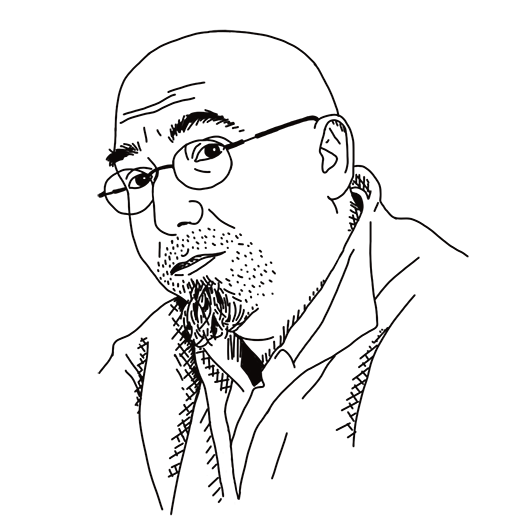
Danny Trom
Danny Trom is a political sociologist and Director of Research at the CNRS. His work combines the sociology of political experience with reflections on Jewish life in Europe, exile, and the State of Israel. His research focuses in particular on the persistence of Jewish existence, minority conditions in Europe, and the reconfiguration of relationships between diaspora, nation-states, and Israel.