A Crime Beyond Words
The Word “Genocide” at the Nuremberg Trials
Eighty years after the Nuremberg trials, Annette Wieviorka revisits the trial transcripts and focuses on one word: “genocide.” This term, which appears twenty-one times over ten months of hearings, remains rare and vague, applied to situations as diverse as those of the Czechs, Poles, and Norwegians—and almost never to refer to the Jews.
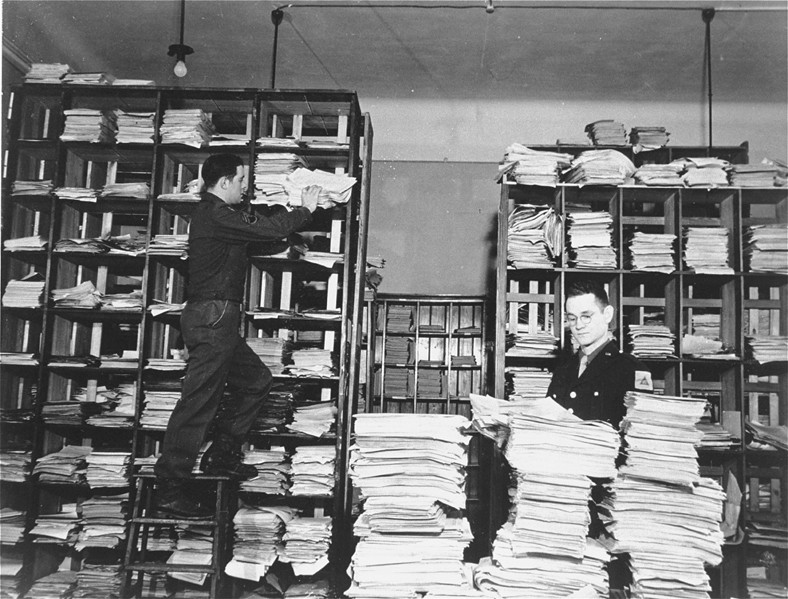
Yet the destruction of the Jews of Europe is present at every stage of the trial and in its archives. Why was the destruction of the Jews of Europe—documented throughout the trial—not recognized for its uniqueness?
Roger Errera was, to my knowledge, the first to raise the question of the place of the destruction of the Jews of Europe at the Nuremberg trials. That was in 1982. The circumstances surrounding his pioneering study are worth recalling. They are not specifically linked to the trial itself, but to the context of that turning point in the late 1970s and early 1980s.
I will mention just two episodes: the publication on December 29, 1978, in Le Monde, of an article by Robert Faurisson, “
The Problem of the Gas Chambers, or the ‘Auschwitz Rumor’”; this gave Holocaust denial the endorsement of the “leading daily newspaper.” And the broadcast of the miniseries Holocaust on French television (February 13–March 6, 1979), watched by more than 15 million viewers. Simone Veil participated in the debate on Dossiers de l’écran that followed the broadcast of the final episode. At the time, she was Minister of Health and enjoyed immense popularity for having courageously defended the law legalizing abortion. She became the leading French figure in the memory of Auschwitz.
This climate explains the organization of two events that would mark the issue’s entry into academic and educational circles: the symposium organized under the patronage of François Furet and Raymond Aron, “Nazi Germany and the Jewish Genocide” (note the use of “Jewish Genocide” rather than “genocide of the Jews”);
and the roundtable discussion organized by the Association of History and Geography Teachers (APHG), in collaboration with the Center for Contemporary Jewish Documentation, entitled “Teaching the Choa”1; this accompanied its inclusion in school curricula and, consequently, in textbooks. Genocide versus “Choa.”
Contrary to prevailing practice in the Anglo-Saxon world, and despite the television series, the term “Holocaust” was rejected due to the religious connotations of a word meaning “sacrifice by fire.”
First, the roundtable discussion.2
The choice of the term “Choa” was the result of a debate. The APHG rejected the term “genocide” because of its multiple uses, which were on the rise during those years. For example, the famine in Biafra and U.S. military interventions in Vietnam were described as “genocide.” Not to mention that in 1977, Brigitte Bardot traveled to the ice floes of Newfoundland, Canada. In news footage from that time, she is seen, in tears, holding an adorable baby seal in her arms. This marked the launch of an international campaign—which, incidentally, enjoyed some success—against the “genocide” of baby seals.
These years also saw the emergence of Genocide Studies, which, in the United States, would often replace Holocaust Studies. Thus, faced with all the possible uses of the term “genocide,” history professors became aware of the need to affirm the distinct nature of the destruction of European Jews by adopting the term “Choa,” a few years before Claude Lanzmann’s eponymous film—and although, in fact,
the word “genocide” would be commonly used in the roundtable discussions. The Nuremberg trials were mentioned in the discussions only by Georges Wellers, who spoke about the resources of the Center for Contemporary Jewish Documentation, citing its archives—including paper documents as well as audio recordings, photographs, and films that were presented there.3
Now, the July 1982 symposium. The impetus: the dismay at the reception Robert Faurisson received. It was therefore necessary for historians to take back the initiative—not to refute Holocaust denial theories (as Pierre Vidal-Naquet consistently stated, “one does not argue with Holocaust deniers; one does not debate with them”), but to present their research on the destruction of the Jews of Europe. Looking at the list of the twenty-four contributors, the paucity of French research on this subject is glaringly obvious. Certainly, Rita Thalmann is an excellent historian of Germany; Claude Lefort, a leading thinker on totalitarianism; René Rémond, the preeminent specialist in the political history of France; the Hellenist Pierre Vidal-Naquet, whose parents were murdered at Auschwitz, published his seminal essay, “Un Eichmann de papier,” in the journal Esprit. But the only French specialists in the history of the genocide are Léon Poliakov, author of the pioneering work Bréviaire de la haine (first published in 1951 and constantly reprinted since), and Jean-Claude Pressac. A reformed Faurisson follower, he undertook a study of the technology of the gas chambers and crematoria at Auschwitz to irrefutably demonstrate the reality of the murders at Auschwitz. The historical research comes from the United States, Germany, and Israel.
“The conditions for research on the Nuremberg trials have changed. The University of Caen-Normandy has digitized all the trial transcripts and made them available online. It is therefore now easy to consult them. I was thus able to quickly identify the instances of the term ‘genocide.’ I counted twenty-one, which is very few considering the thousands of pages.”
But it is Roger Errera’s text, “Nuremberg, Law, and History (1945–1985),” that interests us here. It is a seminal work. His presentation at the conference was expanded for publication.4 Roger Errera was then a member of the Council of State. I am most familiar with his work as a publisher. All of the books he published in the series he conceived, “Diaspora” at Calmann-Lévy5, are on my bookshelf, and I consult them frequently. In his text, he examines the emergence of the concept of “crimes against humanity” and very quickly, instead of “crimes against humanity,” uses the term “genocide.”
“This genocide,” he writes, “was the result of a policy conceived and decided at the highest level, then carried out flawlessly and meticulously by every level of the civil and military organizations, without exception”.6 He notes that the examination of the policy of genocide directed against the Jews “is inevitably conducted in a piecemeal manner,” but is present at every stage of the trial. He summarizes them concisely. In my book The Nuremberg Trials7, I naturally cite Errera’s text. And I proceed in the same manner. I title Chapter 5, devoted to crimes against humanity, “Genocide.” In particular, I devote a very long passage there to Edgar Faure’s closing argument on the persecution of French Jews, drawn from the documents provided to him by Léon Poliakov, which are remarkable for their insight and intelligence. He quotes in extenso the telex sent by Klaus Barbie announcing the arrest and transfer to Drancy of the 41 children from the Izieu home and its staff. Edgar Faure omits the signature: compared to Göring or Hans Frank, Barbie is a minor figure. But I am writing this book after his trial, in which this telegram—discovered by Serge Klarsfeld in the basements of the Center for Contemporary Jewish Documentation—served as the centerpiece. We can thus see how the present (in this case, the Barbie trial) shines a spotlight on an aspect of history that had not been perceived before.
Thus, almost naturally, we used the term “genocide.” I was writing about the Nuremberg trials some ten years after Errera, in a new context—that of their return to the spotlight following the fall of the Berlin Wall and the establishment of the two international tribunals, those in The Hague and Arusha, at a time when genocide was being used as a charge for the first time. This explains why I questioned the limited use of the term during the trial. I noted that the term had not yet caught on; I quoted a British journalist, R. W. Cooper, who observed that purists had viewed the term less as a crime against humanity than as a crime against the English language. This, in his view, demonstrated that “many people have not yet grasped the terrible significance of these proceedings”.8
The conditions for research on the Nuremberg trials have changed. The University of Caen-Normandy has digitized all of the trial transcripts and made them available online. It is therefore now easy to consult them. I was thus able to quickly identify the instances of the term “genocide.” I counted twenty-one, which is very few considering the thousands of pages.9 These instances are scattered between the afternoon session of November 20, 1945—that is, the very beginning of the trial—and the session of August 31, 1946, toward the end of the trial.
The first person to use the term “genocide” (according to the English and French translations, though this would need to be verified in the Russian original) was Lieutenant Colonel Oziol, deputy prosecutor for the Union of Soviet Socialist Republics. He referred to the defendants’ war crimes. “They engaged,” he said, “in ‘genocide.’” He defined it as “the premeditated and systematic extermination of racial and national groups among the population of certain occupied territories, with the aim of destroying specific races or classes of people and national or religious groups, particularly Jews, Poles, Gypsies, or others.” He mentions Majdanek and Auschwitz. The figures are inflated: 1,500,000 dead at the former, 4,000,000 at the latter. “Among these victims were citizens of Poland, the USSR, the United States, Great Britain, Czechoslovakia, France, and other countries.”
Jews are not mentioned in this list. They are sometimes mentioned in connection with “minor” massacres such as the one at Kamenetz-Podolsk: “31,000 Jews, including 15,000 people brought from Hungary.” The Soviets would no longer use the term. This is therefore its only occurrence.
It was not until the 173rd day of the trial, Tuesday, June 26, 1946, that the term was used again, this time by the British Sir David Maxwell-Fyfe, deputy to Prosecutor Sir Hartley Shawcross. He was presenting the case against von Neurath, former Minister of Foreign Affairs and Reich Protector of Bohemia and Moravia (he would be sentenced to fifteen years in prison). “Defendant,” declared Sir David Maxwell-Fyfe, “you know that the indictment charges you and your co-defendants, among other crimes, with genocide—that is, the extermination of racial and national groups—or, as Professor Lemkin’s well-known book puts it, ‘a coordinated plan of various actions aimed at the destruction of the essential foundations of the life of national groups, with the intent to exterminate those groups.’” He then commented, addressing the defendant: “What you wanted to do was to get rid of the Czechoslovak professors, writers, and artists—whom you called the intellectual class—people who could have passed on the history and traditions of Czechoslovakia to future generations.”
As we can see, this is the first time Lemkin’s work is referenced—not in connection with the Jews, but with the Czechoslovak elites.
On July 27, 1946, Sir Hartley Shawcross took the floor again.
One of the phrases from his opening statement had been picked up by the press and is often quoted: “There comes a time when a man must refuse to obey his superior if he is to obey his conscience.” On this 198th day, the focus was on reviewing the responsibilities of each of the defendants. To this end, he used the term “genocide” five times and clarified: “Genocide did not consist solely of the extermination of the Jewish people or the Gypsies. It was carried out in various forms in Yugoslavia, against the non-German inhabitants of Alsace-Lorraine, and against the populations of the Netherlands and Norway. The methods varied from one nation to another, from one people to another. The long-term goal was the same.”
“Why, even though the destruction of the Jews of Europe is evident and documented in its scope and various forms, does it not establish itself [during the Nuremberg trials] as such in the public sphere?”
The French prosecution also used the term “genocide” in the final days of the trial. On July 29, the 199th day of the trial, Prosecutor Auguste Champetier de Ribes spoke of “the methodical, scientific extermination of millions of human beings, particularly certain national or religious groups, whose existence hindered the hegemony of the Germanic race. “A crime so monstrous, so unprecedented in history since the Christian era (…) that it was necessary to coin the neologism ‘genocide.’” Charles Dubost, deputy prosecutor, succeeded him in presenting the case against Kaltenbrunner. He considered Kaltenbrunner to have been “one of the most important figures in the implementation of the policy of extermination and in the carrying out of the genocide.” He then specified, in bringing charges against Hans Frank, that the latter had contributed to “the extermination of numerous Poles.”
The last person to use the term “genocide” was… Alfred Rosenberg, the theorist of antisemitism, the man responsible for the looting of apartments and works of art in France, Belgium, and the Netherlands, and the Minister for the Occupied Eastern Territories. He was defended by Dr. Thoma. One must reread his lengthy closing argument on the 171st day of the trial, Wednesday, July 10, 1946. He was the second—and the last—to quote Lemkin: “There is therefore no genocide in Rosenberg’s case, as Raphaël Lemkin asserts in Axis Rule in Occupied Europe, page 81, who defines this very concept as ‘races and races, peoples and peoples,’ but there is a struggle between one spiritual value and another, and thus a spiritual settlement .” Further on, Thoma launches into a veritable defense of antisemitism: anti-Judaism is not an invention of National Socialism; Rosenberg was a staunch antisemitic figure. “I have already pointed out that figures as diverse as von Papen, von Neurath, and Raeder had rallied to the view that all public life was so saturated by the Jewish element that a change was necessary. This situation, as it actually existed—the fact that the Jews of Germany were united in responding to attacks with tit-for-tat retaliation—had intensified the antisemitic struggle even before the Nazis came to power.” Rosenberg, he continues, relied “on concrete facts proving the Jews’ subversive activities.” And he proceeds to list them.
Thus, before the international court, without being interrupted and without any outcries, one can praise the Nazi determination to remove the Jews from Germany. Nuremberg is indeed a “fair trial,” and the defense of the accused enjoys every freedom.
Let us leave the final word to Rosenberg, since he was the last to use the term “genocide.” The date was Saturday, August 31, 1946. It was the 216th day of the trial. He was the sixth to take the stand for a brief and final statement, following Göring, Hess, Ribbentrop, Keitel, and Kaltenbrunner. “I welcome the idea that the crime of genocide be banned by international convention,” he declared, “provided, of course, that such genocide is in no way permitted in the future against the German people.” Rosenberg was sentenced to death and hanged on October 16.
It was therefore only in the final weeks of the trial that reference was made to Lemkin and that the British and French prosecution used the term “genocide,” the definition of which, as we have seen, seemed very broad. It did not specifically refer to the destruction of the Jews of Europe or that of the Roma.
Yet this destruction—as Roger Errera first noted as early as 1982—was very much present throughout the trial and in the documents—19 volumes, which were also published. It was on the basis of and thanks to this trial that the pioneers Léon Poliakov and Raul Hilberg wrote the first histories. Breviary of Hate was published in 1951. Raul Hilberg defended his dissertation in 1955 but struggled to get it published. It was thanks to the Eichmann trial that the first draft of The Destruction of the European Jews saw the light of day in 1961.
Why, even though it was evident and well-documented in its scope and various forms, did it not establish itself as such in the public sphere at that time? It was referred to as one aspect of Nazi criminality (sometimes subsumed under the term “genocide”), which was massive and multifaceted, in a postwar era where the victims were so numerous. It would take about fifteen years and the Eichmann trial—that “Nuremberg of the Jewish people” (David Ben-Gurion)—to, in a sense, set it apart and produce, for a global audience, a narrative distinct from what Israelis were already calling the Shoah.
- The Hebrew word Shoah (“catastrophe,” “destruction”) has been used in Israel since the 1940s to refer to the destruction of European Jewry. In the early 1980s, its French transcription was not yet standardized: variations such as “Choa,” “Shoa,” and “Shoah” were in use. The spelling “Choa,” adopted by the Association of History and Geography Teachers (APHG) and the Center for Contemporary Jewish Documentation (CDJC) [two prominent French institutions], was the one in use at the time. It was Claude Lanzmann’s film, Shoah (1985), that established its final spelling, which is now the only one in use. “Choa” is retained when reproducing the titles and usage of that era, and “Shoah” is used everywhere else [Editor’s note]. ↩︎
- It was published in November 1982 as a pamphlet by the CDJC with the subtitle: “Comment les manuels d’histoire présentent-ils l’extermination des Juifs au cours de la deuxième guerre mondiale ?” [“How Do History Textbooks Present the Extermination of the Jews During World War II?”] Rereading these texts today is deeply moving, first because—with the exception of Professor André Kaspi—none of the contributors are still with us, but above all because the contributions show that today’s debates were already those of yesterday. As it says on the back cover: “As time passes, the survivors are passing away, and the responsibility of teachers grows.” ↩︎
- On the history of the CDJC and its role in the Nuremberg Trials, see the chapter “17, rue Geoffroy l’Asnier,” which opens my book, Itinérances, Albin Michel, 2025, pp. 13–97. ↩︎
- L’Allemagne nazie et le génocide juif : actes du colloque de l’Ecole des Hautes études en sciences sociales [Nazi Germany and the Jewish Genocide: Proceedings of the Symposium at the École des Hautes Études en Sciences Sociales], Gallimard-Le Seuil, November 1985. ↩︎
- After a long hiatus, the series was revived in 2025. ↩︎
- Op. cit., p. 448. ↩︎
- This was a commission from Éditions Ouest France, in anticipation of the first symposium of historians organized at the Caen Memorial to mark the fiftieth anniversary of the opening of the trial. See Annette Wieviorka (ed.), Les procès de Nuremberg et de Tokyo [The Nuremberg and Tokyo Trials], Complexe, Brussels, 1996. ↩︎
- R.W. Cooper, The Nuremberg Trial, Hachette, 1947, p. 108. ↩︎
- The database I consulted lists 49, but this count includes volumes of documents. Nevertheless, this figure remains low. ↩︎
Annette Wieviorka
Annette Wieviorka is a historian and honorary research director at the CNRS. A specialist in the history of Jews in the 20th century and the memory of the Shoah, her publications include “Déportation et génocide. Entre la mémoire et l’oubli” (Plon, 1992), “L’Ère du témoin” (Plon, 1998), and “Ils étaient juifs, résistants, communistes” (Perrin, 2018). She recounted her family’s history in “Tombeaux. An Autobiography of My Family’ (Seuil, 2022, winner of the Prix Femina for essays). Her most recent publications are: ‘Anatomie de l'Affiche rouge' (Seuil, 2024) and 'Itinérances. Parcours d'historienne' (Albin Michel, 2025).