“Palestine Will Save Us All”
Representations of Palestine in Contemporary Antisemitism Related to Israel
What narratives underpin the idea that Palestine lies at the heart of the universal struggle for emancipation? Tim Stosberg, a researcher at the University of Passau, offers here an analysis of representations of Palestine within the European and American left, examining how these representations distort the conflict and its actors, both Israeli and Palestinian.
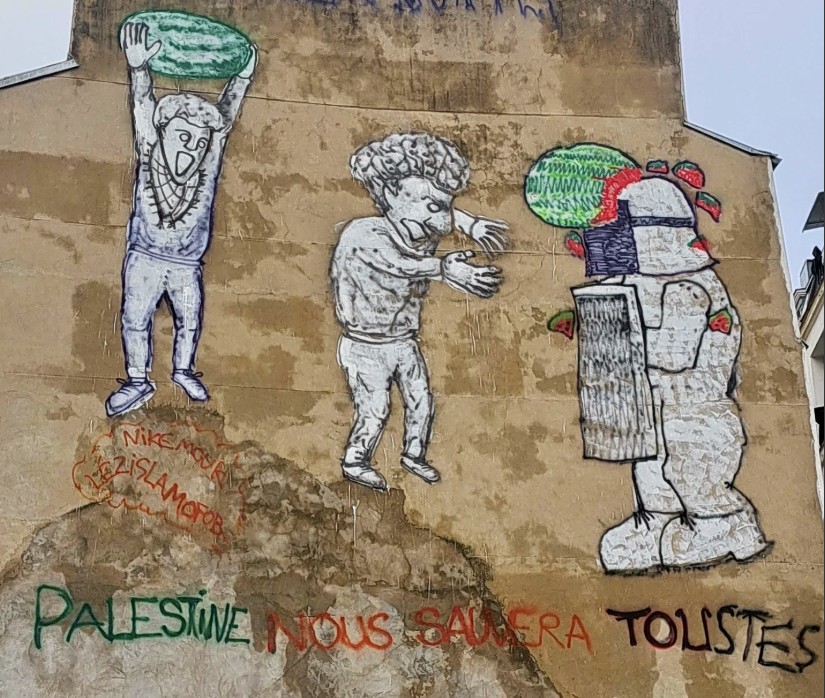
Walking around Paris’ Boulevard de la Villette, close to the Gare du Nord and Paris-Est train stations, these days, one can encounter a striking piece of graffiti: an armored police officer under attack from two men, one of them wielding a watermelon, the other wearing a kufiyah. Once the olive branch symbolized Palestinian identity and the Palestinian struggle against Israel; today, the watermelon has taken its place, circulating from European street protests to social media feeds. Yet, another detail stands out – the slogan inscribed beside it: “PALESTINE NOUS SAUVERA TOUSTES” – “Palestine will save us all.”
In this or in its slightly altered version, “Palestine will set us free,” the slogan was popularized in the aftermath of October 7th, 2023 – when many students on Western campuses and activists elsewhere chose not to express solidarity with the Israeli victims, but with the perpetrators: Hamas and Islamic Jihad. Since then, it has become one of the pro-Palestinian movement’s most popular refrains, chanted by demonstrators with watermelon necklaces or, as here, sprayed onto walls. The question, however, remains: How is Palestine supposed to save or liberate us all – and from what exactly? From climate change and capitalism? From war and injustice? Or, more darkly, from “the Jews”?
False projections and political detachment
It quickly becomes apparent that the “Palestine” invoked in this slogan has little to do with the actual place and the reality of the Palestinian people. As Matthew Bolton observes, multiple versions of “Palestine” circulate in contemporary discourse on Israel/Palestine – one of them being the Palestine of the European and American left, which he describes as “a ‘Palestine’ of a third-hand ‘revolutionary’ aesthetic.”1 This version features several images of Palestine, whose analysis is key to understanding both the meaning and the popularity of the slogan. Critical research on antisemitism offers crucial insights for such an analysis.
When Max Horkheimer and Theodor W. Adorno examined the dynamics of völkisch antisemitism in the 1940s, they interpreted it as an externalization of the antisemite’s own drives: “In the image of the Jew which the racial nationalists hold up before the world they express their own essence. Their craving is for exclusive ownership, appropriation, unlimited power, and at any price.”2 For Horkheimer and Adorno, antisemitism rests on “false projection.” In psychoanalytical psychology “projection” refers to a psychic defense mechanism that attributes unbearable feelings and ideas to an external other. In Horkheimer and Adorno’s understanding, however, its false or pathological nature lies not in projection itself, but in the failure to recognize these impulses as one’s own. As they put it, the subject, unable to return to the object what it has received, “is not enriched but impoverished. It loses reflection in both directions: as it no longer reflects the object, it no longer reflects on itself, and thereby loses the ability to differentiate. Instead of the voice of conscience, it hears voices; instead of inwardly examining itself in order to draw up a protocol of its own lust for power, it attributes to others the Protocol of the Elders of Zion.”3
Antisemitic images of “the Jew” are detached from reality and de-realize Jews. They are rooted instead in a personifying, Manichaean worldview and are sustained by individual projections of which origins the antisemite is not aware.
In other words: Antisemitic images of “the Jew” are detached from reality and de-realize Jews. They are rooted instead in a personifying, Manichaean worldview and are sustained by individual projections of which origins the antisemite is not aware. Culturally entrenched, these images offer seemingly simple explanations for complex conflicts and social phenomena, while “the Jew” serves as a boundless yet concrete projection surface for personal and collective anxieties, grievances, and desires.
Furthermore, critical research on contemporary antisemitism has shown that Israel-related antisemitism, too, draws on such projections. In dominant contemporary images of Israel, the realities of the Middle East, Israel’s history and the Arab-Israeli conflict often appear only in de-realized form. Recent studies have analyzed these images in depth. What is largely missing, however, are examinations of their counterpart: idealized images of Palestine within contemporary Israel-related antisemitism. It can be argued that these images are the product of the same psychodynamic described above insofar they do not only mirror attributes opposed to those projected onto Israel; rather, they are fueled by distinct projections that serve specific individual and social functions.
Palestine imagined as an authentic land
Looking at the field of Settler Colonial Studies (SCS), which today in western academia plays a major in interpreting Israel/Palestine, a first image can be identified: the image of Palestine as a site of indigenous and authentic community. According to historian Lorenzo Veracini, one of SCS key proponents, the settler colonial paradigm among other things provides a framework for evaluating claims to indigeneity.4 Veracini defines indigeneity as an “ontological relationship” to the land, one that exists since “time immemorial.”5 Another proponent of SCS, literary scholar Steven Salaita, adds that the term carries numerous further connotations “about access, belonging, biology, culture, jurisdiction, and identity.”6 While SCS generally regard only Palestinians as indigenous to Israel/Palestine, they seek to redefine Palestinian identity through this understanding of indigeneity, moving beyond familiar narratives of Palestinian folklorism and nationalism.7
Historian Ilan Pappe’s portrayal of the historical village of Sirin, southwest of the Sea of Galilee, can be read as an illustration of this broader academic trend. In The Ethnic Cleansing of Palestine he writes:
“The terrain in that part of Palestine is tough and the summers are unbearably hot. And yet the habitation that developed around the maqam and the nearby springs […] resembled that of villages endowed with a much better climate and an endless flow of fresh water. Animals carried the water from the wells and diligent farmers used it to turn the rugged land into a small Garden of Eden. […] Sirin was noted as a fine example of the collective system of land-sharing to which the villagers adhered, dating back to the Ottoman period, and here had survived both the capitalization of the local agriculture and the Zionist drive for land.”8
Pappe admires not only the villager’s successes but also their resilience to environmental hardship, capitalist transformation, and Zionist expansion. According to him, this way of life ended abruptly in 1948, when Sirin was supposedly destroyed by the Haganah.9 What emerges from this almost poetic portrayal is an image of Palestine as an organic community, rooted in an intimate relationship with nature and resistant to external forces of disruption.
Political scientist Jamal Nabulsi takes this romanticized vision a step further:
“It is clear that Palestinian connections to land, like those of other Indigenous peoples, encompass not merely an ownership of the land, but a far deeper connection to the earth and soil of Palestine. […] Palestinian Indigenous sovereignty is in and of the land. It is grounded in an embodied connection to Palestine and articulated in Palestinian ways of being, knowing, and resisting on and for this land.”10
Nabulsi generalizes the motif of a Palestinian bond to the land into a broader claim about Palestinian indigeneity. Although he later concedes that national identities are socially constructed, he retreats from this insight by essentializing Palestinian indigeneity, attributing to it epistemic and spiritual qualities.
What emerges from this almost poetic portrayal is an image of Palestine as an organic community, rooted in an intimate relationship with nature and resistant to external forces of disruption.
The Australian journalist Caitlin Johnstone radicalizes this logic of the settler colonial paradigm even further. Where Pappe and Nabulsi frame Palestine as authentic through historical resilience or indigenous epistemologies, Johnstone draws a connection to her own desires for purity and belonging. In a blog post she claims to envy Palestinians for “their supremely authentic culture, with its deep roots and ancient connection to the land.”11 She continues:
“Palestinians are such amazingly beautiful people. How tender they are with each other. How real and organic their spirituality is. How deeply they love their culture in all its unique expressions. How profoundly intimate their connections with each other are, both between individuals and with their community as a whole.”12
For Johnstone, such traits derive from the Palestinians’ indigeneity. By contrast, she portrays Israelis as inauthentic, dismissing their culture as “fake.” According to her, they can only envy Palestinians: “And their envy turns to spite. And their spite turns to hate. And their hate turns to genocide.”13 Yet Johnstone herself also claims to share this envy. As one of the “white people in the colonized world”, she confesses that she too lacks any genuine bond to the land where she lives: “We have no connectedness. No historical depth. No real culture. No real grounding.”14 In a bizarre way, Johnstone fends off her own unsettling feelings of guilt, alienation, and desire by projecting them onto Palestine. At the same time, she grants herself a moral absolution by insisting that, unlike the Israelis, she is at least conscious of her envy.
Taken together, these three examples construct a de-realized image of Palestine, where antisemitic semantics – such as the opposition between community and society – intersect with reworked orientalist stereotypes. Each author romanticizes and idealizes Palestine, turning it into a site of authenticity and resistance. While this image of Palestine from a social-psychological perspective can be explained by the mechanism of projection or even false projection in the sense of Horkheimer and Adorno, yet another psychic dynamic can be observed. According to Tom Uhlig, this dynamic can be read through Sigmund Freud’s theory of mass psychology.15 In mass movements, individuals unite around a shared ego-ideal – the inner image of oneself as one wants to become. This ego-ideal can be anchored in an external object such as a leader or an idea. Uhlig suggests that, within antisemitic movements, Palestine has long assumed this function of the ego-ideal – not only since October 7. One might add that this dynamic corresponds with the Left’s ongoing search for a revolutionary subject. What once was the proletariat, and later the peoples of the so-called Third World, now appears to be the Palestinians.
Linking all struggles to Palestine
A second image of Palestine builds on this, portraying it as a site of diverse social and political struggles. The examples are wide-ranging: queer and feminist struggles, struggles for climate justice and anti-capitalism, even the struggles of Native Americans – all are linked with Palestine. Underlying this is an idea advanced by, among others, the feminist icon Angela Davis: that local struggles against oppression should no longer be viewed in isolation but rather in their global interconnectedness.16 As an illustration of this “intersectionality of struggles,” Davis cites both the fight against racism in Ferguson, Missouri, and the Palestinian struggle for national self-determination. According to her, these movements are connected since U.S. police units received training from Israeli police forces. Yet, as Karin Stögner observes, Davis ultimately fails to provide a comprehensive demonstration of how these struggles are in fact historically, politically or religiously interconnected.17
The global neoliberal-capitalist order remains firmly in place, and neither Australia nor the United States have been successfully decolonized. By contrast, Palestine – and the struggle against Zionism and Israel – appears to promise a more tangible prospect of success and satisfaction.
The contradictions become clearer in practice: In September 2025, the leadership of the Global Sumud Flotilla – a multinational convoy of several dozen vessels attempting to breach Israel’s naval blockade of Gaza – expressed discontent with the presence of LGBTQ activist among the flotilla’s crew. According to the newspaper Brussel Signal, they regarded the attempt to link the queer cause with the Palestinian cause as an attack on Palestinian “societal values.”18 However, even such empirical evidence does little to unsettle the American and European left. So how can this image of Palestine as a site of diverse social and political struggles can be explained?
One possible interpretation draws on the Western left’s failure to achieve lasting emancipatory success. The global neoliberal-capitalist order remains firmly in place, and neither Australia nor the United States have been successfully decolonized. By contrast, Palestine – and the struggle against Zionism and Israel – appears to promise a more tangible prospect of success and satisfaction. As Adam Kirsch critically summarizes this quest: “But what if there were a country where settler colonialism could be challenged with more than words? […] Best of all, what if that settler colonial society were small and endangered enough that destroying it seemed like a realistic possibility rather than a utopian dream?”19 From a social-psychological perspective, one may assume that such an image of Palestine further intensifies projections. “Palestine will save us all” illustrates this dynamic with striking clarity.
Palestine as a Path to Redemption
This brings us, finally, to a third image of Palestine: one that envisions it as a site of redemption. Following Detlev Claussen, modern antisemitism can be understood as a kind of everyday religion – a decayed form of religion in which the remnants of once-binding faith are fused with elements of conformist consciousness.20 Saul Friedländer likewise points out that modern antisemitism carries forward elements of Christian anti-Judaism. Among these is the notion that the annihilation of “the Jew,” conceived as a demonic envoy of evil, must precede the coming of Christ and thus redemption. Friedländer therefore speaks of a “redemptive antisemitism”21: the belief that humanity’s salvation depends on the annihilation of the Jews.
Such projections come at the expense of Palestinians themselves, who are cast as sacrificial agents of universal salvation.
As the case of influential decolonial theorist Ramón Grosfoguel illustrates, this legacy persists in Israel-related antisemitism and shapes the image of Palestine: In his 2024 essay Gaza: The Warsaw Ghetto of the 21st Century, written in the context of the Israeli military operations after October 7, Grosfoguel advances a narrative saturated with antisemitic tropes. He speaks of a “deeply spiritual and messianic moment” in which humanity either surrenders to “Western capitalist modernity as a civilization of death” or takes a decisive step toward redemption.22 With reference to Palestine, he radicalizes this apocalyptic vision:
“Palestine is a turning point. In Palestine, the future of humanity is at stake between the anti-imperialist forces of liberation that the prophets always announced and the imperialist powers of the Pharaohs, Emperors and Kings. […] The freedom of Palestine will be a major defeat to Western imperialists forces and will support the struggle for the affirmation of life. The Palestinian victory will take humanity to a higher level of consciousness. Let’s do justice in Palestine to save humanity from the ‘pharaohs’ of our times!”23
Here, the slogan “Palestine will save us all” expands into a comprehensive projective fantasy of redemption: the Palestinian struggle against Israel becomes the decisive act to save humanity. In Grosfoguel’s image of Palestine, anti-Zionism fuses with the older pattern of redemptive antisemitism – a constellation that, following Bruno Chaouat, can be described as “redemptive Anti-Zionism.”24 Such projections come at the expense of Palestinians themselves, who are cast as sacrificial agents of universal salvation. In this image, Palestinians are ultimately deprived of political agency and those, who seek a political compromise with Israel, are silenced.
Since October 7, it has become even clearer that the American and European Left is neither willing nor able to reflect critically on its object – and thus on itself. Instead of questioning their own images of Palestine, they cling to the belief that “Palestine will save us all.” In the broader context, this raises the question of whether the Western Left itself bears a substantial share of responsibility for the current deadlock in Israel/Palestine.
- Bolton, M. (2024) ‘Disenchanting Palestine. Moralism and Hyperpolitics in the Aftermath of October 7’, in R. Freedman, D. Hirsh, and O. Lanir Zafir (eds) Responses to 7 October. Antisemitic discourse. London New York: Routledge, pp. 44–52, here p. 45.
↩︎ - Horkheimer, M. and Adorno, T.W. (2002) Dialectic of Enlightenment: Philosophical Fragments. Edited by G. Schmid Noerr. Stanford, Calif: Stanford Univ. Press, pp. 137–138.
↩︎ - Ibid., p. 156.
↩︎ - See Veracini, L. (2018) ‘Israel-Palestine Through a Settler-colonial Studies Lens’, Interventions, 21(4), pp. 568–581.
↩︎ - Ibid., p. 577.
↩︎ - Salaita, S. (2016) Inter/nationalism: Decolonizing Native America and Palestine. Minneapolis: University of Minnesota Press, p. 19.
↩︎ - See Kirsch, A. (2024) On Settler Colonialism: Ideology, Violence, and Justice. New York: W. W. Norton & Company, pp. 120–123.
↩︎ - Pappe, I. (2007) The Ethnic Cleansing of Palestine. Oxford: Oneworld Publications, pp. 105–106. A Maqam is a burial site of an Islamic saint.
↩︎ - See Benny Morris’ conclusion that Sirin was in fact evacuated on orders by the Arab Higher Committee in April 1948. Morris, B. (2004) The Birth of the Palestinian Refugee Problem Revisited. Cambridge: Cambridge Univ. Press, p. 177.
↩︎ - Nabulsi, J. (2023) ‘Reclaiming Palestinian Indigenous Sovereignty’, Journal of Palestine Studies, 52(2), pp. 24–42, here p. 33.
↩︎ - Johnstone, C. (2025) ‘I Envy The Palestinians’, Caitlin’s Newsletter, 27 March. Available at: https://www.caitlinjohnst.one/p/i-envy-the-palestinians (Accessed: 27 September 2025).
↩︎ - Ibid. ↩︎
- Ibid. ↩︎
- Ibid. ↩︎
- See Uhlig, T.D. (2024) ‘Lang lebe der Widerstand. Zur antisemitischen Psychodynamik nach dem 7. Oktober’, diskus, (124), pp. 15–19.
↩︎ - See Davis, A.Y. (2016) Freedom Is a Constant Struggle: Ferguson, Palestine, and the Foundations of a Movement. Chicago, Illinois: Haymarket Books.
↩︎ - See Stögner, K. (2023) ‘Angela Davis und Queer BDS: Was hat Palästina mit Feminismus zu tun? CARS Working Paper #016’. Available at: https://kidoks.bsz-bw.de/frontdoor/deliver/index/docId/4523/file/CARS_WorkingPaper_016.pdf (Accessed: 27 September 2025).
↩︎ - Deconick, C. (22.09.2025) ‘Not all in the same boat: Gaza flotilla leadership turns on itself over ‘woke’ agenda’, Brussel Signal. Available at: https://brusselssignal.eu/2025/09/not-all-in-the-same-boat-gaza-flotilla-leadership-turns-on-itself-over-woke-agenda (Accessed: 27 September 2025).
↩︎ - Kirsch, 2024, p. 76.
↩︎ - See Claussen, D. (1992) ‘Die antisemitische Alltagsreligion. Hinweise für eine psychoanalytisch aufgeklärte Gesellschaftskritik’, in W. Bohleber and J.S. Kafka (eds) Antisemitismus. Bielefeld: Aisthesis, pp. 163–170.
↩︎ - Friedländer, S. (1998) Nazi Germany and the Jews. Volume 1: The Years of Persecution. New York: Harper Perennial.
↩︎ - Grosfoguel, R. (2024) ‘Gaza: The Warsaw Ghetto of the 21st Century’, Islamic Human Rights Commission, 1 March. Available at: https://www.ihrc.org.uk/gaza-the-warsaw-ghetto-of-the-21st-century/ (Accessed: 27 September 2025).
↩︎ - Ibid. ↩︎
- Chaouat, B. (2016) Is theory good for the Jews? French thought and the challenge of the new antisemitism. Liverpool: Liverpool University Press, p. 236.
↩︎

Tim Stosberg
Tim Stosberg is a researcher at the University of Passau. His work focuses in particular on German media discourse regarding contemporary antisemitism and postcolonial studies. He has contributed to several edited volumes, most recently to "Antisemitismus in Deutschland nach dem 7. Oktober", edited by Olaf Glöckner and Günther Jikeli, and co-edited a German translation of Adam Kirsch’s "On Settler Colonialism".