United Kingdom: The Jewish Community in Turmoil
In the United Kingdom, the Jewish community has been the target of a growing wave of antisemitic attacks since October 7. The succession of these incidents in recent months has fueled a deep sense of insecurity, as well as anger toward a government that is failing to act, and toward a civil society that does not seem to grasp the full extent of the problem. Esther Offenberg revisits these events here, tracing how they have been grasped in an increasingly polarized public and political debate, and documenting the uncertainty that is assailing British Jews.
“Hate has no place in British society” or “We stand with the Jewish community” – statements like these have been circulating once again around statements and politician speak in the past week. The Jewish News even put an assortment of them on their cover last week, calling it “Bulls#@t Bingo”, reflecting a sentiment that has become grimly familiar to many Jews in the United Kingdom: that words of solidarity, however sincerely intended, have long since stopped being enough. But the discourse being had seems to not be able to capture the full magnitude of what Jews are exposed to and what this historic timeline is building toward.
An unprecedented series of attacks
The past eight months have been unprecedented in the modern history of the UK and its Jewish community. Last October, on Yom Kippur, an attacker drove his car into people gathered outside the Heaton Park Synagogue in Manchester and fatally stabbed a Jewish man. Another community member died during the attack after being inadvertently shot by police.
Then, from March 2026 onward, a series of attacks targeting the Jewish community. On the night of 23 March, four ambulances belonging to Hatzola, the Jewish voluntary medical service, were set on fire in the car park of the Machzike Hadath synagogue in Golders Green. CCTV footage showed three hooded individuals pouring accelerant on the vehicles before fleeing, leading to explosions of onboard oxygen cylinders. The blasts damaged stained-glass windows and caused smoke and roof damage to the synagogue, and shattered windows in a nearby block of flats. The following day, the government provided four replacement ambulances, and an online fundraiser raised more than £3.2 million for the charity.
April brought a cascade of further attacks. Attempted arson attacks targeted Finchley Reform Synagogue, a site in Hendon that previously housed a Jewish charity, and Kenton United Synagogue. On 28 April, a memorial wall beside a Jewish centre in Golders Green, commemorating victims of the October 7 attacks and Iranian protesters killed by the regime, was set alight. On 19 April, a Jewish-owned shop in Watford was also targeted, though police treated that incident as an isolated hate crime rather than part of the broader pattern. Meanwhile, several individuals were arrested over an alleged planned attack on the Jewish community that had not yet been carried out.
This barrage of headlines culminated on 29 April, when a man ran along Golders Green Road attempting to stab Jewish passers-by. Two visibly Jewish men, one in his seventies and one in his thirties, were stabbed. They were treated at the scene by Hatzola volunteers and taken to hospital. The 45-year-old assailant was detained by Shomrim (a Jewish security group) volunteers before being tasered and arrested by police. The Metropolitan Police declared it a terrorist attack. The attacker, Essa Suleiman, had in 2020 been referred to the government’s early prevention counter-terrorism programme Prevent1, a case that was subsequently closed. Following the Golders Green stabbing, the national terrorism threat level was raised from “substantial” to “severe”.
On the ground, residents gathered around the police tape expressing fear, exhaustion, and scepticism toward government pledges, with some beginning to weigh up whether their future lay in Britain at all.
Responses in the press provoked a wave of commentary that cut across political lines and cultural registers. On the ground, residents gathered around the police tape expressing fear, exhaustion, and scepticism toward government pledges, with some beginning to weigh up whether their future lay in Britain at all, as reported in a piece by Haaretz. With a more political take, an opinion piece in The Jewish News directed their anger more broadly, at a far left that treats antisemitism as a lesser racism, a far right that exploits Jewish suffering for its own ends, and decades of mainstream political negligence toward radicalisation while also cautioning the Jewish community to not lose perspective or succumb to fear. Another commentator was advocating for more Jewish visibility and encouraging others to do so, as an act of resilience and pride.
One of the more historically sweeping responses came from Ben Judah in The Independent, who argued that the attack signals the definitive end of a post-war Jewish golden age in English-speaking countries, driven by forces such as social media, demographic change, hostile state actors, far-right and far-left radicalisation, that are structural and unlikely to reverse. One can simply scroll through the Jewish News, Times of Israel or the Jewish Chronicle opinion section to get an insight into what the many Jewish British voices are feeling and thinking at the moment and see that the responses are not uniform, speaking to the strength and diversity of this community. Across much of the coverage, a recurring theme was the degree to which the Jewish community had been forced to rely on its own infrastructure rather than state protection.
Antisemitism in the age of outsourced violence
Zooming out to the potential perpetrators of this moment – the majority of these attacks have been claimed by a group calling itself Harakat Ashab al-Yamin al-Islamia, meaning “the Islamic Movement of the Companions of the Right”, operating in the name of “Islamic Resistance”. The group made its debut in early March, when an explosive device was detonated near a synagogue in Liège, Belgium. Since then, the group has claimed responsibility for other attacks in Belgium, the Netherlands, France, and the UK. However, especially the last stabbing attack in Golders Green seems more uncharacteristic of the nature of attacks, i.e. low level arson, Ashab al-Yamin has been claiming in these past two months, so that it is very likely to not have been carried out by them.
Although it is not clear what the origins of this group are or who is really behind them, Ashab al-Yamin is being treated as a possible “ghost proxy” for the Iranian state, who are strengthening the emerging trend of “hybrid warfare”, already employed by Russia across Europe in the last few years – meaning that state, religious and violent extremism as well as criminal networks are being employed and utilised simultaneously and interchangeably to spread fear, chaos and uncertainty.2 As the leadership and membership model of this group is unclear or even inexistent, these attacks are likely to have been carried out through a “violence as a service model”, meaning that the offenders were contacted through social media or encrypted messaging platforms and asked to perform these attacks, likely in exchange for payment. That means that intimidation, danger and aggression are outsourced to low level criminals, who often don’t even know who or what they are attacking and are simply doing this for a financial incentive. By no means does that free them from their actions and their consequences but it is worth turning the attention to the bigger picture that this decentralised model of hate is painting. One where the Western world needs to recognise that warfare is not solely characterised anymore by an open war of bombs dropping and national armies being deployed but a slow and unsettling build up of the threat landscape, disinformation campaigns and sudden attacks on, for now, mainly the Jewish community, instrumentalising the heated atmosphere that over two years of debates, demonstrations, exclusion and hostility have fostered around Palestine and Israel, and the ignorance and hate that has been unearthed in the process.
The Jewish community had been forced to rely on its own infrastructure rather than state protection.
Iran’s Islamic Revolutionary Guard Corps (IRGC) has still not been proscribed as a terrorist organisation by the British government, although the EU has not been that proactive either, having only placed the IRGC on their terrorist list this year in February. In the UK, the Jewish community, other organisations, experts and MPs across the political spectrum have been calling for this designation to be made for years already. Following the string of arson attacks, Prime Minister Keir Starmer pledged that this legislation would finally be brought forward in the next few weeks… Even with such a ban it is not guaranteed that that would produce any meaningful change as the decentralised nature of these allusive groups means that they may just reform again under a different name or find a different outlet. In the meantime, however, whether effective or not in the long-term, these formalities must nonetheless happen to also further a more clear-cut political messaging and strengthen counter-extremism strategies.
A community caught up in Britain’s political fragmentation
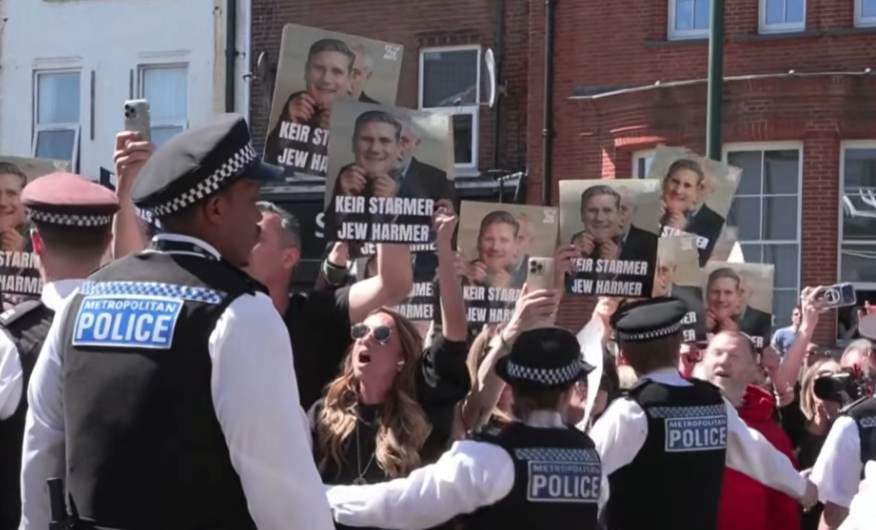
Yet, the British political landscape is not inspiring much confidence. The Labour government, already struggling across the board, has repeatedly made promises to the Jewish community that have not yet materialised – from concrete action on the IRGC to meaningful new policing strategies. When Prime Minister Starmer visited Golders Green after the stabbing, he was heckled by around 100 protesters holding signs reading “Keir Starmer, Jew harmer”. The government has pledged a “fundamental reset” of how it counters extremism, but many in the community have heard such language before. The government did release a comprehensive policy paper last month with the goal of “building confident, cohesive, and resilient communities is a whole-of-society effort” but the road ahead is long for now. The only tangible outcomes of the past few weeks have been new sums of funding support promised to Jewish communal organisations but, contrary to some beliefs, money cannot solve everything. Especially when part of the responsibility to protect the Jewish community is thus delegated to said community. Organisations such as the CST, who not only physically protect but also produce research and monitor antisemitism continuously, have been crucial to the safety of the Jewish community for decades. But these reactive financial responses do not actually create a healthier, more solidary civil society or infuse more nuance into the rigid climate coming out of the regular pro-Palestine protests and the also quite binary but countered reactions.
Meanwhile, the Green Party has drawn repeated accusations of antisemitism coming from within the party in recent months and now also found itself mired in controversy after its leader, Zack Polanski, who is himself Jewish, suggested there was a question to be had about “whether it’s a perception of unsafety or whether it’s actual unsafety” – a comment he made before the stabbing in Golders Green took place two weeks ago. Although some Green activists and local councillors have criticised and distanced themselves from their party leader for his statements, the reality is also that several former Labour councillors, who were rejected as election candidates due to allegations of antisemitism, have been welcomed into the Green Party. For years left-wing Jewish voters have had a hard time finding a stable and understanding political home, with the Labour party having lost a lot of its decades-long favour with the Jewish community during the Corbyn years and the intrepid antisemitic environment it revealed in the party. Although the Starmer version of Labour now does not have those underlying currents in its party politics anymore, it has also not been perceived to show strong leadership in its current reign. For some the Greens were a more natural alternative for a while and in the beginning of Polanski’s mandate the curiosity and expectations for a progressive and proud Jewish voice at the helm of British politics seemed to be a potential breath of fresh air. His recent track record and that of the Green Party has, however, been gravely disappointing and has pushed many Jewish voters away.
These reactive financial responses do not actually create a healthier, more solidary civil society or infuse more nuance into the rigid climate coming out of the regular pro-Palestine protests and the also quite binary but countered reactions.
On the other side of the political spectrum the Opposition and Conservative Party’s Leader Kemi Badenoch has been very outspoken on the recent attacks, describing this moment in time as an “epidemic of violence against Jewish people” amongst other strongly-worded statements, which has certainly resonated with parts of the Jewish community. She is also seeking to ban pro-Palestine marches, saying they platform antisemitism (although she has not been as supportive of efforts to ban the marches organised by far-right activist Tommy Robinson, which regularly feature anti-Muslim sentiments). Both new and long-standing right-leaning Jewish voters have also been drawn toward Nigel Farage’s far-right party Reform UK. Farage and Reform UK have received many antisemitism accusations of their own, which have gone largely unaddressed internally, but Reform has nonetheless positioned itself aggressively on the issue of antisemitism to the outside, with Farage describing the attacks as a “national disgrace” and blaming the government for tolerating the “root causes”, which is mirroring a trend across Europe of far-right parties gaining power by instrumentalising the rise of antisemitism to further their own discriminatory agenda.
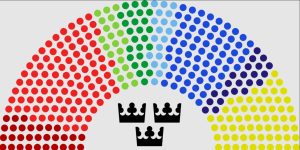
The results from the council elections that took place last week on May 7 have now shone a clearer light on what UK voters are thinking, with Reform UK having gained massive ground across the UK, with 1,450 council seats. Meanwhile, the Labour party experienced its biggest defeat in decades having lost over 1,300 council seats. The London borough of Barnet, home to the UK’s largest Jewish population and where the stabbing in Golders Green took place, ended the election night with two Labour seats and one Conservative seat. It is noteworthy that Reform UK, who was predicted to have an electoral breakthrough in this borough, did not get elected in Barnet. Yet, it is also quite telling that Labour lost control of the council.. Although the next general election is still three years away, these results are sadly illustrating the severe political fragmentation the British population has been going through just in the past year and are not exuding much encouragement for a healthy cross-party response to the rise of antisemitism but also to far-right extremism at large and the intertwined forms of hate against minorities, migrants, women and other groups, that are being played out against one another in the socio-political arena. This is a democracy and populism issue at large, with some commentary even talking about a potential collapse of the two party system.
After the promises, the anger
As witnessed around the globe, antisemitism has also been on the rise for a while in the United Kingdom, especially since October 7. In 2025, the Community Security Trust (CST) recorded 3,700 antisemitic incidents, making it the second highest total ever reported to CST in a year, with the highest number having been reported in 2023. But this intense timeline of attempted and successful attacks has provided serious new fodder for the already tense sense of security of British Jews. Although the ongoing pro-Palestine protests that have been taking place regularly in recent years are not necessarily linked to the current threat level, they are nonetheless an ongoing topic of contention within Jewish community discourse and have been felt by the community as connected, with a range of harms to Jews from latent impacts of normalisation of hate speech and hate crimes at protests to actual violence. Taking all of these experiences of heightened tension, attacks, political homelessness, it is understandable that there is a pervading perception in the British Jewish community of unsafety, of uncertainty, of fear but above all of anger.
Anger that the calls for help, support and action have not been taken seriously. The prosecution rate for antisemitic hate crimes in England and Wales lies currently at a mere 3.8% which in some ways is a reflection of the overwhelm of the justice system at large, but does nonetheless not inspire confidence on the affected side and if anything sends a signal to potential offenders that antisemitism can be more tolerated and ultimately permitted, while also disappointing a Jewish community that is already feeling on edge.
Not only has the government and civil society gladly relied on the Jewish community to fight its own fight in the name of an inclusive Britain but neither have they taken the lessons coming from rising antisemitism seriously nor their own responsibility in fostering a societal landscape that is literate in standing up to hate.
In the light of these attacks, the Metropolitan Police Commissioner Sir Mark Rowley has affirmed his and the police’s dedication to protecting the British Jewish community and has submitted an urgent proposal to the government for funding to recruit 300 additional officers to create a more sustainable policing framework. The Community Service Trust has been promised to receive more funding. There is currently a review of hate speech legislation taking place in Parliament. And of course a wider and more public conversation on security measures in and around the Jewish community, on regulation of digital and messaging platforms, national threat levels and so on. But ultimately, antisemitism is a foreboding and tell-tale sign of the state of democracies and the health of society – an assertion that has been preached by communal representatives and extremism experts alike for years. Reactive measures and isolating the Jewish community behind more security walls will not solve the rise in antisemitism and the increasing polarisation of political and public discourse. The diagnosis of Dave Rich, Director of Policy at CST and who writes the Everyday Hate Substack, is blunt: the platitudes need to stop, and so does the pretence that this hatred is somehow inexplicable or unprecedented.
Civil society has long ago lost its healthy backbone with broad anti-racism movements that stand up against all forms of hate, having splintered into in-fighting or selective solidarity, so that the Jewish community, especially since October 7, has had to mainly advocate for itself. In that vacuum, some of the voices offering solidarity have been those who condemn antisemitism in one breath and traffic in anti-migrant or Islamophobic rhetoric in the next – a form of support that many in the community find deeply uncomfortable, even as they feel they have few other places to turn. Not only has the government and civil society gladly relied on the Jewish community to fight its own fight in the name of an inclusive Britain but neither have they taken the lessons coming from rising antisemitism seriously nor their own responsibility in fostering a societal landscape that is literate in standing up to hate. Individual allies have been invaluable in public as well as in private spaces to British Jews but the broad and profound allyship that is wished for has not truly reared its head, except for an occasional official statement or more political lamentations.
Free speech is a core part of any democratic society, as it also is of the United Kingdom. Although the debate around bans on certain phrases such as “Globalise the Intifada”, which are being chanted at pro-Palestine protests, which continue to take place regularly, are heated and also instrumentalised by different groups to either further a far-right agenda or to minimise or even cast aside the horrors of October 7 and the connected rise in antisemitism afterward, it cannot be ignored that these facets have also contributed to an increased polarisation, lack of nuance and blunt ignorance, which has left many Jews feeling more isolated. At the same time, the Jewish community should be careful to not fall into the trap of the radical right’s attempts at instrumentalising this fear and isolation.
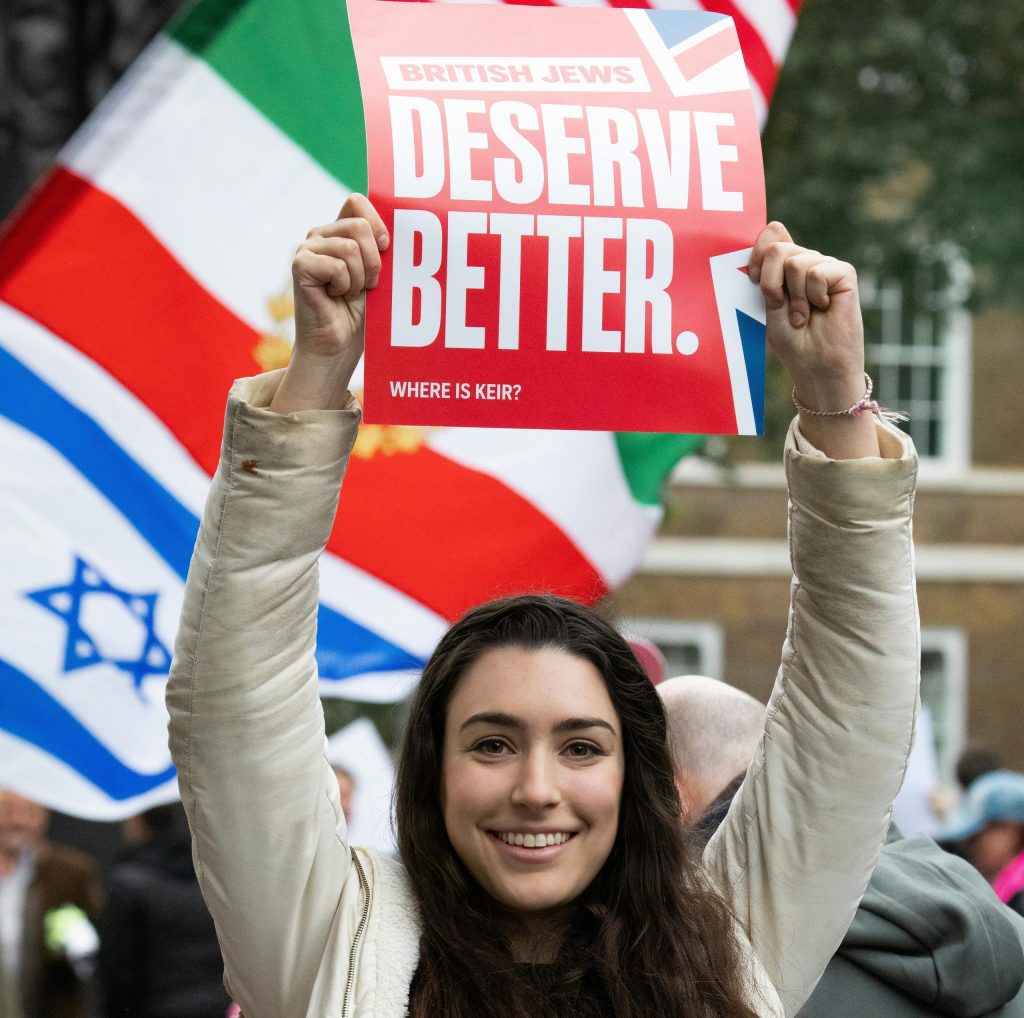
On Sunday, May 11, a rally against antisemitism was held in front of Downing Street, organised by over 30 Jewish organisations, with thousands of people gathered to protest. Speakers included representatives from the Labour, Conservatives and Liberal Democrat party but also the Reform UK deputy leader, who was welcomed with applause. Ahead of Sunday, an open letter circulated, garnering over 2,000 signatures demanding for the organisers to uninvite Nigel Farage from the rally, who ultimately did not attend. Zack Polanski was not invited at all.
It remains to be seen what concrete actions and sincere attitude changes will materialise from this unsettling landscape. For now, it is pertinent to not fall prey to the manipulative and divisive warfare and language that is gaining ground and adding fuel to the metaphorical fires, and to stand in solidarity with true empathy with each other. Many historical analyses have already been dedicated to the long history of Jews in the United Kingdom, whose British and Jewish identities were able to develop uninterruptedly over the past century, as opposed to the rest of European Jewry who are marked by the chasm the Shoah left behind, so that their sense of belonging tends to be much more settled. But the bottom line is that the majority of the Jewish community are proud to be British Jews and Jewish Brits and will not allow others to define or take their identity away from them.
- Prevent: a government programme aimed at preventing radicalisation and terrorism, established in 2003 as part of the UK’s CONTEST counter-terrorism strategy. It aims to identify and support individuals considered to be at risk of radicalisation before they commit any acts of violence. The programme has been the subject of repeated criticism, with some arguing that it stigmatises entire communities, and others that it is not effective enough in preventing people from carrying out attacks. ↩︎
- https://www.isdglobal.org/digital-dispatch/islamic-movement-of-the-companions-of-the-right-the-gig-economy-proxy-group-attacking-europe/ ↩︎

Esther Offenberg
Esther Offenberg is the editor of the English version and coordinator of the Italian, Spanish, German, and Portuguese versions of K. Review. She also conducts interviews and contributes to the magazine's international distribution.