European Jewish Communities Under Pressure
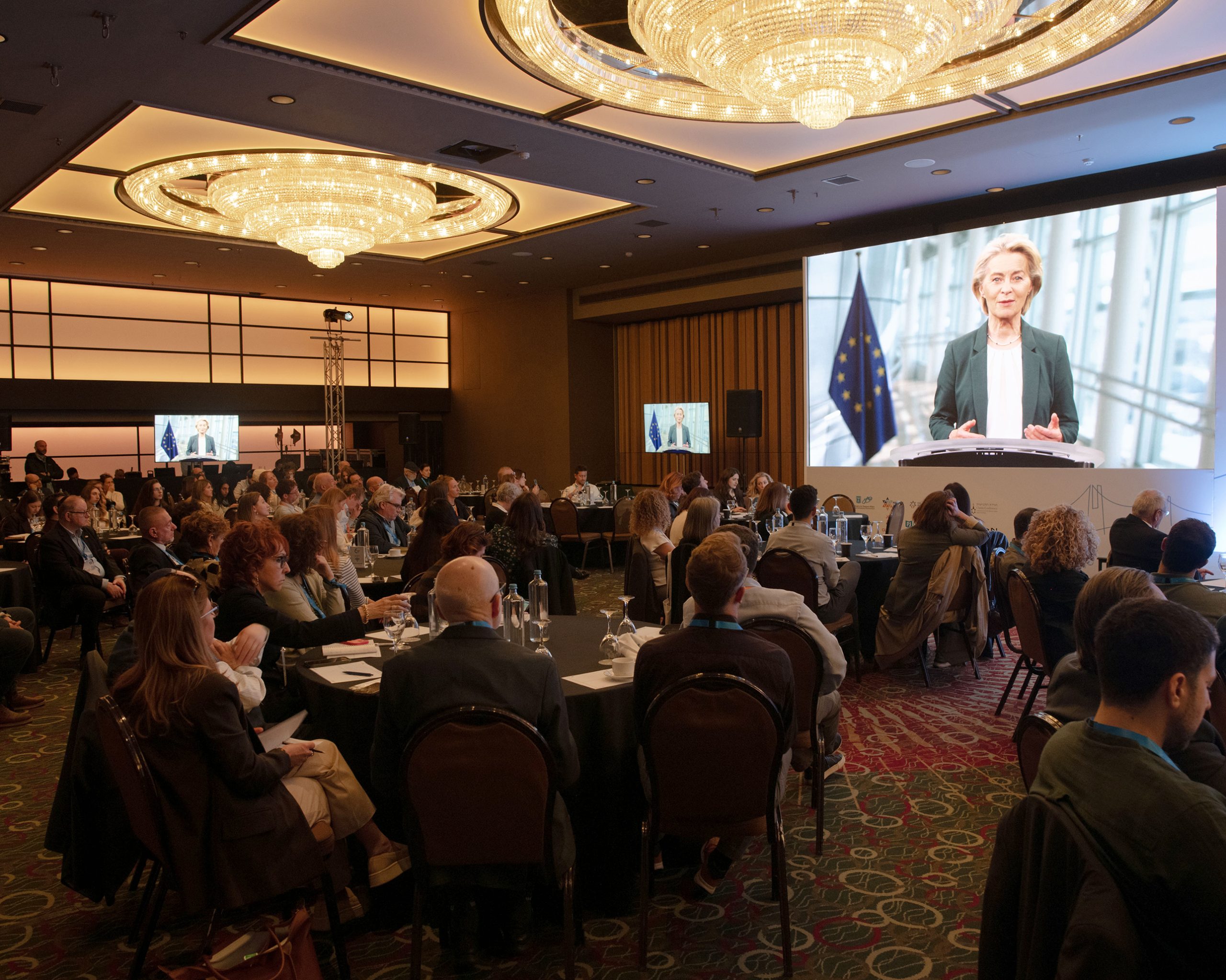
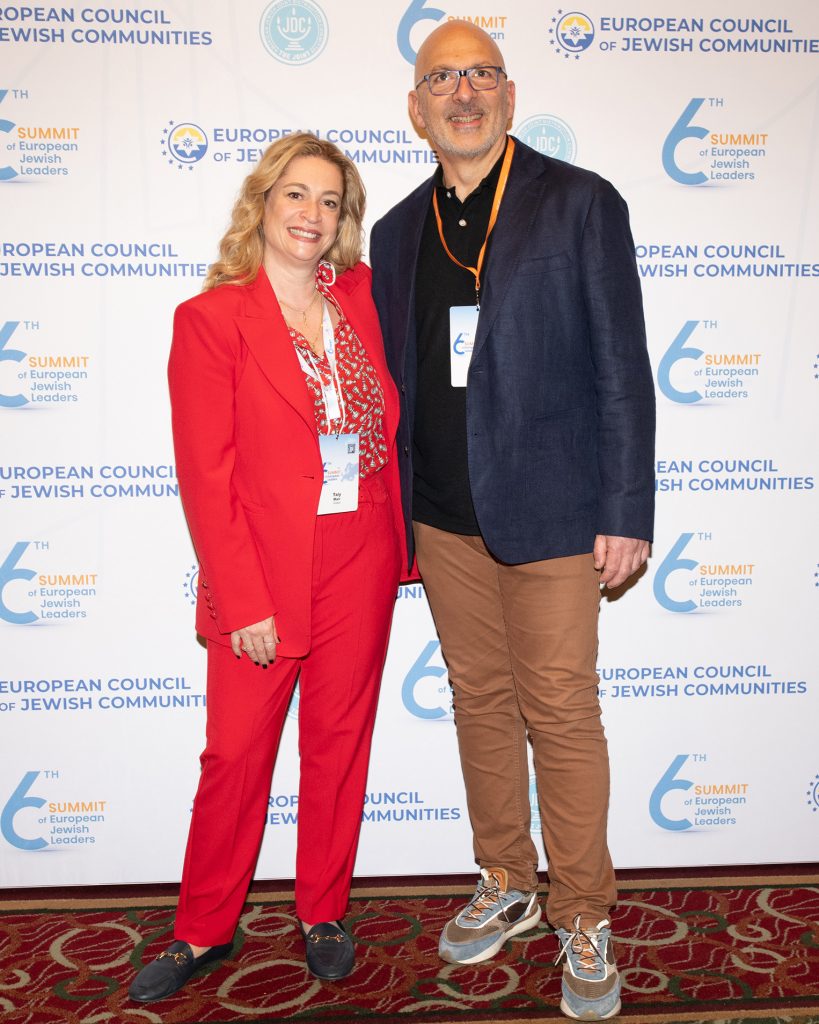
In March 2026, the European Council of Jewish Communities (ECJC) held its annual summit in Athens, bringing together some 250 Jewish leaders from 30 countries. In the hallways of the conference — between sessions devoted to leadership, community governance, and the demographic evolution of European Jewry — Elie Petit spoke with Michel Montreuil, a consultant with the JDC (American Jewish Joint Distribution Committee), and Taly Mair, director of the ECJC, a conversation continued afterward remotely. An opportunity to ask them for their in-depth analysis of the situation facing Jewish communities across Europe today.
Elie Petit: For those unfamiliar with it: what is the role of ECJC? I heard something really significant today: having twenty different types of Jewish communities in a city with such small numbers isn’t viable. Are you trying to bring everyone to the table?
Taly Mair: What I love about ECJC is that it’s a social organization, not a political one. Anyone who feels connected to their Jewish roots — in whatever way, whether liberal, Reform, Orthodox, or otherwise — is welcome. If you are a legal and democratic entity, we are here to support you to strengthen jewish life in your European city or country. And that is precisely the purpose of this summit: to debate, negotiate, even fight — but to find a consensus. The challenges coming from outside our communities are so numerous. We don’t need to add to them internally, or at least we need to find a way to overcome them.
It’s a democratic organization. Communities that no one had heard of have put forward their candidacy in our Board of Directors, like Novi Sad in Serbia to Cologne in Germany, Brighton in United Kingdom to Kraków in Poland. It is truly a pan-European organization. Communities from thirty European countries are represented, along with eight countries outside Europe- USA, Latin America, South Africa and Israel.
E.P.: How would you describe the context of this summit? We arrive in the lobby, where it is announced that a meeting of “European leaders” is taking place, and then we go through security checks worthy of an airport.
T.M.: The easy option would have been to cancel.
The situation is complicated between war, security concerns, uncertainty. We discussed it seriously. But we spoke with the head of security here in Athens, with the Greek police, and we decided to go ahead.
Because at some point you ask yourself a very simple question: If we as an organization that supports communities cancel our flagship event, what message does that send? That when things get difficult, we step back? No. That’s not who we are.
And what you noticed with the signs reflects exactly that reality. The “Jewish” from “European Jewish Leaders” was removed for security reasons. So yes we were cautious. We followed all the guidelines. But we still showed up.
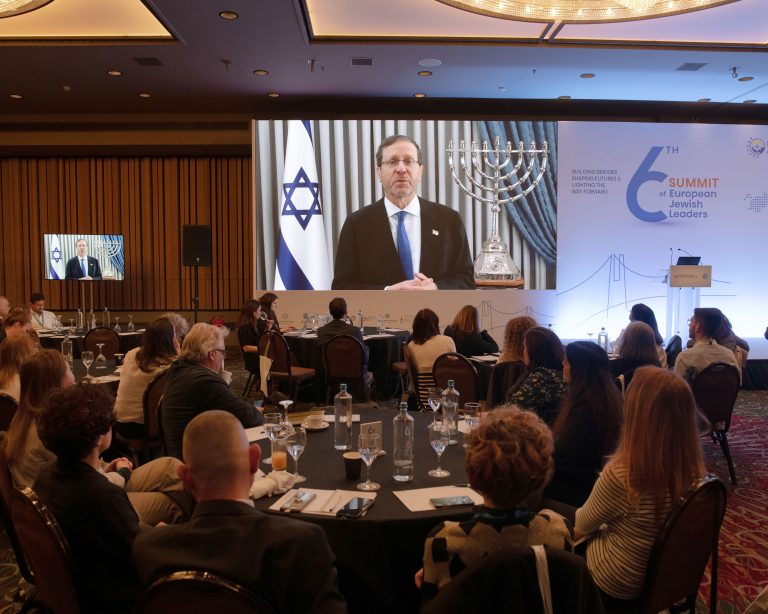
We created a space to connect, to exchange, to build. And when around 40 Israeli participants couldn’t attend, we adapted. We set up live streaming at the last minute so they could still be part of it. That’s the reality of leadership today. You don’t wait for perfect conditions. You adapt, and you continue.
E.P.: Listening here, Jewish communities seem to face many of the same problems as the societies they exist within: gender inclusion, intergenerational tensions… But they also face specific challenges. I heard about the difficulty of being included in the activities of Orthodox communities, and also about the emergence of new Israeli groups settling in Europe.
Michel Montreuil: Those are two very good examples of adaptive challenges that Jewish communities are confronting today. These are realities that didn’t necessarily exist thirty years ago: the emergence of non-Orthodox forms of Judaism gaining ground in Europe, and what we call “Jews in motion” — large Israeli communities migrating to Western Europe. The old recipes simply no longer work. We need new ways of addressing these realities.
E.P.: What is the sociology of the participants? Is it a particular type of community? Rather progressive, rather liberal?
T.M.: From the beginning, even before the war, we were very intentional about bringing together people who are actually doing the work. Not necessarily presidents or people with titles, but leaders in practice – people who care and are engaged in their communities.
“European communities are resilient, but they also need support, connection, partnership. Just as we care about what happens to others, we also expect them to stand by us now.” Taly Meir
And the diversity is very real. You have small communities – like in the Balkans, Serbia, Bosnia, even Athens – where resources are limited and people often wear multiple hats. And then you have much larger, more structured communities in France, the UK, Germany. Very different realities.
But what’s striking is that despite these differences, we are facing many of the same challenges – especially now, after October 7th. Questions of security, antisemitism, identity, belonging – especially among younger ages – connection to Israel, the place of Jewish life in Europe today are all omnipresent.
E.P.: Is there a leadership crisis in the Jewish community – or do Jewish organizations simply have a sharper awareness of this need? Or alternatively: do they objectively need more leadership than others?
M.M.: Jewish organizations face two quite distinct types of crisis.
First, there are acute crises. For about twenty years in Europe, the eruption of Middle Eastern conflicts involving Israel has reverberated through the societal climate of the countries where Jewish communities live, with implications that vary in severity depending on the context. In France, this has gone as far as terrorism, violence, and murder. In other countries, it manifests “merely” as an ostracization of Jewish identity, or as an increasingly freely and openly expressed suspicion of dual allegiance – which amounts, in reality, to questioning the loyalty of European Jewish citizens toward their own country.
And then there is a deeper, continuous, low-level shift that goes back to the 1970s and 1980s: the demographic decline of European Jewry. It results, in my view, from three combined factors.
The first is demographic ageing. Jews have on average a slightly higher level of education than the societies in which they live – and there is a positive correlation between level of education and the age at which one becomes a parent. So children come later, and comparatively fewer of them, in European societies that already have few.
The second factor is massive emigration from the former Soviet bloc and Eastern Europe – largely to Israel, but also to North America – which began with the fall of the Berlin Wall and led to the near-disappearance of Judaism in the former USSR. France remains today the principal reservoir of Jewish population in Western Europe, but it is not immune to the departure of the Jews who live there.
The third factor, which has intensified over the past fifteen years and is particularly visible in France, is the emigration of the youngest populations, who often leave without their parents, who are too old or disinclined to follow. This phenomenon creates cascading effects: more and more elderly people find themselves isolated, their children and grandchildren living abroad, placing a growing burden on community social services.
T.M.: I agree with much of what Michel described – especially the idea that we are facing both immediate pressures and longer-term shifts. But I wouldn’t call it a leadership crisis. If anything, we have extraordinary (though usually underpaid) professionals and committed lay leaders who care deeply about their communities.
What we do see is leadership that often feels isolated. Leaders dealing with complex realities – security, identity, demographic change – but too often within their own local context, without enough connection to others facing similar challenges. And that’s where the gap is. Not in people, but in connection.
Because when you bring leaders together, something shifts. They realize they are not alone, they share more openly, and they learn from each other. At ECJC, we are very clear: we are non-denominational and non-political. We are a platform for connection.
And today, especially after October 7th, when Jewish Europe is facing a serious crisis, the importance of being united and supported is not theoretical but essential. Leadership cannot function in isolation.
E.P.: Two tendencies can be observed in the training programs on offer in the Jewish world: on one side, leadership; on the other, transmission. These two orientations are not necessarily antagonistic, since the leader is also someone who has accepted receiving something, and the one to whom something is transmitted is also someone who accepts bearing responsibility for it. But I see them as somewhat at odds: leadership would serve primarily to engage with the outside, with the non-Jewish world, to engage in politics whereas transmission would be more inward-looking, even in resistance to the outside, to the non-Jewish world. Do you recognize this diptych – leadership and transmission, interior and exterior, engagement and resistance – in the way Jewish communities think about the formation of their members?
M.M.: It’s an interesting proposition, but I would read it somewhat differently.
Where Jewish leadership has primarily been exercised is in its classic representative function vis-à-vis the national, regional, or local authorities of the country in which it finds itself – advocacy, protection, security. You might call that a defensive vision of representation. Not exclusively defensive: there is also, sometimes, a dimension of promotion – highlighting the contribution of Jewish life to society, which is itself a way of defending community interests.
“At the ECJC, we are very clear: we are non-denominational and non-political. We are a platform for connection that supports the development of Jewish life in European cities.” Taly Mair
On the other hand, there is a place where Jewish leadership has, in my view, fallen short for too long and where significant room for progress remains. This is what I call adaptive leadership. That is the capacity to read and decode the complexity of the challenges communities face today.
The challenge of this kind of leadership is not providing solutions, nor embodying a collective oneself: it is sparking conversations and debates, grounded in factually established realities, to confront one’s social body with the dilemmas it will have to face. It can either absorb them, in the sense Saint-Exupéry used, like the tree that absorbs a knot as it grows, or resolve them and make a decision. And I find that we sometimes lack the courage needed to dare confront the Jewish community with the complexity of what we are living through.
T.M.: I see the distinction, but in practice, it’s much more interconnected. Leadership and transmission are not two separate tracks — they feed each other. You cannot lead if you are not rooted, and you cannot transmit if you are not preparing people to take responsibility. At the same time, we often don’t really train people to become lay leaders. They step into these roles with commitment — but without structured support. That’s something we want to address.
At ECJC, we are working on developing, among others, programs around volunteer and lay leadership — where experienced member organizations, like Jewish Care, can share their knowledge with smaller communities. We call it peer learning: leaders transmitting knowledge to other leaders. Because in the end, communities need both: strong identity and the ability to engage with the outside world. And creating the space for that exchange is already part of the solution.
E.P.: In your opinion, what could help European Jews today?
M.M.: in my opinion that raises a fundamental question:
The relationship between European Jewry and the two great world Jewries of today: North American Jewry and Israeli Jewry. Today the latter two together represent 90% of world Jewry, whereas a century and a half ago, it was Europe that concentrated 90% of it. A vertiginous geographical inversion.
The question then becomes: Do these two Jewries stand have the desire to help the European Jewish community, in a disinterested way, without a particular agenda for European Jewry, in respect of its own identity, its DNA, its history and its tradition? Do they even have the capacity to do so?
And on the European side: is European Jewry ready to do its part? Is it capable of asking for help?
For a long time, it proved incapable of doing so – wrapped in a splendid isolation, convinced it needed neither the Israelis nor the Americans. But that is changing. These past two decades mark, in my view, a genuine inflection point: a growing and acknowledged openness among European Jews to say yes, we are interested in inspiration, exchange, skills, global perspective, best practices, and innovations developing on other continents. And Latin America should not be forgotten in that picture. We are less certain of our own superiority, and I think that is a good thing.
I get the impression that European Jewries today are in a far more open and determined posture, drawing inspiration from what is being done elsewhere without simply copying it wholesale. The proof is the explosion of grassroots initiatives we have witnessed over the past two and a half years in Western Europe.
T.M.: I agree with Michel and would add something very concrete to that. What is helping today is not only ideas – but access to real expertise and programs that can be adapted locally.
At ECJC, our role is to connect these resources and make them accessible, to encourage peer learning – communities learning from each other instead of each one trying to reinvent the wheel.
At the same time, we should be honest: this work requires support. We require support. We are a non-profit. At ECJC, we are a very small team working full-time, often non-stop, because we believe in this mission. But to build real structure, to create programs, to connect communities and bring value – we also need the support of partners and donors who understand the importance of investing in European Jewish life.
E.P.: What are some cases in which Jewish communities need training?
M.M.: The first is mental health — trauma management, domestic violence, addiction. Subjects that until now belonged either strictly to the private sphere, or to outright denial: it doesn’t happen among Jews. Yet all the indicators show a prevalence rate identical to that of the general population. There is today a growing recognition of this reality: for example, the Chief Rabbi of France is particularly out front on the subject. And it is a genuine adaptive challenge: does psychological health belong to the private sphere, or can the community take ownership of it, offer a space of support, resources, and containment?
The second is the security of Jewish sites. In a context of antisemitism that can become violent – attacks on property, sometimes on persons – at what point does protection become confinement? Today, entering a community space often resembles passing through a security airlock: identity checks, cameras, filtered access. This has a real effect on people’s ability to frequent these places. How does one protect without closing off to those who might want to come?
The third is the question of mixed marriages and the definition of belonging. How does one evolve the criteria of inclusion – to welcome non-Jewish spouses, candidates for conversion – without watering them down too much? The school question illustrates the dilemma well: many small communities in Europe no longer have the critical mass of children to maintain a viable Jewish school. They thus find themselves compelled to open their doors to children who are not halakhically Jewish – whose father is Jewish but not their mother, for example – simply to balance the books. Which sometimes puts them in direct tension with their own Orthodox rabbi, caught between the survival of the institution and the risk, in his eyes, of diluting the community’s identity.
E.P.: : These are issues that European Jewish leaders meeting in Athens discussed at length.
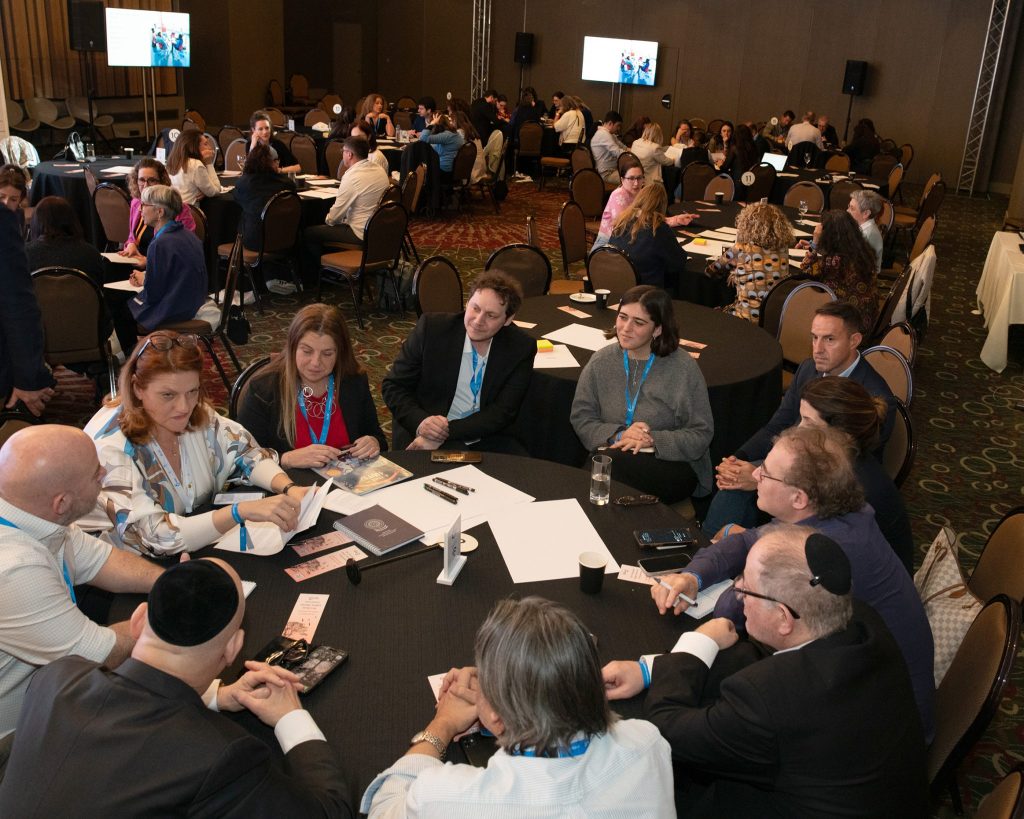
T.M.: Indeed. Of course these topics were present in the formal sessions. But more importantly, they came up constantly in the informal conversations. You could hear the same questions repeating from one table to another — sometimes expressed differently, but essentially the same concerns. And that’s actually one of the most important things these gatherings create. People realize: it’s not just my community. Whether you come from a large community like France or a much smaller one, the context may differ, but many of the challenges are shared. And that realization changes something. It opens the door to more honest conversations, to exchanging ideas, and sometimes simply to feeling supported. And that’s where the real value of the summit is.
“I find that we sometimes lack the courage needed to dare confront the Jewish community with the complexity of what we are living through.” Michel Montreuil
M.M.: These subjects are often the ones discussed in the places that matter most: the breaks, the meals. And it is indeed an acknowledged virtue of this type of summit to create these informal exchange moments — which allow participants, beyond the official program, to share their local challenges and realize, more often than not, that they are widely shared across Europe.
There are of course variations depending on community size — the stakes are not the same between the Paris region and a community of a few dozen members elsewhere in Europe. But these gatherings make it possible to break the isolation that many leaders feel, to find ideas, inspiration, and sometimes simply the energy that comes from knowing one is less alone. And in the best of cases, to say: we are going to pool our ideas, sometimes even our resources, to go further together.
E.P.: You have experience of Jewish communities outside Europe. I would therefore like to ask you for an outside perspective: so you see something deeply coherent about European Jewish communities, beyond their shared geographical belonging? A distinctive trait, a shared identity that defines them?
M.M.: There is first the profound sense of history, and of the rootedness on this continent, which are aspects the two other great Jewries do not share in the same way.
Israeli Jewry lives in a tension between a millennia-old biblical anchoring and an extremely recent statehood – not a dissonance, but a kind of pull between these two temporalities. North American Jewry has at most three centuries of history on its soil. European Jewry has more than twenty – and it does not merely invoke this: it is the bearer of it, culturally, philosophically, traditionally. Ashkenazi and Sephardic Jewries are European Jewries in their very essence: Ashkenaz refers to Germany, Sefarad refers to Spain. The etymology says it all.
And then there is the other end of the historical arc: European Jewry is also the one that lost two thirds of its demographic mass in the Shoah. And which, emerging from the war, had to rebuild from decimated populations and a collective trauma of a depth that the other two Jewries do not know from the inside, or at least not in such a direct way. North American Jewry may be inhabited, for its part, by a form of guilt at not having intervened sufficiently during the war. Israeli Jewry was at that time entirely mobilized in the building of a state. France is an exception, with the massive arrival of Jews from North Africa who profoundly reconfigured the community. England too, for obvious reasons: the Nazi occupation did not take place there. But for the rest of Europe, reconstruction occurred under extraordinarily difficult conditions.
“Today, entering a community space often resembles passing through a security airlock: identity checks, cameras, filtered access. This has a real effect on people’s ability to frequent these places. How does one protect without closing off to those who might want to come?” Michel Montreuil
T.M.: I would add something slightly different. Yes, there is a shared European story – history, culture, memory. But beyond that, what I feel more and more strongly is something simpler: we are one people. The contexts are different – Europe, Israel, North America – but the connection is real. And today, it’s not theoretical. We see how interconnected we are.
Israel is present in Europe in a very tangible way — through people, through families, through movement between communities. And that is changing the way we relate to each other. So for me, the question is less about what makes European Jewry distinct — and more about how we understand our shared responsibility. As we say: Kol Yisrael arevim ze baze. If something happens in one part of the Jewish world, it concerns all of us. And that goes both ways. European communities are resilient, but they also need support, connection, partnership. Just as we care about what happens to others, we also expect them to stand by us now. Because, deep down, what defines us is not just where we live, but the fact that we don’t have to face these realities alone.
E.P.: That is perhaps the European singularity — this fragmentation into small communities, some on the threshold of disappearance, yet continuing to exist? This tension between erasure and persistence, between fragility and life?
M.M.: I am not certain the threshold is sustainable over time. In my experience, I observe one or the other of two phenomena. Either disappearance: young people leave to study in major urban centers, remain there for professional reasons, and often also because those with a strong Jewish identity know that it is there, in large population centers, that they have the greatest chance of founding a Jewish family – not by returning to their small community of origin. The shtetl, so to speak.
Or, conversely, an unexpected revival: communities on the verge of the threshold that find themselves reinvigorated by unsuspected migrations. I think of Portugal, where thousands of young Israelis have settled in recent years. Of Spain, irrigated since the late 1990s by significant Argentine immigration. Of Belgrade, where several hundred Israelis have established themselves – for reasons I would be unable to explain objectively. Of the Netherlands, and Amsterdam in particular, where a large part of the Jewish community today consists of Israelis.
With all the necessary nuance: the capacity and willingness of these newcomers to connect with the local community is a subject in itself, another adaptive challenge. But these migrations create demographic resurgences where one might have assumed disappearance was inevitable.
E.P.: Is there a gap between Western and Eastern Europe? Or between North and South?
T.M.: Not really. I think those divides – East and West, North and South – have become much less relevant over time. Some communities in Eastern Europe, like Poland or Hungary, are today very close in their development and outlook to Western communities. Thirty years ago, there was a clear socioeconomic gap but that’s largely no longer the case, except in places like Ukraine or Russia, for obvious reasons.
For me, the real difference is not geography. It’s size. A large community has structure, resources, professionals. A smaller one often relies on a handful of very committed people, professional and lay, who do everything. That creates very different realities and very different needs.
But interestingly, even across those differences, many of the core challenges remain the same. And that’s why bringing these communities together actually makes so much sense.
“For small communities there is a very real anxiety in the face of the risk of disappearance. Communities below the viability threshold, whose critical mass no longer allows for internal continuity, and whose younger generations migrate toward large population centers.” Michel Montreuil
M.M.: The East-West divide, I think it has largely disappeared – and much of the credit goes to the European Union and its massive infrastructure development aid policies. Poland today has a standard of living that places it in the global top twenty, whereas thirty years ago it was a country only just emerging. The most recent entrants, such as Romania and Bulgaria, are in the process of closing the socioeconomic gap that separated them from Western Europe – it is a matter of years, not decades.
The North-South divide also seems increasingly irrelevant to me, with cultural globalization: entire generations watch the same programs, are exposed to the same media, travel to the same places, and for those with the most internationalized careers, often move through the same professional stages in the same locations – and therefore share, to a certain extent, the same life experiences.
I agree with Taly that the more structurally significant divide today is between large and small communities.
E.P.: Tell us about small communities.
T.M.: From my own experience in Athens, leading a small community for 13 years, I would say that small does not necessarily mean weak. The Jewish Community of Athens is not large, but it is very vibrant, united, and connected. There is a strong sense of belonging, and people feel part of something collective. But that’s not always the case.
In other places – like Barcelona, for example – you can have several small communities, sometimes even smaller than Athens, divided along different lines, not necessarily collaborating. So the challenge is not only size. It’s also fragmentation. And this is exactly where we see our role at the European Council of Jewish Communities — as a platform for connection.
M.M.: For small communities there is a very real anxiety in the face of the risk of disappearance. Communities below the viability threshold, whose critical mass no longer allows for internal continuity, and whose younger generations migrate toward large population centers, as we discussed.
But there is another divide: an intra-community divide, transversal, found more or less everywhere. It concerns the importance accorded to the religious dimension – fidelity to tradition, the centrality of the synagogue – relative to an identity more centered on culture. A genuine fault line.
This divide sometimes overlaps with another, perhaps more artificial one: between Jews who bet on openness to society, even in times of crisis, who believe in coalitions and trust European states to ensure their security – and those who have a more clear-eyed, or more pessimistic depending on one’s perspective, view of the inability of states to concretely protect their Jewish citizens in daily life, despite their goodwill. The latter favor an identity more turned inward, more concerned with ensuring its own security, and less oriented toward seeking coalitions with other actors.

Elie Petit
Elie Petit is a journalist and deputy editor-in-chief of Revue K. He collaborates with numerous international media outlets, including The Washington Post, NBC, and the BBC.