The World of Michael Kovner
Danny Trom visited Michael Kovner’s studio in Jerusalem. The painter was born the year the State was founded, and he is the son of Abba Kovner, who led the Vilna Ghetto Uprising, commanded Jewish partisans, and later fought in Palestine. Between the two men, there is no generational conflict, but rather a silent divide. It separates two ways of being in Israel. And what if, from father to son, the very meaning of what the State of Israel is becoming were being played out as it passes from one generation to the next?
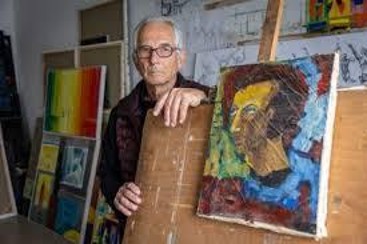
Michael Kovner’s studio is located in Jerusalem, on the second floor of a building that looks like an industrial wasteland painted over by squatters. Down a long hallway, Michael leads me into the room where canvases are piled high, then plops down in a chair in front of me, urging me to sit in the other one across from him—the one that’s higher and more comfortable—as if he were preparing for an interrogation.
To meet the son of the man who led the Vilna Ghetto Uprising, harassed German troops as head of the Jewish Partisan Organization in the forests, planned, after the war, the Jews’ revenge by poisoning as many Germans as possible—though he failed—and then left for Palestine and fought in the War of Independence—that is no easy task. The suspicion still lingers in people’s minds that, through the artist, it is the icon Abba Kovner that we wish to reach. Let’s admit that the suspicion is legitimate.
Yet Michael, at the age of 77, is serene. Born in the year the State of Israel was founded, to Abba—the partisan-poet—and his wife Vitka, reputed to be the brigade’s most intrepid fighter, he grew up on Kibbutz Ein Hakhorech, where some of those young Zionist-Socialist activists had settled—those who had postponed their aliyah to remain alongside their people on the brink of the abyss in Europe, taking up arms as improvised fighters. They later moved to the kibbutz, but in reality they were like ghosts returning from the dead.
Named Michael in memory of his paternal uncle who died in battle in the forests of the East, the painter struggled for a long time to make a name for himself—one he could claim on his own, for who he truly was. Once recognized, he accepted that the weight of his parents’ legacy would irrevocably bear down on his psyche. He resigned himself to it without ever truly coming to terms with it.
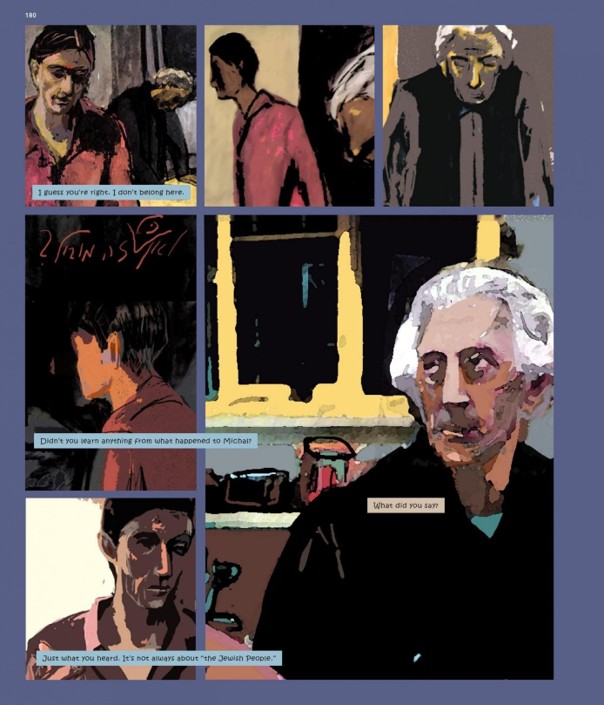
From his graphic novel The World of Ezekiel, published in 1991 and dedicated to his father four years after his death, it is clear that Michael belongs definitively to a new world, from which his parents’ world remains impenetrable. Yet something in the threat looming over Israel in 1991 would build a fragile bridge between the two generations, when every Israeli household was equipped with gas masks in the event of an Iraqi chemical attack.
But the elderly Ezekiel in the graphic novel confides in his grandson, bypassing his son, who grew up in the peaceful microcosm of the kibbutz. The graphic novel is fiction—but only just. For from the kibbutz—that vast playground for young Michael, enveloped in gentle warmth—the storm that continues to rage in his parents’ minds will always remain beyond his reach. Little Michael watches, proud and intrigued, as the entire elite of the young state files past toward his parents’ small house to speak with this father who is both respected and feared by all. A prophet whose voice commanded attention, Abba Kovner remained unyielding, confident in his judgment, obsessed with the security of the State of Israel, resistant to the discipline of the Marxist Mapam party—which he constantly threatened to leave—opposed to the pro-Soviet leanings of the official line, and refusing, with the energy of despair, to accept a normalization of relations between Israel and Germany. He made his eloquent voice heard by his fellow citizens and the entire world, testifying before the court that tried Eichmann in Jerusalem and strove to become a humble member of the kibbutz by refusing all privileges, working to adapt Jewish national customs to the prevailing socialist norms despite the prevailing skepticism, when he was not withdrawing to write. Of this fiery, angry, obstinate, yet learned, inspired, and clear-sighted man—who continued to brood over his resentment toward the establishment that had once denied him the means to carry out a massacre in Germany—of this man who would henceforth live with one foot in Israel and the other stuck in the vanished world of Eastern European Jews, Michael paints a portrait of an attentive father—somewhat of a teacher, loving, and endowed with a solid sense of humor, which is quite unexpected.
Abba had to abandon his studies at the Vilna School of Fine Arts to throw himself headlong into the war against the Nazis, but young Michael, for his part, drew in his carefree world, proved to be talented, and took drawing lessons outside the kibbutz, and then, after completing his three years of military service—just after the Six-Day War, in an elite unit as befits any scion of the pioneering elite—he left to study and paint in New York.
Abba Kovner channeled his artistic sensibility into poetic writing, switching very early on from Yiddish to Hebrew, expressing himself in a tormented, tense, often cryptic style, unleashing verses like bursts of gunfire, sculpting his sentences in the biblical language that modern Hebrew has already rendered obsolete—while Michael paints landscapes. A landscape painter?!
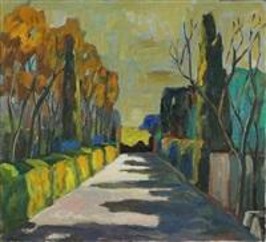
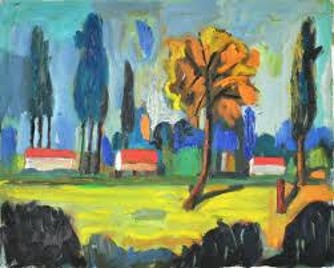
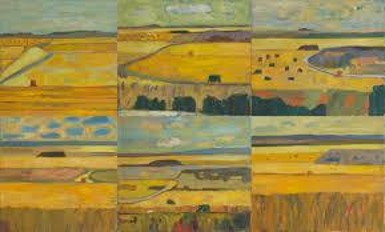
This classicism stood in stark contrast to the inclination of Israeli artists of the 1970s, who had embraced the then-fashionable conceptual art, hoping to join the global artistic avant-garde. Michael instinctively rejects this. He spends a long time feeling his way, searching for his path, and finds it by going against the grain of his time. Abba clashed with the socialist establishment’s perennial pragmatism; he resists academic trends. He did not want to deal in concepts; he wanted to render the colorful, sensuous world as it presented itself to his gaze, on the lookout for something intangible that he aspired to give form to—something that demanded to be revealed, which he perceived with both feet firmly planted on the same ground. Wherever he sets his feet, he captures what he calls the soul of the landscape—whether urban or rural—a landscape whose appearance is always unique, provided he manages to discern the ideal balance between colors and forms, seizing the right moment of its sudden transformation under the effect of shifting light, and immortalizing its specific vibration.
His father saw shadows everywhere; he sees light playing on the surfaces of the world—on the facades of New York’s skyscrapers or on the cultivated fields of a fertile valley in the land of Israel. For Abba, the kibbutz is the center of the world, the shelter finally found that protects from the whirlwind raging everywhere else, that place where Jewish survival endures in a peaceful yet demanding community, where all the world’s contradictions are destined to fade away—that core that already dissolves them the moment he opens his eyes, even as his nights remain haunted by the hell of Europe.
For Michael, the kibbutz is his birthplace, a familiar native land, which he renders in the concreteness of an almost motionless form. A world that has always been there, where his parents cast him, an Eden offered to him like a garden to a child. It is the soil in which he grew. Abba hallucinates, confusing the Alexander River near the kibbutz with the Neris that flows through Vilna, for his vision splits against his will; he superimposes them in his poem sodi che-lo tam; he does not know where he lives, finds no rest, while Michael serenely inhabits a world tailored for him, the same sun glistening on all the surfaces where humans dwell. Can one imagine a more striking contrast?
When the ghetto was doomed, Abba smuggled out the young armed fighters to continue the struggle in the forests, leaving behind their parents, who were doomed to certain death.
“What about your mother?!” asks his indignant grandson, standing before the LEGO model of the ghetto he built with his grandfather Ezekiel in the graphic novel. Ezekiel falls silent and leaves the room. “I have no answer to give you,” Abba Kovner to his mother, soon to be left to her fate in the ghetto, when she asked him what she would do once her son had disappeared into the sewers, weapon in hand—an admission of helplessness that would haunt him his entire life, as he evokes in his famous poem imi imi [Mommy, Mommy].
Michael, ever since he served in the army, has also faced his own dilemmas, but with options that can be weighed and debated endlessly: ending the occupation, liberating the Palestinians, seeking a path to compromise at a time when that prospect is receding from view. Michael, too, is seething. Yet nothing in his painting betrays even a trace of opposition or anger. Unless his landscapes are merely the inverse image of politics—an assemblage of surfaces without borders, save for those traced by the gaze, where each person peacefully inhabits their own and visits those of others. This hypothesis leaves Michael perplexed; he hadn’t thought of it, but perhaps we can discuss it another time, he suggests. For Michael’s paintings, when they take on the appearance of a collage, spill beyond the frame, as if the painter were telling us that every division is arbitrary—and therefore also potentially deliberate—and that the gaze, being free, always extends beyond what the eye is capable of taking in. Since every form, by its very limitation, produces its own excess, this overflow refers to a horizontal world of which the portion inserted within the painting’s frame is but a fragment. To what the painter reveals, the viewer’s gaze must add an endless “and so on.” This floating world, which lends itself to infinite visual divisions, is Michael’s world. When he succeeds in translating this vision with his brush, the painter is at the height of his art.
Michael says with a hint of detachment: “My father used to tell me that his writing comes from the storm.” But then where does Michael’s own pictorial language come from? What he is certain of is where it does not come from: “The Holocaust is outside my painting, and outside my thoughts as well,” he confesses calmly. Michael is indeed a product of the Zionist revolution; he belongs to a generation that was not spontaneous but educated to experience tranquility, and his painting imperceptibly refracts this rupture—one that is neither intended nor claimed by him, but simply acknowledged, like an obvious fact against which the past nevertheless continues to protest. One comes to wonder if he ever lived under the same roof as his parents.
But that is precisely not the case, since he grew up in the kibbutz’s communal children’s house, where a new man is forged for a new world. It is therefore not the drama of a generational conflict that played out on the silent stage of Ein Hakhorech, but a silent rift, separating worlds that no one can bridge anymore, in either direction. A two-way dead end blocks their access.
In Michael’s graphic novel, the son returns from his military service in the occupied West Bank and says to his elderly father, “We’re just like them.” The father replies, “You don’t talk like that in this house.” Yet Michael never dared to make such a remark in his parents’ home. The unspoken rift would have taken the form of an irreparable break.
But for a citizen of the world—as Michael dreams of being—everything is sayable in the presence of his interlocutor; there is no incommensurability except that of landscape textures, each appearance reflecting the cyclical nature of the seasons more than that of a land found or rediscovered. No historical singularity withstands the test of speech; awareness of the past grows blurred, whereas in pictorial terms, uniqueness is the rule for Michael.
Abba Kovner never ceased to assert that what mattered to him above all else was the Jewish people—their trajectory, their tragic destiny, their patina of eternity—not the land of Israel. Yet Michael does not hesitate to describe himself, with a hint of provocation, as an “artzi” painter—a word now somewhat obsolete that means “of the land”—of this land of Israel that has been claimed, cultivated, celebrated, and inhabited. Michael receives the land, and through it, the world’s adornment. Nothing happens there; no historical events unfold there, except that it is worked, inhabited, humanized, and thus reveals itself to the gaze, in its peaceful presence and infinite variation. It is the foundation of life—life in the generic sense. But life—the life that is fading away, despite the desperate struggle to save it, the life of the people—is that not also the very life to which his father devoted all his strength? “The Jewish people”—this axis around which his father revolved—Michael confesses he does not understand what it could possibly mean, as if it were a mystery that Abba took to his grave. This concept, too abstract and too metaphysical for him, he cannot grasp. It runs counter to the normalized life that was secretly bestowed upon him as a gift. “You don’t understand a thing about the State of Israel,” his father snaps desperately at his son in Michael’s graphic novel. Is this the Zionist revolution turning against itself, or is it instead being elevated by dispelling the storm that propelled it forward? What is the State of Israel once the impulse from which it springs eludes those to whom its burden falls? The World of Ezekiel suggests that it is Abba’s grandson who will take up the question and must formulate his answer. Michael, the link overlooked by his father when matters become too obscure for him, will continue to paint.
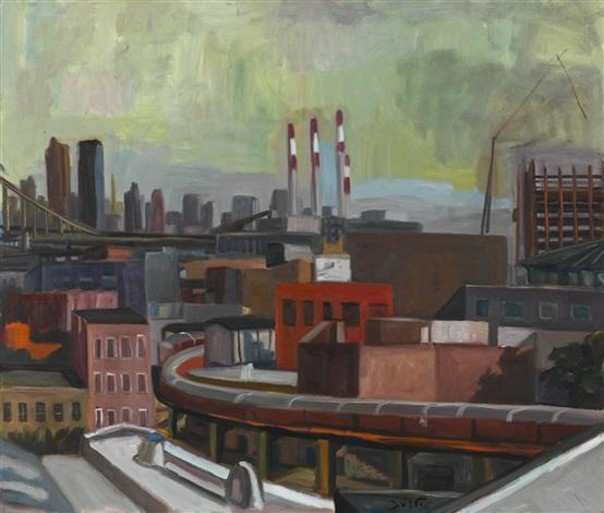
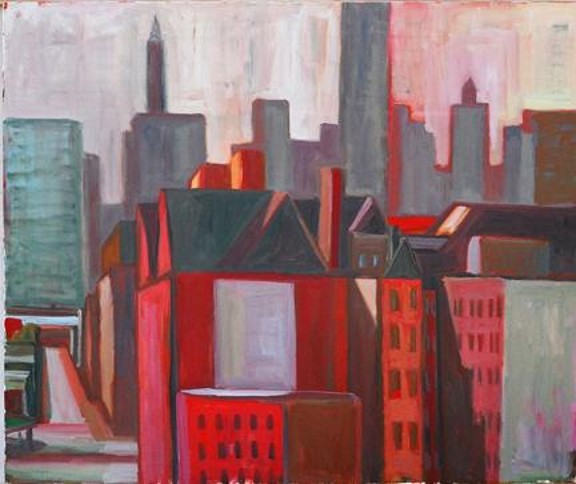
From the window of his studio in New York, Michael painted this panoramic view of New York in 2006—an urban-industrial landscape with three prominent smokestacks in the foreground of the skyscrapers, a still composition cut off from the noise of the world. The window of Abba Kovner’s hospital room in New York, where he passed away in 1987, also looked out onto three smokestacks, which he describes in his final collection of poems as a view of a crematorium. The views of the smokestacks do not overlap; they do not communicate; they turn their backs on one another. Yet a tenuous thread may still imperceptibly connect the painter to his father when, breaking the linearity of the landscape, he paints the trees of the kibbutz soaring toward the sky and firmly anchored to the ground—beneath which one can sense deep roots—trees whose foliage is rippled by a slight tremor. As if they were still vibrating from the force of a storm that has now died down.
Danny Trom
Danny Trom is a political sociologist and Director of Research at the CNRS. His work combines the sociology of political experience with reflections on Jewish life in Europe, exile, and the State of Israel. His research focuses in particular on the persistence of Jewish existence, minority conditions in Europe, and the reconfiguration of relationships between diaspora, nation-states, and Israel.