Before ‘Shoah’, the voices: Lanzmann’s forgotten tapes
Interview with Tamar Lewinsky, curator at the Jewish Museum Berlin
At the Jewish Museum in Berlin, an exhibition presents more than 220 hours of previously unheard audio recordings made by Claude Lanzmann and his assistants between 1973 and 1978, during the preparatory phase of Shoah. This exceptional material, inscribed in UNESCO's Memory of the World Register in 2023, reveals Lanzmann in the midst of his research, groping his way forward, accumulating testimonies and stories far beyond the scope of his film. Tamar Lewinsky, curator of the exhibition, looks back at the genesis of this project, the challenges posed by these sound archives, and what these voices, recorded half a century ago, can still teach us today.
Esther Offenberg: Can you briefly describe the core idea behind “Claude Lanzmann. The Recordings” and explain what motivated the Jewish Museum Berlin to organize this exhibition now?
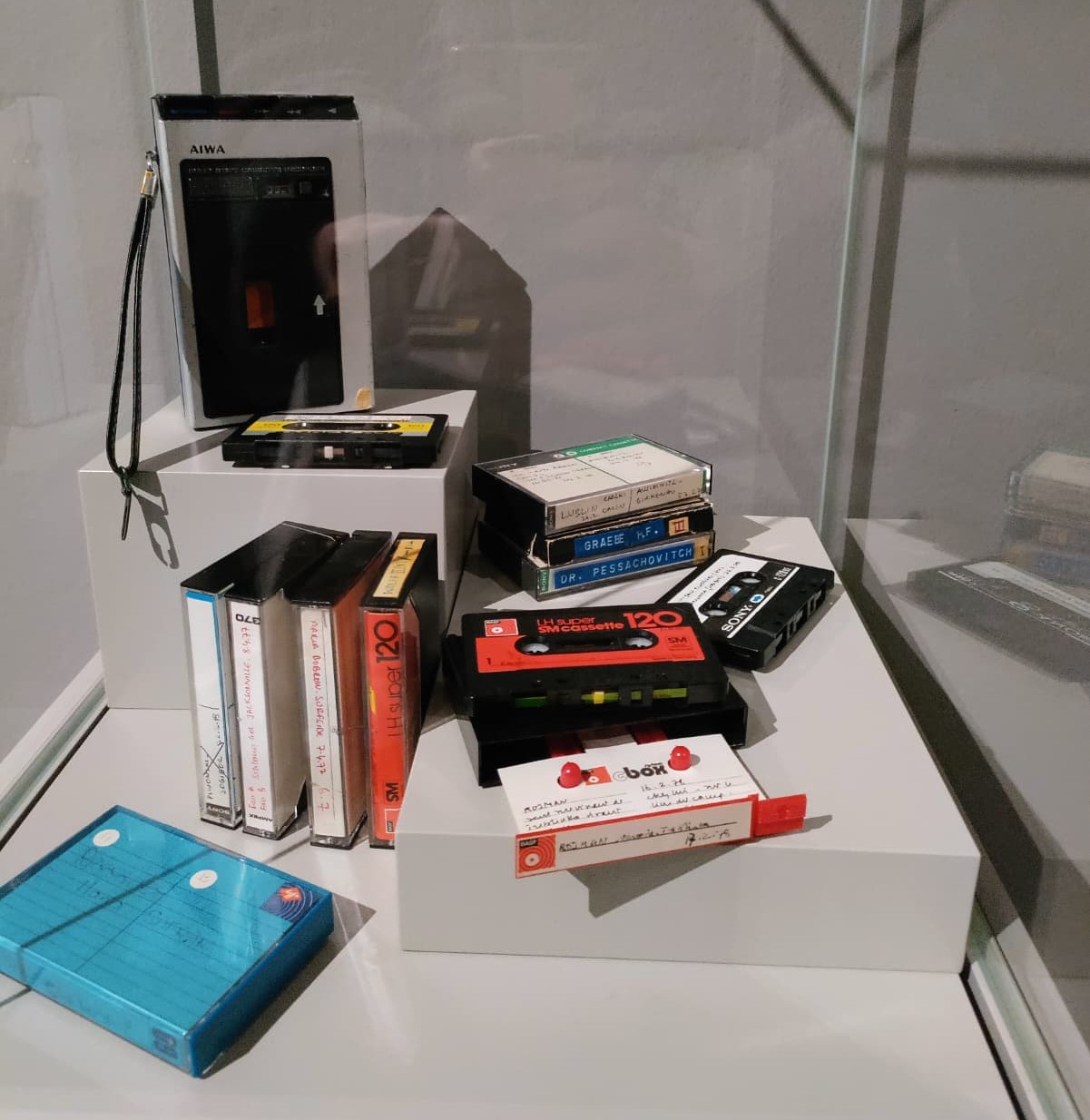
Tamar Lewinsky: We were given a collection, in 2021 and then again in 2022, of over 150 audio cassettes documenting the genesis of Shoah and the preliminary research that went into it. These were recorded by Claude Lanzmann and his two assistants, Corinna Coulmas and Irena Steinfeldt-Levy. This is really the prehistory of the filming, and we are opening up many new perspectives on the genesis of the film.
We are creating a complete edition of the approximately 220 hours of interview material. The exhibition is only one part of a large research and education project. The entire collection will be made available via the Oral-History-Digital platform and should be complete by the end of 2027.
All audio recordings will be available there with complete transcripts, German and English translations, contextual information, summaries, and keywords. This will allow for long-term, in-depth work with the material. The exhibition therefore only provides an insight – the actual core project is this entire collection, which we also want to make accessible via other educational formats, especially for schools. Reaching young people in particular is a central concern.
Our collection, together with the film itself, was added to the UNESCO Memory of the World Register in 2023. And then there was Claude Lanzmann’s 100th birthday last November, plus 40 years of Shoah, the film. So there were various reasons for putting on this exhibition, of course. But it was clear from the outset that we really wanted to focus on this collection, rather than putting on an exhibition about Shoah, the film, or about Claude Lanzmann, but really making these audio recordings the theme of the exhibition.
EO: To what extent does this exhibition contribute to broadening the public’s understanding of Lanzmann’s work beyond what is known from “Shoah”?
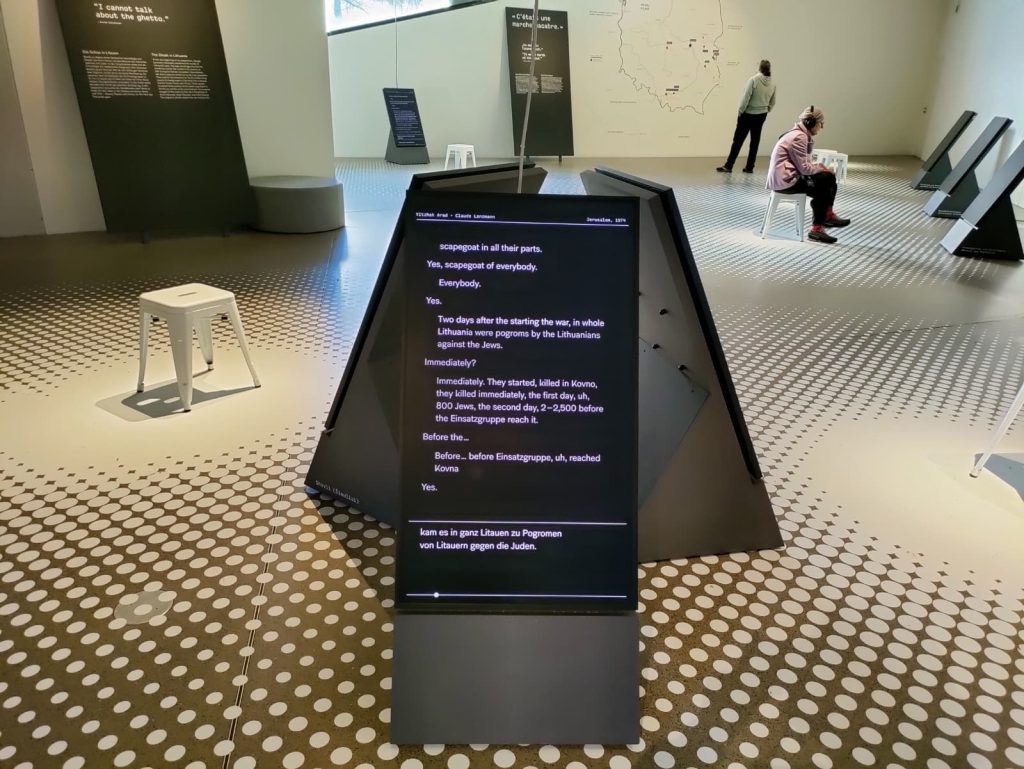
TL: Our collection has very little overlap with what can be seen in the film. Of the 152 cassettes, we have four overlaps with the film and its outtakes. In other words, these are not interviews with the people who appear in the film, but rather they open up a whole range of topics, perspectives on people, biographies, and themes that do not appear in the film at all. In the exhibition and also in our collection, you can really see Claude Lanzmann’s process, how he began to deal with the subject, how he began to deal with the Shoah historically, and how he didn’t know where he was going at the beginning.
This is really the prehistory of the filming, and we are opening up many new perspectives on the genesis of the film. We are creating a complete edition of the approximately 220 hours of interview material.
When you read his autobiography, you get the impression that he had a very clear vision of what he wanted to portray in his film from a relatively early stage. This material reveals a much broader search in all directions and into many aspects of the Shoah. And that’s what makes it so interesting, because ultimately it’s an exhibition about the film and about Claude Lanzmann’s working methods, but it’s also an exhibition about the Shoah as something that happened in Europe.
EO: What also comes across in this exhibition is that all this preparation was not a solo effort.
TL: Exactly. Yes, it was clear that he didn’t do all the preparation work on his own. The role played by Corinna Coulmas and Irena Steinfeldt-Levy, two young women at the time, should not be underestimated. They not only acted as interpreters, but also conducted preliminary interviews on his behalf. They did an enormous amount of research and were really tireless in their work on the subject, together with Lanzmann.
There are various research topics in the collection that are absent from the filmed material. For example, on the Vatican, the role of the American government, certain ghettos, and Switzerland’s refugee policy. Our collection shows exactly where he did his research. And in the exhibition, Lithuania is singled out as one of many research topics that interested him, but which he then rejected for the film.
EO: Can we somehow deduce from this why Lanzmann rejected certain topics, such as Lithuania, which he researched a lot about but ultimately didn’t make an appearance in the film?
TL: In the case of Lithuania, it is quite clear that he had a great interest, especially with regard to the Einsatzgruppen, because he wanted to shed light on the murders committed by these mobile killing squads. He also wanted to find members of the Einsatzgruppen, but he didn’t actually find any he could interview. But he talked a lot with survivors. Ultimately, however, he was unable to film in Lithuania. That was in the former Soviet Union, which meant he couldn’t go there. He was able to do so in Poland, and almost all of the location shots for Shoah were filmed in Poland, but it wasn’t possible in Lithuania. That means he was only able to show Lithuania very marginally with a narrative, with images of two survivors that he filmed in Israel, in a place that looked similar to Ponar in terms of the landscape. But otherwise, the subject doesn’t come up at all. And that was for practical reasons, as was the case with some other topics.
EO: What new insights have emerged from the notes on Lanzmann’s approach to interviewing survivors, perpetrators, and witnesses?
TL: The approach was a very complex process, which can be better understood through this material. In 1973, Lanzmann had not yet decided on the focus of the film. That ultimately came later, with the editing and the selection of people for the shoot. The exhibition also includes several sequences in which it is clear that Lanzmann did not yet know exactly what kind of project this was going to be. In fact, he only knows that he doesn’t know much yet and that he now has to accumulate knowledge and interview people. The breadth of the subject is also overwhelming for him, and only many years later does this focus actually emerge. You learn a lot about the working methods, about the processual nature of this period between 1973, when the initial idea arose, and 1978, when filming began. That is essentially what this collection of audio recordings and our exhibition shed light on.
EO: The exhibition focuses on 220 hours of previously unknown audio recordings. From a curatorial perspective, what challenges and opportunities arose when working with this material?
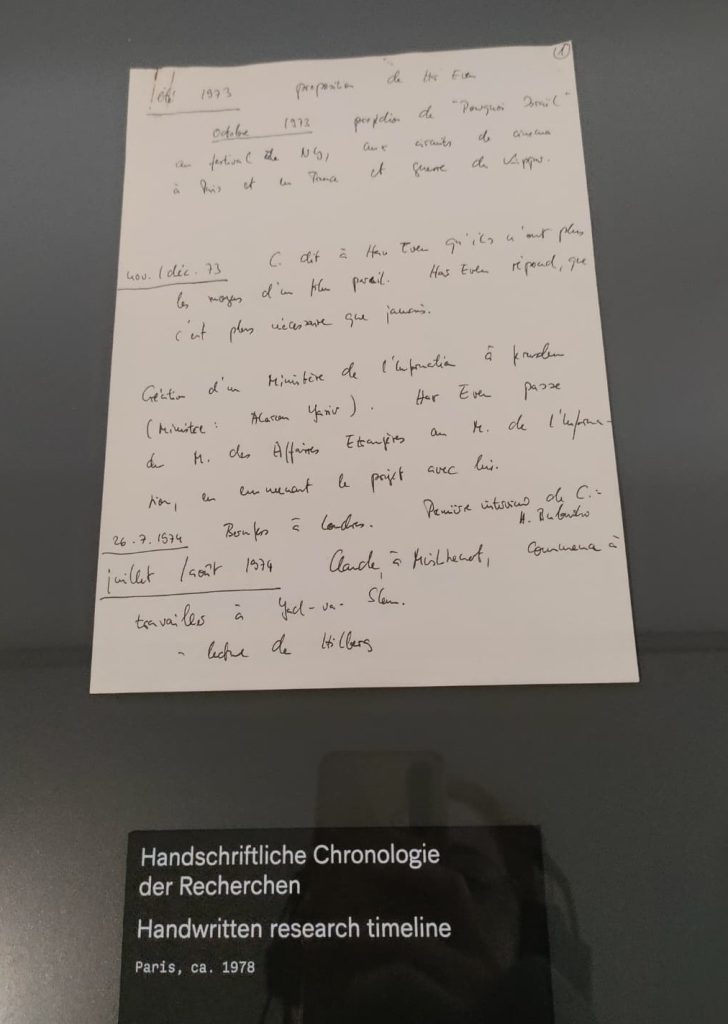
TL: Curatorially, it was a big challenge. Irena Steinfeldt-Levy put it very nicely at the opening of the exhibition: “I didn’t think you could turn a box of old cassettes into an exhibition. I was very skeptical.” And that was ultimately the task at hand: you have a box of old recordings from the 1970s, ordinary compact cassettes that were commonly used at the time to make recordings, but which were never intended to be released. You pressed record and then you had a memory log. That was working material. That’s 220 hours in eight languages in varying sound quality, with people talking over each other, translations happening, people not speaking in their native languages, communication difficulties and background noise, and so on. And to create an exhibition out of all that is, of course, a challenge.
EO: Were there any considerations about how to present an exhibition that not only shows interviews with survivors, but also with perpetrators, especially in Germany, the country of the perpetrators?
TL: There are themes in the exhibition that are simply relevant, no matter where they are shown. What could be particularly exciting for an audience in Germany are the perpetrator interviews. Lanzmann interviewed perpetrators, survivors, and bystanders. And just like in the film, this triangle is also present in the preparatory work. It was clear from the beginning that we also wanted to have these perpetrator voices.
Normally, you have the victim’s perspective. But the perpetrator’s perspective, which may well be linked to your own family history or raise questions, is something you don’t normally hear because there is no collection of perpetrator interviews.
The exhibition also includes several sequences in which it is clear that Lanzmann did not yet know exactly what kind of project this was going to be. In fact, he only knows that he doesn’t know much yet and that he now has to accumulate knowledge and interview people.
When selecting sequences from perpetrator interviews, however, it was always important not to simply try to obtain statements from perpetrators and check whether they were historically accurate or not. I always found that very pointless. Instead, I was interested in showing: “How does Lanzmann work? How do his colleagues work? How do they proceed strategically? How do they try to get people to talk? And what mechanisms of distortion and repression do the perpetrators display? What do they deny, even though it has long since been brought before the courts?
Many of them are convicted criminals, the sentences are known, and you can look at the trial records. Nothing new is being revealed, so to speak, and that’s not what the exhibition is about—it’s not about the question of guilt. Rather, it’s about how such a conversation between the Jewish director or his assistants and a perpetrator works.
EO: How do you deal with the ethical considerations associated with exhibiting recordings that were not originally intended for publication?
TL: We thought about this for a long time because it is, of course, a big question. There are no declarations of consent. With the perpetrators, there is the additional aspect that the recordings were often made secretly and they did not know about them. In the case of the survivors, it wasn’t really discussed, but was simply seen as working material, not something that the public should see or hear later on. In our deliberations, the historical relevance of the recordings and their status as world documentary heritage prevailed. However, we clarified all personality rights for the entire collection and, of course, contacted the descendants where possible to obtain their consent. In addition, if you wish to access the digital edition you first have to register and sign a statement that you will not use the material in an inappropriate context, in order to protect the interviewees.
EO: Do you already have a concept for visitor feedback? Is there a difference between the audiences in Berlin, New York and Paris?
TL: It’s still too early for that, but it’s important for us to find out what people take away with them. Before the exhibition opened, we conducted a visitor survey to find out what they actually know about Claude Lanzmann and Shoah. The results were rather sobering, as both the director and the film were unknown to the vast majority. Younger visitors in particular are unaware that this film exists. In France, of course, Claude Lanzmann is a very different figure than he is in Germany. These preliminary questions were also intended to help us consider how much contextual information should be included in an exhibition so that visitors are not overwhelmed. We have additional offerings on the website to create a foundation so that the exhibition truly functions on different levels.
Something else happens when you hear individual voices, individual stories. When you realize that this is just one of six million stories. That touches you on a completely different level and simply triggers more.
From the outset, it was clear to us that the focus should be on sound – and that the exhibition should be visually undistracting. We use a state-of-the-art audio system in the exhibition to make the recordings accessible in the best possible way. This audio system is not available in the Paris and New York exhibitions. We worked intensively with an audio scenographer to design this immersive experience and determine the best way to present the recordings.. You enter the exhibition space with headphones and basically have 3D sound, hearing voices from all directions, allowing you to really immerse yourself.
EO: In your opinion, what role do exhibitions like this play in the public memory of the Holocaust in 2026?
TL: First and foremost, it’s about a kind of basic knowledge about the Holocaust, but on a different level. Many people are familiar with what is known as school knowledge: numbers, dates, places.
But something else happens when you hear individual voices, individual stories. When you realize that this is just one of six million stories. That touches you on a completely different level and simply triggers more. That is actually my hope. For me, it’s also about not imparting knowledge in a schoolmasterly way, but rather making this basic knowledge accessible again in a roundabout way – through personal stories.
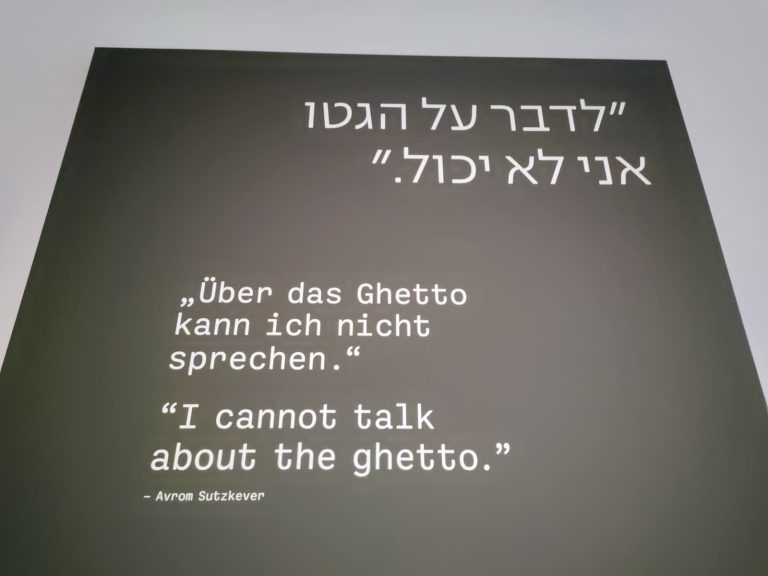
One example is Lithuania. Many people know very little about this, such as how early the murders by the Einsatzgruppen began there, the extent to which they took place, and how many people were affected. When this knowledge is conveyed through interviews and individual fates, I have the impression that it remains more firmly in the memory and has a more lasting effect.
EO: What moved you most personally while curating this exhibition?
TL: It is incredibly fascinating to work with this material. It is a very unique source because it is not classic oral history interviews, which are often highly standardized. Many of the well-known oral history projects only began later, so that the people interviewed were usually already much older at that point.
Here, it’s different. These are simply conversations. And that is precisely what provides insights that would otherwise be difficult to obtain. It is a type of source that does not really exist, and that is what makes it so special to me. The people are still in the middle of their lives, and for eyewitness interviews, that is, despite everything, relatively early.
These are not rehearsed interviews. The interviewees are not “professional” eyewitnesses, as we know them from later years. Often, their stories have never been told before, or only very rarely, and you can tell. You learn an incredible amount about the respective contexts of recording. I find that very special: many conversations take place in living rooms, offices, or public spaces, and all of these environments flow into the narratives. This gives each interview its own unique atmosphere. It is this uniqueness of the recordings that particularly captivates me.
There isn’t one interview that you could say is special. Instead, it’s always individual moments. The question often arises: what is it that affects you so much? And then sometimes it’s very small parts of an interview – three sentences or even moments of silence. Moments when you realize: this person can’t go on talking. The burden is too great, the trauma is too great, and they simply can’t continue. Or someone briefly breaks down inside. You may not even hear tears, but you sense that an incredible amount is happening at that moment. You can hear it.
And it is precisely these moments that have touched me deeply time and again.

Esther Offenberg
Esther Offenberg is the editor of the English version and coordinator of the Italian, Spanish, German, and Portuguese versions of K. Review. She also conducts interviews and contributes to the magazine's international distribution.
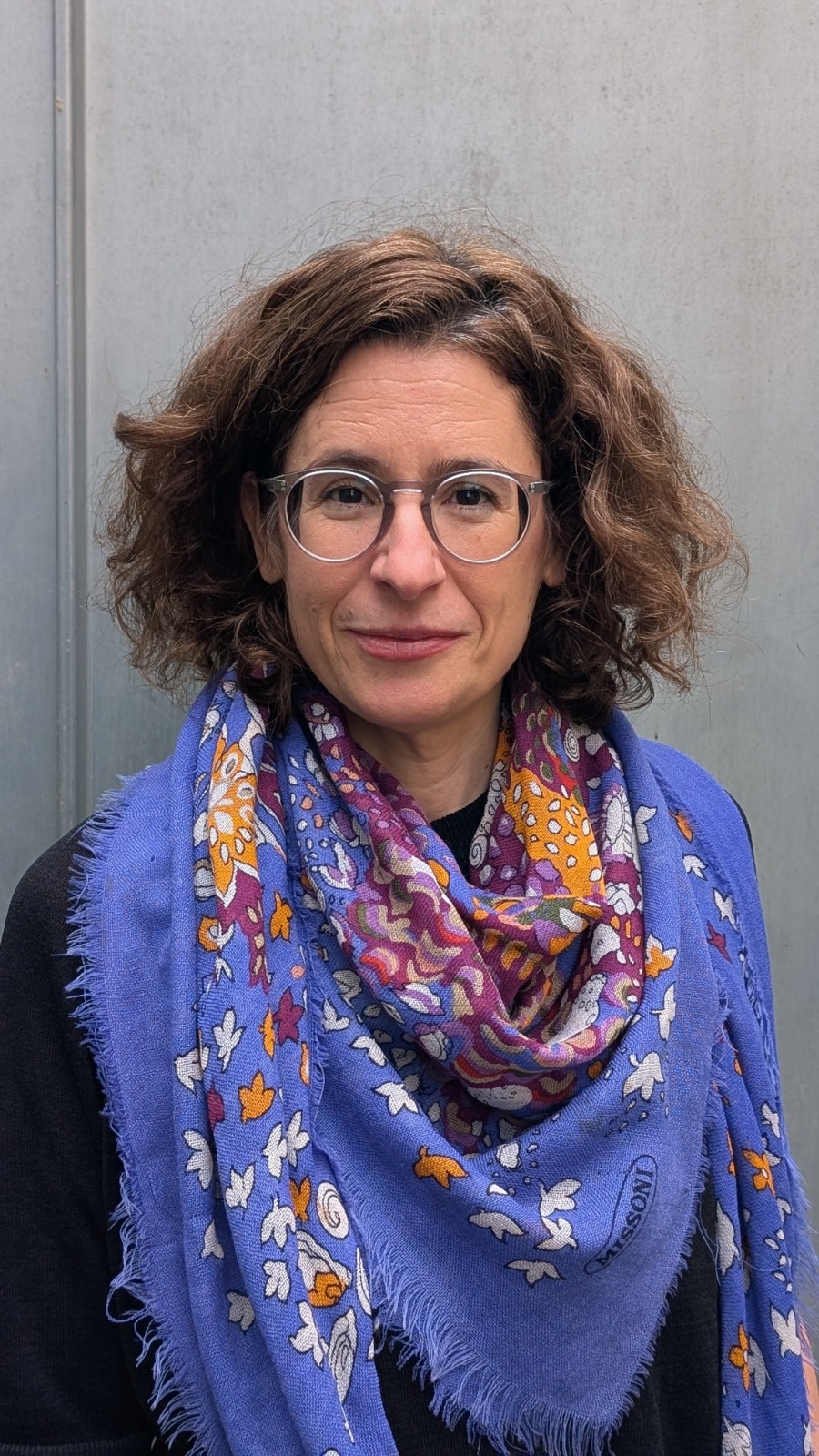
Tamar Lewinsky
Dr. Tamar Lewinsky is the curator responsible for audiovisual media at the Jewish Museum Berlin. She curated the exhibitions Claude Lanzmann: The Records (2025) and Another Country. Jewish in the GDR (2023), and was part of the curatorial team for the new permanent exhibition, which opened in 2020. Since April 2024, she has been leading projects dedicated to the cataloguing, preservation, and sharing of the Lanzmann collection. Previously, she worked at LMU Munich, the University of Basel, and HHU Düsseldorf. Her publications focus on the history of Jewish displaced persons, on Yiddish literature and culture, as well as on Jewish migrations from Eastern Europe.