October 1973 – Vilém Flusser’s “The Jewish War”
Vilém Flusser wrote “The Jewish War” in October 1973, shortly after the outbreak of the Yom Kippur War, as he was preparing to visit Israel for the first time. A philosopher of communication and thinker on exile, he approaches the conflict not as a strategist or activist, but from a unique perspective: that of a Jew who had long been estranged from Judaism, forced to return to it by the events unfolding around him. This text, unpublished in French and introduced by Rainer Guldin, offers a radically different interpretation of the war: neither a purely geopolitical affair nor a simple national conflict, but a test for Judaism itself. By questioning the notion of “Jewish singularity” and the ethical obligations it implies, Flusser questions the state normalization of Israel and calls for a political and moral overhaul.

Vilém Flusser was born on the 12th of May 1920 in Prague into a family of Jewish intellectuals. Shortly after the occupation of Prague by the Nazis in March 1939 he emigrated together with Edith Barth, his later wife, and her parents to London. In 1940 he left England for Brazil. Flusser lost all of his family in the German concentration camps: His father died in Buchenwald in 1940. His grandparents, his mother and his sister were brought to Auschwitz and later to Theresienstadt where they were killed. In 1972, he returned to Europe and in 1982 settled in Robion, in the South of France. On the 27th of November 1991, following his first and last lecture in Prague, Flusser died in a car accident near the German border. He is buried at the Jewish cemetery in Prague. Flusser wrote in four languages – German, Portuguese, English and French – systematically self-translating all of his texts.
He is mostly known for his communication theory, which he called Kommunikologie, and the notions of technical image and telematic society. In the course of the 1980s, he became famous, especially in Germany, with the publication of Für eine Philosophie der Fotografie (1983), Ins Universum der technischen Bilder (1985) and Die Schrift. Hat Schreiben Zukunft? (1987). He was quickly called the “digital thinker”. However, there is much more to discover, like his philosophical fictions, hybrid texts on the border of literature, philosophy and natural science, for instance. Vampyroteuthis infernalis (1987). All these books have been translated into French.1
David and Vilém: Jewish-Christian dialogue between cousins
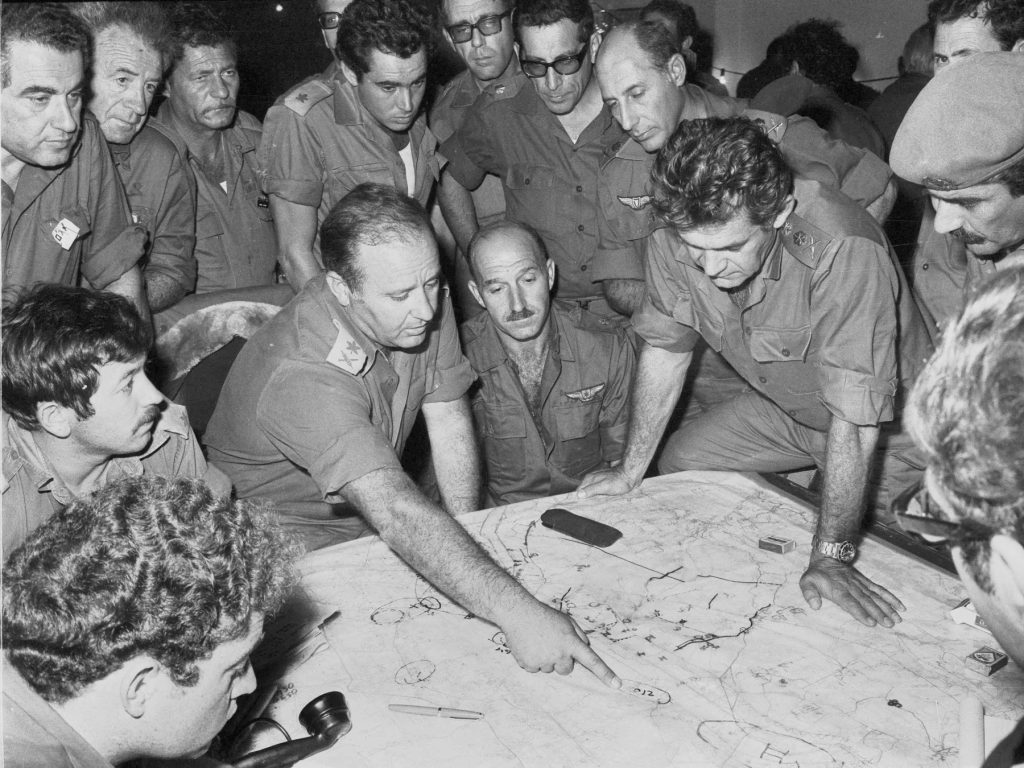
The Yom Kippur War started on Saturday October 6 when an Arab coalition led by Egypt and Syria launched a surprise attack across their respective borders. Egyptian forces crossed the Suez and quickly advanced into the Sinai. At the same time, Syrian forces gained territory in the Golan Heights. From October 3 to 10, Edith and Vilém Flusser – who had spent the summer at the Château du Salvert in Neuillé par Vivy near the Loire valley – were staying at La Mainaz, on the Col de la Faucille, a high mountain pass in the French Jura Mountains. The hotel, in which they had already been before on their regular trips from Merano to Paris and back, is situated at an altitude of 1250 meters and overlooks Lac Léman and the city of Geneva, which is only a 35 minutes’ drive away, “a place radiating peace”, as Flusser put it in a letter he wrote on October 7 to his cousin David Flusser living in Jerusalem. The contrast could not be more striking. “We were just going to buy our tickets for Israel in Geneva and send you the flight number by telegraph, when the hostilities broke out reaching us through the radio. If the situation does not calm down within the next few days, we will have to postpone the trip until after our visit to America, which means approximately until the beginning of March 1974. You will hear from us.”
In the same letter, Flusser reflected on the theological and philosophical implications of the notion of Sabbath. “I am pretty unfamiliar with Jewish things, but I assume that Yom-Kippur-Saturday is a kind of Sabbath of Sabbaths, that it is a double opening of transcendence onto messianic freedom. So, I celebrated the day as a holy one: not with traditional prayer but thankfully opening up to the openness of freedom. Around noon, when I heard about the Jewish mobilization, I suspected that the Arabs might want to transform this day of days into a Dies irae2.”
Humanity, he continued, is but a ball in the hands of forces we cannot control. Perhaps the Arab invasion, was part of a Yom-Kippur plan of which we did not have the dimmest notion. Flusser quotes the Hebrew phrase Gam zu l’tova (גם זו לטובה), meaning ‘this is also for the good’, which stresses an unwavering optimism in the face of catastrophe. “I spent the afternoon with the theoretical reflection, that the Arabs might be an instrument of peace, which finally seemed to dawn at Israel’s horizon and as far as I am able, I prayed in this direction.”
David Flusser was born in Vienna on September 15, 1917, and attended the University of Prague. He emigrated to what was then called Mandatory Palestine, where during the late 1930s he became an observant Jew. In 1957, he completed his doctorate at the Hebrew University of Jerusalem where he taught in the department of Comparative Religions. David Flusser died on September 15, 2000. Among his many publications are a monography on the life of Jesus and several books on the relationship between Judaism and Christianity. David and Vilém Flusser had known each other and been friends while still in Prague. Besides having grown up in Prague and being Jewish they both shared a strong relationship with Christianity. David was sent by his parents to a Christian school as a young boy and Vilém felt the attraction of Catholicism in his early years in São Paulo. In another letter to his cousin dated March 14, 1973, Vilém Flusser commented upon this experience. “The emotional and intellectual experience of being without a ground (Bodenlosigkeit) led me via Wittgenstein and Heidegger and the Orient towards Catholic mysticism.”
In the letter exchange preceding October 1973, David Flusser had invited Edith and Vilém to Israel and repeatedly urged them to come. However, Vilém hesitated: He had lost contact with Judaism. It would have been the very first time he travelled to Israel and his attitude to Israel as a state was more than ambivalent. He could not visit the country as a tourist and was afraid that in this case he would have been forced to take sides either for or against it. “You know, that contrary to yourself” he wrote in the same letter: “I was a Zionist as a young man, but you probably don’t know that my Zionism collapsed, when the catastrophe of 1939 threw me in an existential borderline situation (in eine existenzielle Grenzsituation). For decades, I repressed the question of Jewishness.” Thanks to the letter exchange Vilém Flusser had gained a new interest in Judaism, especially through a new aesthetic understanding of the Jewish notion of ritual which he interpreted as an “acte gratuit”, an unintentional gesture, an expression of the absurdity of human existence, and therefore the true form of religious life in Kierkegaard’s sense. “However, this does not make it any easier for me to become an orthodox Jew. First, because I lack the necessary faith […] and secondly because […] I don’t have any experience of orthodoxy, which to be honest, I find repulsive. […] in this matter, I feel something that many Catholics experience towards the Church: disappointed love. If my understanding of Judaism is correct, then being a Jew means: being there for the other. […] The reality of Judaism (and of a Jewish state, which cannot be separated from Judaism) looks like it is based on determination and self-assertion. […] this Jewish reality contradicts outright the image I have of Judaism.”
Israel’s call: Flusser’s hesitation
Despite these hesitations, Flusser must have decided to fly to Israel in the course of the summer of 1973. A letter from Georges Lévitte (September 25), who he had first met in Paris at the Institut de L’Environment, most probably around September 9 to 11, contains a list Flusser had asked for: a series of people he could have met during his stay in Israel. Among the people Lévitte mentioned are Elihu Katz (1926-2021), the American-Israeli sociologist and communication scientist, Yaakov Malkin (1926-2019), an Israeli literary critic, professor in the Faculty of Arts at Tel Aviv University, Betty Rojtman (1949), a future professor of Comparative literature at the Hebrew University of Jerusalem, “who has just made her Aliyah”, as well as “Georges Weill and his family, good Alsatian bourgeois, who returned to religious Judaism and then settled in Israel.”
Georges Lévitte was born in Ekaterinoslav, today’s Dnipro in Ukraine, on May 11, 1918. In 1922, he left the country together with his family and settled first in Wiesbaden (Germany) and then definitely in Metz (in Lorraine). In Paris, he studied letters at the Sorbonne, as well a Hebrew and Arabic. As Flusser who lost both his parents and his sister in a concentration camp, Lévitte’s parents and his brother were deported to Auschwitz. He played an influential role in the revival of French Judaism after the war, publishing numerous translations and participating in radio broadcasts under the name David Yassine, a pseudonym made up of his parents’ first names. This explains the very emotional reaction when he first met Flusser. “Notre rencontre a été pour moi d’une telle richesse que je lui soupçonne des ‘undertones’ (retours de bâton) que je souhaite personnellement aussi proches et aussi fréquents que possible. Votre intensité intellectuelle et humaine m’a tant appris que je souhaite, et vite, un revoir. A quand?” (September 25, 1973)
After abandoning their plan to travel to Israel, Edith and Vilém decided to continue to Paris via Munich. They travelled from La Mainaz to Neuchâtel and Küsnacht, and from there to München where they spent the night from Sunday 14 to Monday 15. They then continued to Niederaudorf/Oberaudorf where they spent ten days (October 17 to 27), and from there they continued to Baden-Baden and Paris (October 29 to November 2). The parish village of Niederaudorf lies in the Bavarian foothills of the Alps and the Bavarian part of the Lower Inn Valley. Oberaudorf and Niederaudorf are separated by the course of the Auerbach, the western Inn tributary. In Paris, Flusser met Lévitte twice, on Monday 29 and Tuesday 30. Edith and Vilém left Paris for Merano where they arrived on November 5 and stayed until the end of March 1974.
About ‘The Jewish War’
The essay “The Jewish War” must have been written between October 7 and 17, most probably he began writing the text in La Mainaz affected by the worrying news and finished it while travelling through Switzerland and Southern Germany. The geographical distance between Europe and Israel and the movement through space are a fit metaphor for Flusser’s shifting unstable relationship with (his) Judaism and the state of Israel. On October 17, 1974, the day of his arrival in Oberaudorf, Flusser wrote Lévitte: “It is a pity that I could not take advantage of your many suggestions in Israel for the time being. I share with you the wish to maintain close contact between us. […] I wanted to contribute somehow to a ‘Jewish’ discussion of the problem. And towards peace, which I believe to be an important Jewish value. I therefore enclose the paper ‘The Jewish War’, with the hope that you might partly agree with it, or at least find it interesting. And also with the hope that you might get it published in whatever medium you should judge appropriate.” You know how distanced I am from Judaism, and possibly much of what I write might look naive to you. But naiveté is a productive distance from which to look at things, (as Husserl so well knew). Exactly because I am in some sense a naive Jew, I may have something new to contribute to the discussion. As for your suggestion to give a summary on German reactions to the conflict, I shall try my best, but cannot promise it. My stay here is too short, and my contact with persons too spotty.”
The Yom Kippur War ended on October 25. On October 26, the day before leaving Oberaudorf, Flusser wrote Lévitte: “as I promised in my letter of October 17, I enclose a paper on how Germans see Israel. It is not specific but gives, I hope, the general picture. We plan to be in Paris around November 2nd and I shall call you up immediately to renew our intellectually inspiring contact.” This second text must have been written while Edith and Vilém were in Oberaudorf, that is, between October 17 and 26.
Edith and Vilém Flusser had left Brazil for good and arrived in Europe in 1972. The first few years they travelled widely all across Europe, spending their summer in France and their fall and winter in Merano. At this point, Vilém was still relatively isolated and very keen on making new friends but above all to find new publication possibilities. This explains his insistence with Lévitte. Flusser wrote him two more times from Merano, but the contact seems to have dropped after that. On November 16 he wrote: “Dear friend, it was a pleasure to have talked to you in Paris. We are now more or less settled here in Merano, and I beg you to take note of our address. The events in Israel seem to justify the article which I sent you on Oct. 17. In fact, if I understand correctly, one side of the Israeli opposition is practically advocating the same change of attitude I was speaking about […]. But of course, there is a ‘Third world’ quality to my paper which this new attitude does not yet see. Please do help me to have it published quickly, or give me the addresses which you promised. What happened to the second article which you submitted to ‘L’Arche’? And is there anything else which you would like me to write in the same direction? I believe, now is the critical moment for Jewish commitment, after the generals and politicians were finally forced to shut up by brutal reality. Do you agree? Please do write me to the above address as fully as possible about how you see the situation.” L’Arche is a Jewish news magazine based in Paris that is published on a monthly basis. “The Jewish War” was never published. Flusser must have kept a copy that ended up in the Flusser Archive in Berlin. This was most probably also the fate of the other text, which was supposed to be a summary on German reactions to the conflict. A text with the title “How the Germans see Israel” and has been preserved in the Archive in Berlin could possibly fit the description Flusser gives in his letters to Lévitte. However, this typoscript looks like it has been written with a different typewriter and does not explicitly mention the Yom Kippur War. The only reference in the text is “the present conflict.” Flusser liked to have different mechanical typewriters around him. This could possibly explain the different typeface of “The Jewish War” and “How the Germans see Israel”.
In his last letter, dated November 20, Flusser embarks on some general considerations linked to his essay “The Jewish War”. “I just got a letter from ~ cousin David Flusser of Jerusalem. […] He agrees with my position that Jews must commit themselves to the ‘third world’ if Israel is to survive. And if it is to be Jewish. But he holds it to be difficult for two opposite reasons. (1) Africa is breaking contract with Israel, although Israel has helped much. Israel does a lot in the occupied territories […] but nobody knows about it. […] (2) His nephew Daniel Flusser was a leader of the pacifist movement peace at any price. In the war he commanded 11 tanks, bis group shot down 50 Syrian tanks, and he is still fighting. So, theory does not go with praxis. I transcribe my answer to the letter, and beg you, dear friend, to help me in publishing my point of’ view at this moment. […] ‘You tell me about the help Israelis are giving the population of occupied Egypt, but you have no idea what you are saying. I have. I know the hatred which the favelados of Rio feel for the idealistic American students who help them, and I know that the favelados are right. I know that the Egyptian peasant can forget that he was being occupied, but never forgive that he was helped by those who occupied him. If we can do it, we, the intellectuals in Israel and the Jewish intellectuals abroad, then Israel can be saved. If we do nothing of the kind, (and neither you nor I are doing anything) , then Israel will be lost […]’. This is what I wanted to publish: this readiness of ours to open ourselves up, to learn, to change, and to fight for justice together with those who are now being manipulated from abroad, just as we are, to fight us. I wanted to publish this in Israel, and in Europe […]. This is what I believe, because I do not know Israel, but do know the third world: first we, the Jewish intellectuals must change, if we are to be Jews and Israel is to have a purpose. Then the Israel Government must change, and then the Governments that surround it. But we must make the beginning. And now is the time to do it.”
Rainer Guldin
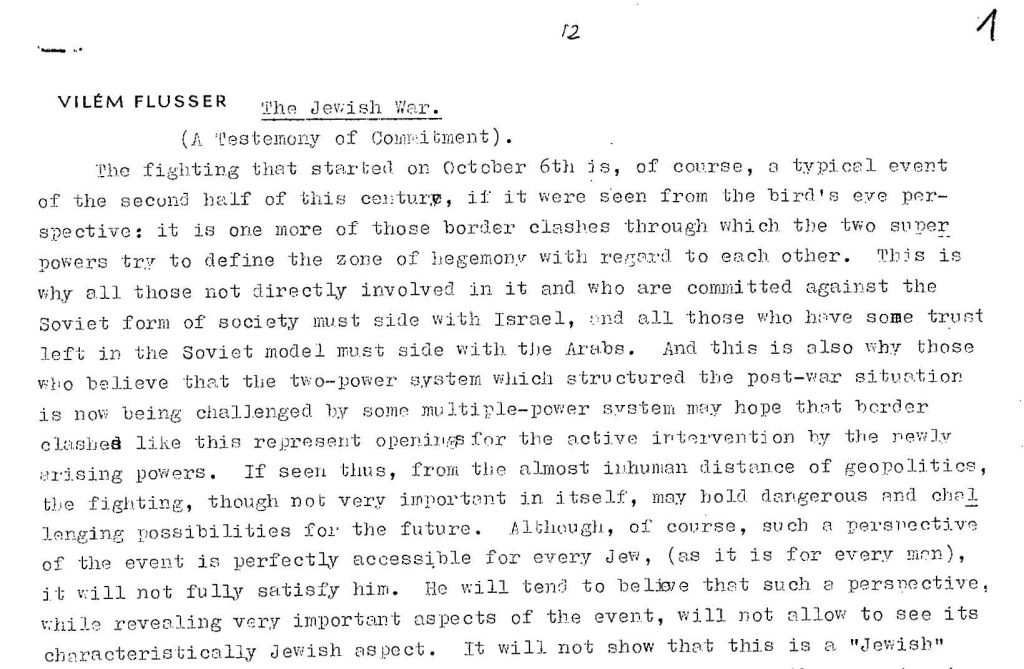
“The Jewish War” (A Testimony of Commitment)
Vilém Flusser — The Jewish War (A Testimony of Commitment)
The fighting that started on October 6th is, of course, a typical event of the second half of this century, if it were seen from the bird’s eye perspective: it is one more of those border clashes through which the two super powers try to define the zone of hegemony with regard to each other. This is why all those not directly involved in it and who are committed against the Soviet form of society must side with Israel, and all those who have some trust left in the Soviet model must side with the Arabs. And this is also why those who believe that the two-power system which structured the post-war situation is now being challenged by some multiple-power system may hope that border clashes like this represent openings for the active intervention by the newly arising powers. If seen thus, from the almost inhuman distance of geopolitics, the fighting, though not very important in itself, may hold dangerous and challenging possibilities for the future.
Although, of course, such a perspective of the event is perfectly accessible for every Jew (as it is for every man), it will not fully satisfy him. He will tend to believe that such a perspective, while revealing very important aspects of the event, will not allow to see its characteristically Jewish aspect. It will not show that this is a “Jewish” war, and, for its being Jewish, it is essentially unlike any other war in similar contexts. He will tend to believe that everything that is Jewish cannot be fully understood through general categories, because “Jewishness” seems to be a species which does not fit well any classification. Now if it were true that the adjective “Jewish” always implies difficulties of classification (for instance: Jewish religion is unlike religion in general, Jewish people is unlike people in general, Jewish state is unlike state in general), if it were true that the specificity of Jewishness is to be no true species of any given genus, then any generalisation of the Jewish war under the heading “border clashes” will fail to really explain it.
No use of trying to deny it: the belief that to be Jewish is to be something special and not easily generalizable is an important element of Judaism. All efforts to deny this belief amount to a denial of Judaism. The paradox in it is this: if such an effort to deny Jewish specificity is made by Jews, it aims at Jewish “normalisation”, which means the disappearance of Judaism. And if it is made by non-Jews, it aims at the acceptance and absorption of the Jews in their context, which also means the disappearance of Judaism. The paradox is that what is “antisemitism” in non-Jews (acceptance of Jewish specificity), is fidelity to Judaism in Jews (the same acceptance). The fact of the belief in Jewish specialness seems to divide all those who consider it in two camps: Jewish assimilants and unprejudiced non-Jews on one side, faithful Jews and antisemites on the other. The paradox is resolved if one considers what is meant by “Jewish specialness.”
Judaism means by this some sort of special and not generalizable obligation toward mankind assumed by every true Jew. Antisemitism means by this some sort of biological or cultural characteristic. This resolution of the paradox permits the following consideration: Jews who try to deny the belief in Jewish specialness do not want to assume the specific obligations it involves. Non-Jews who deny this belief do not see any use for those specific obligations nor for the sufferings it usually brings on the Jews. Jews who accept the belief have no reason to prove its “truth”: Jews are not believed to be special in what they are, but in what they ought to do. Antisemites however must prove their belief that Jews are special, and such a proof is of course impossible.
Therefore: the Jewish war is seen basically under four perspectives, as far as its “Jewishness” is concerned. Jews who try to deny Jewish specialness must try to see it as if it were like any other war, because, for them, it ought not to be different. Non-Jews who try to deny Jewish specialness really do see it like any other war, because it cannot be different. Antisemites see it as a characteristically Jewish war, because the Jews are different (more cunning, more calculating, more intelligent, more heroic). But Jews who try to accept Jewish specialness (and those non-Jews who try to do it in the Jewish meaning, and almost impossible feat) must see it as a challenge to Judaism: namely, to do what ought to be done according to the specialness of Judaism.
All this seems to be pretty obvious, but reality does not allow to see it. The Jewish state which is now at war is the result of an attempt to “normalize” Judaism, to deny Jewish specialness, and therefore to refuse the specifically Jewish obligations. Therefore the Israeli establishment and a large part of Israeli population would like to see this war like any other war, and therefore do, not what they ought to do as Jews, but what any other state does. But it feels that it is not like any other state, because to some extent it is still Jewish. It therefore mixes normalcy with specialness which could be called opportunistic, were it not fighting for its survival.
The Arab states who fight Israel seem to agree with Israel that this is a normal war (more or less a war of liberation from imperialistic oppression), but they feel that there is something special about it (the Israeli state not being easily classifiable as imperialistic), and they therefore tend to become antisemitic. The other states involved more or less directly in the conflict try vainly to eliminate the Jewish aspect from it, but cannot, partly because their own history, and partly because Israelis and Arabs do not allow them to forget it. So that the four perspectives under which the war can be seen in its Jewishness are now all mingled. Except for non-Israeli Jews, whose duty is to point to them.
The pure antisemitic perspective should be as follows: the Jews being a special type of man, this war is a further proof that wherever they are and in whatever social organisation they appear, they cannot be assimilated. Therefore the context (the Arabs) is trying to eliminate them. But since the Jews claim not to be special in this particular instance (they claim to constitute a state like any other), this war is also a proof that any Jewish disclaimer of specialness is a ruse (the state of Israel not being a state, but a position conquered and expanded of international Jewry). The antisemitic perspective starts from a factually wrong position, and does not give therefore a true view of the war, but it is a very widely held perspective (by Jews as well as non-Jews), Jews holding that they are factually a special sort being antisemites in this sense of the term.
The pure assimilationary perspective should be as follows: the Jews are fighting this war in order to impose on their context the fact that they are like any other nation. This the context tries to deny, because it is antisemitic. It is necessary to win the war, to establish strong frontiers, and then negotiate a settlement with the Arabs, under which the Israeli state might continue to grow and prosper. It is in this sense that Israel is seen to be fighting for its survival. (This is the perspective of the Israeli establishment, if purified from the Jewish elements that still adhere to it.)
The pure absorptive perspective should be as follows: the Jews have nothing to do with this war, since it is a fight between local populations that are being manipulated by the great powers. The fact that one side in the fight is of Jewish origin does not matter to Jews abroad, because it is a population which claims to be a Near Eastern nation like all the others, whilst the Jews abroad are in a process of absorption into their various contexts. (This is the perspective of the Soviet establishment if purified from the antisemitic elements that still adhere to it.)
The purely Jewish perspective should be as follows: to be Jewish is to assume special obligations toward mankind, and these obligations have to do with justice. The special obligations may have a transcendental or an immanent explanation, but history seems to point to the fact that Jews have very often assumed it, and very often failed to assume it. This is why Jewish history is different from the history of any other group of persons. The history of the state of Israel is, both for internal and external reasons, a case of failure of assumption of these special obligations. The present war is both a consequence of that failure, and an opportunity to assume the obligations. This perspective requires some elaboration.
Had the Israeli state assumed its Jewishness, it would have assumed itself as a model for individual and social behavior in the future. As did all truly Jewish experiments of the past (Biblical Judaism, original Christianity, Spinozism, Marxism, structuralism and so forth). This means that it would have assumed itself to be a model for the liberation of the so-called “Third World” (as for instance Christianity was a model for the liberation of the slaves, and Marxism for the liberation of the workers). It failed to do so (except for small experiments like the kibbutzim), and therefore it is correctly being excluded from all Third-World attempts at liberation and attacked by those who advocate it.
This is an “explanation” of the present war, and it means that Israel is being attacked because it has concentrated its energies and imagination, not to assuming a molecular place within the Third World, but to impose its alienating presence on the Third World. It has failed in political, social and religious imagination, which means that it has failed to be Jewish. But this war may open new prospects. It may create a revolution in Israeli conscience (and in Jewish conscience abroad), in the sense of an assumption of Jewish obligations.
What seems to be needed now is not more generals, or traditional politicians, but more truly political, social and religious thinkers. Not one or two more military victories, but new ideas and visions of a future Third-World society for which Israel and the Jews abroad should be spokesmen. In short: what is needed is not an enforcement of the will of Israeli establishment on Arab establishments, but a true and open understanding of and collaboration with Arab oppressed masses and oppressed masses in the Third World.
Under this perspective the present war can have only two issues. Either it will lead to some sort of political settlement between the Israeli and Arab establishments, or it will lead to a radical change in Israeli conscience and its becoming truly Jewish. In the first case the war is of no great consequence, just like any other border conflict, unless it endanger the balance between the great powers. Israel will in fact become one more Near Eastern state under American hegemony, and wider or narrower frontiers of it will be of no consequence, as will be further wars or a settlement of the Korean and Vietnam type. In the second case it might become the starting point of a new phase in the fight of the Third World against power dominance, which means a new phase in the history of Judaism.
Although there seem to be very few symptoms at present that would point to the second alternative, it is this to which he who assumes himself to be Jewish should be committed. He should try to stand above the events, not in the unhuman geopolitical distance, but in a distance that permits him to commit himself to his specifically Jewish obligations. One hopes and waits anxiously to see such commitments to manifest themselves (in the form of contacts with Arab masses or any other form), and one hopes and waits anxiously that such manifestations should cancel out some of the chauvinistic exaggerations now being broadcast. This hope is not utopic, because Jewishness has had a way, in the past, to manifest itself in very adverse situations.
Vilém Flusser
- For more detailed information about his life and work see the French site Flusser France (https://flusserfrance.eur-artec.com/) and the multilingual online journal Flusser Studies (https://www.flusserstudies.net/). ↩︎
- The Dies irae (Latin for “Day of Wrath”) is a medieval liturgical sequence traditionally sung in the Mass for the Dead (Requiem) of the Catholic liturgy. This term refers in particular to the symbolism of fire and wrath: the “day of wrath” symbolizes purification through divine fire, often understood as an agent of both destruction and purification of souls. [Editor’s note] ↩︎

Vilèm Flusser
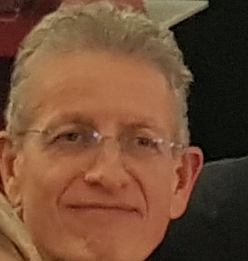
Rainer Guldin
Rainer Guldin was professor of German culture at the USI (Università della Svizzera Italiana) in Lugano (Switzerland). He is the author of numerous publications on the life and work of Vilém Flusser, including ‘Vilém Flusser – Hundert Zitate’ (with Andreas Müller-Pohle), Berlin, 2020; Vilém Flusser (1920-1991). ‘Ein Leben in der Bodenlosigkeit. Biographie’ (with Gustavo Bernardo), Bielefeld, 2017; and ‘Philosophieren zwischen den Sprachen. Vilém Flussers Werk’, Munich, 2005. He is editor-in-chief of the multilingual online journal ‘Flusser Studies’ (https://www.flusserstudies.net/).