The Bull Named Jew
When the artist Moisés Zabludovsky discovered that a bull named Judío, Jew, had been killed at Las Ventas, in Madrid, during the confirmation of a young Mexican matador, he felt betrayed by a tradition he loved. His nephew, the writer Alan Grabinsky, recounts the inflatable sculpture his uncle imagined in response, the silence of Madrid’s officials, and the breeder’s disarmingly simple explanation. Along the way, he describes a Spain where antisemitic words and customs go unnoticed, in a country that has had almost no Jews for centuries.
I can’t really remember the first time I heard about the bull named Jew. I do remember that it was over the phone. My uncle, the artist Moisés Zabludovsky, was calling me from Mexico to Barcelona, where I live.
”I’m not going to let this pass!” His voice sounded profoundly altered — I thought it must still be dark in Mexico. “I’ve got to do something. I can’t just cross my arms and act as if nothing happened, can I?”
I asked him to calm down and explain what had happened. So he told me the following story.
A Jew in the ring
Last year Moisés had spent some days at the Feria de San Isidro, Madrid’s monthlong bullfighting fair and the most important event on the calendar for those who still relish the life-or-death encounter, as Moisés put it, between beast and man — one of the few places, he said, where bullfighting remains a source of pride, even as it comes under growing scrutiny from animal-rights activists and the wider public.
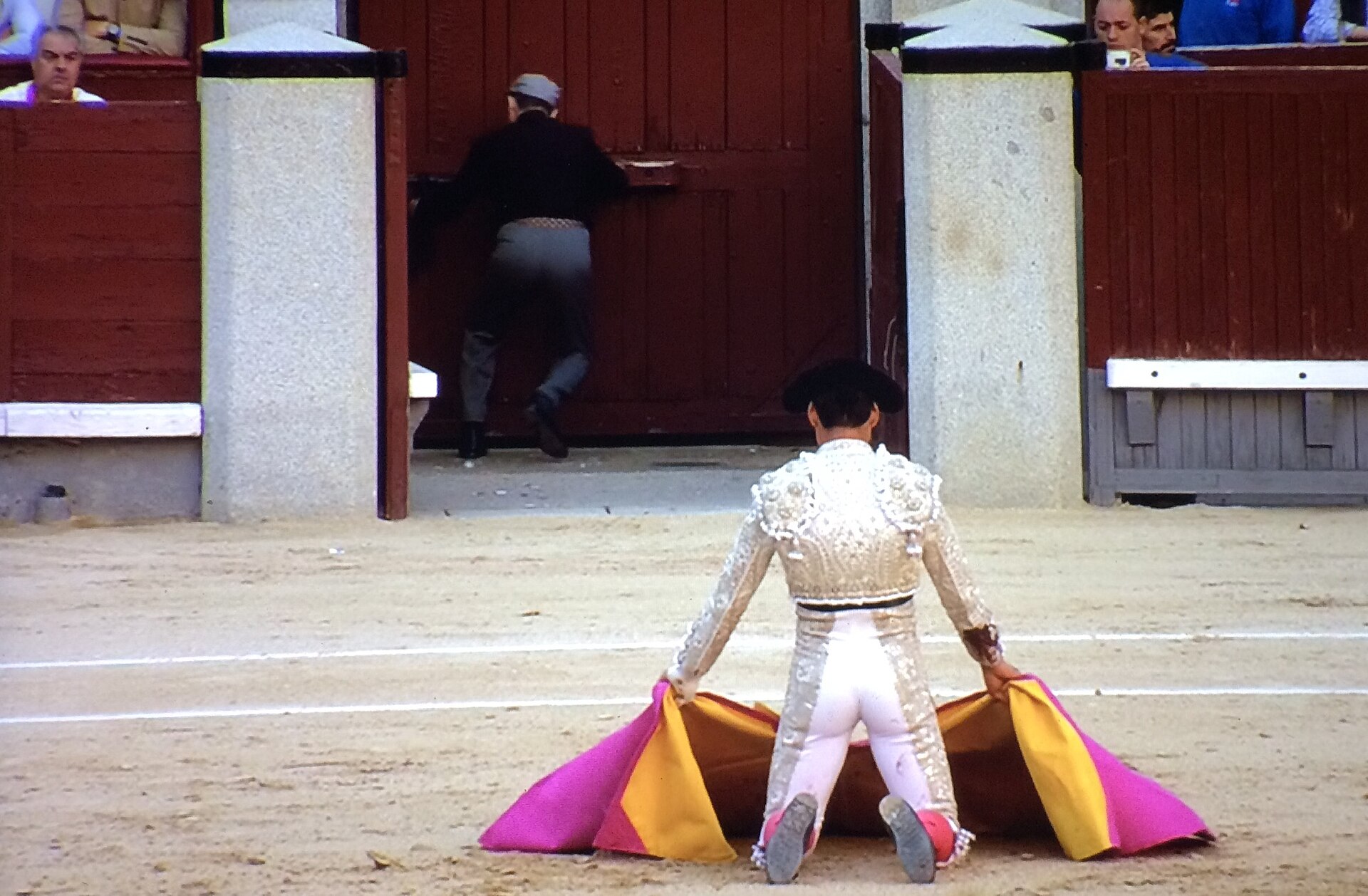
During the feria, Moisés attended a couple of corridas and followed closely the upcoming appearance of Diego San Román, the young Mexican bullfighter who was set to confirm his alternativa — the formal ceremony that ratifies a matador’s full standing — at Las Ventas, the largest bullring in Spain.
”To fight there is a very big deal,” he told me later, when I sat down to interview him for this piece. “A sort of commencement, the equivalent of a Bar Mitzvah.” He laughed. San Román had already taken his alternativa in Mexico, back in 2021; what awaited him in Madrid was its confirmation — a second rite of passage, but no less charged for it. The high expectations were, by most accounts, justified: it was, by the coverage, a strong afternoon (I confess I know almost nothing about the “sport”).
None of that mattered in the end. When Moisés, like other aficionados, looked up the bulls’ names and lineage ahead of the fight, he was stunned.
Judío. The name was Jew. A Jew was to be slaughtered in front of spectators to everyone’s delight.
“Killing a Jew in the arena raised no more comment than if the bull had been named Juan.”
I later confirmed this myself. The bull was the sixth and last of the afternoon — the one saved, by one bullfighting chronicle’s account, for San Román’s most serious test, the fight in which the young torero effectively “became a man” against a wary, dangerous animal. There was no mention anywhere of the bull’s name being remarkable. No complaint, no ringing of bells. Killing a Jew in the arena raised no more comment than if the bull had been named Juan.
”This would never happen in Mexico City,” Moisés told me. “The Jewish community would have put out a press release immediately. There would have been some sort of public reckoning” — although in Mexico City, he allowed, bullfighting itself has fallen out of favor and is constantly pushed in and out of legality.
In Madrid, Moisés felt a void.
A country that sees no problem
And now I find it funny that I was shocked too. In the end it shouldn’t have surprised me. As I’ve written elsewhere, there’s a widespread lack of awareness in Spain of what antisemitism even means. This is a country where every Easter, people in León “kill Jews” — matar judíos — the local name for the custom of drinking limonada, a wine-based punch, during Holy Week. When I mentioned how loaded that sounded to a friend from the region, he realized, for the first time — he’s forty-something — what he’d been saying his whole life; it turns out he’d simply never thought about it. Swastikas etched into the wall of an elevator at my local public health center? Nothing serious, just kids acting out. When I complained to the building administrator, she didn’t even know what the symbol meant.
Anyone who’s been through Alcoholics Anonymous or another recovery program knows the first step: recognizing there’s a problem. On antisemitism, Spain hasn’t taken that step. This despite being, according to the ADL’s most recent European survey, the country in Western Europe with the highest level of antisemitic attitudes — 26 percent of the population hold some form of antisemitic view1, ahead of Belgium, France, Germany, and the UK.
“How could there be antisemitism where there have been no Jews for centuries?”
And so bulls continue to be named Jews, and people in León continue to “kill” them, and even now in the twenty-first century a “Jew” is defined by the Royal Spanish Academy, a state-sponsored organization that publishes the most authoritative Spanish-language dictionary in the world, as, among other things, a “usurer”2, with little pushback, because as far as most of the country is concerned, there is no problem at all. How could there be antisemitism where there have been no Jews for centuries?
A double bind
So my uncle, the artist, felt he had to do something about the bull named Jew. Some kind of public intervention that would let him make peace with the sense of betrayal he felt from a tradition he loved. But he found himself in a double bind almost immediately. Of course he was offended — the way you can be hurt by a relative. But the offense had happened inside a world, the bullfighting world, that was already treated as beyond the pale.
He was planning, he told me, to raise awareness of what had happened.
“He felt, he told me, like a member of two vulnerable minorities at once: the bullfighting aficionado, and the Jew.”
Not “artivism,” though — he would never use that word. In the art and culture world, which leans overwhelmingly progressive, the whole business of killing an animal for spectacle is treated as morally indefensible; most artivism around bullfighting exists to get it banned. That was never my uncle’s position. Decades earlier he had painted a whole series capturing moments from the corrida, rendered in his minimalist but quietly dramatic style. He was the last person who wanted to hand more ammunition to a tradition already under siege.
He felt, he told me, like a member of two vulnerable minorities at once: the bullfighting aficionado, and the Jew. That it had been a Mexican bullfighter forced to face down the Jew added one more turn of the screw. Three dimensions of my uncle’s identity seemed to be fighting it out in the ring, and the fight was to the death. So he designed an intervention that honored the sport while expressing his anguish.
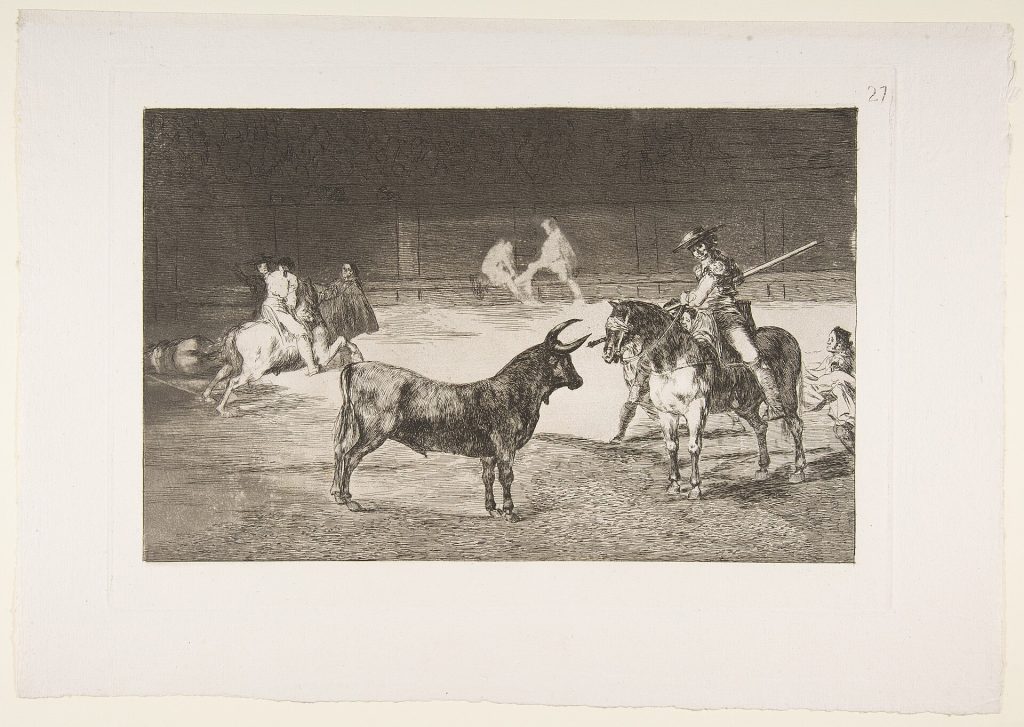
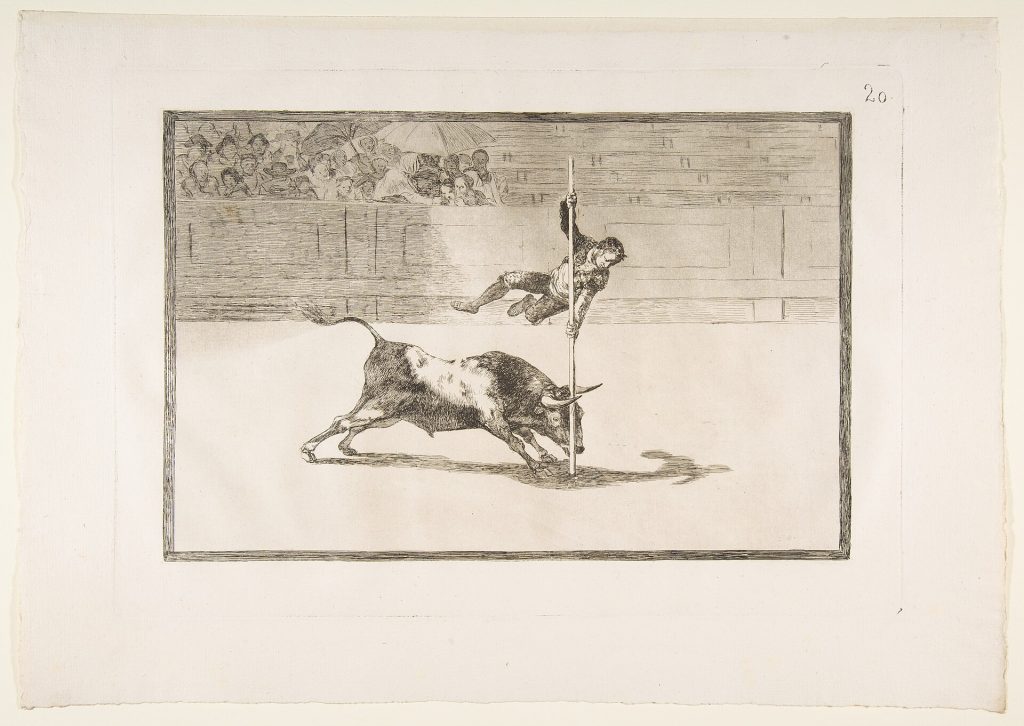
[Texte interrompu : longueur maximale atteinte.] (Francisco de Goya / The Metropolitan Museum of Art, CC0)
Aguantar vara
And he landed on the right image for it. “The Mexican expression aguantar vara” — to withstand the lance, an idiom for stoic endurance through suffering — “comes from bullfighting,” he told me. “It refers to the moment in the fight when the bull is pierced by the mounted picadors but still holds its strength and tenacity.” The animal keeps standing, even weakened, even in pain. That, he told me, was how he’d felt since that corrida. Bleeding, but holding steady. That image is what he decided to deploy — exactly one year after the fight.
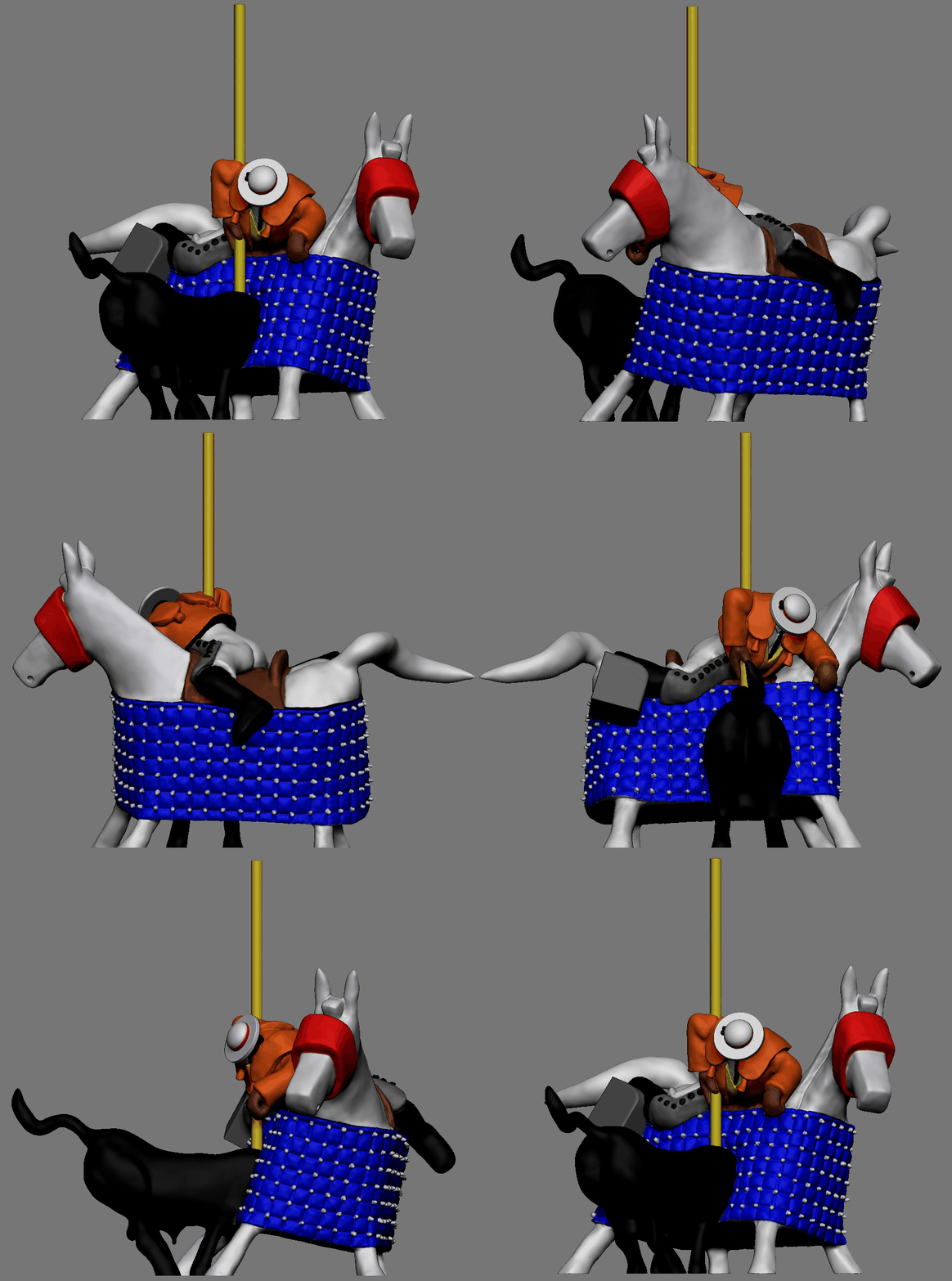
In the months that followed he developed a prototype: a seven-meter-long inflatable, manufactured in China, depicting a bull ramming a horse and its rider. A genuinely striking piece. “But where does the bull named Jew come into it?” I asked him on a call. “I’ll write a message underneath the bull’s and the horse’s bellies,” he said, “so that people walking under it can read what it’s about.”
He wanted to install the inflatable in the plaza outside Las Ventas, which meant getting the municipality’s sign-off. So he reached out. Sent them a model of the piece. And never heard back. The whole process — or should I say the ghosting — dragged on. Logistically, my uncle was in agony the entire time. He kept delaying the expensive order to the Chinese manufacturer, waiting for a green light that never came.
When I first heard this, I assumed it was a textbook case of Spanish institutions failing to take antisemitism seriously. But it turned out my uncle had never actually told them what the piece was about. When I asked him why, in his characteristically contradictory way, he said he hadn’t wanted to draw attention to himself — that he’d planned to add the message about the bull named Jew only once the piece was already inflated and installed. To me, this seemed self-defeating; he’d drained the whole thing of its urgency before it even launched. And it was problematic for me too: I had planned to write a story about a Jew’s epic fight against Spanish antisemitism, that many-headed monster, but this was more of a case of bureaucratic indifference. What’s so special about that?
It was, he confessed later, when I mentioned it, a lost cause from the start. He never believed local officials would risk being seen as too pro-bullfighting. He did what he could.
Maternal transmission
So the anniversary came and went. The inflatable bull named Jew was never deployed. And yet, strangely, when I spoke to my uncle for this piece, he seemed to have made peace with the whole episode. He’d realized early on, he told me, that he wasn’t going to get the statue up. So he let it go. But he still wanted to know why the bull had been named that in the first place.
“Every bull is named after its mother. And this bull’s mother’s name was La Judía.”
So he drew on his considerable insider knowledge of the tradition and, through a contact of a contact, finally reached the breeder — the rancher who had raised El Judío, of the Fuente Ymbro3 ganadería. He got the man on the phone from Mexico and asked him why the bull had been given that name. The answer was short and entirely unremarkable. Every bull is named after its mother. And this bull’s mother’s name was La Judía. No further explanation was needed. There was nothing sinister there. It was simply how things were done.
My uncle told me he then launched into his whole saga — his travails as a Mexican Jew, his sense of estrangement from a world he loved, his frustration at never finding an outlet for his indignation. And he made a characteristically wacky proposal — he’’s an artist, after all — for reconciliation. Would it be possible, he asked, for him, Moisés Zabludovsky, to name a bull himself? Somehow, he felt that would close the circle.
The breeder’s answer was clear and final: no. There’s a tradition, you understand. You don’t go over it.
Somehow, my uncle could live with that.
- ADL Global 100 survey of ten European countries, conducted between November and December 2022 and published in May 2023: Spain 26 percent, Belgium 24, France 17, Germany 12, United Kingdom 10. ↩︎
- The Diccionario de la lengua española gives “usurero” (usurer) as one sense of judío, marked as derogatory. ↩︎
- Bull-breeding ranch (ganadería) in San José del Valle, in the province of Cádiz. ↩︎