Czaplin
In Góra Kalwaria - known as the “Jerusalem of the East” - the birthplace of his parents, Belgian writer Adolphe Nysenholc discovers a road sign across from his father’s house indicating “CZAPLIN,” 4 km away. What is the ghost of Charlie Chaplin—a subject of fascination and writing for Nysenholc—doing in this land he never knew? His investigation leads him on the trail of a family history swallowed up by the Shoah, and of a lost childhood.
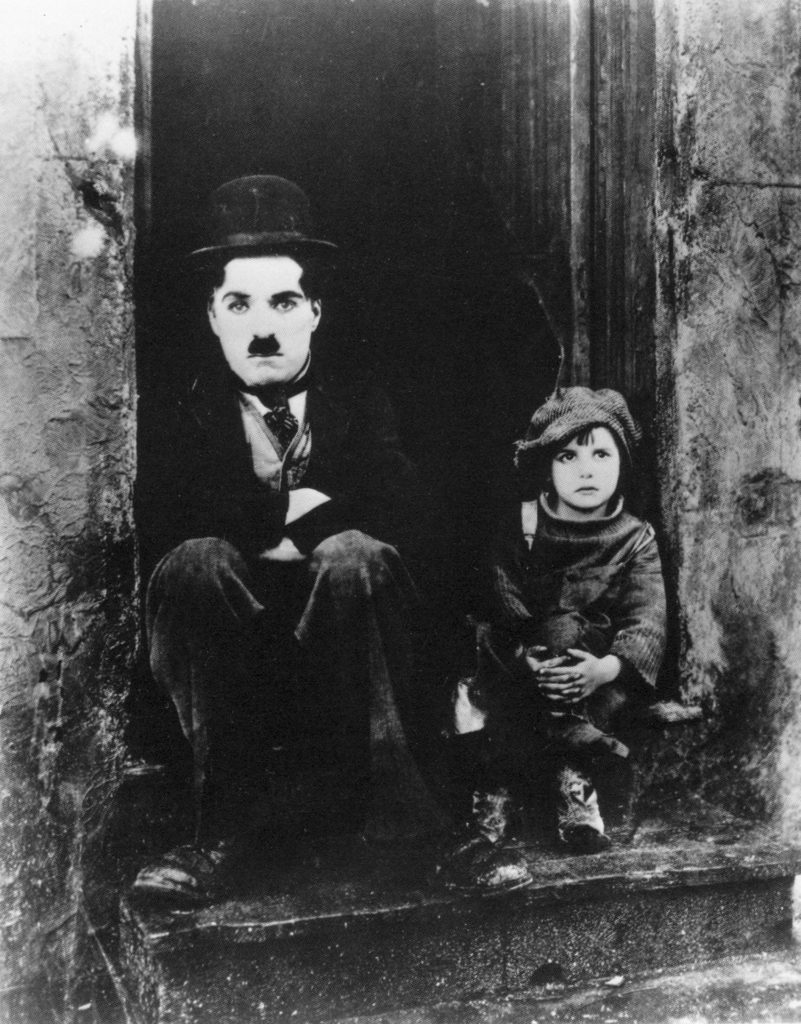
As a former hidden child, I was fascinated by the creator of The Kid.
And then, during a trip to Poland, in Góra Kalwaria, known as the “Jerusalem of the East,” I came across “Czaplin” written on a road sign. Not knowing the language, I struggled to understand its meaning. This place name likely has nothing to do with the creator of The Gold Rush. And if so, could the man reputed to have been born in London have actually been born near Warsaw? Could a village have been named in his honor? For a time, Fontainebleau had indeed been cited as his birthplace. But it was Hannah, Charlie’s mother, who had playfully tricked him when he was a child, and he, ever the joker, had passed this scoop on to a reporter in need of a story. But how did I end up in this place?
A distant memory: one of my former students, Jeremi Szaniawski, told me one day that his father had returned to his homeland, Poland. To Czersk. I looked it up on a map. It was the town next to Góra Kalwaria, where my parents were from!
And recently, another surprise! Jeremi, now a professor at Amherst (Massachusetts), wrote to me that he had translated Mère de guerre into Polish. While on vacation at his father’s house, he invited me to reread his adaptation of the book together. In it, my mother appears as a ghost from Auschwitz.
I land at Frédéric Chopin Airport, not without some apprehension. I was Polish until I was 16. At the bottom of my suitcase is my latest book, Charles Chaplin: The Dream, for my host. I’ll see him tomorrow.
Warsaw, bombed by the Luftwaffe in 1939 after Guernica to terrorize all the cities of Europe, has been rebuilt from memory, with its prestigious monuments, on Krakowskie Przedmieście Street, where I venture out under a clear summer sky. It occurs to me that years ago when I came across three young women there who were chatting happily among themselves, I had a sort of revelation, rediscovering the melody of my first words, for their passing had just “spoken” to me – without them having the slightest awareness of it – of my mother.
Early in the morning, I head to Czersk. More significant than Warsaw, this city was destroyed by another Germanic invasion – that of the Swedes. All that remains is the castle, a royal property, whose ruins have been partially restored.
Father Szaniawski, who welcomes me, lives out his retirement almost in the shadow of his tower.
Father Szaniawski had escaped Gomułka’s communist regime in the postwar period as a Catholic; my father, born Jewish, had fled Pilsudski’s dictatorship in the interwar period because he was a communist. Both had come to take refuge, for reasons unknown to me, in the heart of Brabant, in Brussels.
As for my mother, she had joined her fiancé, thus escaping the poverty that plagued her hometown. But ten years later, in 1940, Góra Kalwaria, “the Mountain of Calvary,” suffered worse. The entire Jewish community was deported from there to the Warsaw Ghetto, to be annihilated. Its miraculous rabbi could not save the shtetl. The old synagogue is currently being restored there. Built of red brick, like the castle of Czersk once was. The place of worship had remained empty since the Holocaust.
Over the centuries, each of these two neighboring small towns has endured a major tragedy.
In 1942, it was on the 9th convoy from the Dossin barracks in Mechelen that my father and mother were forcibly taken back – not to their loved ones, who had already died in Treblinka – but, forever, to “Oświęcim.”
Of my entire extended family, there was one survivor: my father’s younger brother. This uncle had insisted on showing me, many years later, the house in Góra where the family’s fate had been sealed – a shabby three-room dwelling where he had lived in cramped quarters with his siblings, sleeping among nine brothers and sisters. My uncle was small in stature, as if there hadn’t been enough room there for him to grow. Above the entrance on the facade, the number 4 was still visible – that number that had been indifferent to his departure with them, toward an unknown destination.
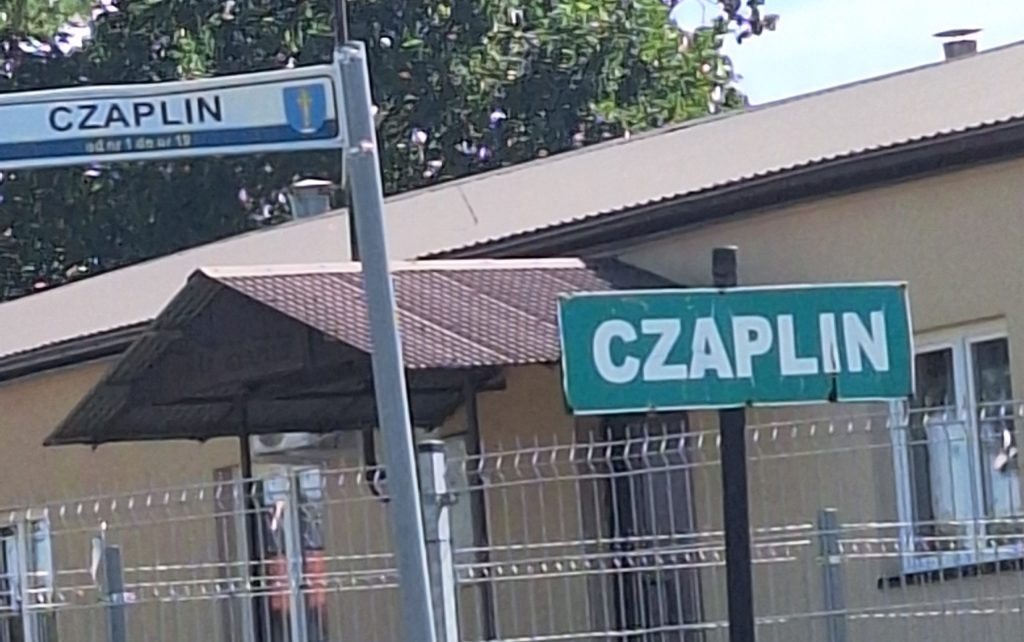
It was when I returned to Góra, years later, without my uncle, that I noticed, across the street, a signpost bearing the enigmatic word “CZAPLIN.” It was on the occasion of the 70th anniversary of the Warsaw Ghetto Uprising. From there, Marian Handwerker, director of Who Will Say the Kaddish, in which I have a role, was interested in accompanying me to Góra. Born in Taldykorgan, he was able to decipher the inscription on the road sign, which he pronounced according to Polish spelling, just as in English: tchaplin!
Could there really be a place with that name just a few kilometers away? We were on foot. We couldn’t go there.
And now, a decade later, thanks to Jeremi, I find myself in Góra Kalwaria, in front of my father’s address: 4 Pijarska ulica (Piarist Street, named after the Piarist brothers whose vocation was to teach underprivileged children). The house remains closed off in its shadow, from which the Nysenholcs were deported, their faces forever hidden.
And, right on the other sidewalk, across from number 4, I see “CZAPLIN, 4” again, in white letters on the green background of the road sign planted right in the heart of the childhood home of my dearest loved ones.
Is there really a connection to Charlie Chaplin? Jeremi suggests we go there; we’re in the car. He drives at a brisk pace, windows open, as if to intoxicate us with the air – now vanished – once breathed by my family. Through the windshield, the landscape unfolds to the rhythm of my reverie, just like in a movie. I recall that Jeremi, a film enthusiast, authored a book on Kubrick, which demonstrates how much the filmmaker’s imagination was nourished by Mittel Europa. It contains a chapter on the film project inspired by Louis Begley, whose autobiography recounts his headlong flight as a child across his native Poland during the Shoah, with a mother who shielded him from all dangers.
Rocked by the sedan, I see myself yesterday on the banks of the Vistula, in Góra Kalwaria, which I thought was located on the other side of the river across from Czersk. Yet the two towns lie side by side on the same bank. I discovered this when I caught sight of the medieval castle silhouetted in the lustrous evening light. My parents, during their walk along the riverbank, must have seen its reflection shimmering in the river. Could they ever have imagined that one day their child would walk in their footsteps there? In their exile, they undoubtedly even wished for it.
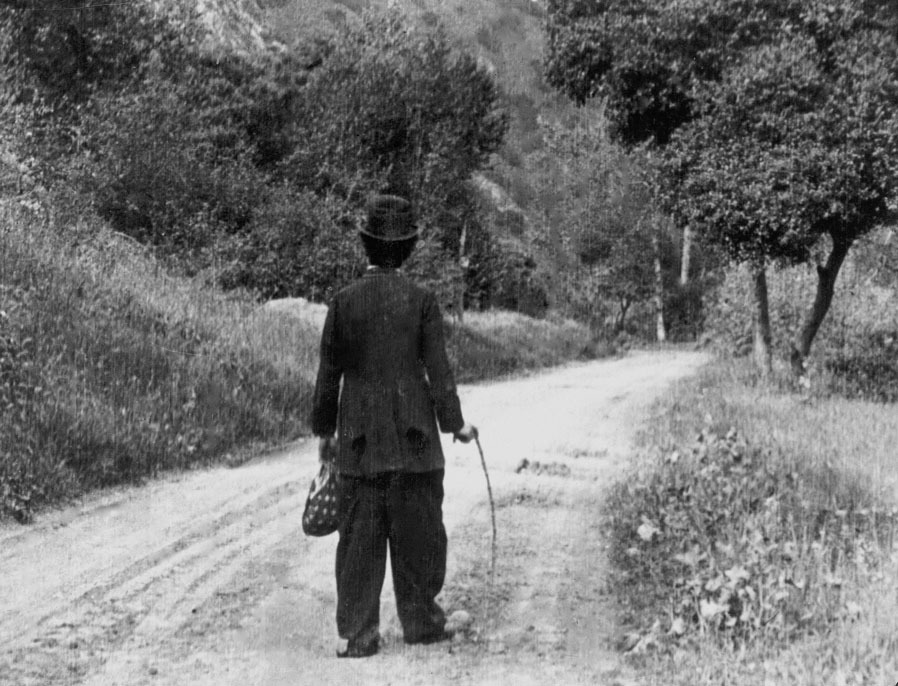
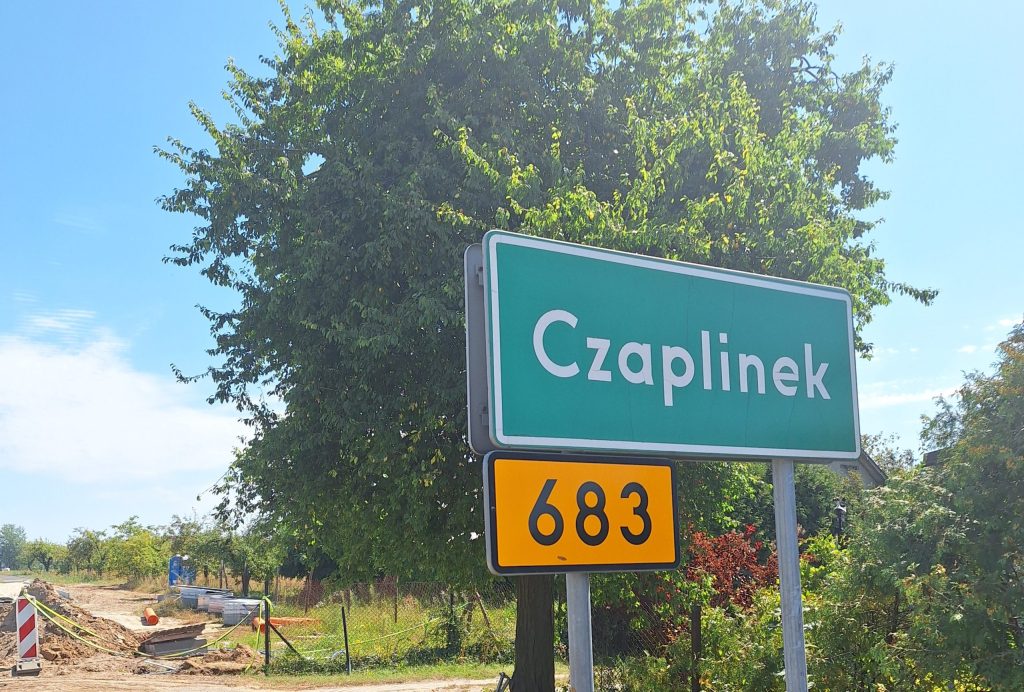
After a straight, paved road, as empty as the one in the finale of Modern Times, and turns on a dusty track similar to the one in The Tramp, we arrived at a cluster of three villages, which seemed anonymous, named respectively: Czaplin, Czaplinek, and Krzaki Czaplinowskie. I was in Chaplinland!
Did my mother ever tell me about this place located “4 km” away, which was familiar to her? Czaplin is a municipality (“gmina”) of Góra Kalwaria! Did she speak of its existence to me with emotion, as one of her most memorable memories, and utter the word by chance or in jest, with love, with humor, in an exchange of particularly meaningful smiles while I was still too young to speak?
When Bubele, in The Child in the Shade, my life story, loved to wander about in his Juste’s clogs – the left one on his right foot, and the right one no less left-handed – the woman who saved him by hiding him would call out to him, amused: “Come on, Charlot!”
I don’t know if, in that call from my wartime godmother, there wasn’t, silently, the same open-armed invitation from my mother, long repressed within me.
For my most original observation of Charlot – and the one that formed the basis of my study of his character in The Golden Age of Comedy – was that his famous gait was like a parody of our first steps, feet splayed wide to the sides. No one had written that. Why had I noted it? Wasn’t it a reminiscence of when my mother saw me toddling toward her for the first time and she – who knows? – encouraged her little one, murmuring with a smile, “Come here, my Charlot! ”, as if I reminded her of the funny man’s toddling, seen on the big screen in her youth, or even a happy time spent long ago with her beloved in Czaplin, between Czaplinek and Krzaki Czaplinowskie? My first book on Charlie shows that the master of silent film uses traits of early childhood to make people laugh. Did I seek to relive, through this great child of the century, my earliest days with my mother, the days forever lost of my infancy, in the original sense of one who does not speak?
My mother lived at 2 Kalwariska Street, perpendicular to my father’s street. Her parents owned the house. My uncle was certain to leave me an inheritance. He turned the corner to show it to me. The house was no longer there. Demolished! Calvary Street.
On the third day, I swam in the blue lake of Czersk, where perhaps my father and mother, Solomon and Lea, had once bathed in the rain falling from a cloud that came from Czaplin. As if I had rediscovered a primal water, not to say baptismal water.
Jeremi had invited Agneska from Warsaw, who proofread the translation. A single mother of a daughter, she has mahogany-red hair – like my mother.
They swam the breaststroke with me in cold water under a blazing sun, to the point that a distant image of my family saga seemed to emerge there, little by little, as if on the surface of a developing bath for a film photograph under a red lamp.
Jeremi’s father, who generously welcomed me along with his son, lives almost on the edge of this lake, in a country house, lost amid acres of apple orchards that perfume the air.
The uncle could have come to pick them there. He had told me of an orchard from which, as a young man, he transported this fruit – the first of paradise – in a horse-drawn cart all the way to Warsaw. Thus, the region persists in the tradition of this ancestral culture as if nothing had changed.
When, in 1981, I gave him my first Chaplin – subtitled The Golden Age of Comedy (which is the time of our youth when we all naturally bring joy to others) – my uncle ran, holding the book aloft, proud and happy, to his neighbors in his Miami condominium. They were gathered upstairs near the open-air pool.
With them, he could speak Yiddish and Polish, the mother tongue of his shtetl. But he was the only one who seemed to truly understand “Czaplin” – he who came from Góra Kalwaria, whom everyone else called Guèr – speaking to them in Ashkenazi, unaware that this major center of Hasidism included a village whose name evoked the famous comedian often imagined as Jewish. I myself hadn’t quite grasped why my Tchaplïn – as the uncle pronounced it while reading the title aloud from the cover page – had made him burst out laughing as if it were a witz, a witty remark.
Jeremi’s father is the age my grandparents never reached.
The Szaniawskis have a family coat of arms and can trace their lineage quite far back in time. The Nysenholcs and the Frydmans (on my mother’s side, where not even a single uncle survived) have no genealogy – no names, no faces, no addresses, no photos, no birth dates, and even fewer death dates. No trace in the archives, at City Hall.
As a wanderer through their space, I went as far as I could within myself.
In Matka wojny (Mother of War, now translated), my mother tongue is finally spoken – a language of which I now know only the melody. The French of the original version masks my first language, the language of affection. Jeremi dreams of having the play performed in Góra Kalwaria, in the synagogue, during the inauguration next year, after its ongoing renovation. My mother in Góra! Next year, in East Jerusalem. Back! Like me… her, out of her hiding place of death!
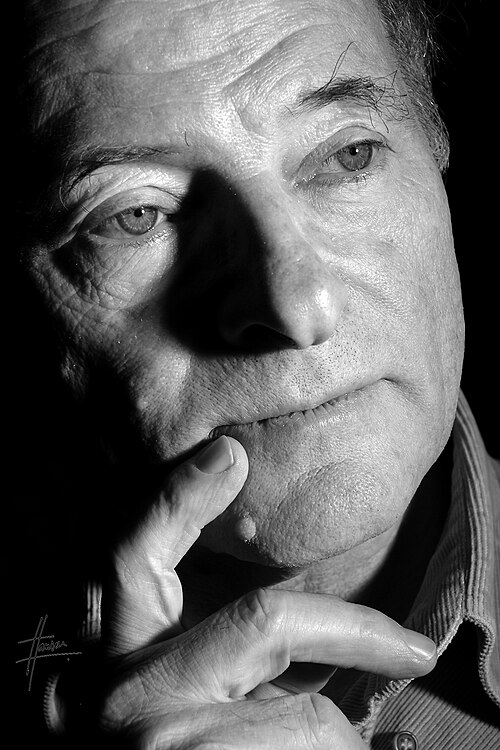
Adolphe Nysenholc
Adolphe Nysenholc was born in Brussels in 1938 to a Jewish family originally from Poland. In 1942, his parents were deported and died in Auschwitz, while he himself survived by going into hiding during the Occupation. He turned to the study of cinema and wrote a pioneering thesis on Charlie Chaplin. In 1980, he became a professor of cinema at the Université libre de Bruxelles, where he helped raise awareness of the importance and richness of Belgian cinema. Alongside his academic career, he was active as a writer. He published novels, essays on cinema, and autobiographical accounts. Among his works, 'Bubelè, l’enfant à l’ombre' was published in 2007.