Are There Too Many Jews?
“The Jewish community—there are too many of you,” declared the owner of a snack bar in Les Deux-Alpes this summer. This statement encapsulates an age-old antisemitic obsession—that of “too many Jews”—and mirrors an equally ancient Jewish concern: How many of us are there, and are there enough of us to survive? Ruben Honigmann explores this paradox of numbers with both humor and gravity, from the biblical prohibition against counting Jews to the hypothesis that their survival may depend precisely on what cannot be quantified.
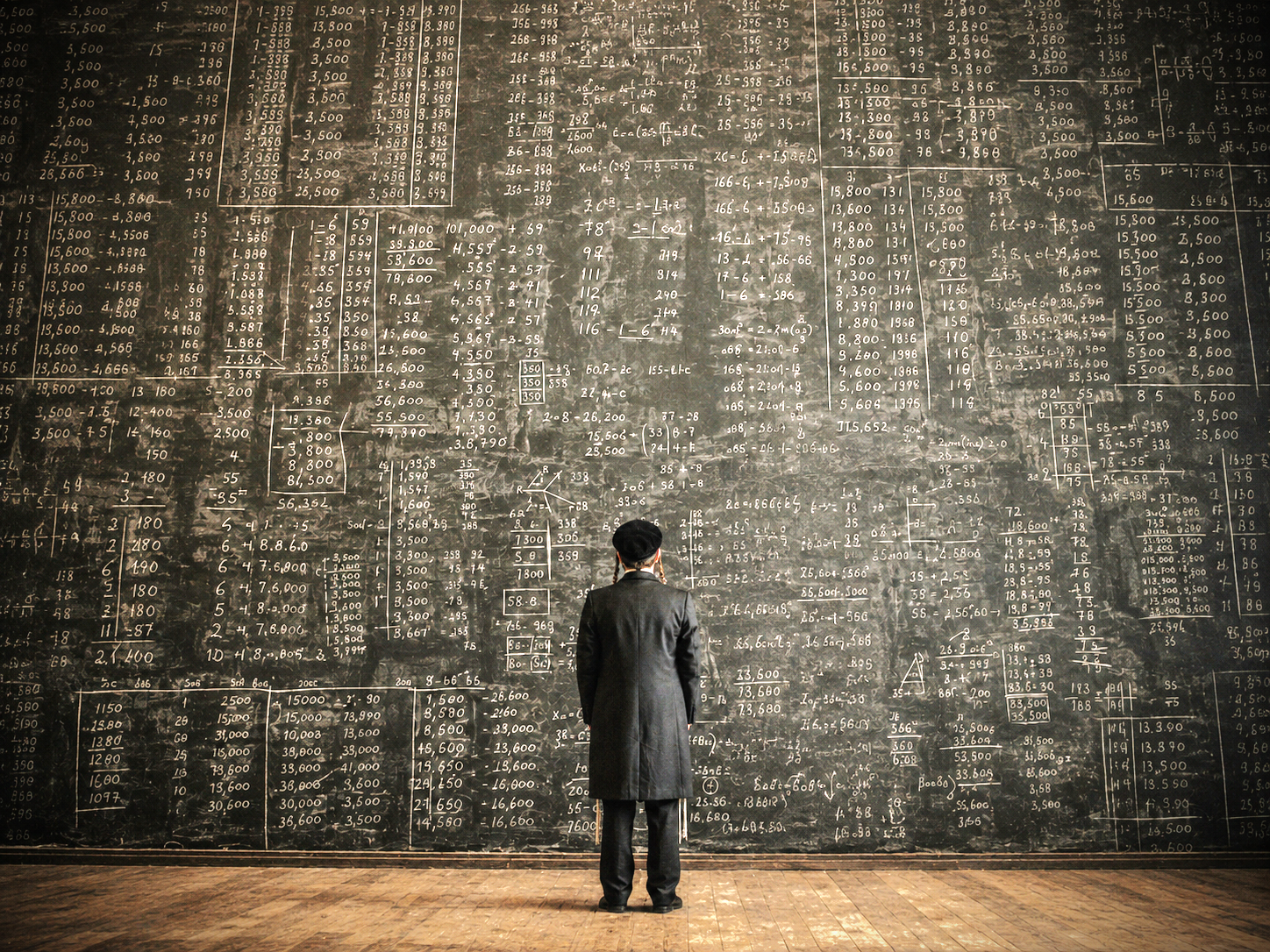
It is said that Elie Wiesel once met Mao Zedong and told him about the Holocaust and its six million victims. To which the Great Helmsman is said to have replied: ‘In our country, that figure corresponds to the margin of error in our censuses.’
The Jews are worried: how many are there? Are there enough of them to survive—in Israel as well as in the diaspora—in a world so hostile to them?
Anti-Semites are also stirring up trouble: whether in the media, the “deep state,” or the bars of Les Deux Alpes, there are always too many Jews.
Both concerns are surprising, for the Jewish experience has never been a matter of numbers. Demographically, the Jewish population has always been negligible. This is due, of course, to the weight of history—exile, persecution, extermination—but also, more recently, to the effects of assimilation, which has so often led, and continues to lead, to self-dissolution and disappearance.
Added to this is the very ancient awareness that being Jewish cannot be reduced to a quantitative issue. Their founding text states this explicitly: “You are the smallest of the nations,”1 and the Prophets take the opposite stance from Jean-Luc Mélenchon: it is not anti-Semitism that is residual, but the Jewish people themselves; they are a “cherished remnant,”2 an irreducible residue.
It follows from these texts that Jews are, by their very nature, a remnant, a surplus, an excess—which is the height of irony for a people whose identity is founded on the removal of precisely that which exceeds the norm.
It is thus the “excessive” nature of the Jews that forms the foundation of the hatred they provoke. In the eyes of anti-Semites, there are always too many Jews. “The Jews will overwhelm us” is the fear upon which their first persecutor, the Pharaoh of the Exodus, based his decision to “throw all the Hebrew boys into the water.”3
Ultimately, the fear of “too many Jews” is disconnected from their actual numbers. Worse still, antisemitism rests on a strange psychological mechanism: the fewer Jews there are, the more powerful they are imagined to be. If Jews are so inconspicuous—and thus seemingly so few in number—it is because they are acting and pulling the strings from the shadows.
Haman, the archetype of the genocidal maniac, understood this well in the Book of Esther: he wants to wipe out the Jews not because there are too many of them, quantitatively speaking, but because they are out of place, “scattered and separated”4—and thus everywhere and nowhere at the same time. Haman is exasperated by the Jew Mordecai, precisely because the Jews defy the natural order of things; they are humanity’s statistical anomaly that threatens to jam the machinery of history.
Jews and anti-Semites ultimately find common ground on one point—a shared intuition, though perceived in opposite ways: the Jewish presence in the world lodges itself in the interstices.
This is, incidentally, illustrated by a shared obsession: at the end of a movie, they hunt for Jewish names in the credits. Some do this to fuel their madness; others, perhaps, to assure themselves that they are still there—much as one might, after a hard fall, take stock of one’s limbs to verify that everything is intact or, if necessary, to piece the fragments back together.
The tragic culmination of this fantasized representation of a Jewish surplus was the 20th century, the stage for the most macabre “politics of numbers” imaginable. First on the part of the executioners, obsessed with the idea of ridding the world of its Jews through lists, roll calls, selections, and numbers tattooed on the arm. This was the very nightmare of the Auschwitz camp commander, as portrayed by Robert Merle in Death Is My Profession: failing to meet his corpse-production quotas, failing to satisfy the targets set by the planners of the genocide.
Then, in a perverse reversal of history, after the Holocaust, the victims found themselves entangled in the sacralization of the very number representing their own murder. Six million has become a totemic number that no longer conveys any meaning. An anecdote shared with me by a friend—who teaches in his spare time—illustrates this: a college student had handed in an essay in which she wrote about the six billion Jews killed during the Holocaust, to which he could only ironically reply in the margin, “Are you referring to ancient Jews here?” By treating the number as sacrosanct, we’ve ended up removing it from the realm of arithmetic…
For my part, I had to wait until I turned forty to truly grasp what six million really represents: if that many people were to hold hands, I was told, they would form a human chain stretching from Paris to Moscow and back. That, in concrete terms, is what six million murdered human beings amount to.
In recent years, a shift of a different kind has taken place: there are now more Jews in Israel than outside of Israel, and there are now more Jews in Israel than were murdered during the Holocaust. The numbers add up, but can Jewish survival rely solely on such a numerical sleight of hand?
The general concern surrounding Jewish demographics has reignited an old question for me: why does such a small population occupy such a disproportionately large place in the collective imagination? I found the beginning of an answer to this question at my bar mitzvah.
In the community where I grew up, the main rite of passage for a young man was not so much the public reading of the Torah as it was preparing a presentation to deliver before the gentlemen of the yeshiva.
My father, following his return to Judaism, had developed a passion for Jewish demographics. Coming from the most assimilated German Jewish community imaginable before embracing Orthodoxy, he had taken an interest in those who had traveled the opposite path, amusing himself by compiling a list of Berlin Jews who had been baptized in the previous century.
Perhaps that is why, as my bar mitzvah approached, he chose as the theme for my speech a relatively little-known biblical prohibition: that against counting Jews.5 My father entrusted me to a teacher who introduced me to and helped me study the biblical and rabbinic texts on the subject, including the episode in which King David suffered the consequences of the biblical prohibition: a plague ravaged his kingdom because he had conducted a census of his subjects.6 The central idea that emerged was that counting human beings amounts to objectifying them, reducing them to numbers and statistics—what we did not yet call data at the time. In short, refraining from counting human beings is to affirm their unquantifiable, indefinable nature, in accordance with the manner of their creation: “in the image of God.”7
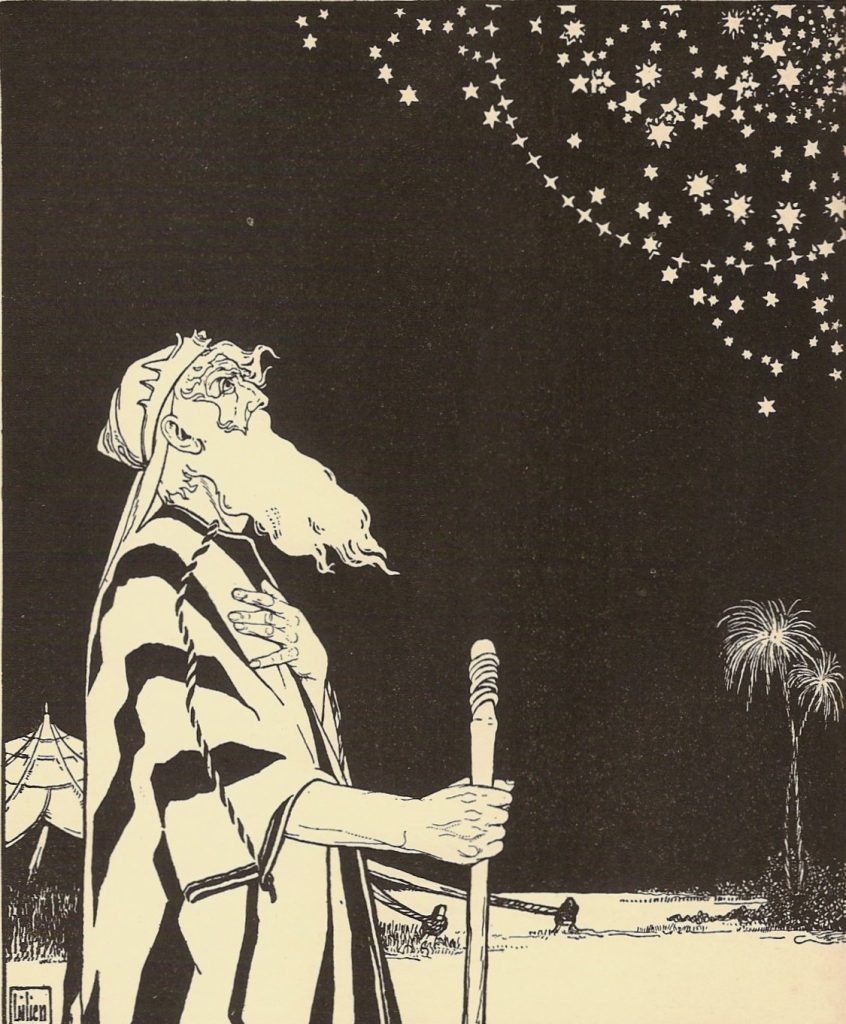
The “sand of the sea and the stars of the sky,”8 to which Abraham’s descendants are compared, clearly express this impossibility—not only because of their great number, but because of their elusiveness: sand slips through one’s fingers, and stars make one’s head spin. The Jews are destined to defy counting, and therein lies their inaugural blessing.
The biblical prohibition has consequences in the daily lives of those who heed it that are as concrete as they are whimsical. In every Jewish school, one is compelled to take a headcount of the children, and in every synagogue, one is forced to count the congregants to ensure that the quorum of ten men—necessary for communal prayer—is met. To reconcile the biblical prohibition with the necessities of life, a clever workaround is employed: instead of counting people, we fall back on counting caps, T-shirts, or hands. Another, more unusual option is to count “step 1, step 2, step 3” instead of 1, 2, 3, in order to explicitly invalidate the very act of counting that is being performed.
Or, taking the trick a step further, the teacher recites a Bible verse that contains exactly the same number of words as there are children in the class, then verifies that there are indeed as many words as there are children so that the verse is complete. This stratagem coincides, in the process, words and people, beings and language, and transforms each member of the group into a signifier.
The process is characteristic of those legal subterfuges that lend themselves to a classic argument of anti-Judaism: the Jews, hypocritical and cunning, manipulate their Law, circumvent it, artificially preserve its letter while killing its spirit. The accusation of Pharisaism is as old as Christianity itself.
But counting caps instead of children, twisting normal and necessary usage without losing its benefit, is above all an expression of an admission: since we cannot fit the circle of the ideal into the square of reality, the subterfuge serves as a constant reminder that we live below the heights to which we aspire. Much like the circumflex accent preserved as a vestige in words where the s of Old French—which was no longer pronounced—has been dropped. This is neither a compromise nor a concession, but a sublimation.
Just as the Torah comes to terms with its own inconsistencies, the biblical narrative itself is peppered with censuses. Each of the five books of the Pentateuch (beginning with the Book of… Numbers) contains long lists of names and numbers, family by family, tribe by tribe, which make up the entirety of the people.
Except that with the Hebrews, the numbers never add up: in every census, there is a gap. The 70 who went down to Egypt at the end of Genesis are, upon closer inspection, only 699; certain families disappear from one book to the next10—if not the census-taker himself, in this case the High Priest Aaron, who, unable to be both the counter and the counted11, casts a shadow over his own work.
Accuracy is invariably missing from biblical censuses. An empty slot always remains, allowing the group to avoid becoming frozen into a static mass.
A few years after my religious bar mitzvah, I sort of went through another bar mitzvah—that of the other side of my identity. I took German, my native language, as a modern language for the baccalaureate as an independent candidate. The exam consisted of an oral analysis of a text from German literature chosen from among about ten proposed by the candidate. Generally speaking, I read very little and with great difficulty, and I knew absolutely nothing about German literature. So this time, it was my mother who prepared me for it. The bar mitzvah, in both cases—Jewish and German—amounted to retracing, in my own way, a part of the path my parents had taken.
During the months leading up to the exam, my mother sat with me to discuss the texts she had selected and that were close to her heart. The one closest to her heart was a short poem by Thomas Brasch, a Jewish author who, like her, had grown up in postwar Germany—a country still thoroughly Nazified—and who, before his tragic and untimely death, had been her best friend.
The poem in question is titled Wie viele sind wir eigentlich noch?, which can be translated as How many of us are actually left? In it, Brasch took aim at the gentrification of all his former fellow protesters, whom he saw gradually disappearing into an “anonymous void”: one now wore a suit and tie, the other rimless glasses. Yesterday’s dissidents had surreptitiously mellowed; having fallen into line, they had ultimately succumbed to the spirit of seriousness.
The poem did not explicitly mention the Shoah, but I nevertheless read a double meaning into it: that of taking stock of the survivors in the post-cataclysmic void and, more generally, the abysmal questioning that the simple fact of being Jewish can provoke—much like the doubt that gnaws at the barren Abraham regarding his posterity.
During the exam, I didn’t come across Brasch, but rather Kafka. My mother had chosen a micro-story—almost a haiku—titled Gibs auf (Give It Up), which was even worse than Brasch’s anxiety. In it, Kafka asserted the impossibility of a path to follow, since we could count on no one to show it to us—if indeed such a path even exists.
I don’t know how many of us are left. Nor do I know how many of us there must be to perpetuate ourselves and survive, nor what the appropriate numerical balance is between Israel and the diaspora, nor at what point—given the number of anti-Jewish acts—it will be time to pack our bags
But the miracle of Jewish survival may lie precisely in the fact that they are innumerable.
- Deuteronomy 7:7. ↩︎
- Jeremiah 31:6 and Joel 3:5. ↩︎
- Exodus 1:9. ↩︎
- Esther 3:8. ↩︎
- Babylonian Talmud, Tractate Yoma 22b and Tractate Bera’hot 62b. ↩︎
- Samuel II, Chapter 24. ↩︎
- Genesis 1:26. ↩︎
- Genesis 22:17. ↩︎
- See Rashi’s commentary on Genesis 46:26–27. ↩︎
- See Rashi’s commentary on Numbers 26:13. ↩︎
- See Rashi’s commentary on Numbers 3:39. ↩︎
Ruben Honigmann
Born in 1983 in East Berlin, Ruben Honigmann grew up in Strasbourg. After studying at a yeshiva and completing a degree in history at university, he joined Akadem in 2008, where he now serves as editorial director.