Jürgen Habermas: The Prosaic Bedrock
Jürgen Habermas died on March 14, 2026. The entire work of this giant of philosophy rested on a single conviction: after the Holocaust, philosophy had forfeited the right to think of itself as eminent. What he built from there — a thought without pathos, concentrated on what is possible devoid of the banality of ordinary life — was also a form of uprightness. Julia Christ returns to this founding gesture, and to the question his departure addresses to us: what remains of that uprightness?
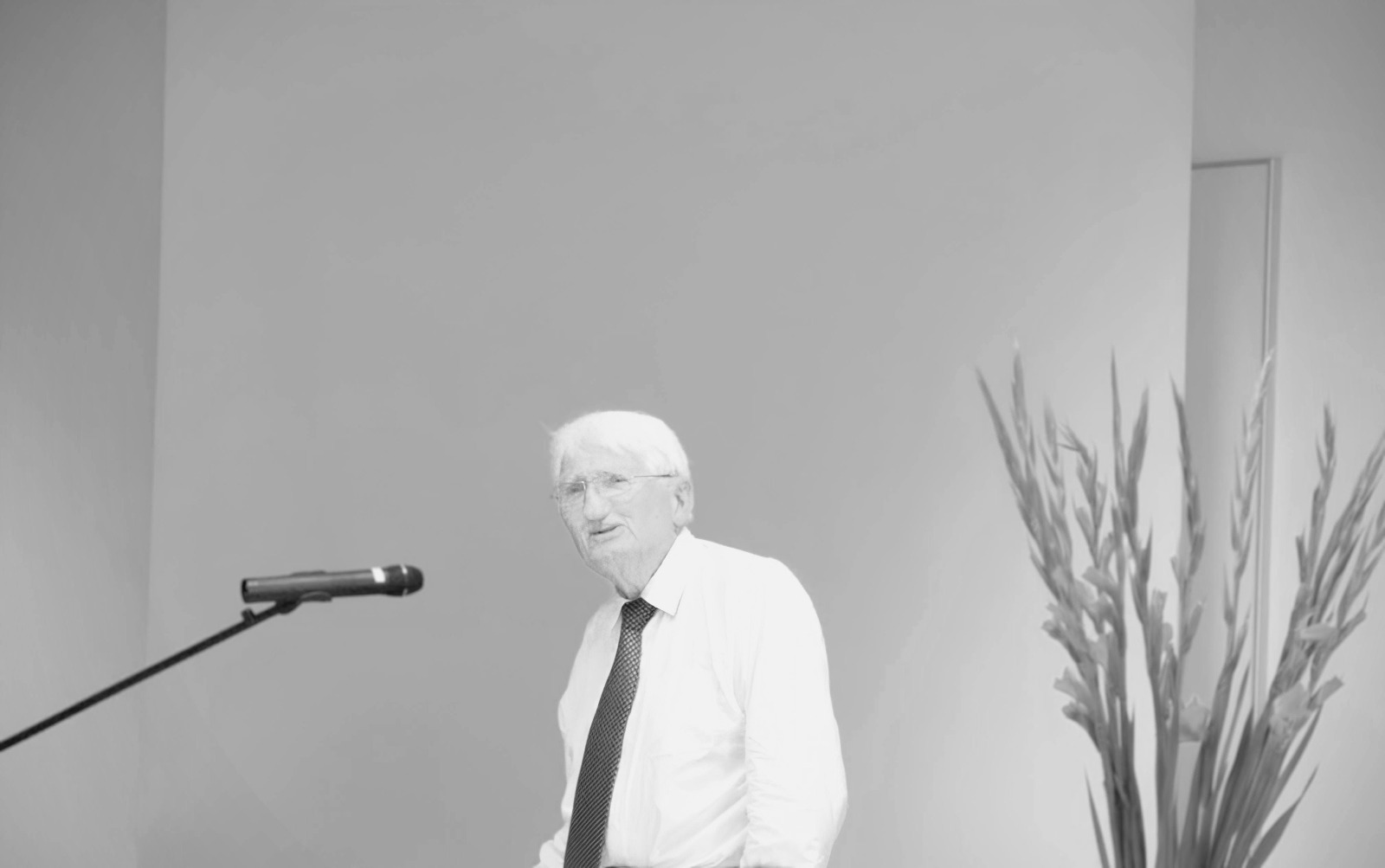
In 1952, at the age of twenty-three, Jürgen Habermas made his entry onto the public stage of the young German Republic by publishing two critiques in the FAZ — the German equivalent, even then, of the New York Times. The first was on a radio play by the poet Gottfried Benn; the second, a year later, on Heidegger’s recently published 1935 lecture course, Introduction to Metaphysics. In both cases, the young Habermas had in his sights the privilege accorded to immediate experience — whether the experience of orgasmic pleasure in Benn’s case, or a mysterious intimate rapport with “Being” in Heidegger’s. Also in his sights were two intellectuals, one a poet and the other a philosopher, who had offered themselves as zealous servants of the Nazi regime and were for a time accepted by it — before the regime confined them to their occupations as insignificant “thinkers,” which allowed them, after the war, to appear relatively clean. Habermas, in his text on Heidegger, advances the hypothesis, however, that it was only the mediocrity of the Nazi leaders that “saved” these intellectuals — who had delivered enthusiastic speeches on the greatness of Nazism (Heidegger), or on the absolute necessity for German poetry to serve it (Benn) — from becoming the organic intellectuals of Nazi Germany.
Despite his compromise with Nazism, Benn had received the most prestigious poetry prize in the FRG, the Büchner Prize, in 1951. And Heidegger had published, in 1953, a lecture course on metaphysics delivered in 1935, in which he proclaimed “the greatness and inner truth of the National Socialist movement” — apparently without troubling anyone but Habermas. And this is the third target of Habermas: a Federal Republic that never ceases to speak of denazification while, in practice, perpetuating a personal and intellectual continuity with Nazism.
The young Habermas was powerless in the face of the continuity of personnel. One would have to wait until 1968 — the student protests against a professorial body deeply compromised with Nazism, and the slap that Beata Klarsfeld delivered that same year to Chancellor Kiesinger, a member of the Nazi party since 1933 — for that question to begin to be raised. But from the very onset of adulthood, Habermas felt it his duty to oppose the intellectual continuity of German thought with Nazism.
“[This text] serves but a single question: can the planned and methodical murder of millions of human beings, which we all know today to have taken place, be rendered comprehensible as a fatal aberration within the history of Being? Is it not rather the actual crime of those who committed it in full possession of their faculties — and the guilty conscience of an entire people? Have we not had eight years since then to take the risk of confronting what was, what we were? Is it not our eminent task to shed light on the acts of the past committed in full responsibility and to keep their memory alive?”
This is not merely a prosecution of all Heideggerian philosophy and its mystical pathos, where thought is said to be genuine when it exposes itself to the danger of “Being”, that is, when it works from a layer of experience where logic – whether conceptual, rational, bourgeois, or technico-instrumental – does not yet cover over what is lived. It is, more broadly, an attack on a Germany that believes it can absolve itself of responsibility for a crime it committed methodically and deliberately. A Germany that tries to justify itself, to think no more of it, by claiming that “it happened” — as though the Holocaust were something that had come about, in a destinal manner, unbeknownst to the intentions of those who carried it out.
Habermas does not object to Heidegger that this pre-logical layer of experience demanding our attention (Being) does not exist, nor that it would have nothing to teach us, in return, about the civilization we have built by obstructing it. But he notes that abandonment to this layer is a choice, a decision one makes. Nobody is summoned by Being; those who surrender to it are not responding to a noble call that only the strongest can sustain. To abandon oneself to the “danger” of the irrational is to take the decision to say “yes to everything that is strange, obscure, uncertain,” in order to be able to claim a “heroic existence opposed to the insipid dissolution of an average life.”
What is this heroic life of which Heidegger and his disciples and followers dream — in 1935 as in 1953? A life of “violence,” led by men who are “creators who sustain and overcome Being, realizing in their speech what has not been said, in their gaze what has not been seen, in their deeds what has not been done.” The man who resolves upon this life of heroic creation separates himself radically from “those small, cowardly minds who aim at cooperation, compromise, and a world where people look out for one another, and who experience every form of violence as nothing but a disruption of their lives.” In this desire for violent and heroic life, there manifests, according to Habermas, “boundless self-assurance in a personal and national mission,” which, in a game whose outcome is known in advance, sets “the powerful elect against the bourgeois, the thought of origin against common sense, and the exceptional man’s courage to face death against the ordinariness of a life free of danger.”
Habermas had no attraction to these men who believe themselves heroic because they prefer hell to nothingness.
The young Habermas of that time admired Heidegger. Philosophically, he regarded him as the equal of Hegel. Yet if he attacked him so sharply, it was because, as he puts it by way of an aphorism of his master Adorno, “style is uprightness as it is lived.” And Heidegger’s style betrayed an attitude toward the present and the past constitutively wanting in responsibility — that “bourgeois” virtue par excellence. The cause of this yawning gap, constitutive of the Heideggerian edifice, is the heroic posture upon which his thought is founded: his contempt for ordinary life. It was this posture that impelled him to offer his services to an “extraordinary” political regime — extraordinary in the sense that it had devoted itself, from 1933 on, to the violent destruction of the dull, a-heroic bourgeois comfort that Heidegger despised all the more because it went hand in hand with a cult of reason (Aufklärung), classical culture (Bildung), and technical rationality. But whoever categorically rejects the exchange of rational arguments (Aufklärung), knowledge (Bildung), and material reality (technique) as the authority capable of grounding thought and action, harbors an attitude toward life from which the word “responsibility” is absent. He can say anything, claim anything, do anything without restraint, for only his unmediated relation — unmediated by rationality, knowledge, or technique — to Being (or to life) authorizes and legitimates everything he says, claims to be true, or does.
From the very beginning of his adult life, Habermas contested this kind of recourse to the immediacy of experience, this kind of claim to an incommensurable truth that Benn, too, had placed at the center of an authentic existence. He had no attraction to these men who believed themselves heroic because they preferred hell to nothingness. And if he chose what these men repudiated — the ordinary, the bourgeois routine, compromise, common sense, cooperation, and a world in which care for the other constitutes the supreme commandment — if he chose to construct a philosophy without any pathos, concentrated on what is possible from the banality of daily life, this was not from any personal predilection for boredom. If he refused the heroic posture of the profound philosopher, it was out of historical responsibility in the face of the “planned and methodical murder of millions of human beings.” The analysis of the Public Sphere and its potential for the ongoing democratization of modern societies, the Theory of Communicative Action that reconstructs the exchange of reasons in daily verbal interaction as the foundation of democratic social life, the project of a Europe whose integration rests on procedures — these are theoretical undertakings aimed at sustaining the construction of a Europe endowed with institutions and knowledge of its own potential for rationality, a Europe in which the Holocaust could not be repeated. But above all, these are theoretical undertakings that express an uprightness. The uprightness indispensable to each and every one of us if the crime is not to recur — the uprightness of the thinker, but also of the ordinary citizen — an uprightness that legitimates itself neither through intimate experience, nor through the pathos of the great man, nor through the immediacy of affect, but solely through the famous “force of the better argument” in discussion between persons who, if they do not already share the same uprightness, at least aspire to it. It is this ideal that his detractors so often mocked, precisely because the style that goes with it — and this right down to his manner of dress — lacks the sex-appeal emanating from the “profound,” the “originary,” or the “obscure” that philosophy is supposed to embody.
For Habermas, post-Holocaust Europe, and its philosophy with it, had lost the right to dream of itself as heroic and to escape boredom in any way other than finding something to excite it in ordinary life.
Habermas wanted to be an anti-hero. His philosophy restores the dignity of ordinary life; his philosophical writing demands the most exacting conceptual attention without ever affording the reader any pleasures but intellectual ones; his work does not aim to excite; his posture does not seek to seduce. Given the enormity of the crime, remaining prosaic seemed to him the bare minimum that could be expected of philosophy. The prosaic man does not evade his responsibilities. He does not absolve himself of his acts by pleading temporary insanity, by invoking the destiny that called him, or by citing some impenetrable group pressure that dragged him down in its fall. The prosaic man applies himself to the task of the day, in the hard daily labor that was, for Habermas, the routine of his life as a researcher — without projecting himself into grand dreams of revolution or radical overturning, contenting himself with the pleasure of having elucidated a question, or even of having found one. For Habermas, an inability to tolerate the prosaic amounts to a “regression into primitivism” — to that attitude which believes it can shed the level of thought, reflexivity, mediations, and complexity attained by modern societies, resorting instead to simplistic formulas for mastering reality. Such formulas always operate through the designation of an enemy supposedly responsible for all the suffering caused by the cessation of the simple and immediate relationship to life — a cessation to which, however, life in modern societies inexorably compels us. Rationality and technique embodied this enemy for the Heidegger of 1935; the Jews, “inventors” of this technical rationality obstructing access to life, embodied it for Nazism — and, truth be told, for Heidegger too — though these ideas he committed only to his “Black Notebooks,” which Habermas could not have known in 1953.
Habermas refused the primitive. His work is a call to reflexivity and demands that one take on the complexity of the world. It is therefore consistent that he polemicized against every attempt, in philosophy, to reintroduce the obscure and the irrational, vitalism and authentic lived experience, as the legitimation of philosophical discourse. French philosophy of the 1970s bore the brunt of his fury against the new irrationalism he saw seducing the young. Already in 1953, concern for the young was one of the reasons he took up his pen. In attacking Heidegger, he was also concerned with the effect that his writings might have on the formation of the will of students whose youth made them easily excited and enthused. What he would later hold against the French philosophers was their preference for the satisfaction of being acclaimed by a youth in search of profundity over the hard work of European thought on itself. In this ease, he perceived a betrayal of the six million European Jews who had been murdered. French philosophy, by resorting to the figures of thought of the immediate, of life, of “Being” itself, lacked uprightness in his eyes. Not that he would claim that everything it produced was false and without moment — what exceeded his patience was the unbearable lightness of its style, which erected the absence of clarity and univocity as the hallmark of a philosophical discourse that, heroically, seeks itself in authentic fashion. For Habermas, post-Holocaust Europe, and its philosophy with it, had lost the right to dream of itself as heroic and to escape boredom in any way other than finding something to excite it in ordinary life. When, in 1968, he — the young Marxist thinker adulated by students in ferment — accused the radical factions of being “left-wing fascists,” it was this fundamental conviction that sustained him. Revolution, too, is a dream to which Europe has forfeited all right. Henceforth, its only possibility of reaching a just world lies in the attentive listening to what the other has to say, in helping that other, when necessary, to transform their experience into an argument that can be debated, and in fighting for the liberal constitutions that sustain and promote this practice of justice.
Jürgen Habermas was a dike, a breakwater in the sea of affects and political attitudes that feed on the promise of the heroic act, the virile decision, or the elimination of the adversary.
Habermas was acutely aware that the work of his life was being increasingly contradicted by reality. Thus, in interviews conducted in 2024, he admits to contemplating the present with “growing despair,” for “everything that mattered in [my] life is being destroyed, step by step.” This destruction unfolds as “the unleashing of barbaric violence everywhere in the world,” “erosion of social integration,” “disintegration of liberal political cultures,” “decomposition of the party system and of the institutions of the rule of law,” “destruction of the political public sphere,” “deterioration of political culture,” and finally the “constant growth of an enigmatic anomic potential at the very center of our societies.” The war in Ukraine, October 7 accompanied by the return, in Europe, of an uninhibited antisemitic discourse, and finally the tipping of the world’s oldest democracy — the United States, which he had believed definitively protected by its pragmatism from the call of the sirens of the irrational — into the jouissive authoritarianism of Donald Trump: these things explain this pessimism. Axel Honneth, in the tribute to his master published last Sunday, reports that “he no longer wanted to go on, no longer wanted to look on passively at the destruction of his hopes for a democratic Europe and a world at peace.” Back in 2024, Habermas had added, to the enumeration of all the calamities of the age:
“I am too old now for the gloomy image of an eternal cycle of cultures or powers rising and falling to be able to take the place of my fundamental intuition — namely, that the history of humanity is made of learning processes and their cumulative inscription in history. In other words, this intuition of a progression of Reason in history which, while constantly arrested and even reversed by regressions, nonetheless remains a progression.”
In another aphorism that Habermas certainly knew by heart, Adorno said: “He who dies in despair has lived his whole life in vain.” Jürgen Habermas was not in despair at the regression toward primitivism of a world he helped to build as no other philosopher of his generation did. His last public intervention — which he generously gave to K. for publication in English — bore the title “From Here On, We Must Go It Alone.” What was a call to Europe to remind it of the integrative power of its identity — an identity ineluctably post-Holocaust, and therefore a renunciation of heroism and dreams of political greatness in favor of rights, procedures, and social justice — resonates differently today. With Habermas gone, we must indeed continue alone, without that immense intellectual whose uprightness led him, again and again, to intervene in public debate whenever he perceived that, once more, people were on the verge of succumbing to the immediate, to the comfort of destiny, or to dreams of radicalism. Nobody was as unrelenting in his demand that we measure up to the historical responsibilities of Europe; nobody was as inflexible when Europe or its intellectuals relaxed that demand and dreamed of decisive action; nobody protested with greater verve when Europe wished to lull itself into forgetfulness.
Jürgen Habermas was a dike, a breakwater in the sea of affects and political attitudes that feed on the promise of the heroic act, the virile decision, or the elimination of the adversary. He held firm — through his immense philosophical work but also through his public voice. Part of that dike has just given way. The work, to be sure, will remain and will continue to lend support to the progression of Reason; but his voice has fallen silent, and with it that rock to which one could turn in times of crisis, in the hope that a word might spring from it capable of cutting against the spirit of the age and forcing it to perceive itself as the continuation of a history that began in 1945. Faced with the swelling surge that grows ever more threatening, the question he addresses to us from his small text of 1953 becomes burning: what is left standing in our contemporary societies — that uprightness founded on awareness of the crime committed and demanding a renunciation, one apparently growing ever more intolerable for many, of heroic exaltation and the admiration of force?
Julia Christ
Julia Christ is a philosopher and research fellow at the CNRS. A specialist in critical theory, she works on the transformations of universalism and liberalism in dialogue with European Jewish history. Part of her research focuses on the place of Jews in modern political constructions, antisemitism, and the ways in which the Jewish perspective challenges classical categories of political thought.