Pasolini’s Jews
A thwarted identification
How can we understand Pasolini's position during the Six-Day War, which was both radically opposed to the anti-Zionism of the Italian communist left and deeply ambivalent in its relationship to Zionism? Tristan Koskas revisits the political context in which Pasolini expressed himself and analyzes the special place occupied by Jews and Israel in Pasolini's aesthetic, where identification with the figure of the eternally oppressed leads to a disappointed view of the Zionist project.
Part One: Pasolini’s pro-Israeli stance during the Six-Day War
This text by Pasolini appeared in the April-June 1967 issue of the magazine Nuovi Argomenti, shortly after the Six-Day War.1 To fully understand Pasolini’s position, it is necessary to place it not only in the context of the Six-Day War, which saw Israel oppose Egypt, Jordan, and Syria in June 1967, but above all in the context of its reception in Italy, particularly among left-wing intellectual circles.
The Italian reception of the Six-Day War
Let us briefly recall the key elements of the conflict. The Six-Day War was the culmination of rising tensions in the Middle East, particularly from May 1967 onwards, leading to an international political crisis.2
While Israel sent ambiguous signals, the Arab side, particularly Nasser’s Egypt, engaged in hateful verbal escalation, calling more and more openly for the destruction of the young state, all against the backdrop of the Cold War. While the United States, then bogged down in Vietnam, feared the outbreak of a new conflict, the USSR, on the contrary, sought to advance its interests in the Middle East and encouraged a strategy of escalating tensions. As Nasser stepped up his provocations on the ground, Israel seemed to hesitate, which galvanized the hopes of the Arab populations: the Arab countries all aligned themselves with Cairo, where huge crowds gathered in support of the war, while Egyptian leaders made increasingly inflammatory statements.3 Feeling abandoned by the Western powers4 and with its back against the wall in the face of Arab threats, Israel decided to take its adversaries by surprise, first striking the Egyptian air force on June 5, then continuing a lightning offensive until June 10. While Israel seized East Jerusalem, Gaza, the West Bank, the Golan Heights, and the Sinai, the Arab world emerged from the war deeply humiliated and weakened.
The Six-Day War also had a profound impact on Western public opinion. Before it broke out, fears of Israel’s annihilation sparked a wave of emotion and considerable sympathy for the Jewish state. In Italy, for example, a rally in support of Israel on May 28 drew a large crowd in Rome.5
The crisis in the Middle East also caused upheaval in Italian political life.6 Public opinion was largely favorable to Israel, but this was not the official line of the Italian government, which, under the leadership of Foreign Minister Fanfani, sought to maintain good relations with Arab countries and advocated a policy of “equidistance”, which meant refusing to take sides.
The crisis also divided left-wing parties and intellectuals.7 While the moderate left, and especially the socialists, adopted a pro-Israeli stance, the Italian Communist Party (PCI), aligned with the USSR, stood out for its clear support for the Arab position and its harsh criticism of Israeli policy. The communist press, notably l’Unità, the official organ of the PCI founded in 1924 by Antonio Gramsci, waged a fierce campaign against the Jewish state: while affirming their support for its right to exist, they portrayed Israel as the outpost of imperialist maneuvers in the region that they believed had led to the conflict, and did not hesitate to compare Israel’s behavior to that of the Nazis, while accusing the Israelis of exploiting the Holocaust and ignoring the virulence of Arab threats. On June 8, 1967, with the conflict in full swing, journalist Antonello Trombadori, to whom Pasolini responds directly in his text, published an article in l‘Unità entitled “From Anne Frank to Moshe Dayan8,” in which he emphasized that Israelis should no longer be considered a persecuted people, nor the socialist homeland of the kibbutzim, but rather a theocratic and racist state that exploits its past to discriminate against its Arab minority.9 From this point of view, the Six-Day War did not represent a real anti-Israeli turning point for the communists, as has sometimes been understood: this type of criticism of Israel can be found in the years following the first Arab-Israeli war of 1948.10
Pasolini against the Italian Marxists
It was in this context that Pasolini published his text “Israel” in Nuovi Argomenti, a literary magazine founded in 1953 by Alberto Carocci and Alberto Moravia, which Pasolini had co-edited since 1966. In it, he affirms his firm and unambiguous support for the existence and legitimacy of Israel, strongly attacks the positions taken by the communists, and virulently criticizes Nasser’s “senseless” policy and the “fanatical nationalism” of the Arab world.
Pasolini was, according to historian Alessandra Tarquini, the only prominent Italian Marxist intellectual to take an explicitly pro-Israeli stance at the time of the Six-Day War.
This position, and the text itself, are surprising in more ways than one. First, because Pasolini is of course a left-wing intellectual, viscerally attached to Marxism and a lifelong supporter of the Italian Communist Party, even though his relationship with the communists has always been difficult.11 While the PCI dominated Italian intellectual life12 at the time, Pasolini was, according to historian Alessandra Tarquini, the only prominent Italian Marxist intellectual to take an explicitly pro-Israeli stance at the time of the Six-Day War.13 His criticism of the communists’ position was particularly virulent: he accused them of waging a mendacious campaign against Israel, worthy of the worst bourgeois newspaper. The PCI’s position was not without controversy within the party, particularly among its many members of Jewish origin. The most prominent of these, Umberto Terracini, one of the main founders of the PCI in 1920 alongside Antonio Gramsci, who like him was imprisoned under fascism, criticized l’Unità in an open letter in 1969 for deviating from the party’s historical position by de facto denying Israel’s legitimacy as a Jewish state.
Pasolini’s criticism of the Arab populations may also come as a surprise. The text begins with a kind of preliminary warning, which displays a visceral love for the Arab peoples (“I swear on the Koran that I love the Arabs almost as much as my mother”), and identifies them with the “sub-proletariat” and the Third World, which have a prominent place in Pasolini’s aesthetic. However, he does not hesitate to fiercely criticize their hatred of Israel, which prevents them from pursuing a coherent policy towards their neighbor. This criticism of Arab countries’ policies is not unique to Pasolini: it is also found among moderate left-wing intellectuals.
The Shoah at the heart of Pasolini’s work
It is also important to note the significance of the Shoah in the 1967 text, which refers to it several times, quoting Hitler and evoking concentration camps and the notion of “genocide.” According to Pasolini, Israel’s existence is made necessary by the hatred that Jews have suffered in Europe, which cannot be guaranteed not to return.
The reference to the Shoah is far from anecdotal in Pasolini’s work; on the contrary, it is constantly present, and it could be argued that it is at the heart of his aesthetic, both poetic as well as theatrical and cinematographic, but also of his intellectual work. As Robert S. Gordon, a specialist in the reception of the Shoah in Italy14, has pointed out, Pasolini is undoubtedly the Italian intellectual who embraced with the greatest metaphysical and artistic intensity the new role that the Shoah and the Jews began to play in European consciousness from the 1960s onwards, following the turning point of the Eichmann trial in 1961.
Israel’s existence is made necessary by the hatred that Jews have suffered in Europe, which cannot be guaranteed not to return.
The issue appears in Pasolini’s work as early as 1962, in a poem entitled “Monologue on the Jews,” written in response to neo-fascist and antisemitic provocations that took place in June 1962 in Rome, in and around the former ghetto, in the very streets where a large roundup of more than a thousand Jews had taken place in October 1943, who were then deported to Auschwitz.15 The poem evokes the resistance of the Jews at the time of the events of 1962, while meditating on photographs of Buchenwald survivors and the importance of the Shoah in Pasolini’s “worldview”:
“I don’t think, no,
of Buchenwald: although…
the idea of such a foul death
is at the heart of my worldview: the wounds on their cheeks,
their hair attached to their living skulls,
their sickly, limp legs entwined
with repulsive confidence with other
sickly legs wrapped in rags: their sides
exhibited with ridiculous endurance
in the light of an old Chaplin tragedy.”16
References to the Shoah and the image of the camp remained very present in Pasolini’s aesthetic, and even became more pronounced over time—think of Porcherie in 1969, centered on two German industrialists who made their fortune by exploiting extermination camps, or Salò, or the 120 Days of Sodom in 1975, a sort of allegory of the camp. Above all, the notions of “genocide” and “extermination camp” gradually became detached from their Jewish connotations to refer, in an almost obsessive manner in the last years of his life, to what he perceived as cultural annihilation linked to technological progress, the advent of consumer society, and the capitalist bourgeoisie. Thus, he wrote in his Écrits corsaires that “consumption is, in its effects, only a new form of totalitarianism—in that it is completely totalizing and alienating to the extreme limit of anthropological degradation, of genocide (Marx). Its permissiveness is therefore false: it is the mask of the worst repression that any power has ever exercised over the masses.”17 Remarks of this kind can be found throughout his theoretical writings of the 1970s, i.e., the end of his life—remember that Pasolini was assassinated in November 1975, at the age of 53.
But let us return to the 1967 text: if it is the Shoah that ultimately legitimizes Israel’s existence, what does this mean for Pasolini’s view of Zionism? It is on this point that we find one of the most surprising passages in the text, which asserts that, just as it is necessary to “distinguish the Arab populations from the irresponsibility of their fanatical nationalism,” it is also necessary to “distinguish the Israeli nation from the stupidity of Zionism.” Why should a nation be distinguished from the national emancipation movement that gave birth to it? And why would this national movement be “stupid”? To understand this, we need to look in more detail at the relationship that Pasolini’s work had not only with Jews but also with Israel and Zionism, on which he never ceased to express himself, in a more or less ambiguous way.
Part Two: Pasolini’s Criticism of Zionism
From the Trip to Israel to Poetry in the Shape of a Rose
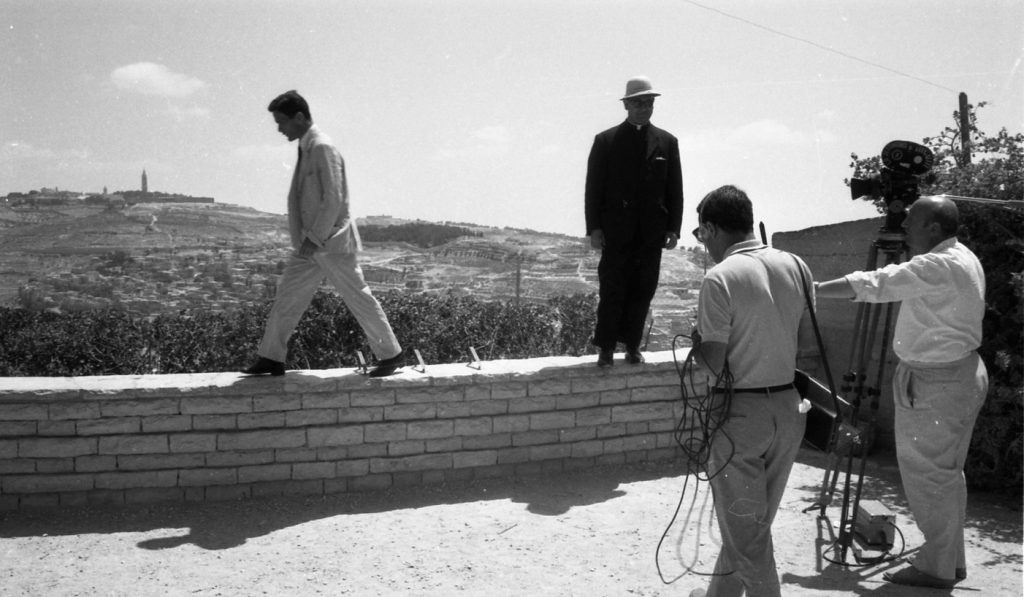
Pasolini’s stance in 1967 must be placed in the context of his own experience of Israel, which he visited from June 27 to July 11, 1963 (a few months after the publication of his “Monologue on the Jews”), with the intention of shooting his film The Gospel According to St. Matthew there. The idea had been maturing for nearly a year: in October 1962, he was invited to Assisi by Pro Civitate Christiana, a rather liberal Christian association that sought to promote Catholic culture in contemporary Italy. Pasolini reread the Gospels on this occasion and had a kind of aesthetic and spiritual revelation, which led him to conceive his project to adapt St. Matthew’s account of the life of Jesus for the screen.18 He was supported by Pro Civitate Christiana, which financed the expedition to Israel, from which he made a documentary film, Location Scouting in Palestine (Sopraluoghi in Palestina, released in 1965), the first in a series of documentary films recounting various journeys (notably to Africa and Yemen), and in which he expressed his interest in the Third World.19 Under the guidance of Father Don Andrea Carraro, who served as his travel guide, Pasolini followed roughly the itinerary of Jesus’ life: he passed by the Sea of Galilee, the Jordan River, then Nazareth, the Dead Sea, and the Judean Desert, before arriving in Jerusalem and concluding his journey in Bethlehem. He also visited a Druze village and the Baram kibbutz, where he interviewed an Italian family who had settled there, the Luzzatis.
But the trip disappointed Pasolini’s expectations, both aesthetically and culturally. He found Israel too modern, too industrialized, too capitalist. Worse still, he could not find any potential extras for his film, even though he was accustomed to casting amateur actors he met on location. He explains this very clearly in a voice-over in his Location Scouting in Palestine, telling his audience about the impossibility of making his film in Israel: “As you can see, the problem of extras would really be an unsolvable problem, because, as I repeat, Jews would be unusable. And as you can see, the faces of Arabs are faces where the preaching of Christ has absolutely not taken hold. They are pre-Christian, pagan, indifferent, joyful, animalistic faces.”20 So he decided not to shoot his film in Israel, but in the countryside of southern Italy.21
This trip was also an opportunity for Pasolini to produce a large number of poems, some of which he selected for the “Israel” section of his collection Poetry in the Shape of a Rose, published in 1964. These poems constitute a kind of travel journal: he describes his impressions of Israel, its landscapes and its people, and offers a subtle meditation on the fate of the Jews, between Europe and the young Hebrew state. However, these poems are closely linked to the complex editorial device set up in his 1967 statement—a device to which we must return.
The trip disappointed Pasolini’s expectations, both aesthetically and culturally. He found Israel too modern, too industrialized, too capitalist.
Indeed, the 1967 text was not published alone in the journal Nuovi Argomenti. It was preceded by five poems written during his trip to Israel, but ultimately excluded from the collection for reasons that he described in 1967 as “purely literary.” But on closer inspection, almost all of the poems published alongside the 1967 text have in common that they express fairly harsh views on Israel and Zionism, whose contradictions he seeks to highlight. The publication of these poems was intended to highlight Pasolini’s change of perspective during the Six-Day War, but perhaps also to soften his pro-Israeli stance, as indicated by the warning that follows the poems and precedes his text: “Why am I publishing these verses excluded from the ‘Israel’ section in Poetry in the Shape of a Rose (1964)? I am publishing them so that no one can say that I am now easily justified in thinking a certain way.” It is worth dwelling on these poems to understand what led Pasolini to describe Zionism as “stupid.”22
Criticism of Zionism in Pasolini’s Israeli poems
The criticism of Zionism in the Israeli poems published in 1967 brings together a number of themes that are fairly consistent when viewed in relation to the characteristics of Pasolini’s thinking and work, as well as the specificities of the history of Italian Jews. The first theme concerns fundamental questions of Zionism, on which the Zionists themselves were divided: the place of religion and Israel as the Promised Land. In the poem “I know that old Ben Gurion…”, Pasolini gives voice to “the wounded,” who “are not intimidated by the wounded” (no doubt the Arabs who became victims of the Israelis, themselves formerly oppressed). The poem ends with these words:
“Wasn’t this land the Promised Land
when it was at the center of the world?
Now it is on the margins: and you believe
that it is still the same, chosen by God
for you?
How can you, more secular than any secular person,
found the most secular of states
on a promise from God?
But I am in your absurd homeland
as one of your fellow citizens.“23
Particularly interesting here is this identification of Jews with a certain form of secularism, which is challenged by the seemingly contradictory consideration of the notion of the ” promised land” by God. Thus, while Zionism is often interpreted as a modern political movement of secularization of Jewish populations and revolt against tradition, led mainly by secularists—despite the presence of a minority of religious Zionists—Pasolini seems to point to the indelible religious element that led the Jews to establish their state in their ancestral land.
From this point of view, Pasolini’s thinking is undoubtedly indebted to the particular history of Italian Jews, who are certainly the most assimilated and integrated Jewish population in all of Europe. Italian Jews have long considered themselves to be in an exceptional situation in Europe, particularly because of their very active participation in the Italian independence movement in the second half of the 19th century. Unlike French Jews, for example, they were not integrated into a pre-existing state, but participated in its creation on an equal footing with the rest of the Italian people.24 At the turn of the 20th century, there was no antisemitic movement on the scale of those found in France, for example, and no event comparable to the Dreyfus affair.25 Jews therefore felt more protected in Italy than elsewhere, until the late antisemitic turn of the fascist regime with the racial laws of 1938.26 For a long time, Zionism appeared to many Italian Jews as an interesting but unnecessary project27, so much so that it remained relatively marginal.
Pasolini accepts only the negative side of Zionism (the need for refuge from European antisemitism) and not its positive side, the construction of a modern political and national project.
Pasolini also moved in intellectual circles that included a significant number of perfectly assimilated secular Jewish writers, such as Natalia Ginzburg, Elsa Morante, Carlo Levi (whom Pasolini mentions in his 1967 text), Alberto Moravia, and Giorgio Bassani, all of whom were close to Pasolini.28 In other words, whether he was aware of it or not, Pasolini was proposing a very reductive, somewhat Italian-centered conception of Jews, reducing them to certain traits (secularization, intellectualism, etc.). This also leads him to propose a largely biased view of Zionism, which he interprets as a return to a traditional religious vision. In other words, Pasolini accepts only the negative side of Zionism (the need for refuge from European antisemitism) and not its positive side, the construction of a modern political and national project.
Another element of his criticism is more directly linked to his vision of modernity. Pasolini reproaches Jews, in a way, for becoming capitalist bourgeois, working towards the industrialization of their country. In the same poem, Pasolini refers in particular to the “return to the land,” in the sense of agricultural work, by Jews, which we know to be one of the essential aspects of Zionism:
I saw, with the white hands of an intellectual,
a Jew using a farmer’s tools.
What is the point of this experience
now that the agricultural world itself is dying,
moving from prehistory to history (…)
– to make way for a New Prehistory?29
A defender of a peasant world that he sees, in Italy and in Third World countries, on the verge of disappearing, subjected to forced and destructive modernization and industrialization that he also describes elsewhere as “new prehistory,”30 Pasolini is cautious about the Israeli agricultural experiment. In his last collection of poems, Transhumanize and Organize, published in 1971, he again associates it with industrial agriculture:
Have there ever been Jewish peasants? Do any of you know any? Do you know any?
I know a few (who work in Israel, a
completely industrialized, ultra-modern territory).31
But Pasolini’s particular disappointment with this situation on the part of the Jews is that they have reproduced in Israel the world they wanted to leave behind, the world that had oppressed them. Thus, in “I know that old Ben Gurion… “:
”(…) Tell me, you, inwardly
wounded by a glorious, millennial shyness…
why did you escape from the world
to rebuild it according to the old loves
that intimidated you so much?”32
In other words, the Jews left their marginalized status to become normal—normal, including in the sense of producers of norms, as they were now the majority in their new territory. This problem of a formerly minority people becoming the majority, which is one of the driving forces behind Zionism, is frequently found in Pasolini’s writing.
We see it, for example, in another of the poems excluded from the initial collection, “Past the first glance…,” which evokes Tel Aviv, a city that becomes almost an allegory of the Jews themselves:
Once the first glance is over, Tel Aviv
is nothing more than a city with its own life.
With the life of a majority.
With its destiny that may not interest,
that may not move. Life
that goes on, on, always
The life of others, as everywhere in the world.
A closed city, lost in itself,
aloof, without that tenderness,
that need for help, that need
to free oneself,
to give the gift of one’s own history.33
This question of a suffering minority that has become an active majority brings us to the heart of the problem that torments Pasolini.34 He explains this even more explicitly in his long interviews with Jon Halliday, conducted in 1968 and published in 1969. When Halliday mentions his 1967 text at the time of the Six-Day War and the accompanying poems, and asks him what he thinks of Israeli society, Pasolini replies:
I did not include the poems I published in Nuovi Argomenti in Poetry in the Shape of a Rose, where the section ‘Israel’ gives an idea of the impression Israeli society made on me. It was a contradictory impression, in the sense that I fundamentally disapprove of it insofar as this society is based on an essentially racist, messianic, and religious idea: the idea of a Promised Land based on religious foundations dating back three millennia is completely delusional. I do not accept the premise, which is nationalistic and religious. It is horrible, even if all states are based on these principles. However, on this premise, a nation has been built that inspires great sympathy. The kibbutzim, for example, while deeply sad and reminiscent of concentration camps, which implies a tendency among Jews toward masochism and self-exclusion, are at the same time a very noble enterprise, one of the most democratic and socially advanced experiments I have ever seen. Moreover, I have always loved Jews because they have been excluded, because they have been the object of racial hatred, because they have been forced to be separated from the rest of society. But once they founded their own state, they are no longer different from others, they are no longer a minority, they are no longer excluded. They became the majority, they became the norm. And that disappointed me a little, I don’t know exactly how to explain it. They, who had always been the champions of difference, of the struggle of those considered “other” against the “normal,” had now become the representatives of the majority and the norm. That was something I found a little hard to digest.”35
While this response echoes several themes already encountered in her poems, it adds others, notably on the “racism” and “nationalism” of Israeli society—criticisms that are frequently found on the Marxist left. Above all, this response allows us to better understand the contradiction that was perceived in his 1967 text: Pasolini understands in the abstract the need for Jews to have a national home to serve as a refuge (as evidenced by the 1967 text), but he viscerally rejects it; or rather, in his own words, he has “difficulty digesting it” – and Pasolini, in all his often iconoclastic positions on modern society, May 1968, abortion, and religion, is a much more intuitive than theoretical thinker.36
Pasolini and the Jews, or impossible identification
But what really bothered him about the new status of the Jews, their becoming the majority in Israel, was that he could no longer identify with them.37
From this point of view, the difference between the “Monologue on the Jews” written in 1962 and the Israeli poems of 1963 is striking. What lies between the two is Pasolini’s realization of what the existence of Israel means not only for Jews, but for Europe and Europeans. In 1962, Jews still had the image of sublime martyrs, who could be identified with other marginalized people, and with whom Pasolini himself identified as an individual perpetually in a position of marginality.38 His “Monologue on the Jews” ends with these lines:
“Life may begin
when the angels of resignation
— the poor in spirit, the meek, the wounded,
the unfortunate, the Jews, the Blacks,
the boys, the prisoners, the virgins,
the peasants, the peoples lost
in the candor of barbarism,
all those who live by devoting themselves
to humiliating difference,
commit violence!
Then life will begin!“39
The literary device of enumeration (”the poor in spirit, the meek, the wounded, the unfortunate, the Jews, the Blacks,” etc.) is essential here: it allows Pasolini to place all those he considers oppressed minorities on the same level, erasing everything that separates these different groups, in a kind of alliance of the oppressed that Pasolini dreamed of during his Third Worldist period.40
Pasolini understands in the abstract the need for Jews to have a national home to serve as a refuge (as evidenced by the 1967 text), but he viscerally rejects it; or rather, in his own words, he has “difficulty digesting it”.
In 1963, a few months later, everything changed: with the recognition of Israel’s existence, identification became impossible. One poem in particular, published in the 1964 edition of Poetry in the Shape of a Rose and quoted here in its entirety, depicts this identification that has become impossible—and the resulting feeling of nostalgia:
“Go back, ah, go back to your Europe.
A terrible transfer from me to you
makes me feel your nostalgia
that you do not feel, and gives me a pain
that upsets all connection with reality.
Europe no longer belongs to me! Warsaw,
Prague, Rome are there, torn forever
from my life to pursue a life
of which I was the son and protagonist
and which now gradually escapes me
in the color of Western days
made foreign to my eyes!”41
The situation depicted in the poem is complex: Pasolini’s “I” identifies with the Jews of Israel to experience a feeling that they do not feel, nostalgia for Europe. The uprooting of the Jews from Europe is felt as a pain, not by the Jews themselves, but by Pasolini as a Jew—a feeling that, he says, “upsets all relationship with reality.”
Having become the majority, developed and normal, the Jews of Israel lose, as such, all interest for Pasolini.
This change in the status of the Jews, both geographical and imaginary, has another consequence for Pasolini: it removes them from his poetic language. Having become bourgeois, “normal,” Jews (and particularly those in Israel) find themselves fundamentally in an “unpoetic” situation, incapable (like Tel Aviv in the poem quoted above) of moving him, unassimilable to his aesthetic.42 He explicitly emphasizes this in the poem “A Day in Tel Aviv,” published in the 1964 edition, where he evokes passersby he encounters on the street, and where, by contrast, the haunting image of the extermination camps reappears, which in a way fits better with his poetics:
But they are Jews. Why do they behave
like this, like the sons of Aryan bourgeoisie,
of the big, stupid families of the West?
Why this lack of poetry?
Aren’t they here to be killed?
Don’t they know that? Why these looks
of sons-fathers, before whom their fathers
are nothing but miserable, stinking beasts
in the small courtyards of the extermination camps,
in the freight cars already full of dead bodies?43
This undoubtedly explains the aesthetic impossibility of filming The Gospel According to St. Matthew in Israel. Having become the majority, developed and normal, the Jews of Israel lose, as such, all interest for Pasolini. What is interesting to him, however, even if he cannot fully explain it, is the contradiction that this situation creates in him, the void left by the loss of the figure of the suffering and oppressed Jew, the Jew he loves—and his poems on Israel are, in essence, only about that. And this is undoubtedly one of the reasons for his 1967 stance: in that brief moment of fear of annihilation for the Jewish state, the contradiction was abolished, with the Israeli Jew becoming one with the oppressed European Jew.
The question remains as to what makes the figure of the Jewish outcast or the oppressed Jew in Europe so indispensable to Pasolini – and what, conversely, makes Israel so difficult to “digest.” As demonstrated, among other things, by his entire approach to his trip to Israel and his project for The Gospel, his reading of Judaism is fundamentally Christian. And we can recognize this same Christian perspective in many of his positions, from his glorification of marginalized people to his anti-abortion stance, whether they take the form of Marxism, Third Worldism, or anti-modernism. Could we not therefore see in his attachment to the Jewish outcast, and in his rejection of the modern, sovereign Israeli Jew, a secularized transposition of a well-known Christian theme, analyzed in particular by Léon Poliakov: that of the necessity of the existence of suffering Jews, to prove their error and thus demonstrate the truth of Christianity?
- To read the original text “Israel”, 1967 you can find it here in Italian or in French. ↩︎
- For details on the Six-Day War, see Pierre Hazan, La Guerre des Six Jours. La victoire empoisonnée (The Six-Day War: The Poisoned Victory), Brussels 2001 [1989]. ↩︎
- Nasser, May 29: “If we have succeeded in returning to the status quo before 1956, God will help us return to that before 1948. We are now ready to resolve the entire Palestinian problem.“ Egyptian General Mourthagi: ”Five days will be enough for us to wipe out the small state of Israel. Even without war, it would collapse, because it is incapable of bearing the burden of mobilization.” Ahmed Shukairy, founder and president of the PLO from 1964 to 1967: “It is possible and even likely that the liberation army and Jordanian forces will fire the first shot that will trigger a war in the Middle East. It will be us or Israel. There is no middle ground; nothing will be accepted except liberation. In the event of conflict, there will be virtually no Jewish survivors in Palestine.” All these quotes are taken from Pierre Hazan, La Guerre des Six Jours, op. cit., pp. 29-31. ↩︎
- On June 2, for example, de Gaulle decided on a military embargo aimed at depriving the Israelis of certain weapons systems, thinking that this would ease tensions. The opposite happened. ↩︎
- See Mario Toscano, Ebraismo e antisemitismo in Italia. Dal 1848 alla guerra dei sei giorni, Milan, 2003. ↩︎
- See Stéphane Mourlane, “L’Italie et la Guerre des Six jours : enjeux et débats,” Cahiers de la Méditerranée, 71, 2005, pp. 1-14, [online]. ↩︎
- On the various reactions to the Six-Day War on the left, see Andrea Becherucci, “Vincere la guerra e perdere la pace. Israele e la Guerra dei Sei Giorni in tre riviste della sinistra italiana: ‘Il Ponte’, ‘L’Astrolabio’ e ‘Rinascita’,” in M. Simoni and A. Marzano (eds.), Roma e Gerusalemme. Israele nella vita politica e culturale italiana (1949-2009), Genoa, 2010, pp. 117-137; Claudio Brillanti, “The Italian Communists and Socialists’ Reading of the Six-Day War and Its Consequences,” in Alessandra Tarquini, The European Left and the Jewish Question, 1848-1992. Between Zionism and Antisemitism, Cham, 2021, pp. 243-262. ↩︎
- Israeli Minister of Defense at the time of the Six-Day War. ↩︎
- On the PCI’s position during the Six-Day War, see Claudio Brillanti, “The Italian Communists and Socialists’ Reading of the Six-Day War and Its Consequences,” op. cit., as well as Alessandra Tarquini, La sinistra italiana e gli ebrei. Socialismo, sionismo e antisemitismo dal 1892 al 1992, Bologna, 2019. ↩︎
- Cf. Alessandra Tarquini, La sinistra italiana e gli ebrei, op. cit. ↩︎
- The relationship between Pasolini and the communists was punctuated by tragedies and numerous conflicts: his younger brother Guido, a communist partisan, was assassinated in 1945, at the age of 19, by a rival communist faction; Pasolini, who joined the PCI in 1947, was expelled two years later following a sordid sexual abuse scandal, from which he was ultimately acquitted. In addition, communist critics continued to harshly criticize his literary and cinematographic work. On his loyalty to the PCI, see, for example, his article “Il mio voto al Pci,” published in l’Unità on June 10, 1975 (reprinted in Pier Paolo Pasolini, Saggi sulla politica e sulla società, Walter Siti and Silvia De Laude (eds.), Milan, 1999, pp. 850-852). ↩︎
- On this issue, see, for example, Frédéric Attal, “Les intellectuels italiens,” in M. Leymarie and J.-F. Sirinelli (eds.), L’histoire des intellectuels aujourd’hui, Paris, 2003, pp. 11-28. ↩︎
- Alessandra Tarquini, La sinistra italiana e gli ebrei, op. cit., p. 191. ↩︎
- See his book The Holocaust in Italian Culture, 1944-2010, 2012. ↩︎
- The poem was published in February 1963 in L’Europa lettararia.. ↩︎
- Pier Paolo Pasolini, “Monologo sugli ebrei”, op. cit ↩︎
- P. P. Pasolini, Écrits corsaires, 2009 [1976], Paris, p. 174. ↩︎
- The story of the film’s conception is recounted in detail by Noa Steimatsky, Italian locations: reinhabiting the past in postwar cinema, Minneapolis, 2008, p. 120 ff. On the complex question of Pasolini’s relationship to Christianity, who always claimed to be an atheist while indicating that he had a religious view of the world, see in particular Le Christ selon Pasolini, selected texts, translated and presented by René de Ceccatty, Montrouge, 2018. ↩︎
- On these documentary films and their political content, see Luca Caminati, “Seuls les marxistes aiment le passé”le tiers-mondisme de Pier Paolo Pasolini dans le genre des appuntii,“ Cinémas, 27, 1, 2016, pp. 57-75. ↩︎
- Another passage on this question: ”I couldn’t talk about disappointment, that would be absolutely absurd. From a practical point of view, perhaps that is the case, I am disappointed. I haven’t found anything that I can use for my film. Neither the landscapes nor the characters; the landscapes are four eroded slopes, and the characters are Jews… with extremely modern faces. They immediately have… all of contemporary culture, from Romanticism to the present day, deeply ingrained in them; they are deeply “lacerated” by it and have lost all the characteristics, let’s say, archaic, that I would like to find for my film.” The text spoken by Pasolini in his Location Scouting in Palestine was translated in the journal 1895, no. 95, 2021, pp. 158-169. ↩︎
- Pasolini’s attitude during his visit to Israel is severely judged by Israeli historian Asher Salah: “Pasolini is perhaps the most emblematic example of how the interest of a large part of Italian culture in Israel depends solely on its conformity with a preconceived image of its political situation; in this case, based on a Marxist reading and the relationship with Jewish history interpreted from the teleological perspective of Catholic providentialism.“ (”Lo Stato di Israele nell’immaginario cinematografico italiano,” in M. Simoni and A. Marzano (eds.), Roma e Gerusalemme, op. cit., p. 83). ↩︎
- In addition to the journal Nuovi Argomenti, which is difficult to find in France, they have been republished in Pier Paolo Pasolini, Tutte le poesie, vol. 1, Walter Siti (ed.), Milan, 2003, pp. 1421-1425. ↩︎
- « Questa Terra non fu Terra Promessa
quando era al centro del mondo ?
Ora ne è nei margini: e voi credete
che sia sempre la stessa, scelta da Dio
per voi ?
Come potete voi, laici più di ogni laico,
fondare il più laico degli Stati
su une promessa di Dio?
Ma sono nella vostra assurda patria
come un vostro concittadino.” ↩︎ - This is what Arnaldo Momigliano, echoed by Antonio Gramsci, described as the parallel nationalization of Italian Jews, whose national consciousness, according to him, was formed at the same time as that of the rest of the Italians. On these issues, and the debates they have generated, see, for example, Dan V. Segre, “The Emancipation of Jews in Italy,” in P. Birnbaum and I. Karznelson (eds.), Paths of Emancipation. Jews, States, and Citizenship, Princeton, 1995, pp. 206-237, as well as Mario Toscano, “Italian Jewish Identity from the Risorgimento to Fascism, 1848-1938,” in Joshua D. Zimmerman (ed.), Jews in Italy under Fascist and Nazi Rule, 1922-1945, Cambridge, 2009 [2005], pp. 35-54. ↩︎
- So much so that at the time of the Dreyfus Affair in France, the Minister of the Army (from 1902 to 1903), Giuseppe Ottolenghi, hero of the Italian wars of independence, was Jewish. It was also in Italy that the first Jewish Prime Minister in Europe, Luigi Luzzatti, was found in 1910, 26 years before Léon Blum (and leaving aside the special case of Benjamin Disraeli in the United Kingdom). Cases of antisemitism in Italy (particularly forced conversion) came mainly from the Church: see the first chapters of Marie-Anne Matard-Bonucci’s book, L’Italie fasciste et la persécution des juifs (Fascist Italy and the Persecution of the Jews), Paris, 2007. ↩︎
- See the detailed study by Marie-Anne Matard-Bonucci, L’Italie fasciste et la persécution des juifs, op. cit. It should be noted that Italian Jews participated in the fascist regime in similar proportions to non-Jewish Italians. ↩︎
- On the interest that Zionism, particularly that of Herzl, nevertheless aroused among rabbis and certain prominent Italian Jews at the beginning of the 20th century, see Dan V. Segre, “The Emancipation of Jews in Italy,” op. cit. ↩︎
- The place of Italian Jewish writers in 20th-century Italian literature is the subject of H. Stuart Hughes’ book, Prisoners of Hope: The Silver Age of the Italian Jews, 1924-1974, Cambridge, 1983. ↩︎
- Ho visto, con bianche mani di intellettuale
un ebreo adoperare arnesi d’agricoltore.
Che senso ha fare questa esperienza
Ora che proprio il mondo contadino muore,
da preistoria fatto storia (…)
– per cedere il posto a una Nuova Preistoria ? ↩︎ - On this point, see Luca Caminati, op. cit., p. 60. ↩︎
- Pier Paolo Pasolini, “Il mondo salvato dai ragazzini” (“The World Saved by Children”), in Trasumanar e organizzar, 1971, a poem that is in fact a review of Elsa Morante’s collection also entitled Il mondo salvato dai ragazzini, published in 1968.. ↩︎
- (…) Dite, voi, nell’intimo
feriti da una gloriosa, millenaria timidezza…
perché siete evasi dal mondo,
per ricostruirlo secondo i vecchi amori
che tanto vi hanno intimiditi ? ↩︎ - Esaurito il primo sguardo, Tel Aviv
non è che una città con la sua vita.
Con la vita di una maggioranza.
Col suo destino che può non interessare,
che può non commuovere. La vita
che va avanti, avanti, sempre
degli altri, come in tutto il mondo.
Una città chiusa, perduta in sé, scostante, senza più quella tenerezza,
quel bisogno di aiuto, quel bisogno
di liberarsi struggentemente,
per farne dono, della propria storia. ↩︎ - In “I know that old Ben Gurion…”, we also read the following lines: “How can you, a minority of former victims, bear to be now, in the kibbutzim, in the cities, a majority full of the dignity of being? “ (”Come potete sopportare, minoranza di vittime antiche, di essere ora, nei kibbutz, nelle città, una maggioranza piena della dignità di essere?”). ↩︎
- Pasolini su Pasolini : conversazioni con Jon Halliday, Guanda, 1992. ↩︎
- In these same interviews with Jon Holliday, he said that he had embraced Marxism before reading any theoretical texts, in his youth, during his stay in Friuli: “I was confronted with class struggle. I didn’t hesitate: I immediately took the side of the day laborers. They wore red scarves around their necks, and from that moment on, I embraced the cause of communism, just like that, on the spur of the moment. Then I read Karl Marx and some Marxist philosophers” (pp. 32-33). On Pasolini’s political positions, which often ran counter to those of the progressive left, see his Écrits corsaires. ↩︎
- The question of the figure of the Jew in Pasolini’s work and his identification with them has been studied in detail by Robert S. Gordon, “Pasolini as Jew, between Israel and Europe,” in L. Di Blasi, M. Gragnolati, and C. F. E. Holzhey, The Scandal of Self-Contradiction: Pasolini’s Multistable Subjectivities, Traditions, Geographies, Vienna, 2012, pp. 37–58. ↩︎
- As Luca Caminati summarizes, op. cit., p. 62, “Pasolini was a communist expelled from the Party, a homosexual not affiliated with the gay movement, a Catholic exiled from the Church, and a polemicist opposed to both mainstream thinking and ‘alternative’ currents in Italian culture.” ↩︎
- Pier Paolo Pasolini, “Monologo sugli ebrei”, op. cit. ↩︎
- As Léa Passerone has thoroughly studied, “‘I affirm a heart-rending need for allied minorities’: Pasolini’s thinking and poetics on minorities,” Tracés. Revue de Sciences humaines, 30, 2016, pp. 163-186. ↩︎
- Pier Paolo Pasolini, Poésie en forme de rose, op. cit., p. 337. ↩︎
- On this question, see in particular Giovanna Trento, Pasolini e l’Africa. L’Africa di Pasolini. Panmeridionalismo e rappresentazioni dell’Africa postcoloniale, Milan/Udine, 2010, pp. 90–94. ↩︎
- Pier Paolo Pasolini, Poésie en forme de rose, op. cit., p. 347. ↩︎