Lamed Vovniks
Amidst the advertising signs for Sukkot and bakery windows filled with matzos, live the Lamed Vovniks of Brooklyn. In this personal essay, Susan Daitch immerses us in urban Jewish life in America, with its saturation of symbols and constant bustle, introducing us to a cast of colorful and unexpected characters.
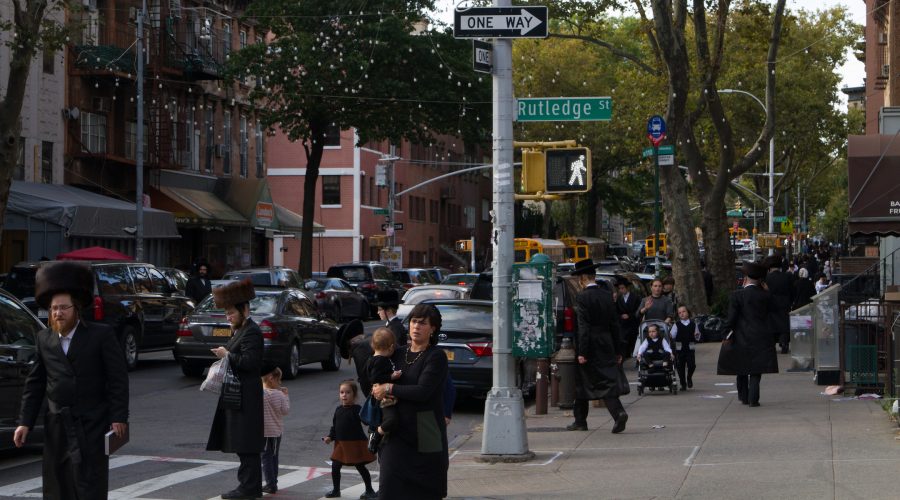
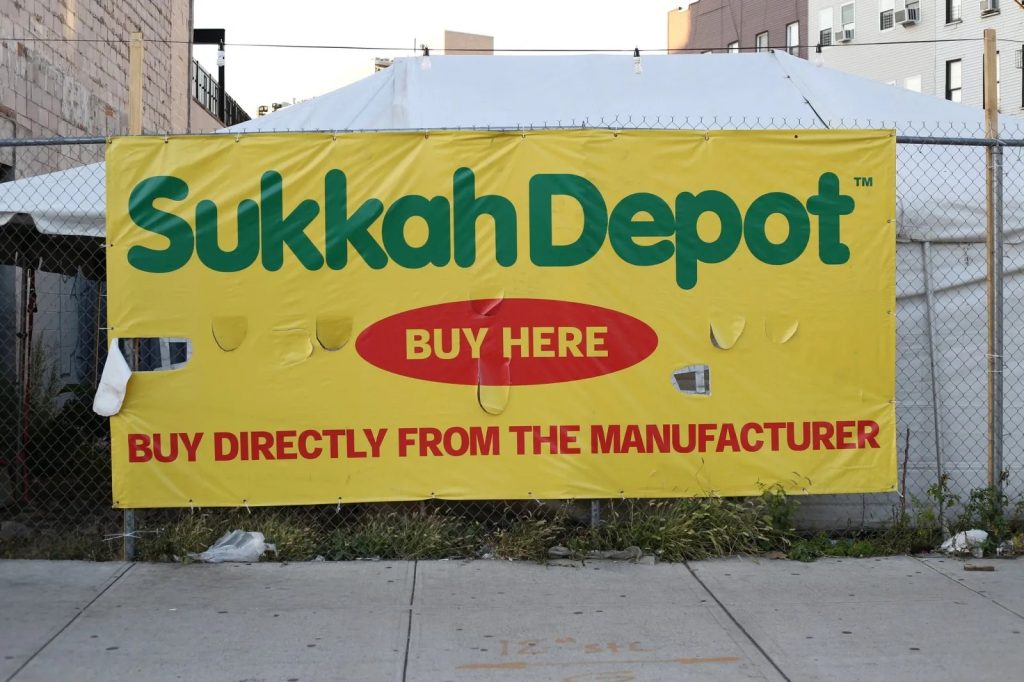
One New Year’s Eve I volunteered at an organization that served kosher food to those in need. I was under the impression it was managed by a young Israeli chef who made organic, locavore food, and the people working there would talk about the inventive things they were doing in music, technology, performance art. Dressed with these illusions in mind, I got on the subway, knowing that even on New Year’s Eve, in only three stops and a long walk away, the city would change back to what it had been like when a ride on the F train was one dollar. Church Avenue is full of roti shops, Dominican diners, Pakistani travel agencies, Keter Better Judaica. The bulldozer of gentrification hadn’t yet made it this far south, and maybe it never would. Turning onto 14th Avenue, I crossed a few deserted, eerie streets, including one block mostly taken up by a warehouse-like structure: Sukkah World For All Your Sukkah Needs. I was in a Ben Katchorland of unknown usages and cul de sacs of both meaning and architecture. Sukkah World appeared ominous and possibly full of ghosts. The sukkot they sold were dark canvas boxes, easy to install and disassemble, plastic grapes and pomegranates stapled to their rooftops, though perhaps only for window display purposes, plastic fruit most likely sold separately.
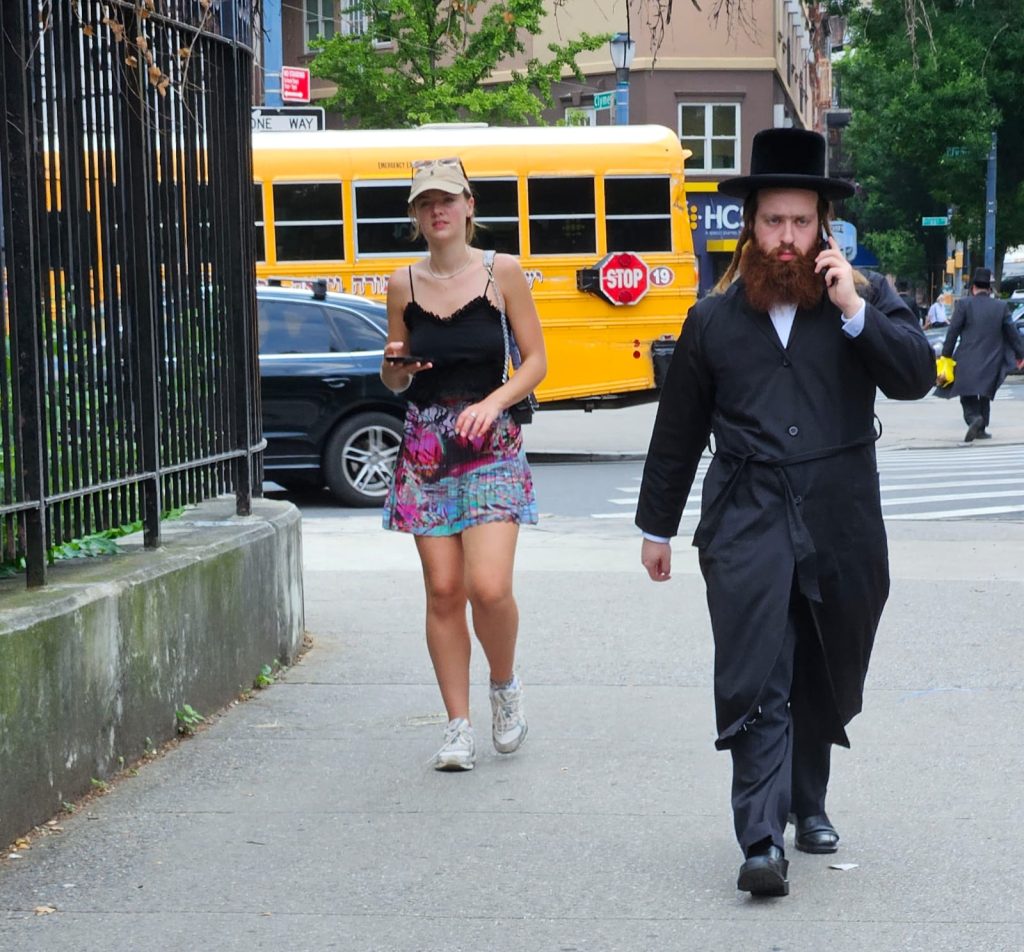
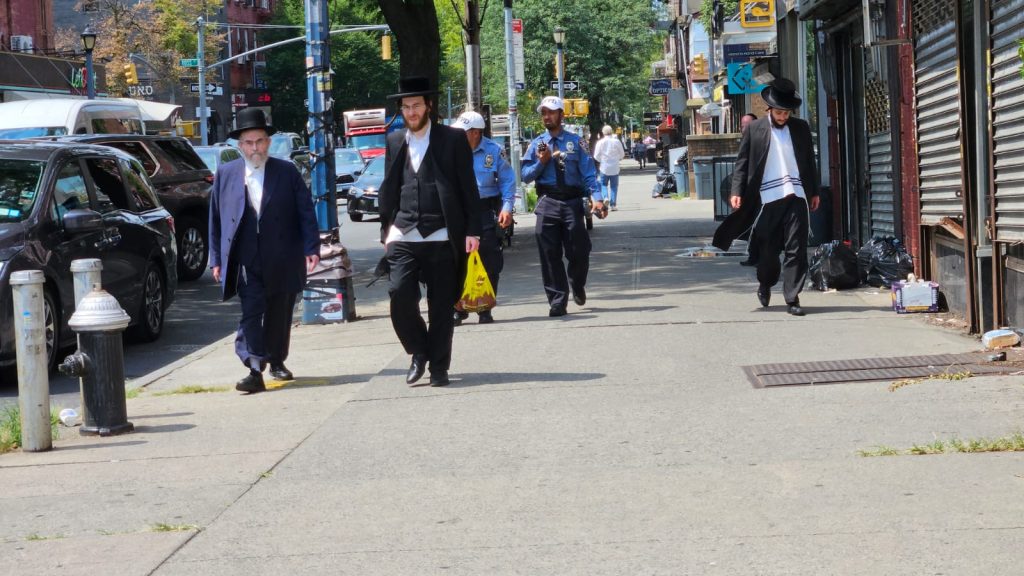
The streets became more populated by men in black hats and women in sheitels. I got to my destination, a yellow brick storefront, very different from the pictures on the organization’s website. At the entrance I was stopped by a man who looked as if he’d stepped off the cover of a Merchant of Venice playbill, though I’m reluctant to describe him in these terms, like one of those wooden dolls sold in Poland near commemorative sites, carved in China, holding money bags, looking fierce. He was likely thinking the same of me: secular, delusional, what’s she doing here? He didn’t say out loud that I wasn’t frum or orthodox, no head covering, and wearing black jeans, but he was irritated. I was one more problem for him, still he allowed me to sign in, and pointed to the back where I should wash my hands, pick up orders in the kitchen, and deliver to patrons who wouldn’t speak to me, and I shouldn’t speak to them. Most of the customers were Hasidic or ultra-orthodox men, and the conversational air was full of Hebrew, Russian, and Yiddish.
A talkative Ukrainian met me at the counter where food was put on trays and explained how serving was done, like a restaurant, but there is no check, no money changes hands. He told me he had two years of university before leaving Krakow, had been in the city six years, and would like to return to college, but the expense was out of reach. There would be no New Year’s celebration for him, he had to get up early to go to work the next day, but he was cheerful as if he knew what he couldn’t possibly know: in a few years his city of origin would be bombed, so he had made the right decision to depart, even if it meant working through someone else’s holidays.
As the night wore on as the man at the entrance had said it would, I spoke to no one and no one spoke to me, not even to say thank you, little eye contact, bodies shifting in chairs to avoid even the most glancing, accidental touch, but the process of serving food and removing dishes was not pacific, even if it was best done mechanically.
A woman sitting near the front window shouted about treyf in her food, while a man a few yards away couldn’t stop davening, and as the night wore on, it looked like the place would have to close before either of them had even begun to eat. The Ukrainian asked if I could calm the woman down, explained that she was harmless, just ranting, there was no pork or shellfish in her food, not here, not in this place. Could I also talk to the man with Tourette Syndrome? I explained he was davening, praying, and he wouldn’t listen to me in any case, but I approached the woman screaming about milchiks and fleischiks.
For my father’s parents Yiddish was a language of complaint, of borching, of nothing being what it should be, of constantly falling short. Every day was Yom Kippur, but it remained someone else’s fault, always. They waited in vain for offenders to apologize to them. The diasporic catapult had lobbed them, not to Midwood or Crown Heights but to Sheffield, England where they were wary and nearly solitary immigrants, not wanting to be identified, but not really able to disguise themselves either. They knew nothing of Shylock or Fagin. Though the library wasn’t (and still isn’t) far from Silver Street where they lived, I don’t know that they used it, certainly not to read those kinds of books. There were similarities between the Yorkshire and Yiddish accents: tendency towards short vowels, use of articles, and glottal stops, and they slipped easily from one language to the other. Russia and Spain were far behind them. For my mother’s family Yiddish was a language of comedy, hilarity, mayhem, freilach with chaos. They would listen to Mickie Katz and Jan Peerce with tears in their eyes. They sang now lost songs in Yiddish in melodic accents and cadences rarely heard anymore. For us, descendants of Chelm, between anger and hilarity, I had a language I could use to a limited extent.
But the screaming woman became as frightened of me as the food on her plate. I was that foreign to her, and no words would assuage her feelings of terror. She had no one with her, no husband or children, but she was wearing a hat and a dry and brittle-looking sheitel, so they must have existed somewhere, whoever they might have been, they were not feeding her, and she was not feeding them, not that night, perhaps not ever. The restaurant didn’t say it was kosher, because it didn’t need to, not in this neighborhood, but that only fueled her suspicions that she was being targeted and poisoned. She recoiled from me as if I were an alien from Mars who would eat her alive.
The man at the front disappeared into the kitchen and returned with two boxes of food to go for each of them, and explained they were closing, everything was fine, go back to their families whose names he knew, and azei geshunt. He warned the woman not to throw out the box, and the man davened his way into the street, then, as if a spell had been broken, returned to some kind of ordinary walking down the street behavior.
When I made my way back to the subway after clean-up, all kinds of words returned to me, I could have phrased the guarantee of safety this way or that, an entrance ramp to a kind of calmness, but it might not have made any difference. There was no magic combination of syllables, no Xanax of language to make either one of them feel at home in the world.
A few months later, it was erev Pesach, and I was planning to take then my three-year-old son to Borough Park in search of a fantastic hidden cuisine that I imagined we might find evidence of in the shops of that neighborhood. I’d taught for a semester in Iowa City, where you couldn’t even find marked up matzah, and spent part of my childhood in an area of upstate New York which wasn’t much better. Though I felt nostalgia for the jelly fruit slices, matzah balls made with club soda, stained Maxwell House haggadahs. I suspected people in other parts of the world had incredible seders, charoset made of oranges and pistachios, rice with pomegranate seeds, wine that didn’t taste like grape juice, but what those meals might look like, at that time, I had only a hazy idea.
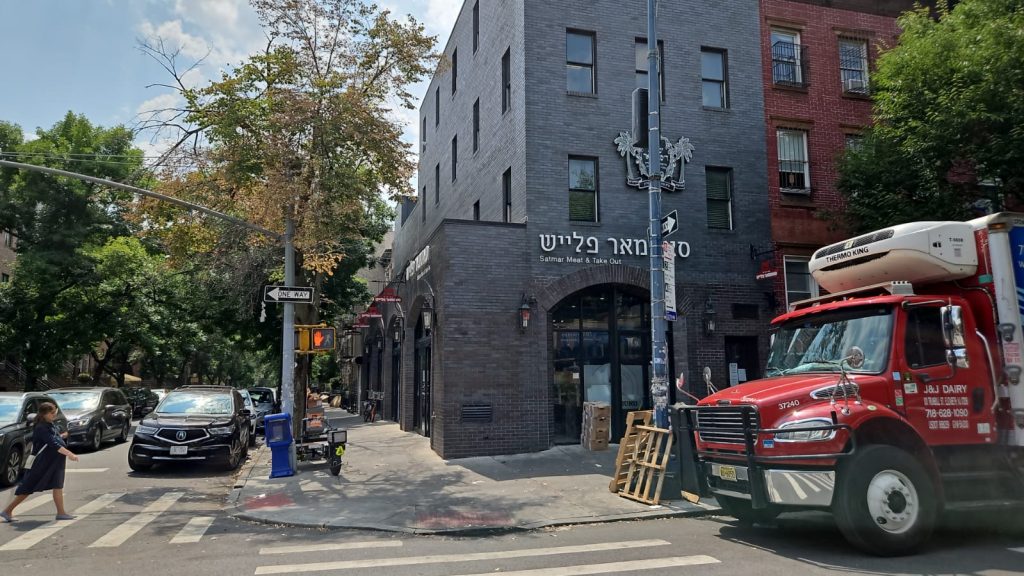
Borough Park, a neighborhood of small apartment buildings and houses, often brick, single and multiple family, was a very different community. As you walk on the side streets you see laundry hung over balconies in the front of the houses, not hidden in the back. The rows of black, white, and navy blue clothing in many sizes because of the huge families, seem to claim a familiarity, as if to say within these few blocks it’s only us, or mostly only us, so why not air laundry in public? I had a great aunt who lived on 44th or 45th Street in Borough Park. Her husband, a Communist fishmonger, one of the men in my family who was known for “giving the ladies a lot of service” was not religious. When my parents were married as a wedding present he gave them a subscription to a Communist newspaper. This gift was noted by the FBI when investigated my father who required Q clearance to serve on the Nuclear Regulatory Commission. That’s the extent of my history with Borough Park.
The streets were crowded, and everyone was occupied with the same set of tasks, working towards the same deadline. The sun goes down, and that’s it, Pesach is not a moveable feast. You envy their industry. Dry cleaners offer a service which will rid your pockets of the last crumbs of chametz, dumb waiters at street level take your dishes down to the basement for a dish mikva, a special cleansing, men in gas masks set up shop grinding horse radish from fresh roots, and bakeries time matzo with micro precision, eighteen minutes in the oven, that’s all. My son was born on the eighteenth, doesn’t yet understand the meaning or significance of that number, but he was interested in pizza, so we stopped at the first one we came to.
From the moment you walked in the door, the pushing and shoving was like an experimental theater performance in which fifty or sixty people on a small stage were asked to move like tectonic plates during an earthquake, and they slam into each other accordingly. You’d think the last slice on earth was about to be slid onto a paper plate. It didn’t matter if I held a small child’s hand. Women with other children butted ahead of me. Everyone elbowed everyone else, fueled by an unknown collective drive that had nothing to do with hunger or time running out.
There is a clip by comics Elon Gold and Modi Rosenfeld doing a routine in such a pizza shop. Modi makes jokes about families with seventeen kids, and tells a man wearing a kippah, no babies in here, or we lose our license. A woman asks if they have gluten-free, and he tells her Gluten doesn’t work here anymore. He was fired for stealing money. Sometimes his accent is Israeli, sometimes Brooklyn Jewish from another era, but the jokes are funny, we get it, we’re good at making fun of ourselves, but this shop, the one I’m in at this moment, seems particularly without any kind of humor whatsoever.
We finally got our slices and made our way to the cashier to pay. It was manned by an elderly, bearded fellow, tiny and as aggravated as everyone else in the room, a smaller version of the man at the soup kitchen. His shirt sleeves were rolled up, and he had a number on his arm. Very frail, and too old to be still working, he rang up and slammed the cash register over and over. He couldn’t hear me when I told him what I had ordered, and I could barely hear his answer. We shouted at each other. He was angry with us, outsiders, what were we doing here? I was annoyed at the shoving and pushing as if the world were about to end which it certainly was not. Soon the man would have eight days without screaming, yelling, ringing up a kind of food unheard of in his childhood. What would he do if he had a ring like King Solomon’s for one moment? What would he wish for?
My son had a children’s story about Lamed Vovniks, Tsadeks like the Sahus, holy men, of his Tamil father’s childhood. How is the lightning-shaped Lamed different from all the others? It raises its arm above a line of letters, a small fist at the end of its arm. Vov, the sixth letter of the alphabet, is also the Hebrew prefix ‘and,’ responsible for joining two halves of a sentence, perhaps it linking two recalcitrant, if not strange, bedfellows.
Lamed Vovniks, are supposed to appear in unlikely places: homeless musicians playing in the subway, short-tempered ambulance drivers, aged pizza workers, clowns, and simpletons. They can sometimes be angry, and hurl insults, making it hard for you to recognize them, but underneath everything you think you know from their exterior rags and/or mercurial speech patterns lies someone else whose history you can barely imagine. Lamed Vovnniks can be thought about in terms of Superman’s Bizarro World. You think you’re in a mad race to eat, pay, leave, go home, the most ordinary of human tasks, then someone appears who has a whole other agenda, but it doesn’t really matter, perhaps least of all to him. Nothing is as it appears, and he or she is actually the opposite of everything you assumed. The trajectory of their travels has brought them to this very unlikely place, and we all do the best we can under the circumstances.