Durban Antizionism: Its Sources, Its Impact, and Its Relation to Older Anti-Jewish Ideologies
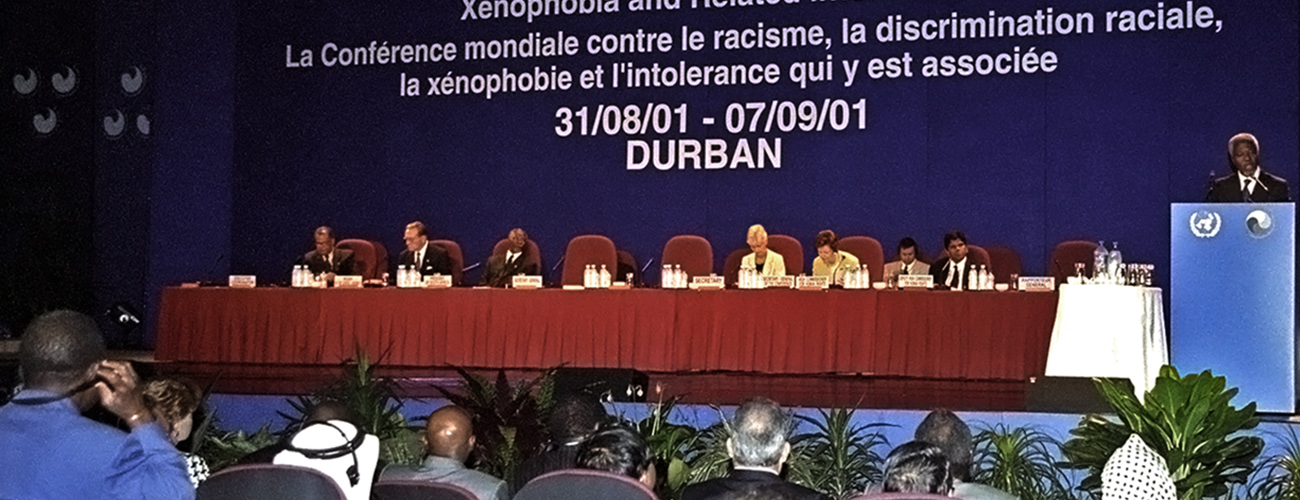
The antizionism that dominated the 2001 UN “World Conference against Racism” was neither a completely “new antisemitism” nor was it simply the latest manifestation of an ahistorical and eternal phenomenon. During the peace process in the late 80s and 90s, the intensifying focus on Israel as a key symbol of all that was bad in the world had been in remission, but at Durban, the 1970s “Zionism=Racism” culture returned...
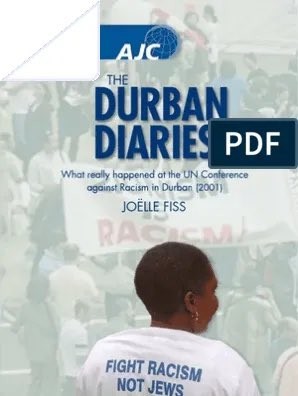
Wherever you turn, Israel is compared to Nazi Germany. Posters associate Israel with the former South African regime and its apartheid policies. Everywhere, there are images of suffering Palestinian children. Arab women display photos of their “martyred” husbands, killed during the Second Intifada.
The stand of the Arab Lawyers Union is selling The Protocols of the Elders of Zion. Caricatures are hung up. One of them depicts a rabbi with The Protocols of the Elders of Zion under his arm and an Israeli army cap on his head. Another poster describes how the Jews make their bread: with the blood of Muslims.
Joëlle Fiss, Durban Diary
Durban was a super-spreader event for a new variant of the antisemitism virus. This new variant was especially well-adapted to thrive in populations which were thought to have already been vaccinated against racism and other bigotries. It had been assumed that the experience of the Holocaust had functioned like a vaccine, achieving effective herd immunity for antisemitism in human populations. It turns out that existing vaccines fail to inhibit the new variant. In fact the new variant has evolved a mechanism that specifically makes use of the complacency caused by the existing vaccination programs to make its way around the natural defenses of populations that believe themselves to be immune to racism.
Perhaps this 2021 reconfiguration of the virus metaphor for antisemitism helps us to think about the significance of Durban even if we have to overlook, for the moment, the well-rehearsed shortcomings of the analogy. Should one judge that Durban was not especially significant because the antisemitism that erupted there was little more than a continuation of what was always present? Or should Durban be thought of as a moment of creation, of what was at the time named the “new antisemitism.”5 The super-spreader metaphor positions Durban as a significant step-change, but not as an innovator of something completely new.
The conference was attended by people from all over the world who were influential, or who would become influential: in government and civil society, in non-governmental organizations (NGOs), as well as in left wing, antiracist, and feminist movements and their associated scholarly spaces. The worldview that was consolidated at Durban was to become influential in academia as well as in human rights and international humanitarian law circles, in teaching, journalism, and the arts, in practical and activist politics and in more scholarly and theoretical thinking.
The rest of this text is available (open access) here. It was first published in JCA – Journal of Contemporary Antisemitism, vol. 5, no. 1, 2022, pp. 21-36, under the title “Durban Antizionism: Its Sources, Its Impact, and Its Relation to Older Anti-Jewish Ideologies”. It is one of the chapters in the forthcoming book The Rebirth of Antisemitism in the 21st Century: From the Academic Boycott Campaign into the Mainstream Edited by David Hirsh, which will be part of the “Studies in Contemporary Antisemitism” series, from Routledge Publishing in partnership with the “London Centre for the Study of Contemporary Antisemitism”.
David Hirsh is Director of the London Centre for the Study of Contemporary Antisemitism and Senior Lecturer at Goldsmiths, University of London.
Hilary Miller is completing a Master’s degree in Human Rights at Columbia University and is a Research Fellow with the Freedom of Religion or Belief Project at CUNY’s Ralph Bunche Institute.