The Crisis of Critical Theory.
Towards a Renewed Critique of Antisemitism after October 7
The critique of antisemitism lay at the heart of the Critical Theory developed by Adorno and Horkheimer within the Frankfurt School. After the massacres of October 7, 2023, it became a breaking point among those who claim this legacy. Karin Stögner revisits the controversies over Israel and Gaza, from the statement co-signed by Jürgen Habermas to the positions taken by Nancy Fraser. She draws on the tools of Critical Theory to shed light on two distinct phenomena: the intertwining of antisemitism and misogyny in the ideology of Hamas, and the way certain antizionist discourses make Israel responsible for ills that lie beyond it.
October 7 and the Fractures in Critical Theory
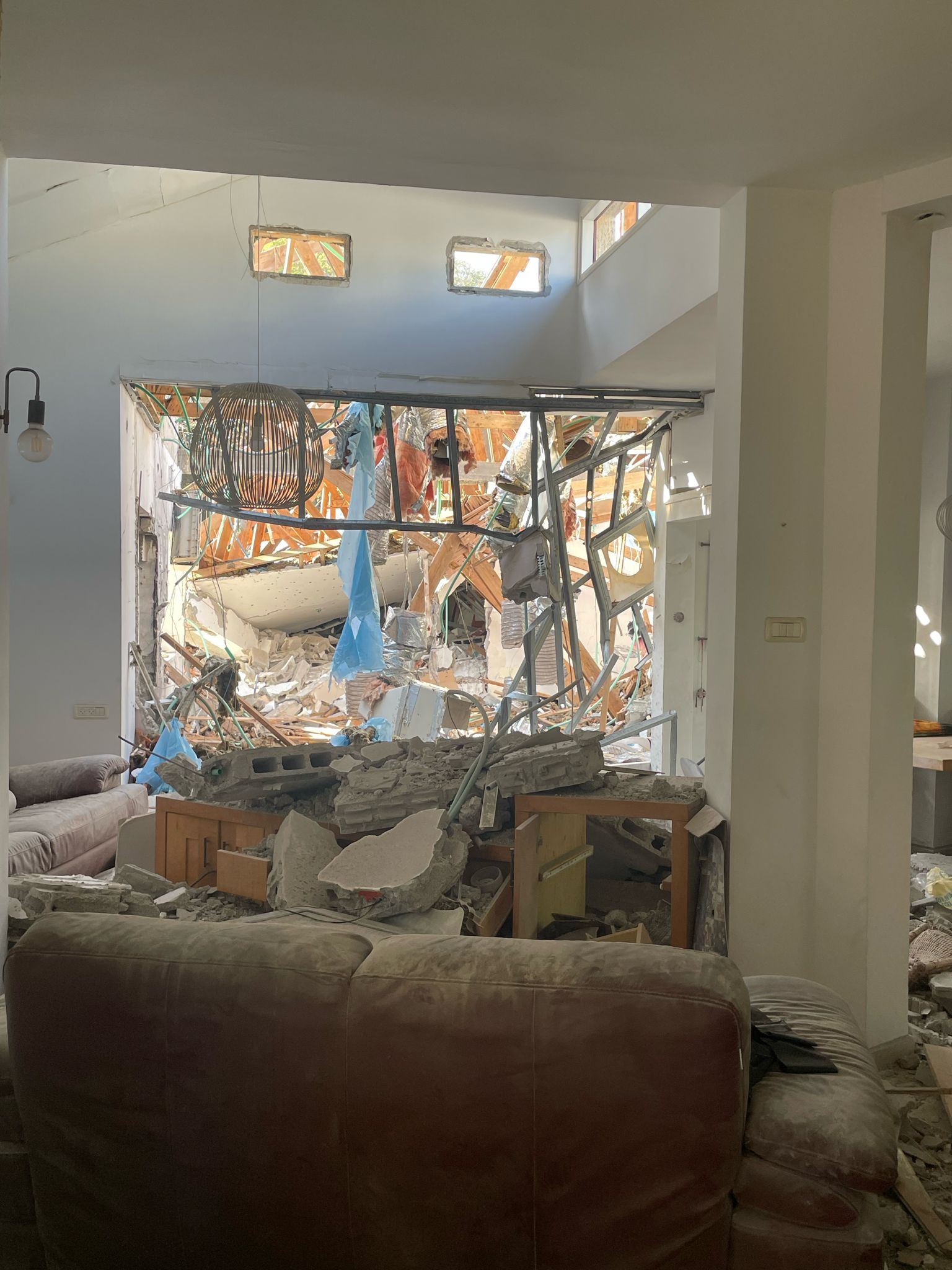
Can a theory devoted to emancipation become blind to anti-emancipatory forces because they do not fit its political expectations? The Hamas massacres of October 7, 2023, the deadliest massacre of Jews since the Shoah, and the responses they provoked in Western academia, brought this contradiction into sharp focus. They confronted contemporary Critical Theory with the urgent task of critically examining antisemitism and misogyny, reaffirming the centrality of the critique of antisemitism in the work of early Critical Theorists such as Theodor W. Adorno, Max Horkheimer and Else Frenkel-Brunswik. Yet they also exposed a fundamental conflict over contemporary Critical Theory’s political orientation.
The responses to October 7 revealed the depth of this conflict, as the discourse became increasingly polarised. Hamas’s eruption of open, brutal antisemitism appeared to open floodgates that had previously been kept shut with considerable effort. The “Al-Aqsa Flood” symbolically swept as far as Europe and America,1 accompanied by a sharp rise in antisemitic incidents worldwide.
“Can a theory devoted to emancipation become blind to anti-emancipatory forces because they do not fit its political expectations?”
Within academia, this political polarisation found expression in increasingly prominent scholar activism. Numerous critical theorists wrote or signed open letters calling for boycotts of Israel, some even calling into question the very existence of the Jewish state.2 Particularly striking was the tendency of part of this activism to ignore or even legitimise Islamism, one of the most powerful ideologies of domination operating globally today and a driving force behind Hamas. Already in 2006, Judith Butler insisted that the radical Islamist terrorist organisations Hamas and Hezbollah were progressive social movements that should be recognised as part of the global Left.3 Similarly, after September 11, 2001, Susan Buck-Morss sought to supplement Critical Theory’s critique of modernity with the reactionary, misogynistic and antisemitic antimodernism of Sayyid Qutb, a leading ideologue of the Islamist Muslim Brotherhood.4 Diagnosing a failure of Critical Theory’s critique of modernity, she believed she had discovered in Islamism, which she took for a socially revolutionary project, a new source of both critique and utopia.
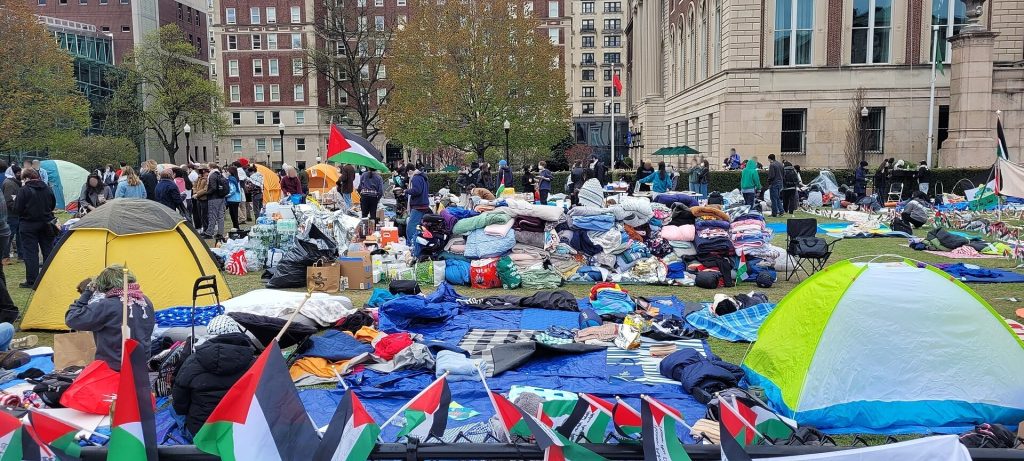
The resonance that 9/11 found among some critical intellectuals in the West returns, unrestrained, after October 7. Today, too, some seek to liberate Critical Theory from its supposedly old, excessively European baggage and a few even go so far as to be open to alliances with Islamist movements. In this well-worn rhetoric of resistance against “the West”, understood only through the frame of anti-imperialism, Gaza becomes a stage for “virtue signalling”5 that disregards not only the political and historical realities on the ground, but even more seriously ignores, when it does not justify, the misogynistic and homophobic authoritarianism that Hamas combines with an exterminationist antizionism.
Even though Critical Theory has never been a monolithic body of theory, the fractures that have emerged since October 7 run most visibly along the “Israel question”. This became apparent in the reactions to the statement “Principles of Solidarity”, written by Jürgen Habermas, Nicole Deitelhoff, Rainer Forst and Klaus Günther in November 2023, in which they called for evidence-based differentiation, warned against growing antisemitism, reiterated Israel’s right to exist and criticised the use of the term genocide: “Despite all the concern for the fate of the Palestinian population, however, the standards of judgement slip completely when genocidal intentions are attributed to Israel’s actions.”6
Nancy Fraser, Robin Celikates, Daniel Loick, Eva von Redecker and more than a hundred other signatories declared in yet another open letter that they were “deeply concerned by the statement.” Rather than engaging with it as a contribution to an ongoing debate, they insisted that solidarity with Jews and Muslims meant refusing to “close down the space for debate and reflection about the possibility of genocide.”7 Ironically, their defence of open debate does not seem to extend to the critical scrutiny articulated by Habermas, Deitelhoff, Forst and Günther.
Following Habermas’s death in March 2026, the controversy resurfaced in obituaries and assessments of his intellectual legacy. While Michael Brenner interpreted Habermas’s solidarity with Israel as consistent with his lifelong confrontation with National Socialism and antisemitism,8 other commentators regarded the statement as a fundamental failure of his critical and universalist commitments. Eva von Redecker, for instance, invoked the authority of unnamed leading scholars who had “wondered whether Critical Theory would ever recover from such a failure of judgement”.9 Gerard Delanty likewise described the statement as a “grave error of judgement” that revealed a selective application of Habermas’s own understanding of critique. He attributed this to the “limitations of critical theory and Habermas’s work”, which, in his view, remained “too concerned with the historical experience of Nazism and the German collective guilt complex.”10
“Its task is not to affirm prevailing convictions but to uncover the contradictions concealed within what appears to be widely accepted.”
These reactions reveal that the controversy goes far beyond disagreements over Israeli government policy or the war in Gaza, raising the fundamental question of what constitutes Critical Theory today. They also reveal a climate in which even expressing solidarity with Israel and affirming its right to exist can provoke accusations of turning a blind eye to Palestinian suffering. Yet Habermas and his co-authors neither defended Netanyahu’s government policies nor denied Palestinian suffering. On the contrary, they explicitly insisted on proportionality, the protection of civilians and the prospect of future peace. What they rejected was the hasty use of the term genocide, a term that denotes the most heinous crime imaginable. Many of their critics, however, insisted on using precisely this term and no other. The insistence on this particular designation thus appears to operate not as a conclusion drawn from empirical evidence, but above all as a supposed moral imperative.11 For instance, Delanty substitutes an appeal to an alleged consensus for critical argument. He considers Habermas’s position mistaken, “especially in the light of worldwide condemnation of what is now widely accepted to be genocide”.12 Yet basing a judgement on what an unspecified majority, on equally unspecified grounds, accepts as true runs counter to the very principles of Critical Theory. Its task is not to affirm prevailing convictions but to uncover the contradictions concealed within what appears to be widely accepted.
Identity politics, too, takes precedence over empirical evidence on the ground. This becomes apparent in an interview with Nancy Fraser, one of the initial signatories of “Philosophy for Palestine”. Asked where philosophers derive their knowledge of injustice from, she said that “philosophers possess no special ‘expertise’; we speak as citizens”, citing as an example the protests of Jewish activists in the United States who, carrying signs reading “Not in Our Name”, demonstrated “a powerful assertion of Jewish identity.” 13 Such statements suggest that it is unnecessary to know much about antisemitism, the Middle East conflict, or apparently even Hamas’s genocidal and antisemitic charter from 1988 in order to arrive at an unequivocally anti-Israel judgement. When Seyla Benhabib14 insisted on the historical facts of the Middle East conflict against the simplistic and ideologically distorted perspective of “Philosophy for Palestine”, and pointed to the nihilism of Hamas, which used the Palestinian civilian population as human shields, Fraser expressed her “disappointment” with Benhabib, arguing that statements such as Benhabib’s would “destroy any hope of an immediate ceasefire”.15 Against this academic backdrop, it should come as no surprise that campus activists, too, have shown little regard for facts. As Alvin Rosenfeld recently put it: “We’re not in a fight about facts … We’re in a fight about feelings, and those feelings are very impassioned, very determined, very aggressive.”16
It seems that anyone who today continues to insist on the centrality of the critique of antisemitism to Critical Theory, who refuses to turn this critique into a museum piece and instead applies it to contemporary forms of antisemitism, whether they stem from Islamism or, in different forms, from parts of the Left, and who recognises in the massacres of October 7 a manifestation of an extremely misogynistic and exterminationist antisemitism, risks provoking considerable opposition within Critical Theory. Because we argue that attacks on Israel and the denial of the Jewish state’s right to exist may express antisemitic resentment, Lars Rensmann and I, associated with what some have begun to call the “Passau School”, have been accused of “further delegitimiz[ing] Critical Theory in the eyes of those who already are inclined to dismiss it precisely for its unreconstructed ‘colonial unconscious’.”17 In parts of the postcolonial academic milieu, the legitimacy of Critical Theory seems to rest on the delegitimation of Israel.
The issue is no longer evidence-based truth. It is the attempt to make Critical Theory palatable to those who, instead of subjecting the Enlightenment to immanent critique and thereby salvaging its emancipatory potential, prefer the simpler path of dissolving social contradictions into a Manichaean worldview that pits the West against the Global South. Against this, we should take seriously Adorno’s injunction in Minima Moralia “to let neither the power of others, nor our own powerlessness, stupefy us”.18 This entails confronting contradictions and enduring the ambivalences of a concrete historical situation without relinquishing critical judgement: showing solidarity with Israeli victims of Islamist terrorism and acknowledging Palestinian suffering without obscuring Hamas’s and Palestinian Islamic Jihad’s responsibility; or criticising Israeli government policies without delegitimising the Jewish state itself.
An updated Critical Theory must take as its object precisely what so many today choose to ignore: Islamism, antisemitism and misogyny. Drawing on The Authoritarian Personality, I therefore develop an intersectional critique of ideology that examines how antisemitism and misogyny constitute two interpenetrating ideological pillars of Islamism, and how Islamism itself forms an essential context of the present conflict.19 I also refer to the concept of “projective antizionism” 20 to interpret the mechanisms of derealisation, victim–perpetrator reversal, and perceptual defence against Israel among some scholar activists who invoke Critical Theory.
Islamism as an Object of an Updated Critical Theory
An updated Critical Theory should concern itself not merely with concepts but with the analysis and critique of social formations that did not yet play a systematic role in the early Frankfurt School. The production of repressive unity based on antisemitism and authoritarianism, which Critical Theory analysed in National Socialism, can today be discerned particularly in the various formations of Islamism. These are modern political ideologies that invoke Islam and respond to the contradictions of social modernisation by constructing an authoritarian religious-political community. Accordingly, they interpret the Umma, the worldwide community of Muslims, in authoritarian and identitarian terms. Two systematically interconnected elements stand out: antisemitism, or eliminationist antizionism, and a repressive gender regime, or gender apartheid. Both respond to processes of social modernisation, secularisation and individualisation by promising to restore a supposedly original unity, while remaining compatible with modern technologies.
The critical scholar of Islam Bassam Tibi captured the contradiction at stake here with the concept of “semimodernity”.21 Islamist ideologies embrace certain aspects of modernity, such as scientific and technological developments, while rejecting the political, social and cultural dimensions historically associated with them, particularly secularism, individualism, gender equality, sexual self-determination, and the critique of religious authority and traditional forms of social organisation. This constellation, however, should not be understood as a cultural peculiarity of Islamism. National Socialism, too, can be characterised as an antimodern modernity: it strengthened modern industrial capital while massively obstructing individualisation and eliminating the social values of the Enlightenment. Jeffrey Herf coined the term “reactionary modernism” to describe this constellation.22 Even beyond the barbarism of National Socialism, Western modernity fell short of its own claims and promises of freedom and equality: technological innovation often brought only hesitant social modernisation in its wake. This is the critical insight of Critical Theory: modern societies themselves produce the contradictions to which authoritarian movements respond regressively.
Islamism, too, radicalises a regressive response to modernity.23 It manifests an unwillingness to reflect on the contradiction between social modernisation and traditional domination. Instead, it personalises this contradiction and projects it onto a preconceived enemy image: Zionism. Personalisation and conspiracy thinking are the decisive steps here: abstract, impersonal processes of social change are attributed to a concrete collective that is imagined to have willed and steered them. Thus Islamism portrays processes of individualisation, secularisation, women’s emancipation and sexual liberalisation, which are taking place within Muslim societies themselves, as forces of disintegration introduced into the Islamic community, the Umma, from outside. Here, misogyny becomes directly intertwined with antisemitism. Judaism, Zionism and Israel come to represent a modernity imagined as corrosive and destructive. In this way, Islamism reinterprets social change within Muslim societies as an external attack.
This constellation becomes particularly apparent in the ideology of the Islamist terrorist organisation Hamas, which has ruled the Gaza Strip since 2007 and bears primary responsibility for the massacre of October 7. Its 1988 Charter, which retains ideological relevance today,24 combines antisemitic myths of a global conspiracy with a strictly patriarchal gender order. Women occupy a peculiarly ambivalent position within this ideology. On the one hand, the Charter portrays women as weak and dependent on male authority; on the other, it attributes to them enormous power over the future of the community. As “the maker of men”25, woman reproduces the Umma and thereby guarantees its continued existence. Precisely for this reason, female autonomy appears as a threat.
Hamas constructs a conspiracy narrative in which its supposed enemies have recognised women’s central importance and therefore seek to alienate them from Islam through the media, education and cultural influence. The Charter identifies “Zionist organizations” as the forces orchestrating this alienation of women from Islam. It externalises women’s emancipation and their desire for self-determination, interpreting both as products of hostile manipulation. Similarly, Iranian state propaganda repeatedly portrayed demands for women’s rights during the Woman, Life, Freedom movement as the result of Zionist or Western conspiracies. The late commander of the Revolutionary Guards, General Hossein Salami, specifically identified the United States and Israel as the “masterminds behind the unrest” and referred to them as “Satans”. Their satanic deed, in his account, was to overturn gender apartheid. Salami explained: “They want to take the hijab away from our women – but the hijab is our trench.”26
We already find this distorted logic in the writings of Sayyid Qutb, one of the most influential ideologues of the Muslim Brotherhood, whose tradition Hamas follows. This is all the more significant since Susan Buck-Morss referred positively to Qutb in her book Thinking Past Terror (2003) and regarded his critique of modernity as a valuable complement to Horkheimer and Adorno’s immanent critique in Dialectic of Enlightenment. In doing so, she not only overlooked the anti-emancipatory thrust of Qutb’s critique of modernity but also completely ignored his virulent antisemitism and sexism. In his pamphlet “Our Struggle with the Jews”, first published in 1950 and frequently reprinted, he wrote: “The Jews liberate sensual desires from their restrictions and destroy the moral foundation on which pure faith is based. They do this in order to drag the faith into the filth that they spread in abundance in this world.”27 Antisemitism provides the conspiracy myth; misogyny defines gender relations as one of the principal fields in which the conspiracy is imagined to operate.
This explains why sexuality and gender relations are so central to Islamist antisemitic conspiracy thinking. It does not simply accuse Jews of political or military aggression. It imagines a much more intimate form of penetration: Jews and so-called Zionist agents supposedly infiltrate the community by transforming gender relations and introducing sexual liberation and emancipation. Consequently, the survival of the Umma appears to depend both on fighting Israel and so-called “world Jewry” and on controlling women’s sexuality and maintaining a strictly patriarchal gender order. The external enemy and the internal gender regime are thus structurally interconnected.
“Islamism therefore both idealises and fears women: it venerates and needs them as mothers who reproduce the community, while demonising them as autonomous subjects of desire.”
A Critical Theory of Islamism must therefore go beyond analysing political programmes and examine the subjective dispositions on which this ideology draws and which it mobilises. This is where the authoritarian intolerance of ambiguity investigated by Else Frenkel-Brunswik becomes relevant.28 Modern subjectivity requires the capacity to confront and critically endure contradictory demands: autonomy and dependence, individuality and social belonging, instinctual desires and social norms, proximity and distance. Authoritarian socialisation deals with these contradictions through repression and projection.
As Hamas demonstrates, sexuality assumes particular significance within this constellation. The French psychoanalyst Fethi Benslama pointed out that Islamism both sexualises women entirely and treats sexuality as a danger to the community.29 Female autonomy and sexual desire appear as forces of individualisation that threaten the unity of the Umma. Islamism therefore both idealises and fears women: it venerates and needs them as mothers who reproduce the community, while demonising them as autonomous subjects of desire.
The German-Iranian psychoanalyst Mahrokh Charlier likewise demonstrates that wherever individuals cannot integrate the renunciation of instinctual gratification into the autonomous formation of the subject, resentment may develop against those who come to represent the gratification they have been denied.30 Aggression then turns not against the authoritarian order that imposes renunciation, but against the object that recalls what has been denied. This is where the theorem of authoritarian rebellion, developed in The Authoritarian Personality and Dialectic of Enlightenment, comes in. It describes an entanglement of conformism and rebellion from which authority ultimately emerges strengthened.
This reveals another connection between antisemitism and antifeminism. Both Jews and women become associated with a supposedly unregulated life. In the projective fantasy, they appear exempt from the renunciations to which the authoritarian subject must submit. The authoritarian subject attributes its own denied possibilities of happiness, pleasure and autonomy to them, only to persecute these very possibilities in them.
Hatred, in this sense, does not target concrete groups alone. What it attacks in them is a possibility and promise of life itself: individuality, pleasure, happiness and freedom. This is what gives the entanglement of antisemitism and misogyny its particularly destructive dynamic.
October 7 as a Convergence of Antisemitism and Misogyny
Within this theoretical framework, we can analyse October 7. The massacres perpetrated by Hamas, Palestinian Islamic Jihad and other actors were not merely an attack on Israeli citizens. They constituted antisemitic violence and, particularly in the sexual violence against women, an expression of extreme misogyny.31 A Critical Theory of October 7 must consider these dimensions together: the victims were Israelis, the vast majority belonged to a Jewish society, and some of the violence specifically targeted women and their bodies. While Judith Butler still insisted in 2024 that the massacres were “an act of armed resistance”, “not a terrorist attack” and “not an antisemitic attack”, but “an attack against Israelis”32, an intersectional critique of ideology informed by Critical Theory understands these dimensions as intrinsically intertwined.
Israeli women occupy a particularly charged position within Islamist ideology. They embody both Jewish sovereignty and female autonomy. The image of the armed Israeli woman, particularly the female soldier serving in the Israel Defense Forces, radicalises this constellation: she contradicts both the historical image of the defenceless Jew as a dhimmi and the patriarchal conception of women as vulnerable and subordinate to men. Within this imaginary, the emancipated Jewish woman appears as a monstrosity, at once feminine and unfeminine, and thus as an assault on the unambiguous boundaries of a strictly heteronormative gender order.
“The violence aimed to destroy those bodies and forms of life that represented everything Islamist ideology prohibits and despises.”
On October 7, these antisemitic and misogynistic projections converged in extreme violence. To adequately understand the sexual violence against Israeli women, we need to recognise it as a strategy aimed at destroying a group. Yet we must also examine the ideological and psychological motivations underlying the perpetrators’ actions. The cruelty and monstrosity of these acts are out of all proportion to any military objective Hamas might conceivably have pursued. The violence targeted what the victims represented within Islamist ideology: Jewish self-determination, female autonomy and the possibility of a self-determined life.
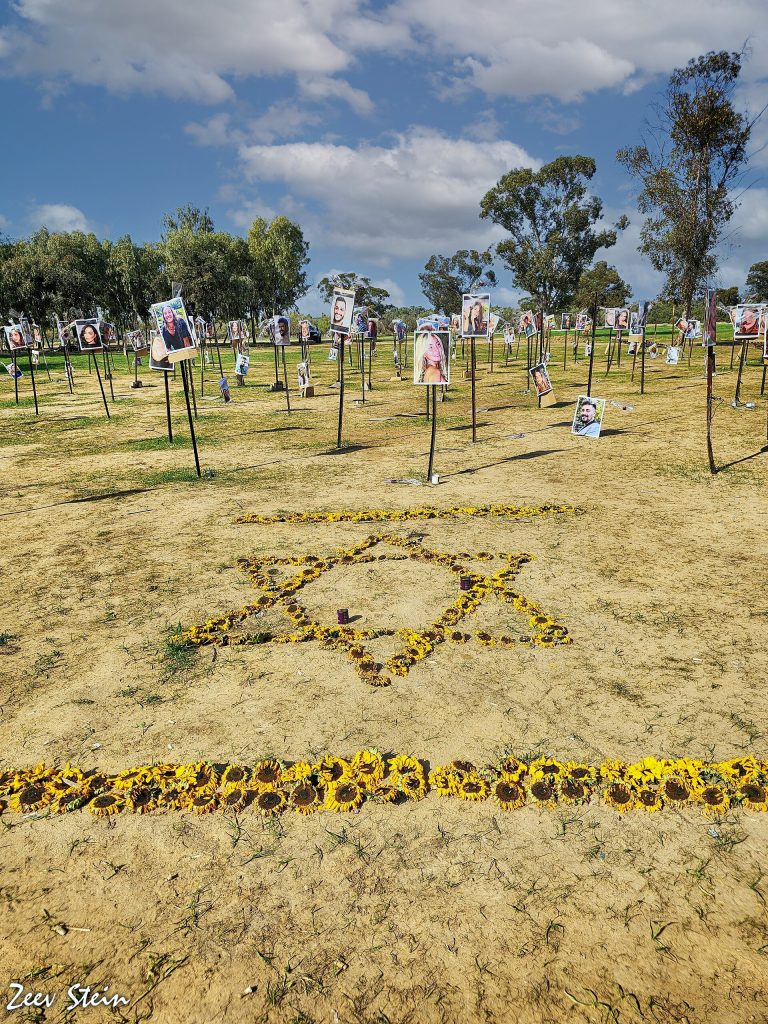
In this context, the attack on the Nova music festival acquires an ideological significance. The attackers targeted people who were listening to music, dancing, celebrating and enjoying life in an entirely unheroic manner – young, secular Israelis, many of them committed to peace, whose way of life embodied individuality, sexual freedom and happiness in the here and now. The extraordinary brutality and sexual violence inflicted upon them thus point to something beyond any conceivable military objective. The violence aimed to destroy those bodies and forms of life that represented everything Islamist ideology prohibits and despises. October 7 manifests the eruption of an ideology that places death above life and obedience above happiness.
This also explains the deadly rage directed against the bodies of Israeli women, which ultimately reduced them to a bloody pulp. The apparent contradiction between sexual repression and extreme sexual violence is therefore not really a contradiction. Sexual violence is one way in which repressed sexuality returns.
The other side of this Islamist sexual horror fantasy concerns Israeli men. Within the Islamist worldview, fighting women are abnormal, and Israeli men who fight alongside women, who recognise them as equals and who therefore accept the blurring of gender boundaries, are no longer seen as properly masculine themselves. The old antisemitic image of the Jewish man as weak, feminised and incapable of fighting returns here. One aim of the violence of October 7, I argue, was precisely to “demonstrate” the supposed weakness and effeminacy of Israeli men. The sexualised violence against men, including rape and genital mutilation,33 can be understood within this same symbolic structure. It attacks Jewish and Israeli masculinity at the level of the body.
Benslama’s concept of jihadist thanatopolitics34, a politics oriented towards the triumph of death, helps us grasp this connection between rigid masculinity, sexuality, extreme cruelty and the longing for death. Where death is ideologically elevated above life in this world, the lives of those who affirm this worldly existence become intolerable. The autonomous subject must become an object of absolute domination. Sadistic violence thus targets the very possibility of subjectivity.
In this sense, we can understand October 7 as the practical crystallisation of an ideological constellation in which antisemitism and misogyny are systematically intertwined. Hatred of Jews and hatred of emancipated women converge in a hatred of ambiguity, autonomy and forms of life that escape the dictates of the repressive community.
Projective Antizionism
October 7 and its aftermath demonstrate that contemporary antisemitism is directed to a considerable extent against Israel, a development which an updated Critical Theory must recognise. As Stephan Grigat and I argue in the introduction to our book Projektiver Antizionismus,35 Islamist ideology and part of Western left-wing scholar-activism share a hostility towards Israel, yet they follow different logics and projections that must not be conflated. In Islamist ideology, Israel is predominantly portrayed as an artificial and illegitimate entity, a foreign intrusion into an allegedly authentic political and religious order. In a certain postnational left-wing antizionism, by contrast, Israel is imagined as the embodiment of an ethnically exclusive nationalism or settler-colonialism that supposedly obstructs universal emancipation. Israel is thus condemned on the one hand for lacking authentic national roots and on the other hand for clinging to ethnic particularity. This shows that the oppositions between concrete and abstract, natural and artificial, universal and particular can be mobilised against the Jewish state in contradictory ways. What unites these projections is the refusal to recognise Israel as a state subject to the same contradictions as other nation-states. Projective antizionism thus rests on a “rumour about Zionism”36 rather than an engagement with Zionism as the national and anticolonial liberation movement of the Jewish people. It ultimately provides an ideological justification for the destruction of Israel as the home of the world’s largest Jewish community.
“What unites these projections is the refusal to recognise Israel as a state subject to the same contradictions as other nation-states.”
This geopolitical reproduction of classical antisemitic tropes is precisely what distinguishes projective antizionism from concrete criticism of state policies and social developments: it turns Israel into “the Jew among the nations”37, thus into a projection screen for global contradictions. Projective antizionism draws on longstanding antisemitic tropes that portray Jews as the embodiment of absolute evil and transfers these projections onto Israel and Zionism. In this process, the antisemitic image of the Jew as the source of modernity’s evils reappears in the conviction that Zionism is synonymous with racism and fascism, that it constitutes an obstacle to world peace, and that Zionists place themselves outside humanity.
In “The Meaning of Working Through the Past”38, Adorno described mechanisms of derealisation and victim–perpetrator reversal after 1945 as forms of defence against guilt and experience. After October 7, we encounter a different historical constellation but a comparable pattern of defence against reality.
A striking example of derealisation and victim–perpetrator reversal is Nancy Fraser’s recent essay “Gaza as World Event”. She argues that “in the current period”, that is, after October 7, “‘Gaza’ bids to replace ‘Auschwitz’ as symbol for the worst human atrocities of our time.”39 This extraordinary claim rests on a series of conceptual and rhetorical manoeuvres that culminate in a profound distortion of history.
Fraser consistently downplays threats to Jews as “grossly magnified when not invented”, which, in its sweeping generality, is itself a classic antisemitic trope. She further deconstructs the concept of antisemitism by referring to a “false and exaggerated affection for one group of Semites, ‘the Jews’,” which “is used to justify the hate-filled oppression of another group, the Palestinians.”40 In doing so, she dissolves the historical and ideological specificity of antisemitism into an abstract linguistic category. When Wilhelm Marr popularised the term antisemitism in the late nineteenth century, however, he sought to lend Jew-hatred a veneer of scientific legitimacy; the term never designated hostility towards other supposedly “Semitic” groups. By treating its etymology as though it revealed a meaning obscured by history, Fraser strips the concept of antisemitism of its critical force precisely where it is needed to confront Hamas’s antisemitism, which her essay leaves as unaddressed as Hamas’s misogyny. Instead, her argument suggests a victim–perpetrator reversal, insinuating that Jews themselves have become the new antisemites.
The same reversal underlies Fraser’s juxtaposition of Gaza and Auschwitz. By presenting Gaza as a potential successor to Auschwitz as the ultimate symbol of human atrocity, she establishes a comparison that either trivialises the Shoah as a military conflict comparable to the war in Gaza or elevates the latter into a genocide of historically unprecedented proportions. The implication is not simply that Gaza constitutes another genocide, but that it surpasses Auschwitz as the defining reference point for moral outrage. Both Gaza and Auschwitz are transformed into abstract symbols, detached from their concrete historical and ideological contexts. The concept of genocide itself is likewise increasingly treated as a matter of political and moral conviction rather than a judgement requiring empirical and legal substantiation.
These conceptual operations have far-reaching political implications. They contribute to the delegitimation of Zionism by reducing its historical and contemporary significance to that of a racist colonial ideology, while casting Israel’s existence as a Jewish state into question. The Shoah, and its significance for the establishment of Israel as a refuge from antisemitic persecution, is eclipsed by a narrative in which Gaza becomes the overriding historical and moral reference point. Within this framework, the implicit political conclusion is that the establishment of Israel must be reversed, and the Jewish state replaced by a Palestinian state claiming sovereignty over the entire territory. What disappears from view is not only the historical specificity of the Shoah and the historical conditions of antisemitism that gave rise to Zionism in the first place, but also the antisemitic and misogynistic ideology of Hamas and the violence of October 7 that brought their intersection into such brutal focus.
Critical Theory after October 7
October 7 and its aftermath thus pose a challenge to contemporary Critical Theory’s self-understanding. A theory for which the critique of antisemitism became constitutive through the experience of National Socialism cannot exclude contemporary antisemitism from its field of perception simply because it does not emerge within familiar political constellations. Precisely because antisemitism constitutes a focal point of social critique for Horkheimer and Adorno, Critical Theory must uphold its critique where antisemitism manifests itself in Islamism or as projective hatred of Israel.
This also has implications for Adorno’s formulation of a “new categorical imperative” that “has been imposed by Hitler upon unfree mankind: to arrange their thoughts and actions so that Auschwitz will not repeat itself, so that nothing similar will happen”.41 As a categorical imperative, it claims validity not merely for the historical situation after 1945, but for as long as the social conditions persist that produce antisemitism and keep open the possibility of antisemitic persecution.
Against this background, the struggles over how Critical Theory should orient itself today become increasingly significant. Yet these struggles are accompanied by more fundamental disputes over what should count as antisemitism in the first place. Those who categorically refuse to recognise antisemitism as a historically changing constellation also reject the possibility that, since the founding of Israel, it can take the Jewish state as its target. This refusal explains why many scholars and activists see no problem in demanding the disappearance of Israel as a sovereign Jewish state. Following the same ideological logic, Critical Theory’s critique of antisemitism can be relegated to the museum of intellectual history and Adorno’s imperative to prevent Auschwitz from recurring, or anything similar from happening, reinterpreted as a claim that Palestinians are now the new Jews and Israelis, conversely, the new Nazis, a reversal implied by the claim that Gaza replaces Auschwitz42 or by the equation of Gaza with the Warsaw Ghetto43.
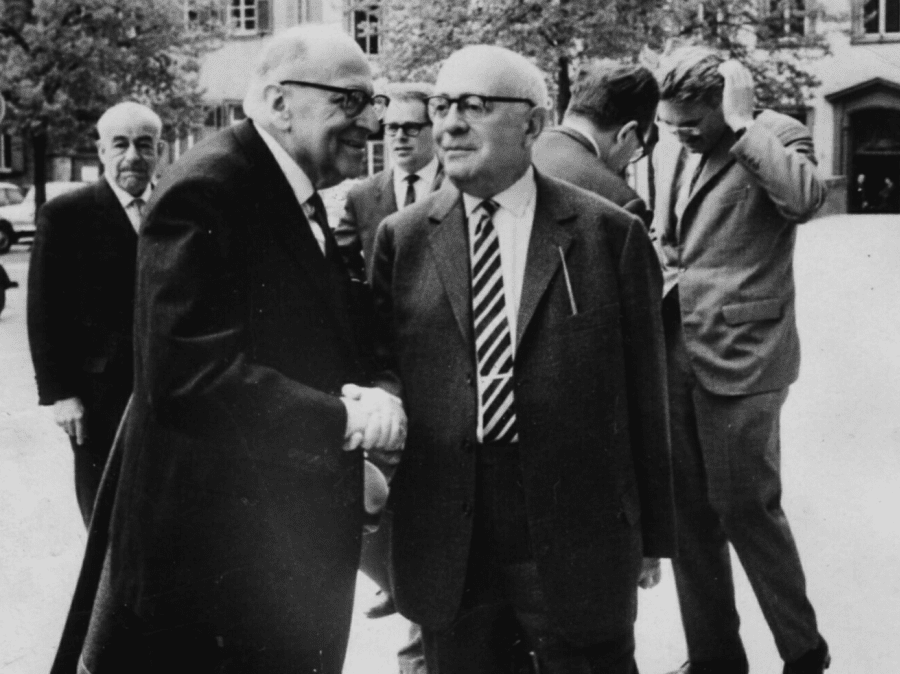
Horkheimer’s own view of Israel was quite different from these distorted images in parts of contemporary Critical Theory. Despite his critique of the nation-state order and of successive Israeli governments, he emphasised that Israel served as a potential refuge for Jews worldwide and was therefore necessary. Marcuse similarly argued that Israel’s historical purpose was to prevent the recurrence of antisemitic persecution, including pogroms and concentration camps. Under prevailing international conditions, this required a sovereign state capable of offering refuge and protection to persecuted Jews. He maintained that the existence of such a state when the Nazis came to power could have saved millions of Jewish lives.44
Underlying this position is the historical experience that the world did nothing to stop the Shoah. As long as antisemitism persists globally, the existence of Israel therefore reduces the danger that Jews will once again face antisemitic persecution without protection. October 7 and its global repercussions, manifested in rising antisemitism in Western democracies too, demonstrate the necessity of a Jewish nation-state. According to Stephan Grigat, “for a materialist critique, Zionism is not the right answer to antisemitism (that would be the establishment of a free association of free individuals, an emancipated society that enables people to be different without fear or coercion), but it is, quite independently of Israeli government policies, which must be evaluated on a case-by-case basis, the only provisionally possible answer.”45 Such a position might argue against the establishment of a Palestinian nation-state if that state refuses to recognise Israel. This, however, does not contradict a commitment to universal norms; on the contrary, it upholds them. Rather, it is those who demand a Palestinian state without recognising Israel’s legitimacy, or even at the expense of Israel’s existence, who violate universal norms.
Antisemitism in the Middle East is not merely a consequence of the Israeli-Palestinian conflict but one of its fundamental causes, insofar as the rejection of Israel’s right to exist has obstructed a political settlement based on mutual recognition and peaceful coexistence since 1947. After October 7, this constellation acquires renewed urgency. The Hamas massacres demonstrated the persistence of eliminationist antisemitism and targeted both the Jewish capacity for self-defence and Israel as a site of Jewish sovereignty. This also resonates in the slogans “From the River to the Sea, Palestine will be free” and “Globalize the Intifada”. The fact that the overwhelming majority of victims were Israelis, predominantly Jews, is no more contingent than the antisemitic and misogynistic ideology of the perpetrators. In each case, the violence represents an attempt to restore Jewish and female defencelessness and subjugation. The convergence of hatred of Israel, antisemitism and misogyny that became visible on October 7 demonstrates why an updated Critical Theory must connect the critique of Islamist antisemitism and projective antizionism with a critique of misogyny and radically unequal gender relations.
Criticism of an Islamist gender order that is based on strict gender segregation and legal inequality between the genders does not amount to an unqualified affirmation of “the West”, any more than the critique of projective antizionism implies an endorsement of every Israeli government policy. Critical Theory rejects such false alternatives. It measures social relations against the possibility of individual freedom and emancipation. These values remain the normative foundation of Critical Theory.
Similarly, the struggle against antisemitism is not only a particular concern of those directly affected. Because antisemitism condenses social contradictions into an all-encompassing conspiracy fantasy and promises to eliminate those whom it holds responsible for these contradictions, its critique concerns the very possibility of emancipatory social critique as a whole.
- Maxim Biller, Schwarze Samstage: Roman eines Jahres, Köln: Kiepenheuer & Witsch 2026. ↩︎
- See, among the numerous open letters: “Philosophy for Palestine”, 1 November 2023, https://sites.google.com/view/philosophyforpalestine/home; “Open Letter to the Israeli and U.S. Governments and Others Weaponizing the Issue of Rape”, February 2024, https://stopmanipulatingsexualassault.org; “A Response to ‘Principles of Solidarity: A Statement’”, Public Seminar, 22 November 2023, https://publicseminar.org/2023/11/a-response-to-principles-of-solidarity-a-statement/; “Brief aus Berlin: Kritische Wissenschaftler*innen an die deutsche Politik und Öffentlichkeit”, 28 October 2023, https://docs.google.com/forms/d/e/1FAIpQLSdQexuMBpgFM3PK0DJUtRwYd1ZuKo3bIvsNrShXc11orOmzrA/viewform; “Germany’s Response to the Israel-Gaza Conflict Is Out of Line with Its Principles”, 26 March 2024, https://statementisraelgaza.wordpress.com/. ↩︎
- “Judith Butler on Hamas, Hezbollah & the Israel Lobby (2006)”, Radical Archives, 28 March 2010, https://radicalarchives.org/2010/03/28/jbutler-on-hamas-hezbollah-israel-lobby/. ↩︎
- Susan Buck-Morss, Thinking Past Terror: Islamism and Critical Theory on the Left, London/New York: Verso 2003. ↩︎
- Nicholas Potter, “Linksautoritäre Irrungen: Nicholas Potter im Interview mit Christoph Piorkowski”, Philosophie Magazin, 18 June 2026, https://www.philomag.de/artikel/linksautoritaere-irrungen. ↩︎
- Nicole Deitelhoff, Rainer Forst, Klaus Günther & Jürgen Habermas, “Grundsätze der Solidarität: Eine Stellungnahme”, Normative Orders, Goethe University Frankfurt, 13 November 2023, https://normativeorders.net/news/grundsaetze-der-solidaritaet-eine-stellungnahme/; English version: “Principles of Solidarity: A Statement”, K. Jews, Europe, the XXIst Century, 16 November 2023, https://k-larevue.com/en/principles-solidarity-statement-habermas/. ↩︎
- “A Response to ‘Principles of Solidarity: A Statement’”, Public Seminar, 22 November 2023, https://publicseminar.org/2023/11/a-response-to-principles-of-solidarity-a-statement/. ↩︎
- Michael Brenner, “Jürgen Habermas – die jüdische Gemeinschaft verliert einen großen Freund”, Jüdische Allgemeine, 16 March 2026, https://www.juedische-allgemeine.de/kultur/juergen-habermas-die-juedische-gemeinschaft-verliert-einen-grossen-freund/. ↩︎
- Eva von Redecker, “Talk Is Precious: In the Age of Communication Collapse, Jürgen Habermas’s Message Remains Vital”, The Guardian, 17 March 2026, https://www.theguardian.com/commentisfree/2026/mar/17/talk-precious-communication-collapse-jurgen-habermas-philosopher. ↩︎
- Gerard Delanty, “The Contested Legacy of Jürgen Habermas: Reason, Critical Dialogue, Critique”, Dialogues in Sociology 2 (2), 2026, 163–174, here 171. ↩︎
- The legal question remains open. In South Africa v. Israel, the International Court of Justice has so far ordered only provisional measures (from January 2024 onwards); as its then President Joan Donoghue later made clear, the Court did not rule on the plausibility of the genocide claim (it found plausible only the right of Palestinians in Gaza to be protected from acts of genocide), and it has not yet examined the merits: Israel submitted its counter-memorial in March 2026, and South Africa’s reply is due in November 2027. The arrest warrants issued by the International Criminal Court against Benjamin Netanyahu and Yoav Gallant in November 2024 concern war crimes and crimes against humanity, not genocide. The finding of genocide by the UN Commission of Inquiry on the Occupied Palestinian Territory (September 2025) came from a body whose impartiality had been contested from the outset, not least after one of its members, Miloon Kothari, spoke in 2022 of a “Jewish lobby” controlling social media, a remark for which he later apologised; all three of its members announced their resignation in July 2025. No court has so far found that genocide has been committed. A critical account of these debates is given by Philip Spencer, “The Return of the ‘Jewish Question’: Universalism, Antisemitism, the Left and the Genocide Charge Against Israel”, Jewish History Quarterly 2 (298), 2026, 325–348. ↩︎
- Delanty, “The Contested Legacy of Jürgen Habermas”, 171. ↩︎
- Ronald Pohl, “US-Philosophin Nancy Fraser: ‘Niemand verharmlost Hamas’”, Der Standard, 14 November 2023, https://www.derstandard.at/story/3000000194979/us-philosophin-nancy-fraser-niemand-verharmlost-hamas. ↩︎
- Seyla Benhabib, “An Open Letter to My Friends Who Signed ‘Philosophy for Palestine’”, Amor Mundi, November 2023, https://medium.com/amor-mundi/an-open-letter-to-my-friends-who-signed-philosophy-for-palestine-0440ebd665d8. ↩︎
- Pohl, “US-Philosophin Nancy Fraser”, art. cit. ↩︎
- Zev Stub, “‘We’re Not in a Fight about Facts’: Scholars Analyze Post-Oct. 7 Pop-Up Campus Protests”, The Times of Israel, 13 November 2026, https://www.timesofisrael.com/were-not-in-a-fight-about-facts-scholars-analyze-post-oct-7-pop-up-campus-protests/; see also Alvin H. Rosenfeld (ed.), Toward the Last Encampment: Campus Culture and the Jews Before and After October 7, Brentwood, TN: Post Hill Press 2026. ↩︎
- Samir Gandesha, “A Loftier Misery?”, The Montréal Review, September 2026, https://www.themontrealreview.com/Articles/ct_A_Loftier_Misery.php. ↩︎
- Theodor W. Adorno, Minima Moralia: Reflections from Damaged Life, translated by E. F. N. Jephcott, London: Verso 2005, 57. ↩︎
- I have analysed these relationships in detail in Karin Stögner, Antisemitism and Sexism: Ideological Constellations Before and After 7 October, London: Routledge 2026. ↩︎
- Stephan Grigat and I developed this concept in Stephan Grigat & Karin Stögner, “Kritik des projektiven Antizionismus”, in: Stephan Grigat & Karin Stögner (eds.), Projektiver Antizionismus: Antisemitismus gegen Israel vor und nach dem 7. Oktober, Baden-Baden: Nomos 2025, 11–22. ↩︎
- Bassam Tibi, Islamism and Islam, New Haven/London: Yale University Press 2012, 177. ↩︎
- Jeffrey Herf, Reactionary Modernism: Technology, Culture, and Politics in Weimar and the Third Reich, Cambridge: Cambridge University Press 1984. ↩︎
- Dan Diner, Lost in the Sacred: Why the Muslim World Stood Still, Princeton: Princeton University Press 2009. ↩︎
- In 2017 Hamas published “A Document of General Principles and Policies”, which states that its conflict is with the “Zionist project” and not with Jews because of their religion. The document did not revoke the 1988 Charter, which Hamas leaders described as a “historical document”. Both the 1988 and the 2017 documents make it unequivocally clear that Hamas opposes not Israeli settlement policy in the West Bank but the very existence of Israel as such. The Jewish state is not to exist in the region, regardless of the policies or conduct of its governments. ↩︎
- Hamas, “The Covenant of the Islamic Resistance Movement”, 18 August 1988, The Avalon Project, Yale Law School, https://avalon.law.yale.edu/20th_century/hamas.asp. ↩︎
- Cited in Rainer Hermann, “Iran warnt vor einem Bürgerkrieg”, Frankfurter Allgemeine Zeitung, 17 November 2022, https://www.faz.net/aktuell/politik/ausland/iran-warnt-wegen-protesten-vor-buergerkrieg-18468274.html. ↩︎
- Cited in Thorsten Fuchshuber, “The Role of Sexual Violence on October 7”, ISCA Research Paper 2025-4, Bloomington: Institute for the Study of Contemporary Antisemitism, Indiana University, March 2025, https://isca.indiana.edu/documents/ISCA%20research%20papers/isca-paper-2025-4-fuchshuber.pdf. ↩︎
- Else Frenkel-Brunswik, “Intolerance of Ambiguity as an Emotional and Perceptual Personality Variable” (1949), in: Nanette Heiman & Joan Grant (eds.), Else Frenkel-Brunswik: Selected Papers, New York: International Universities Press 1974, 58–91. ↩︎
- Fethi Benslama, Un furieux désir de sacrifice: Le surmusulman, Paris: Seuil 2016. ↩︎
- Mahrokh Charlier, Ost-westliche Grenzgänge: Psychoanalytische Erkundungen kultureller und psychischer Differenzen zwischen “Orient” und “Okzident”, Gießen: Psychosozial-Verlag 2017, 65–79. ↩︎
- See also the meticulous forensic work to determine the extent of the sexual violence component of the October 7 antisemitic attack in: The Dinah Project, A Quest for Justice: October 7 and Beyond, Ramat Gan: Rackman Center, Bar-Ilan University, July 2025, https://thedinahproject.org/wp-content/uploads/2025/07/The-Dinah-Project-full-report-A4-pages_web.pdf; and The Civil Commission on October 7th Crimes by Hamas Against Women and Children (CCO7), Silenced No More: Sexual Terror Unveiled – The Untold Atrocities of October 7 and Against Hostages in Captivity, May 2026, https://cc4e0711-9401-400e-ae14-65ae0400675b.filesusr.com/ugd/aab121_7ac7981aff1043d49c55e5aeb012abe9.pdf. ↩︎
- “Judith Butler – Contre l’antisémitisme et pour la paix révolutionnaire en Palestine”, Paroles d’Honneur, YouTube, 7 March 2024, https://www.youtube.com/watch?v=rlQNBJOq-0E. ↩︎
- CCO7, Silenced No More, 193–195, https://cc4e0711-9401-400e-ae14-65ae0400675b.filesusr.com/ugd/aab121_7ac7981aff1043d49c55e5aeb012abe9.pdf. ↩︎
- Benslama, Un furieux désir de sacrifice. ↩︎
- Grigat & Stögner, “Kritik des projektiven Antizionismus”, art. cit. ↩︎
- Philipp Lenhard, “Benny Morris’ The Birth of the Palestinian Refugee Problem, die ‘Neuen Historiker’ und der 7. Oktober 2023: Nachwort zur deutschen Übersetzung”, in: Benny Morris, Die Geburt des palästinensischen Flüchtlingsproblems: Eine Neubetrachtung, Berlin: Hentrich & Hentrich 2025, 799–810. ↩︎
- Léon Poliakov, De Moscou à Beyrouth: Essai sur la désinformation, Paris: Calmann-Lévy 1983. ↩︎
- Theodor W. Adorno, “The Meaning of Working Through the Past”, in: Critical Models: Interventions and Catchwords, translated by Henry W. Pickford, New York: Columbia University Press 1998, 89–104. ↩︎
- Nancy Fraser, “Gaza as World Event”, New Left Review 158, 2026, 49–64, here 49. ↩︎
- Ibid., 53. ↩︎
- Theodor W. Adorno, Negative Dialectics, translated by E. B. Ashton, New York: Continuum 2007, 365. ↩︎
- Fraser, “Gaza as World Event”, art. cit. ↩︎
- Masha Gessen, “In the Shadow of the Holocaust: How the Politics of Memory in Europe Obscures What We See in Israel and Gaza Today”, The New Yorker, 9 December 2023, https://www.newyorker.com/news/the-weekend-essay/in-the-shadow-of-the-holocaust. ↩︎
- Jack Jacobs, The Frankfurt School, Jewish Lives, and Antisemitism, Cambridge: Cambridge University Press 2015, 120, 140. ↩︎
- Stephan Grigat, Vom Antijudaismus zum Hass auf Israel: Interventionen zur Kritik des Antisemitismus, Opladen: Barbara Budrich 2025, 231. ↩︎

Karin Stögner
Karin Stögner is Professor of Sociology at the University of Passau. She received both her PhD and her Habilitation from the University of Vienna. Previously she did research and teaching at various universities, e.g. Goethe University Frankfurt, Hebrew University of Jerusalem, Lancaster University, and Central European University. Her research focuses on Critical Theory and feminist theory, on antisemitism, racism, nationalism, and sexism as well as on National Socialism and Islamism. Her recent publications includes the monograph 'Antisemitism and Sexism: Ideological Constellations Before and After 7 October' (Routledge 2026). Website: https://www.sobi.uni-passau.de/soziologie/lehrstuhlteam/prof-dr-karin-stoegner