Bitter Love: Israel or the Shores of Intimacy (1/4)
Episode 1: When Israel Was Eilat
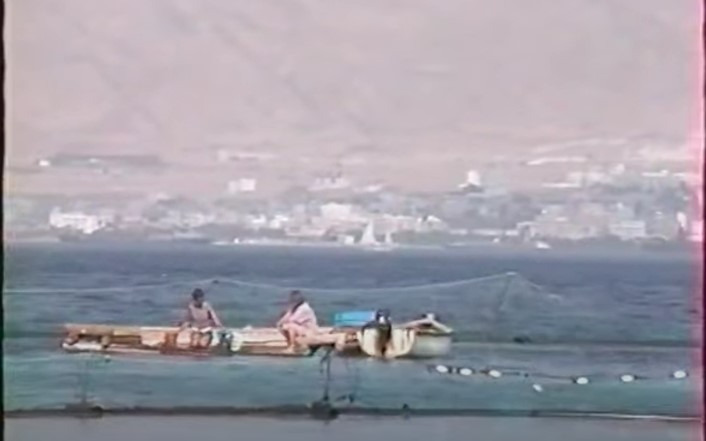
Before it is a matter of ideology or war, Israel is first and foremost, for the child, a holiday destination: Eilat, with its coral reefs, its desert, its Club in resort, and its bunker repainted with cartoon-style murals. Yet beneath this apparent innocence, other realities are surfacing: the incomprehensible Hebrew, the turmoil following Rabin’s assassination, and the first questions about belonging—amidst provocation, family legacies, and a Jewish identity that resisted any stable definition..
Introduction:
In this four-part series we’re publishing this summer, Samuel Ghiles-Meilhac doesn’t portray Israel as a cause to defend, a subject of study, or a country to be judged from afar, but as an intimate and contradictory presence that entered his life very early on through vacations, books, the Jewish Scouts, radio broadcasts, maps, bereavements, and love affairs. It all begins in Eilat, amid the deceptive innocence of a family’s exotic experience, then the child gradually discovers that this seemingly carefree place is also a hotbed of existential and political unease. The text moves between personal memory and collective history: Rabin’s assassination, the Second Intifada, Southern Lebanon, suicide bombings, checkpoints, the Israeli left, October 7th. But its true focus lies elsewhere: in the gap between the Israel imagined, the Israel read about, the Israel that is feared, the Israel that is loved, and the Israel ultimately encountered. Alongside Daniela, an Israeli activist with Mahsom Watch, the author discovers the Palestinian territories, the ambiguities of criticism, the dead ends of moral certitude, and the fragility of an Israeli left that is now in mourning, aging, or defeated. “Bitter Love” is the story of an attachment that cannot be simplified: neither a Zionist conversion, nor a repudiation, nor a condescending stance, but an exploration of what it means to love a country that eludes you and compels you.
*
A warm sea teeming with brightly colored fish appears at the end of a vast desert. On one side, the Egyptian Sinai, with its Bedouins, diving spots, Mount Sinai, and St. Catherine’s Monastery. On the other, just a few hundred meters away, the Jordanians—figures both near and far in a landscape blurred by the sun. On the horizon, at the end of the strait, the same stretch of sand,, gives way to Saudi Arabia, the moon.
I’m completely unaware that the view before me is just a tiny sliver of a sea stretching all the way to the Horn of Africa and the coasts of Yemen.
Eilat, the holidays of my childhood in the ’80s and ’90s. No heavy historical and religious legacies in conflict like in Jerusalem, nor the wild hedonistic lifestyle of Tel Aviv, which I couldn’t care less about. No holy sites, no Palestinians. Everything feels simple. I find it perfectly natural to eat schnitzel with hummus stuffed into pita bread while it’s 35 degrees Celsius in the shade.
It is another world, exotic yet reassuring. My parents, my sister, and I come from Grenoble, with its executives and engineers who spend their weekends hiking and skiing. In the spring, we come to this bridge between Africa and Asia. Every day, we make our way to the coral beach, just before the border crossing with Egypt. I feel at ease. We read Le Monde, bought at the Club Med, which keeps us informed about France as well as what’s happening here in the mid-1990s: the establishment of the Palestinian Authority, fragile alliances within the Rabin government, tensions and negotiations with Syria. Local politics reach us via a journalistic detour printed in Paris.
We’re staying at a vacation resort, the Club in. Our days revolve around the pool, green lawns, and breakfasts featuring creamy eggplant. My sister and I spend our days at the kids’ club, which offers activities all day long. It takes me a while to realize that the building also serves as a bunker in case of an attack. The door—so heavy and thick, resembling that of a submarine, loses its unsettling quality because it’s been repainted with murals of Mickey Mouse and other cartoon characters that distract us from the prospect of having to protect ourselves from a missile.
And the Israelis? I first began to learn about them through books and the press back home in France. I don’t think I tried, as a teenager, to make friends with them in Eilat. They were the distant, almost silent figures of my holidays. Hebrew wasn’t entirely foreign to me. While preparing for my bar mitzvah with the rabbi, I painstakingly learned the alphabet and how to read. I know a handful of prayers, but—just like in music class in middle school—I quickly resort to dubious lip-syncing that’s obvious if you watch my lips. Not understanding the language doesn’t bother me. I want to know Israelis, document them, and worry about them without having to grapple with their language.
When did Israel begin to cling to me? Was it on the morning of Sunday, November 5th, 1995, when my father, coming out of the shower, tore me away from the compulsive attention I was paying to my computer screen by blurting out, “Rabin was assassinated last night by a Jewish extremist”? He was pale; he looked at me and then went into the living room. My tense fingers hovered for a few seconds above the keyboard. Even then, I sensed—albeit vaguely—that something politically and existentially was unfolding in that foreign land.
In those years, I discovered Israel through books and Judaism mainly through the Jewish Scouts, the EI—the Éclaireurs israélites de France . One or two Sundays a month throughout the year, and above all, a winter ski trip and three weeks in the summer in tents that reek of sweat—this is the rhythm that binds us together. We’re expected to observe the major rules of Jewish religious life: kosher food, prayers upon waking, before and after meals, and above all, adhering to the Sabbath prohibitions (using electricity, cutting, drawing). These obligations are softened by the euphemism “minimum common standard”—meaning the minimum set of religious rules allowing participants to take part in the activities. Yet this minimum feels terribly coercive to me.. Everyone is Jewish— slightly, deeply or hardly at all. One boy’s entire family tree is spread across three Moroccan villages just a few kilometers apart. A few have a non-Jewish parent—Catholic, Protestant, or atheist—and find it amusing when Orthodox Jews quibble over the need to pre-cut toilet paper before Sabbath begins. But surnames can be misleading. Names that sound quintessentially French mask a name change after 1945, and a young Cohen or Levy whose mother isn’t Jewish may secretly face the greatest difficulties in being allowed a bar mitzvah. These serious questions preoccupy us. The overwhelming majority attend public school. There are also Israelis staying temporarily in Grenoble while their parents are visiting researchers at the local university. I belong firmly to the camp of provocation, mocking the rules and spouting obscenities left and right: “I live at 69 Pleasure Street,” “Is there such a thing as Arab Jews?”—these are my refrains, hurled at the counselors, the rabbi’s daughters, and those wearing a kippah all day long.
My own names, incidentally, sow doubt. One is a Berber first name, the other comes from the Limousin region (a rural area in the South West of France), and there’s nothing to suggest that my great-great-grandfather, a rabbi from Lithuania, is buried on the Mount of Olives. I love this life where I light the Hanukkah candles and, a few days later, I dress up as Santa Claus for my little cousins. I can still see myself on the balcony at my paternal grandparents’ house, with a huge paragliding backpack on my back, filled with gifts for my extended family, for whom the Jewish heritage has vanished like stardust. The wind is blowing, I grip the railing, slowly making my way toward the glass door through which I’ll enter and proclaim in a voice I wish were deeper: “Hello, kids. Have you been good this year?”
Samuel Ghiles-Meilhac
Samuel Ghiles-Meilhac holds a Ph.D. in sociology and teaches at Sciences Po Paris. He is the author of "Le CRIF De la résistance juive à la tentation du lobby de 1943 à nos jours" [The CRIF: From the Jewish Resistance to the Temptation of the Lobby, 1943 to the Present] (Robert Laffont, 2011) and "Le Monde diplomatique et Israël Histoire moderne de l'Etat juif à travers un journal de référence" [Le Monde diplomatique and Israel: A Modern History of the Jewish State Through a Leading Newspaper] (Le Manuscrit, 2006).