What is it that remains Jewish in psychoanalysis?
What was Jewish about Freud’s invention of psychoanalysis? Joel Whitebook, in his intellectual biography of Freud—of which K. had published advance excerpts— argues that it was a certain “spirit of heresy” unique to Judaism that made Freud’s discovery possible. David Krausz and Déborah Gutmann-Krausz engage with this text while taking a stance at odds with this thesis, insisting instead on the mystery of this Judaism with which Freud never ceases to grapple, without ever being able to attribute a specific content to it. Yet it is precisely this attention to what remains despite everything that shapes the analytical listening process and contributes to its radical skepticism toward promises of salvation.
Introduction
When the broad theme of “Judaism and psychoanalysis” is raised, some might question its relevance. It is common knowledge that Sigmund Freud, the father of psychoanalysis, was Jewish. Admittedly, there is already a connection there. But we also know—and Freud never denied this, quite the contrary—just how assimilated he was, how distant from his Judaism and his origins; how much he belonged—and sought to belong—to a certain Bildung, an Austro-Germanic civilization and culture; how much, guided by the principles of the Aufklärung, he championed freedom of thought, science, reason, and the progress of a universal Humanity par excellence, freed from the “obscurantism” of any religion, including that of his ancestors. One might therefore question the connection between this man and his work, on the one hand, and a cultural and religious tradition with which he was clearly at odds, on the other.
Some authors suggest viewing Freud as a “secular Jew,” an “atheist Jew,” or even a “godless Jew”1 who, through the invention of psychoanalysis, specifically affirmed this position. As an adherent of the modern beliefs characteristic of his era and culture, Freud, according to this thesis, would have held a critical, even hostile, stance toward religions in general and the religion of his forefathers in particular. He would see in his “Jewish heresy” and in his stance as a “secular Jew” the key to what enabled him to invent psychoanalysis. Furthermore, according to these authors, Freud would see such a position as the very embodiment of what is most essential in Judaism, which would thus be identified with the spirit of heresy. This thesis is notably defended by Joel Whitebook in his book Freud: An Intellectual Biography2, published in French last April, and from which K. published an excerpt on May 21.
Indeed, Whitebook notes that Freud seems to point in this direction in some of his writings, notably his 1918 letter to Oskar Pfister3 and his “Preface to the Hebrew Edition” of Totem and Taboo, from 19304. There he declares, on the one hand, that he is “completely estranged from the religion of his fathers,”5 and, on the other hand, that the “essential nature”6 of Judaism remains within him. The tension is clear: on the one hand, Freud sees himself as a heretical Jew; on the other hand, he considers that the essence of Judaism has not left him. Whitebook resolves this apparent paradox with the following syllogism: since Freud saw himself as a heretic while declaring that he carried within him the essence of Judaism, this means that he saw heresy as the essence of Judaism and himself, a heretical Jew, as the most essential of Jews.7 For Whitebook, the essence of Judaism would remain within Freud precisely because of his heretical nature.
While this interpretation is, from a purely logical standpoint, possible, it is not necessary. We could also interpret that the so-called “essence of Judaism” remains within him despite his heretical nature, or at any rate independently of his own heretical character. “I am a godless Jew and, yet, the essence of Judaism remains within me,” rather than “I am a godless Jew and, therefore, I embody the essence of Judaism.” Whitebook identifies Freud’s “essence of Judaism” in Freud with a purified content of Judaism, a content that could be embodied in the spirit of heresy and in the figure of the heretic that is Freud himself. In this article, however, we will propose a different reading: Freud’s Jewish heritage is not a matter of content. It lies in the realm of the indecipherable residue, the remnant that persists despite the disappearance of all content. We will emphasize the dimension of question and mystery, which is inherent in a Judaism whose essence remains very difficult to grasp and, even more so, to embody.
While, in some of his writings, Freud may give the impression of embodying the quintessential “godless Jew,” a closer look reveals a far more complex reality. Analyzing Freud the man within his context shows us, first and foremost, that it was not so much he, as an individual, who was at odds with traditional Judaism. Freud did not experience a traditional Jewish life that he would later have rejected. On the contrary, born during the golden age of the Austro-Hungarian Empire—which, for the first time in history, was seeking to integrate its Jewish population—belief in reason and the progress of civilization was self-evident to him. The rejection of obscurantism and the love of science, rather than a personal achievement, were for the young Freud—as well as for many Jews of his time—a given starting point established by the civilization to which they aspired to belong. In this context, Freud’s high culture and profound erudition in various fields—including medicine, anthropology, and ancient history—contrasted with a rather rudimentary knowledge of Judaism and its traditions. The Judaism found in his books and private correspondence is almost anecdotal, devoid of any precise content, or at any rate very meager.
Freud’s Jewish heritage is not a matter of content. It lies in the realm of the indecipherable residue, the remnant that persists despite the disappearance of all content.
A reading of some of Freud’s works—notably Totem and Taboo8, The Future of an Illusion9, or Moses and Monotheism10—may certainly reveal a harsh, generalized critique of religions, and more specifically of Judaism. However, this critique stems less from an original contribution by Freud than from a line of thought that was self-evident in fin-de-siècle Vienna.
Far more remarkable is the fact that Freud’s reflections also question the limits of scientific thought that aims to replace religions and “enlighten” humanity. In his book Psychotheology of Everyday Life: Reflections on Freud and Rosenzweig11, Eric Santner shows how Freud, while criticizing various forms of obscurantism, draws his readers’ attention to the dangers of new forms of “enlightened” obscurantism. According to Santner, Freud had the clarity to see how science, along with other major symbols of modern Bildung, could covertly reincarnate the very same obscurantism of the past that they proposed to criticize. For Santner, from a theological perspective, the Aufklärung did not eliminate the God of obscurantism, but replaced him in a “secularized” manner. The project of the Aufklärung, as its own name suggests, continued to operate according to the same logic as that of Christianity, which had given rise to it and preceded it. Just as the Jesuits, a few decades earlier, had penetrated the most remote corners of Africa and the Americas to bring the light of Christ there, the Enlightenment project fundamentally sought to illuminate the world with its Truth.
It is remarkable that, in Freud, this enlightened stance—his contempt for obscurantism and this enthusiasm for progress, typical of his era—is systematically accompanied by a mistrust of and reluctance toward the Enlightenment itself.
Thus the young neurologist’s scientific perspective is gradually supplanted by the emerging psychoanalytic approach. The progressive illusion of control and mastery promoted by neurology gives way to the observation upon which psychoanalysis will be founded: certain symptoms cannot be explained by science, and yet they remain. These symptoms should no longer be understood as part of a physiological syndrome, but rather recognized as bearing a subjective truth. Only the patient can say anything about them. Analytic practice gradually shifts its focus to recognizing what is wrong, rather than to treating and eliminating the pathology.
The original contribution of Freud’s work lies in the radical nature of his skepticism toward progress—and in the attention paid to the remnants that no progress can erase.
Over the course of his years of work and writing, Freud observed that “what is wrong,” both in the individual and in society, is not contingent. Discontent and malaise are intrinsic to the human condition. There always remains a remnant, something that cannot be tamed. Like the Copernican and Darwinian revolutions, Freud considers his work to represent not so much a step toward the knowledge of universal truth, but rather as “a third and most irritating insult […] flung at the human mania of greatness.”12 Psychoanalysis “wants to prove to the ‘I’ that it is not even master in its own home.”13 Beyond a simple call for modesty, the original contribution of Freud’s work lies in the radical nature of his skepticism toward progress—and in the attention paid to the remnants that no progress can erase. There is something very Jewish about this skepticism, and we will attempt to demonstrate why.
The Remnant in Freud
“My parents were Jews, and I have remained a Jew myself,” writes Freud in An Autobiographical Study.14 Anaëlle Lebovits-Quenehen analyzes this sentence by Freud in her book L’actualité de la haine [The Relevance of Hatred]15, dividing it into two parts: (I) “My parents were Jews” refers to the heritage received at birth; (II) “I have remained a Jew myself” highlights the dimension of choice: Freud the man decided to remain a Jew, which was not a given. He chose to take responsibility (II) for his heritage (I)—in other words, “where [he] comes from”16— despite the difficulties this entailed.
Freud, for all his faith in science, never denied his Jewish identity. The theme of Judaism remained a constant in both his private and public work: from letters sent to his beloved to his final book, Moses and Monotheism. He never ceased to grapple with a certain “Jewish cornerstone”, from which the thought of the Aufklärung could not free him.
In her book Antisémitisme : une lecture psychanalytique [Antisemitism: A Psychoanalytic Reading]17, Sarah Abitbol demonstrates, using excerpts from Freud, just how tormented he appeared to be by Judaism, in that he never ceased to return to it, to be unsettled by it, to dissect it, and to take opposing positions regarding it—sometimes criticizing it, sometimes embracing it, but in any case never rejecting it. Throughout his work, Freud sought to put into words the mystery of this Judaism that remained within him, and for which he felt a profound sense of responsibility. Here are three illustrative excerpts:
“Even if the form wherein the old Jews were happy no longer offers us any shelter, something of the core, of the essence of this meaningful and life-affirmingJudaism will not be absent from our home..”18
In 1882, Freud wrote these lines in a letter to his beloved, Martha Bernays. Freud observed that a certain naches19—the ancient Jewish tranquility—was no longer relevant to him and his family, though he did not specify the reasons; yet he expressed his confidence that the essence of Judaism, full of meaning and joy, would endure forever in their Jewish home. This “essential” aspect resists, as Ernest Jones reports in The Life and Work of Sigmund Freud: “An old Jew is tougher than a Royal Prussian Teuton.”20
“No reader of [the Hebrew version of] this book will find it easy to put himself in the emotional position of an author who is ignorant of the language of holy writ, who is completely estranged from the religion of his fathers—as well as from every other religion—and who cannot take a share in nationalist ideals, but who has yet never repudiated his people, who feels that he is in his essential nature a Jew and who has no desire to alter that nature. If the question were put to him: ‘Since you have abandoned all these common characteristics of your countrymen, what is there left to you that is Jewish?’ he would reply: ‘A very great deal, and probably its very essence.’ He could not now express that essence clearly in words; but some day, no doubt, it will become accessible to the scientific mind.”21
The term “essential” reappears, fifty-two years after the letter to his beloved, in his preface to the Hebrew translation of Totem and Taboo, published in 1934. There he describes a Judaism that remains within him despite his detachment from religion, a Judaism he described he “could not now express […] clearly in words.” Although he never ceased his efforts to define this strange “Jewish thing” that dwelled within him, toward the end of his life, Freud was still unable to name it with greater precision.
“We were both Jews and knew of each other that we carried that miraculous thing in common, which—inaccessible to any analysis so far—makes the Jew.”22
In 1936, three years before his death, Freud wrote to Barabara Low about his deceased friend David Eder, and about a strange “Jewish thing”, “miraculous” and still inaccessible to analysis, that connected Freud and Eder to each other. Translating this “Jewish thing” into words is difficult, if not impossible, but it is what “makes the Jewish.”
In his book Notre objet a23, François Régnault attempts to define the contours of this miraculous thing that, for Freud, “defines what it means to be Jewish.” For Régnault, it is something that lies beyond the various aspects with which Judaism might be associated. Being Jewish is not merely synonymous with being observant, or an activist, or culturally engaged, and so on. It is all of those things, but also something else that is “impossible to put into words.” The “essence” of Judaism always seems to lie beyond the succession of its definitions; it can never be fully articulated or revealed. It eludes all definitions.
Freud never ceased to grapple with a certain “Jewish cornerstone” from which the Aufklärung could not free him.
Judaism represents an “impossible remnant in the order of speech,”24 a remnant that never leaves one in peace. The “Jewish thing”25 does not budge, and every Jew comes up against it in his own way. While some of Freud’s contemporaries renounced their “Jewish thing” in the name of an “abstract universality,”26 Freud, for his part, never relented on his Judaism, even though he was never able to explain it.
In this regard, Freud often refers to the story of Rabbi Yoḥanan ben Zakkai, which, for him, exemplifies this “essence” to which he is attached. At the time of the destruction of the Second Temple, Ben Zakkai was granted the opportunity to ask a favor of the Roman general who had become emperor. Rather than asking for greatness, or even to spare Jerusalem from destruction, he contented himself with a seemingly very modest request: “Give me [the city of] Yavne and its sages.” Rather than a state, a revolution, Jerusalem or its Temple, he was content to ask for a yeshiva—an academy of Jewish study—to ensure the survival of Judaism after destruction and exile.27
If Freud constantly refers to this story in his work and private correspondence, it is probably because he saw in the preservation of the study—without grandiloquence or despair—the persistence of what is essential to Judaism. Yavne and the other yeshivot are small study places that resist destruction and perpetuate, throughout the ages, what remains of the Jewish people—a people so difficult to name—who are traditionally referred to as she’erit Israel, “the remnant of Israel.”28
The “Remnant” in Psychoanalysis
The “remnant” would seem to be an essential aspect of the relationship Freud maintained with the Judaism that persisted within him. But it would also seem to pertain to the nature of the special attention that Freud paid to his patients’ persistent symptoms. Neurotic symptoms are the starting point of psychoanalytic practice. These symptoms often remained unknown to science, thus constituting a “remnant” that could not be reduced to any physiological explanation.
The aspect of “remnant” seems to characterize both Freud’s relationship to his Jewish heritage and the foundations of the discipline he invented. We venture to suggest that this is not a biographical coincidence, but rather an essential dimension of the Jewish heritage that shaped Freud and which he, in turn, imbued into the very foundations of the discipline he created.
Freud’s resistance—even mistrust—toward modernity and the Enlightenment’s idea of progress lies at the heart of the psychoanalytic approach. It also echoes a certain Jewish stance throughout the ages (and particularly since the emergence of Christianity), a stance so aptly depicted by Maurycy Gottlieb (1856–1879), in his painting Christ Preaching at Capernaum.
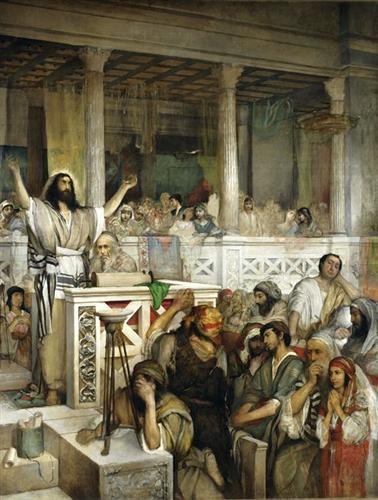
Gottlieb painted this work in 1878, likely in Vienna, while Freud was working there as a physician. Freud and Gottlieb were both 23 years old when they arrived in Vienna to study their respective arts—one, neurology; the other, painting—both drawn to the culture and science that radiated from the Habsburg capital to the far reaches of the Austro-Hungarian Empire. For the first time in history, culture and civilization were opening up to these young Jews thirsting for knowledge, beauty, and modernity.
In this painting by Gottlieb, a certain Jewish man preaches a “new salvation,” a new revelation, a new path to deliverance—itself freed from the chains of an old Judaism, too much attached to the body and its imperfections. Yet, apart from a man on his knees and a woman with a pious expression, all the listeners to the sermon seem bored, or even falling asleep. These are Jews in a synagogue, listening yet again to a sermon full of new promises, but remaining skeptical. With their accumulated disappointments, they undoubtedly prefer to cling to their old Jewish customs.
One of these figures is a self-portrait. Gottlieb seems to identify with these bored Jews, who are reluctant to accept what Jesus preaches—but perhaps also with what the “Enlightenment” of modernity preaches, and its new form of “salvation.” Freud and Gottlieb, like many Jews of their time, were on the one hand drawn to—even dazzled by—the promises of a universal and enlightened salvation. On the other hand, they retained, like the figures in the painting, a hint of reluctance, an inexplicable reserve devoid of pathos, often devoid of any substance, driven by “dark forces.”
Freud’s resistance—even mistrust—toward modernity and the Enlightenment’s idea of progress lies at the heart of the psychoanalytic approach. It also echoes a certain Jewish stance throughout the ages (and particularly since the emergence of Christianity).
The era of Freud’s youth, perhaps more than any other, was marked by a deep belief in culture, progress, civilization, and, more generally, the possibility of achieving harmony. Guided by moral and spiritual ideals—the guarantors of Truth (science, reason, etc.)—humanity would succeed in ushering in a true messianic era. Even when we speak of a secular modernity and a truth grounded in science, the distance from the promises of this preacher is, in the end, not so great. In this painting, Gottlieb expresses his reservations about the Christian religion and its promises; but, more precisely, he expresses them as a Jew—a Jew who hears the preaching of a false messiah.
According to Santner29, the same is true of Freud. While he openly criticizes “religion,” this criticism is directed in particular at Christian theology, which he knew far better than the Jewish tradition. He criticizes religion to the extent that it refers to the idea of humanity’s definitive salvation. As a Jew, Freud expresses his reluctance toward this idea; on the contrary, he aims to work as closely as possible with human beings who remain imperfect. Consequently, his criticism extends to new modern and secular doctrines. These idealistic doctrines, which belong to the same type of theology as Christianity, advocate for a liberated Humanity—one that would certainly have no need for psychoanalysis.
Freud, standing on the brink of salvation through a messianic Bildung, nevertheless decides to remain; to remain, one might say, with the imperfection of the body—the Jewish body that stands in opposition to the Christian spirit, perfect and full of virtues, but also the body in which the word and the symptom, so dear to psychoanalysis, are embodied. Freud distances himself from “modern”/“ideological” visions and turns his attention to everyday life, to the subject in the imperfection that characterizes an existence devoid of absolute points of reference; a subject who, like the Jewish remnant, insists on remaining with what is wrong.
Freud refrains from justifying or changing what is here to make it resemble the references of elsewhere (ideals, utopias, salvation, God). As Jacques Lacan humorously puts it, the question that preoccupies psychoanalysis is not why a patient is silent, but rather how to get her to speak.30 All its actions and interventions are deeply rooted in the “here and now” of clinical practice. Psychoanalytic theory is constantly undergoing changes as a result of encounters with imperfect, sick men and women, and, moreover, men and women whose sickness and suffering seems to resist all cure and all explanation.
Freud criticizes religion to the extent that it refers to the idea of humanity’s definitive salvation. As a Jew, Freud expresses his reluctance toward this idea; on the contrary, he aims to work as closely as possible with human beings who remain imperfect.
Modern medicine, as well as pre-Freudian psychology, seeks to understand and treat through understanding. Freud, on the other hand, drawing on his encounter with his patients’ symptomatic remnants—but perhaps also on his Jewish heritage and background—created a praxis that works with the remnant. Without illusions, but without despair, the psychoanalyst agrees to lend an ear to the various manifestations of the unconscious: slips of the hand, slips of the tongue, dreams. Analysis takes the byproducts, repressed drives and traumas—both minor and major—with the utmost seriousness; it works as closely as possible with what we tend to forget or dismiss as unimportant: “That’s nonsense!”, “It was just a dream!”, “I didn’t mean that,” and so on.
With psychoanalysis, an entirely different approach to these same manifestations becomes possible: we take an interest in them, we take them on, we ask ourselves whether a truth lies within these “errors” that disrupt our daily lives; we ultimately come to terms with a daily life and a psyche disrupted by remnants that cannot be completely resolved.
The Remnant in Judaism
Highly erudite in various fields, yet with only a rudimentary knowledge of Judaism, Freud—perhaps without realizing it—nevertheless hit the mark regarding his Jewish heritage. In his subjective stance—a stance also embodied by his theory—he remains deeply attached to something that has marked Jewish tradition since time immemorial. It is a certain form of acceptance of the remnant and the turmoil it engenders; an acceptance of an existence marked by imperfection; an acceptance of the fact that deliverance may be a long time coming. This acceptance is not accompanied by resignation, but rather by a determination to make something of what remains. Acceptance drives one to act and intervene within this state of imperfection.
Judaism is, certainly, a tradition with a religious foundation. Judaism is, on the surface, a theological discourse; it believes in ideals and seeks harmony between humanity and God. Nevertheless, according to Yeeshay Mevorach,31 this tradition also includes sources and concepts that call this into question; while it sometimes speaks of perfection, it speaks far more often of the Jews’ —and even God’s—capacity to remain in a state of imperfection. In this tradition, man’s encounter with the divine sphere does not take place solely through the path of light—the revelation of the world’s ultimate meaning and truth. In the Jewish tradition, humans encounter God above all through God’s intervention in the most mundane aspects of human life. The relationship between humans and God, in this tradition, is embedded in the minutest details of Jewish law (Halacha), which constitutes the heart of Judaism. Through the law, God disrupts human life rather than providing ultimate meaning to human existence. The law intervenes in human life, disrupting it, but there is never any question of humanity becoming one with the law or with the One who establishes it.
Let us examine an illustrative example.32 The Mishna33 (Baba Batra 1:5) discusses the obligations of the residents of a courtyard toward their neighbors. Among these obligations is the requirement to contribute financially and/or with their own labor to the construction of a gatekeeper’s booth and a gate, which are intended to isolate and protect the courtyard from the open and unknown collective space of the street. This obligation is imposed on the individual (the courtyard resident) by the collective (all the neighbors). It applies even if the private interests of a particular neighbor are thwarted. This is because, according to the Gemara34 (Babylonian Talmud, Baba Batra 7b), which comments on the Mishna, a gatehouse and a gate are generally viewed as “good things”—elements that represent added value for all the courtyard’s residents as a whole.
Nevertheless, the same Gemara presents an objection to this reasoning: “We know of an incident involving a pious man with whom the prophet Elijah used to converse. He built a gatehouse for his home, and Elijah stopped visiting him.” The prophet Elijah, the ultimate symbol of deliverance, stopped speaking to this pious man as soon as he built the gatehouse. Such a gatehouse, therefore, cannot be seen as a positive thing! The commentator Rashi explains that, even though the gatehouse has the positive aspect of shielding the courtyard from passersby on the street, it also acts as a barrier to the voices of the poor and the beggars; once the pious man is shielded from the cries of the poor, he is also shielded from the voice of the prophet who heralds redemption. Elijah seems to be heard only by those who are able to open their ears and hearts to the suffering of the poor who wander the streets, poor who cannot penetrate a safe courtyard’s barriers and gates. The privilege of having deliverance announced to them is reserved for those who can bear to hear the reality of the voice of misery.
It is indeed a lovely story from the Gemara, conveying a very powerful moral message. Nevertheless, Jewish law, in this instance, follows the pure rule of the Mishna, without taking into account the Gemara’s objection. According to Jewish law, a pious man such as the one described in the Gemara must be deprived of his generosity for the sake of his neighbors’ comfort. While the story of the pious man may have its significance and is preserved in the Gemara as a narrative (agada), it has no place in the normative realm (halacha).
Through the law, God disrupts human life rather than providing ultimate meaning to human existence. The law intervenes in human life, disrupting it, but there is never any question of humanity becoming one with the law or with the One who establishes it.
Jewish law, the Halacha, given by God, presents itself as a normative path for normative human beings. However, this does not mean that it claims to establish a natural norm capable of connecting the person who adopts it to his essence, to his proper place in the cosmos, or even to his Creator. While divine law is supposed to embody the divine will, its fulfillment does not, however, aim to purify human character to the point where it, in turn, would embody God on earth.
Thus, the law prescribes actions that, generally speaking, for the “normative” person, disrupt his natural inclinations. Yet this law also does not align with the virtuous traits of the pious person; it also stands in opposition to his inclinations toward generosity. Anyone whose noble character drives him to act for the good of the oppressed without being commanded to do so by the law finds himself, precisely, restrained by the law. The Halacha establishes a collective order. It holds that while the generosity of the pious person is a privilege for him, for the collective, the same generosity is more often a source of inconvenience.
The law rules: “He [one of the residents of a courtyard] can compel each inhabitant of that courtyard to financially participate in the building of a gatehouse and a door to the jointly owned courtyard” (Mishna, Baba Batra 1:5); yet no one is obligated to become pious. And if an individual is already pious by nature, the law may compel him, in the name of the community, to cease being so. In any case, the law requires the pious to keep their piety to themselves and not to impose it on their neighbors.
Divine law subjects all people, both the mediocre and the pious. Yet this is a divine law that does not presuppose the existence of a harmony to be attained. Rather, divine law imposes a disharmony that is necessary for life in society. Its aim, in the Jewish tradition, is not perfection, nor the eradication of poverty, evil, private interests, or the darkest aspects of human nature. It is a law that intervenes, precisely, within this enduring imperfection. Without seeking to free humanity from imperfection, it seeks to make something of that which, in humanity, remains human.35
Although Freud knew almost nothing about the content of Jewish tradition, his stance toward imperfection diverged very little from it. Without aiming to liberate humanity, psychoanalysis also proposes to intervene within its imperfection, to make do with what remains.
Conclusion: A Taste for What Remains
This biographical, theoretical, and even theological analysis of psychoanalysis leads us to the observation of a profound—albeit difficult to pin down—link that unites psychoanalysis with the Jewish heritage of its inventor.
It is thus perhaps not surprising that Freud feared his invention would be perceived as a “Jewish science”; nor that he struggled throughout his life to combat this perception. In 1912, for example, Freud deliberately attempted to separate psychoanalysis from Judaism, seeking to open the psychoanalytic circle to non-Jews. Until then, all of his students had been Jewish. However, his plan to open up the field did not work out as he had anticipated. Very quickly disappointed by his first non-Jewish student, Carl Gustav Jung—in whom he had placed great hope but with whom he eventually broke ties—Freud concluded that this rift was no coincidence. His Jewish identity stood in the way of the universality to which he was trying to anchor his science—and to which he himself sought to belong.
Freud saw psychoanalysis as a project capable of contributing to universal culture and science. Nevertheless, sometimes due to the rejection of others, sometimes due to his own disappointment, he was led to realize that something profoundly Jewish—and therefore unassimilable—remained within his person and his work. Psychoanalysis turned out to be the bearer, unbeknownst to its inventor, of his own Jewish remnant.
From that moment on, Freud’s optimism regarding the progress of science and universal culture became intertwined with a chilling lucidity regarding his Jewish condition. Caught between despair and illusion regarding the Universal, Freud remained on the razor’s edge of lucidity. This did not prevent him from working to make psychoanalysis more than just a practice for and by Jews. On the contrary, it was perhaps precisely by recognizing the inassimilable nature of his Jewish condition that he was able to develop an interest in other forms of the inassimilable, choosing to work as closely as possible with psychological suffering—a suffering so often unassimilable and inexplicable by medical knowledge, and yet one that persists, like a remnant.
If our initial question was “What is it that remains Jewish in psychoanalysis?”, we may perhaps, after these considerations, offer a tentative answer: what remains Jewish in psychoanalysis is, precisely, its taste for the remnant.
- Terms taken, in particular, from FREUD, Sigmund, and PFISTER, Oskar, The letters of Sigmund Freud and Pastor Pfister, 1909–1939.
↩︎ - Joel Whitebook, Freud : An Intellectual Biography, 2017
↩︎ - FREUD, Sigmund, and PFISTER, Oskar, The letters of Sigmund Freud and Pastor Pfister, 1909–1939, op. cit., p. 126.
↩︎ - FREUD, Sigmund, Totem and Taboo (1913), Routledge & Kegan Paul , 1950.
↩︎ - Idem, p. xiii-xiv.
↩︎ - Idem.
↩︎ - In the book cited, Whitebook asserts that Freud “is the essential Jew.”
↩︎ - FREUD, Sigmund. Totem and Taboo, op. cit.
↩︎ - FREUD, Sigmund. The Future of an Illusion (1927), Hogarth Press, London 1928.
↩︎ - FREUD, Sigmund. Moses and Monotheism (1939), Hogarth Press .
↩︎ - SANTNER, Eric L., On the Psychotheology of Everyday Life: Reflections on Freud and Rosenzweig, Chicago, University of Chicago Press, 2001.
↩︎ - FREUD, Sigmund, A General Introduction to Psychoanalysis (1916), p. 251.
↩︎ - Idem.
↩︎ - FREUD, Sigmund, An Autobiographical Study (1925), London, The Hogarth Press, 1959, p. 8.
↩︎ - LEBOVITS-QUENEHEN, Anaëlle, Actualité de la haine, Paris, Navarin, 2020.
↩︎ - Idem, p. 110.
↩︎ - ABITBOL, Sarah, Antisémitisme, Une lecture psychanalytique, Saint-Denis, PUV, 2024.
↩︎ - FREUD, Sigmund, Letter to Martha Bernays, July 23, 1882. L’emphase est ajoutée.
↩︎ - The Yiddish term naches is derived from the Hebrew nacḥat (tranquility). In Yiddish, this term refers to tranquility in the literal sense, but also, more broadly, to the feeling of deep joy, mixed with emotional pride, that one experiences especially toward one’s children or loved ones when they bring honor, success, or fulfillment. Naches is a form of joy characteristic of the Jews of yesteryear, which Freud viewed with a certain detachment, insofar as it is based on the celebration of the small, recurring events of community and private life; it differs from the enthusiasm for progress and the modern joy that depends on it, which is, par excellence, a celebration of the new.
↩︎ - JONES, Ernest, The life and work of Sigmund Freud, vol II, New York, Basic Books , 1955, p. 44. The emphasis has been added.
↩︎ - FREUD, Sigmund. Totem and Taboo, op. cit.The emphasis has been added.
↩︎ - FREUD, Sigmund, Letter to Barbara Low, April 19, 1936.
↩︎ - REGNAULT, François, Notre objet a, Paris, Verdier, 2003.
↩︎ - Idem, p. 8.
↩︎ - Idem, p. 17.
↩︎ - Idem, ibid.
↩︎ - This story is recorded in the Babylonian Talmud, tractate Giṭṭin, 56a–56b.
↩︎ - The first occurrence of this expression—which has become a classic in rabbinic literature and is repeated in many of the prayers in the Siddur—dates back to the Bible: “I will gather you in, O Jacob, and bring you together, O remnant of Israel!” (Micah 2:12).
↩︎ - SANTNER, Eric L., On the Psychotheology of Everyday Life: Reflections on Freud and Rosenzweig, op. cit.
↩︎ - LACAN, Jacques, Le Séminaire, livre XI : Les Quatre concepts fondamentaux de la psychanalyse, Paris, Seuil, 1973, p. 20.
↩︎ - See: MEVORACH, Yeeshay, The Jew of the Edge: Towards Inextricable Theology (in Hebrew), Tel Aviv, Resling, 2018 ; Theology of Absence: On Faith after Chaos. Tel Aviv (in Hebrew), Resling, 2016 ; The Ark: A Return of the Final Repressed Fantasy (in Hebrew), Tel Aviv, Resling, 2020.
↩︎ - This example is discussed at length by Yeeshay Mevorach in Ha-adam hu mikre shel shem (“Man Is an Instance of a Name,” in Hebrew), Jerusalem/Alon Shevut, Mey-Barukh, 2023. We bring here Mevorach’s analysis in a simplified form.
↩︎ - The Mishna is the first written record of the Oral Torah, compiled in the third century under the authority of Rabbi Yehuda ha-Nasi; it concisely and casuistically compiles the teachings of the sages of previous generations concerning various areas of Jewish law. The passage we are examining here concerns rules of civil law, specifically laws governing neighborly relations.
↩︎ - Written in Aramaic as a commentary on the Mishna, the Gemara refers to the collection of discussions, analyses, and elaborations by the sages of the 4th–6th centuries (the amoraim) on the Mishna; together with the Mishna, it constitutes the Talmud.
↩︎ - Emmanuel Levinas also emphasizes that “remaining human” is a fundamental requirement of the Jewish tradition. For him, Judaism does not aim to sacralize humanity or to withdraw from the world, but rather to establish and maintain an ethical relationship between humanity and divine holiness. “For Judaism, the goal of education is to establish a relationship between humanity and the holiness of God and to keep humanity within that relationship” (LEVINAS, Emmanuel, Difficile liberté, Paris, Albin Michel, 1976, p. 31).
↩︎

Déborah Gutmann-Krausz
Déborah Gutmann-Krausz is a clinical psychologist and psychoanalyst in Paris.

David Krausz
David Krausz is a clinical psychologist and psychoanalyst in Paris. He is writing a doctoral dissertation at the Université libre de Bruxelles (ULB) on the topic “Reason and Unreason in Talmudic Law: On the Use of the Concept of ‘Madman’ (shoṭe) in the Approach to Reason (da‘at) and Its Limits.”