Purim 1962, or when we started dressing up as Jews
What do we see in the mirror of a mask when young German Jews dress up as Hasidim? Using photographs from Purim in 1962, Cilly Kugelmann explores the internal tensions within German Jewish identity, between efforts to reclaim its history and ironic detachment.
At the beginning of 1962, a vague sense of unease hung over Germany. News of the escalating crisis in Fidel Castro’s Cuba had already had an impact: panic buying, capital flight, stock market crashes, and fears of a new war. The Eichmann trial, which ended with a death sentence on December 15, 1961, did not yet lead to a comprehensive social debate, but for the first time drew widespread media attention to the crimes of the Nazi regime. Fritz Bauer, who had informed the Israeli secret service of Adolf Eichmann’s whereabouts because he considered prosecution in Germany unrealistic, initiated the Auschwitz trial in Frankfurt shortly afterwards – a trial that challenged the fragile order of a society in avoidance mode in the young Federal Republic.
How these developments affected the members of the Jewish community in Frankfurt am Main is not documented. It is possible that the situation remained abstract for many. In any case, the young people who came to the Jewish community’s youth center at Baumweg 5–7 in colorful costumes in March 1962 to celebrate Purim probably noticed little of the political tension and social shifts of those years.
Two years earlier, the Jewish community had established the youth center – an institution that soon entered into a certain competitive relationship with the Zionist Youth. Both groups represented different ideas of Jewish youth education and collective belonging. Their coexistence thus reflected an internal reality within the community: on the one hand, there were German-Jewish returnees from exile, emigration, or concentration camps; on the other, there were survivors from Eastern Europe, so-called displaced persons, who had not emigrated after the founding of the State of Israel and the relaxation of immigration regulations in the US in 1948 and 1952. While the Zionist youth group was mainly made up of children of German-Jewish origin – almost all of whom were born in Israel or other countries of emigration – the youth center was mainly attended by children of displaced persons who were born in Germany. It was one of the contradictory realities of the early postwar Jewish period in Germany that the children of displaced persons were born in Germany—in a country that their parents did not consider a permanent home—while, conversely, the children of German Jews often did not return to Germany with their parents until they were teenagers. Origin and place of birth intersected—and could no longer be clearly assigned.
In the Zionist discourse of the 1950s, the Eastern Jewish “type” was considered a burdened symbol of the diaspora—his piety, poverty, and imagined weakness were diametrically opposed to the ideal of the new Hebrew field worker.
Three photographs from this Purim festival have been preserved as casual testimonies to Jewish youth in the early postwar period. They are found, rather by chance, in a private photo album. In light of today’s debates about representation, cultural attribution, and the visibility of marginalized groups, two of these images take on new meaning: they show four young people dressed as Eastern European Hasidic Jews—a manifestation of Jewish life that was not only largely absent from West German public life in those years, but had already been viewed with distance or rejection in the pre-war period due to its visibility.
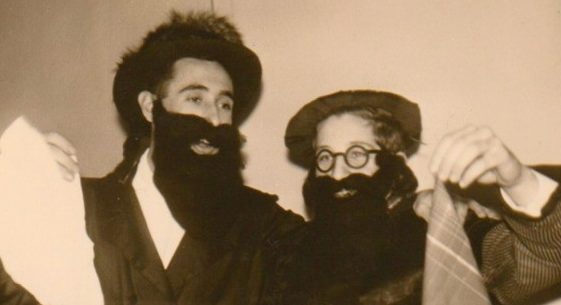
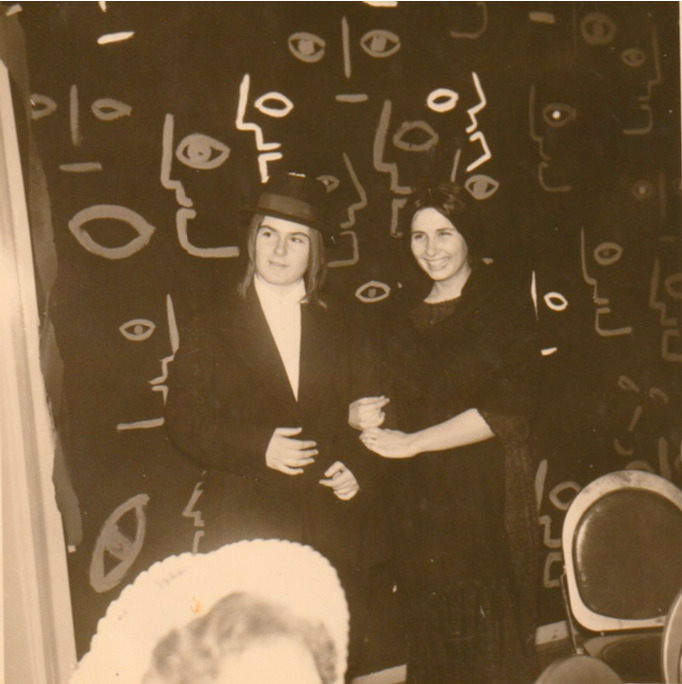
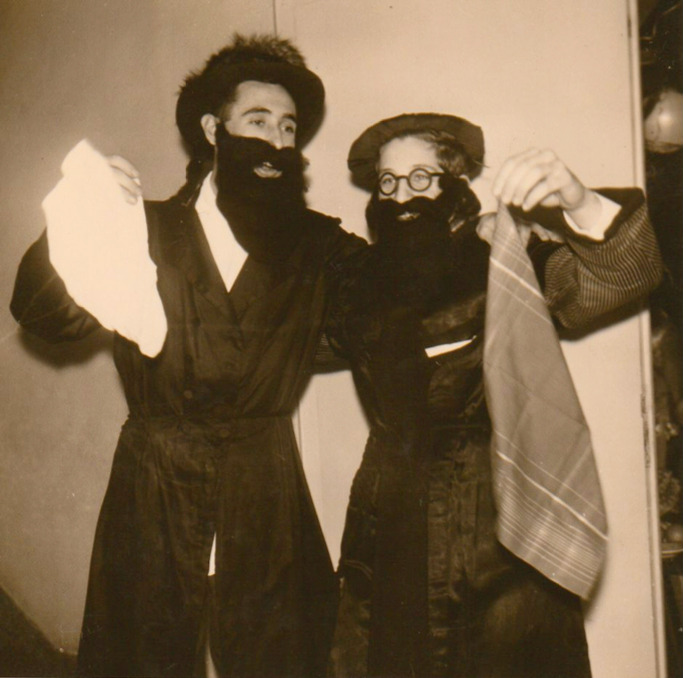
Two of the photographs show two 16-year-old youths – daughters and sons of German Jews who had returned from Israel – whose costumes are coordinated in pairs. In the first picture, we see two young women in the role of Orthodox Jews from Eastern Europe: one, wearing a hat, shtreimel, and kaftan, embodies a man, while the other plays his wife. In the second picture, two young men are standing, also in Eastern Jewish costume – with shtreimel, false beards, and hinted sidelocks. They are holding handkerchiefs, as seen in photos of dancing Hasidim at weddings.
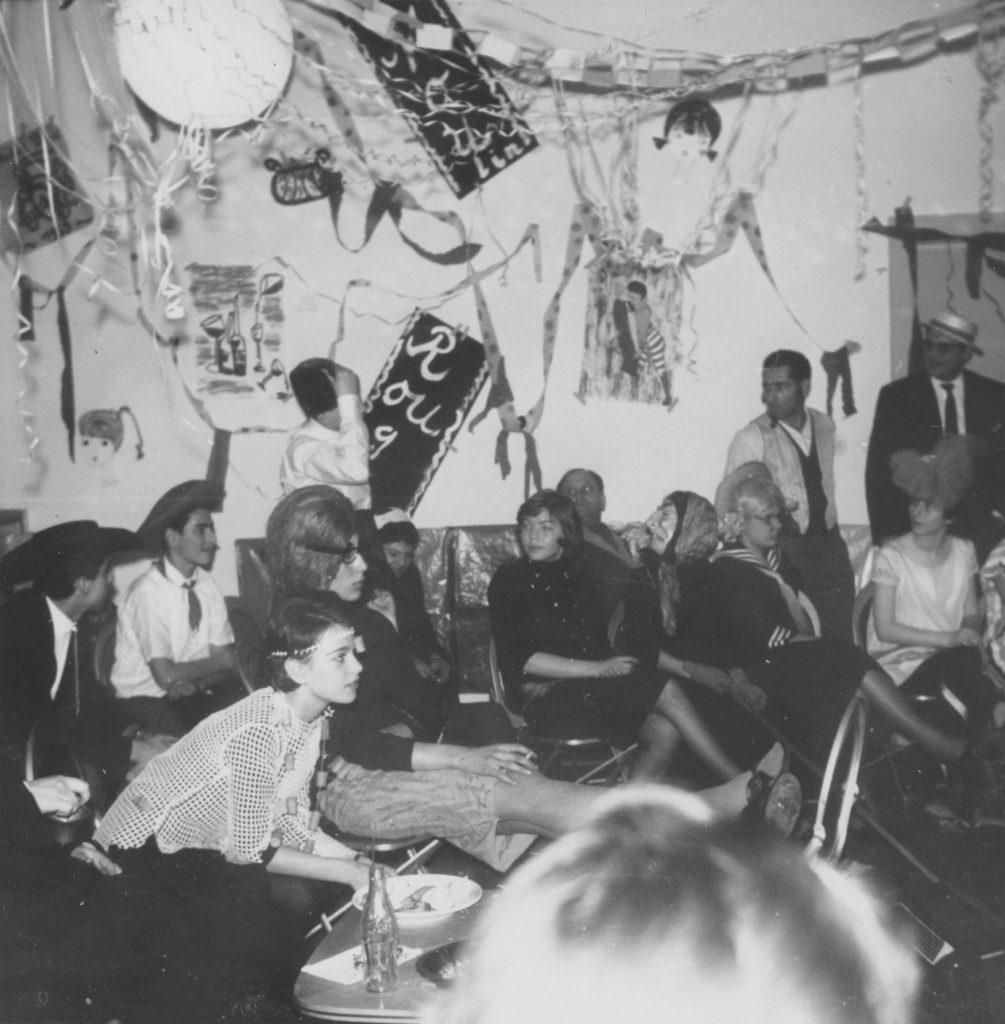
The third photograph shows the party room and a section of the young audience watching a performance that cannot be clearly identified. The young people have made costumes in the style of the time – from hinted Mexican hats to popular sailor outfits to gloomy carnival masks, wigs, and large headdresses made of stiff tulle.
The costumes in the group photo refer to an iconographic grammar of the postwar period: a visual repertoire of popular carnival aesthetics in 1950s Frankfurt.
The Hasidic costumes, on the other hand, do not follow this pattern. They do not mark a cultural outsider status, but rather refer to a “self” that is simultaneously staged at a distance—as a difference within the community, as a return to a form of Jewishness that was probably not highly valued by parents or grandparents. In retrospect, this can be seen as a tentative, ironic staging of intra-Jewish self-questioning after the Holocaust.
The costume becomes a medium for intra-Jewish self-questioning – between closeness, embarrassment, and the need to encounter oneself in the mirror.
The Purim Hasidim in the photos are children of Jews who were able to flee to Palestine in the 1930s to escape the Nazi regime and who returned to Germany after the amendment of the Federal Compensation Act of 1956 to claim compensation. Many of them stayed for various reasons. They were part of the Zionist youth movement founded by Ichud Habonim, a socialist-oriented association with roots in the British and Palestinian labor movements. As “madrichim,” or youth leaders, they tried to make the “chanichim”, or younger members, enthusiastic about a future in Israel, if not necessarily about joining a kibbutz. The fact that this rarely succeeded was less due to the lack of persuasive skills on the part of the “guides” than to the appeal of apple wine, social democracy, and regulated student loans.
It is remarkable that it is precisely in this context that the disguise as an “Eastern Jew” appears.
In the Zionist discourse of the 1950s, the Eastern Jewish “type” was considered a burdened symbol of the diaspora—his piety, poverty, and imagined weakness were diametrically opposed to the ideal of the new Hebrew field worker. It is all the more surprising that this very figure became the model for a masquerade.
Perhaps it was more than just a game: a symbolic appropriation of a repressed part of German-Jewish history, as idealized in the “Jewish Renaissance” by thinkers such as Martin Buber and Franz Rosenzweig. Both tendencies are echoed in the Frankfurt youths’ disguise: a romanticized return to the past – and at the same time its ironic refraction.
Dan Ben-Amotz’s literary grotesque Masks in Frankfurt (1970) opens up a second area for reflection. In a monologue, the protagonist runs through all the usual carnival costumes – Tarzan, Cossack, Arab sheikh – until he has a “devilish idea”: Why not dress up as a Jew? Why, he asks, is it obvious to dress up as a Scotsman or a Frenchman, but not as a Jew – especially in Germany?
What is deliberate provocation in Ben-Amotz’s work appears in the photographs of the Frankfurt Youth Center as a gesture of unclear intent. But both scenes – one literary exaggeration, the other documentary – revolve around the same unsettling question: What does it mean when Jews dress up as Jews? What exactly becomes visible when a minority slips into the mask of its own caricature – and on Purim, of all days?
Today, Ben-Amotz’s satire seems to echo the uncertainty of a generation that tried to navigate between self-assertion and performative distance. The photographs do not show deliberate satire, but rather a similar ambivalence. In both cases, the costume becomes a medium for intra-Jewish self-questioning – between closeness, embarrassment, and the need to encounter oneself in the mirror.
What exactly becomes visible when a minority slips into the mask of its own caricature?
This ambivalence was evident once again in 2019: the cover of a special edition of SPIEGEL magazine on “Jews in Germany” featured a Hasidic Jew from Berlin’s Scheunenviertel neighborhood. Many Jewish voices protested. The image, they argued, reproduced a cliché of Jewish life that had little to do with the reality of Jews today. It came across as nostalgic exoticization—an aesthetic strategy of distancing. What SPIEGEL inadvertently revealed was the fragility of Jewish visibility in Germany: the dilemma of being recognized either in stereotypes or not at all.
The young people of 1962 did not have a SPIEGEL cover in mind. And yet they asked a similar question: Who are we? Who were we? And who do we show when we put ourselves on display?
There is nothing ridiculous about their costumes, but rather a tentative, playful, almost tender approach to Jewish history. The mask is not a protection here – but a mirror. A mirror in which one recognizes the other – and oneself.