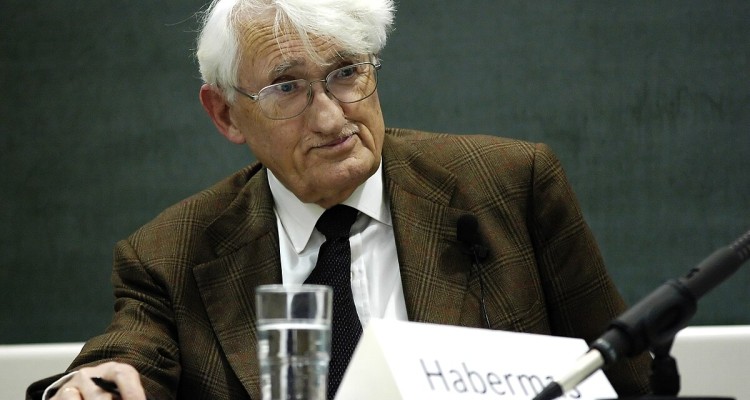
For philosopher Bruno Karsenti, the form taken by the contemporary rise in antisemitism – which is organized primarily around denial – shows that Jews are being put on trial once again. In this lecture, given at the Shoah Memorial on July 4, 2025, during the annual training seminar for university “Racism and Antisemitism” advisors, he sets out to open our eyes so that we can recognize what is new about the current situation. A question then emerges, addressed as much to Jews as to Europe: that of their persistence.

Antisemitism is a phenomenon so unanimously condemned in our societies that one wonders about the reasons for the controversy sparked by its objective analysis and the actions taken to combat it.
The intensity of this controversy alone is a sign of the times, a sign of our unease. This unease stems from the impression that between pre-World War II European societies, where antisemitism was an openly expressed opinion that had its place in public debate, and post-Shoah societies, where this is no longer the case, something persists while undergoing a transformation. Jews are still a problem, the only difference being that they no longer do so simply by themselves, eliciting positive or negative attitudes toward who they are, but also, and perhaps above all, through the conflicts that arise over how to deal with the hatred they still face. A significant part of the problem centers on the extent of this hatred, whether or not its seriousness is acknowledged, and the implementation of a resolute policy to counter it. In short, Jews are now a problem through the awkward fight against antisemitism, an antisemitism that no one can ignore, but which no one agrees on how to see and describe in the same way. This seems to be the lot of liberal democratic societies post-Shoah, as we speak.
When antisemitism does not become a public problem
Therefore, talking directly about what should or should not be done, said or not said about the phenomenon cannot be the best method. We must proceed differently. In order to address contemporary antisemitism, we are forced to go through the embarrassment of addressing it, since it is an integral part of the phenomenon. In short, since antisemitism and the act of protesting against it, its actual manifestations in words or deeds, and the genuine or feigned outrage and condemnation they provoke, are inextricably intertwined.
This is what I will do to begin with: a series of remarks that are less points of entry into the problem at hand – the current trends in antisemitism – than remarks about what obscures it. And it is only in a second step, once the conclusions of these negative and indirect remarks have been drawn, that I will try to speak more directly about the phenomenon.
First remark: while everyone agrees on the important figures, namely that antisemitism is a phenomenon that has been growing steadily since the beginning of the 21st century, that the discourse expressing it is spreading at an impressive rate, that its proportion among all hate crimes based on religion or origin is exorbitant, that the type of violence it it triggers extends to violent crime and the murder of children, and that since October 7, we have reached a new peak, the synthesis of all this data into a genuine public problem is not self-evident. For there to be a public problem, certain conditions are necessary that are not being met. The will of political leaders is certainly one of these conditions – and the recent conference on antisemitism held under the auspices of the ministry responsible for combating discrimination, as well as the legislative texts presented in the assemblies, mark a turning point in this regard. But the sociology of public issues teaches us one thing: such will is only effective if it is backed by what sociologists call a “public culture”.
Jews are now a problem because of the difficult fight against antisemitism, an antisemitism that no one can ignore, but which no one agrees on how to see and describe in the same way.
Public culture is the level at which the “problematization” of facts takes place within society. A wide variety of social actors are involved in this process, belonging to various groups, political and non-political, academic and non-academic, educational and non-educational, media and non-media… For this to happen, there must be a relatively clear understanding at the level of collective consciousness there must be relative clarity about what antisemitism is as a specific problem, that is, as a phenomenon that undermines communal life as a whole, but which does so in relation to the exact problem it represents. Or, in other words, which does so insofar as it expresses hatred of that very particular minority, the Jews.
However, I believe that despite all the signs that we would like to see this happen, we are still not there yet. Antisemitism, as a socially and politically worked out and shared issue, has still not become a “public problem”.
Racism and antisemitism: the vice of two extremes
This brings me to my second point: the impasse seems to depend primarily on the difficulty that public culture (or collective consciousness, if you will) to address the distinction between racism and antisemitism today, a distinction that it cannot avoid making, as if something were preventing it from completely reducing the latter to the former, while at the same time their complete decoupling seems absurd, if only because of historically proven racial antisemitism. We will have to come back to this. What we can say at first glance, since we are here examining a new development in recent times, is that saying the words “racism and antisemitism” in the same breath, or denouncing “antisemitism and all forms of racism” in grand declarations, has become much more ambiguous than it was in the 1980s and 1990s.
There are two reasons for the embarrassment that this causes, which together form a trap from which it is very difficult to escape.
On the one hand, we are faced with the fact that racism undeniably finds its echo on the far right in the argument for the selective defense of Jews, and Jews alone among minorities, against their supposed enemies of choice, who are said to be members of other minorities, particularly post-colonial ones. A strategy has been established at this extreme end of the spectrum, which politicizes the fight against antisemitism in a counterproductive way, obscuring the fact that the fate of every minority, whatever it may be, determines the fate of all minorities in terms of rights and integration.
On the other hand, we are faced with the fact that anti-racism, brandished by the far left as a prominent cause and the culmination of the fight against domination, is indeed becoming a vehicle for antisemitism. This happens in three ways: either negatively, by erasing the specificity of this type of hatred (because although the fate of each minority potentially concerns all minorities, their fates are not equivalent); or by complacently or unconsciously conveying antisemitic tropes under the guise of opposition to the elites (denying the resurgence of this phenomenon is disingenuous); or, finally, and most importantly, by refusing to acknowledge the reality of antisemitism at work among those who are designated and who designate themselves as “dominated” and “racialized” (this last point overlaps with the second, but is not to be confused with it).
We can see the vise in which the fight against racism and antisemitism is caught. The problem boils down to the fact that while the distinction between the two terms, racism and antisemitism, is being challenged on the one hand, their decoupling is being advocated on the other, and that both positions allow, or even encourage, both racism and antisemitism.
At this stage in the fight against discrimination and persecution in general, it is urgent to rework the distinction between racism and antisemitism, which is becoming analytically crucial.
Let us insist on this point. It is highly insufficient, given the current scale of antisemitism at the other end of the spectrum, to simply say, as if to reassure ourselves, that antisemitism still exists on the far right behind blatant racism (more often culturalist-differentialist than biological), and to emphasize that this antisemitism is expressed as soon as we scrutinize opinions closely enough. current scale of antisemitism at the other end of the political spectrum. We must therefore bring to public attention the fact that antisemitism is experiencing its most significant surge outside the far right, that it is often driven by anti-racism spearheaded by the left , which in turn provides the far right with easily exploitable arguments in its political strategy of selectively defending one minority against others.
This observation leads to an important conclusion: at this stage in the fight against discrimination and persecution in general, it is urgent to rework the distinction between racism and antisemitism, which is becoming analytically crucial. But the difficulty is that it is crucial precisely in a context where we know that the gesture is being watched for as a godsend for the wrong reasons. In short, where the risk of instrumentalization is real.
But since invoking this risk of instrumentalization serves precisely to ensure that antisemitism is not discussed, or is discussed only as a form of racism that does not distinguish between minorities, obscuring the antisemitism that reinvests anti-racism, we have absolutely no choice. It is only on the basis of this re-explicitized distinction – a re-explicitization that, it should be noted, neither the far left nor, in truth, the far right, which must confine itself to postulating it, want – that a global fight against discrimination and persecution, which all democracies sorely need, can be rebuilt. On the contrary, if we start from their junction under the heading of a generic hatred of otherness in all its forms, we find ourselves trapped. For this abstract universalism, whether well-intentioned or not, is in any case outdated in view of the real conditions.
Anti-Zionism, political Islam, and new breeding grounds for hatred
This brings me to my third preliminary indirect remark on why the fight against antisemitism is so difficult to articulate. It concerns the assessment of the role of political Islam, as an international doctrine with intranational relays, in current antisemitism. This role can take different forms. It is often combined with motives that have nothing to do with Muslims and Islam, but it also sometimes draws on available theological and political sources, which it interprets according to its own agenda. Whether we consider it in its international expression or in its manifestations at the national level, it is absurd to deny that it is a facet of contemporary antisemitism.
The problem here is that the necessary analysis of this issue, at the level of collective consciousness or public culture, is once again blocked. The main cause seems relatively clear. The blockage is due to the rise of anti-Zionism, which in recent years has become a position whose influence has grown significantly. October 7 was, in this respect, merely a spectacular amplifier and accelerator, whose effects took less than a day to unfold and did not need the crimes committed by Israel in Gaza in the months that followed to manifest themselves.
What is new is the widespread acceptance of the intrinsic illegitimacy of Zionism, which allows clearly antisemitic positions to spread and renew themselves.
What I would like to note, as far as we are concerned, is that here too we are a long way from the 1970s and 1980s, when anti-Zionism was part of what was known as Third Worldism, in support of anti-colonial national emancipation struggles. A double movement has taken place, again in the space of twenty-five years. On the one hand, we have seen the terms “Zionism” and “colonialism” become closely linked in large sections of progressive opinion, far beyond the radical positions held by small groups. This fusion took place against a backdrop of staggering ignorance of the respective national histories of the populations involved and a drastic simplification of what falls under the heading of colonialism. On the other hand, a second underlying trend has been the systematic suppression of any questioning of the nature of the supposed liberating forces, even as their national project has clearly degenerated into a reactionary Islamist-style religious program – a program in which the abolition of all Jewish sovereignty, and even of all Jewish existence in the Middle East, is a unifying creed that nothing can shake.
Of course, the link between Third Worldism, antisemitism, and Islamism is not new in itself. One need only think of Roger Garaudy’s book, The Founding Myths of Israeli Politics, published in the mid-1990s by Aaaargh. What is new, however, is the widespread acceptance of the intrinsic illegitimacy of Zionism, which allows radical positions of this kind, clearly antisemitic, to spread and renew themselves. The consequence of this is that the fight against antisemitism must necessarily go as far as reaching this common ground of rejection of legitimacy.
This is where we grasp a fundamental point: this background consists of opinions that do not consider themselves antisemitic and that see absolutely nothing wrong with the constant confusion between anti-Zionism and criticism of Israeli policy. That this, in what is strictly speaking denial, is one of the main breeding grounds for antisemitism. Yet this is the case. For this reason, regardless of its tautological turns of phrase, the IHRA’s definition of antisemitism should be welcomed for its relevance: because it has given this factor its rightful place, it remains the best support we have at our disposal at the moment. Its merit, in fact, is that, without causing confusion, it correctly guides our view of antisemitism, of which anti-Zionism is now the channel. To deny this, as the “Jerusalem Declaration” that was opposed to it, is to turn our backs on the real problem, once again for fear of instrumentalization. But as before, invoking the risk of instrumentalization is denounced as a strategy to cover up the objective fact of antisemitism lodged in anti-Zionism. That there is something real behind the instrumentalization, that instrumentalization is only possible on the basis of reality, is what the denunciation of instrumentalization seeks to obscure. Since October 7, faced with the explosion of this reality, some signatories of the Jerusalem Declaration have realized this, which has prompted them, more or less explicitly, to retract their statements.
The breeding ground for current antisemitism consists of opinions that do not consider themselves antisemitic and that see absolutely nothing wrong with the constant confusion they make between anti-Zionism and criticism of Israeli policy.
So, while today we must start from the distinction between racism and antisemitism in order to rework the overall picture, here, on the contrary, it is imperative to make clear the exact point where anti-Zionism and antisemitism intersect, their deep correlation. This must be done without conflating one term with the other, without brandishing the accusation that all anti-Zionism is ipso facto antisemitic, but by confronting anti-Zionism with an explanation of its premises. And in doing so, exposing the fact that there is no justification for anti-Zionism today — if by that we mean a position that goes beyond simply criticizing Israeli policy to rejecting the very right of the State of Israel, as established in 1948, to continue to exist — that there is no position of radical criticism of this kind that does not have to reckon with the resurgent antisemitism, through the idea that it is one of the pillars around which the entire Jewish people’s existence has been built that they want to destroy. This work of unmasking anti-Zionist reasoning has been masterfully carried out by Julia Christ in the pages of K. Review, and I simply invite you to read it.
The European “Jewish fact” and the French singularity
Finally, one last indirect remark. It is both the simplest and the most difficult to explain. Put simply, it stems from a refusal to see who the Jews are. To see who they are, not abstractly as a timeless collective subject, that mythical and fantasized other onto whom many projections have been made possible throughout history, but as a minority group with its own history. A history in which Europe was the center of gravity in the modern era, until the Shoah, and in which, in the post-Shoah era, a certain reconfiguration of its polycentric existence took place, distributed throughout the world in different Jewish centers. In this post-Shoah polycentrism, as we know, it is Israel and the United States that occupy by far the most important place. But we would be very wrong to forget that France has nonetheless been unique, because of the substantial cultural and spiritual life it revived after the disaster.
This concerns us first and foremost, and I would like to dwell on this point for a moment. France is not just any country for Jews. It never has been, but we can say that what was true yesterday is even more true today. This singularity of the French Jewish center has become more pronounced in the contemporary era, thanks to the avoidance, despite Vichy, and then thanks to the migrations linked to the decolonization processes of the 1960s.
The fact that France appears, from this period onwards, to be the only Jewish center in Europe to have more Jews after the destruction than before is something that is not sufficiently noted. And yet, we can gauge the significance of this fact as soon as we state it in black and white and try to understand what it means. Here, in the revolutionary country that triggered the civil and political emancipation of Jews – a proposition to which Jews adjusted as if to the gradient of their modern destiny – their persistence after 1945 took the form of a renaissance. The verb “to persist” took on a meaning other than that of “to survive”. And this happened differently than in Israel and the United States. For, compared to these two very large centers, the French Jewish center is affected by a unique trait: whether it likes it or not, it is up to it to embody every day the factual denial that European Jewish existence has no future after the Shoah. Or that the “destruction of the European Jews”, to borrow the sober and clear title of Raul Hilberg’s book, was not sanctioned in every part of Europe by their disappearance, or by a mere residual existence.
We must relearn how to see, and at the same time show others, who the Jews are. What prevents us from doing so, apart from the fear of making statements that are “exclusionary” to others, is the risk of reactionary appropriation of the argument, which amounts to selecting a “good minority” over others who are then stigmatized as unassimilable.
However, if this statement strikes us, it is because we can sense the effort required to make it fully understandable, contrary to everything that obscures it today. There is therefore a European Jewish fact, and the French situation is the privileged angle from which we can grasp this reality. This fact is inseparably sociological and historical. It has a present density, but this density, or “facticity,” is due to the fact that it reflects a long history that continues, beyond all the faults and chasms. This history is that of a very particular minority, whose trajectory is obviously marked by the hatred, discrimination, and persecution to which it has been and continues to be subjected – antisemitism – but which is not limited to this, the paradox being that this negative aspect is inseparable from a positive one: the Jewish contribution to the European project itself, considered in all its scope and its emancipatory vocation for individuals and peoples.
While drafting the report I participated in this year as part of the Assises contre l’antisemitism (Conference Against Antisemitism), I was able to gauge the extent to which talking about “European Jewishness” or “Jewishness in Europe” “ offends sensibilities. Unfortunately, the expression was rejected, and the more vague term ”Jewish worlds” was chosen instead. Again, it is not difficult to understand why.
The fear is always the same, as with the overly marked distinction between racism and antisemitism, or the conjunction between anti-Zionism and political Islam: there is a fear that speaking in this way will offend other minorities, whose degree of “facticity” is not as recognizable, that is, who cannot claim the same incorporation into European history and the processes of national emancipation that it represents. Furthermore, if we take this argument a step further, there is a fear that Europe’s colonial and post-colonial history will be relativized, that its dimension, which is just as constitutive of modern Europe but in a fundamentally different sense from the history of the Jews, will be pushed into the background, and that the crimes and oppression that are woven into it will be obscured.
This is indeed a difficult task, as these pitfalls are not fictitious. But it is essential today to overcome avoidance if we are to see clearly the reality of contemporary antisemitism. For here we reach the root of the problem: if the specificity of current antisemitism is so difficult to identify, it is not because other victims come forward to protest against the oblivion that has befallen the crimes and suffering that concern them specifically, an oblivion supposedly attributable to the shadow that the Shoah casts over the overall representation of European crimes. This thesis, that of competition in the recognition of evils, is superficial, and merely repeating it achieves nothing. The real problem is Europe’s current inability to analyze itself in all its dimensions, that is, to distinguish the different threads that make up its real composition, in which the various minority groups present have been involved in ways that are irreconcilable with each other.
Among these groups are the Jews, as a unique minority. Not focusing on unraveling this singularity of minority status that Jews embody, not trying to understand and make others understand what this Jewish variation of minority status entails – where, and this is an important part of the problem, it is minority status as such that is at issue – is to deprive ourselves of any means of moving forward. We must therefore relearn how to see, and at the same time show others, who the Jews are.
What prevents us from doing so, apart from the fear of making statements that are “exclusionary” to others, which I am well aware of, is the risk of reactionary appropriation of the argument, which amounts to selecting, as has already been pointed out, a “good minority”, to endorse it by decreeing it as already “domestic”, as opposed to others who are then all the more easily stigmatized as unassimilable. The fact that it is not a question of assimilation and domestication, but rather of integration and internal differentiation within a political society that is renewing itself, is obviously enough to disqualify the argument. At least if we adopt, as I believe is absolutely necessary on these issues, a consistent social-democratic position. In any case, to those who are concerned about this risk, we will respond as before: systematically invoking the argument of instrumentalization is both a political and a moral mistake. For it presupposes that the fact of instrumentalization matters more than the reality of what is being instrumentalized, thus covering it with a veil of modesty: antisemitism as such, the Jewish fact as such. On the contrary, we must pierce through all the screens that stand between our gaze and what is, if we want to combat antisemitism and restore the historical consistency of the Jewish fact.
Let us recapitulate the obstacles that our preliminary remarks have revealed: a deficiency in public culture regarding the fact that antisemitism is a problem for everyone (and not just a small segment of society); an inability to distinguish and articulate correctly between racism and antisemitism, where, under the pretext of facile universalism, the salient features of the latter are dissolved in the good conscience conferred by the fight against the former; the pathology of anti-Zionism which, with or without bad faith, fails to perceive what it conveys in terms of rejection of the persistence of the Jews; and finally, a reluctance to restore the European meaning of the “Jewish fact” in the post-Shoah era in which we find ourselves, that is, after the reconstruction of both Jewish existence in Europe and the European project, which was elevated to a higher consciousness of itself after 1945.
Finally, armed with all this knowledge, can we say something more direct about the antisemitism we are currently facing? So far, we have seen it take shape in the background. Can we now lift the veil and address it head-on, grasp it at a glance?
This is possible if we start from what we have just seen about the Jewish question and the reluctance to acknowledge its uniqueness.
From the ancient trials of the Jews to the European “never again”
When we consider the various trials of the Jews throughout their long history, both the post-exilic period, which, through migration, found its main home in Europe, and the period between the late 18th and late 19th centuries, which was marked by emancipation, that is, their integration into nations as subjects with rights equal to all others, two major blocks emerge. The whole question, debated by philosophers and historians, is to know what remains and what changes from one bloc to another, whether the word antisemitism can already be used in the pre-modern period, what changes with its racialization and its determination as discrimination and persecution that is more social than legal and institutional, since the lives of Jews take place in supposedly egalitarian national societies.
It must be repeated that the denial of antisemitism is just as active as antisemitism itself, whether overt or covert. And that it is expressed both in good faith and in bad faith.
I will not intervene in this debate, which revolves around the long-term articulation between predominantly religious anti-Jewish hatred and ‘rational’ antisemitism, based on scientistic, if not scientific, arguments, where inequality is reestablished against a backdrop of equality. However, it seems to me that there is a contrast between two forms of hatred, whose logics can obviously be combined – the products of these combinations overlapping in time – but which are nonetheless distinct in their principles.
For a long time, the case against the Jews has been what I would call a “case for separation”. They do not want to hear the good news; they do not want to merge into the inseparable human and divine unity embodied in the body of Christ – the defining body of the Church in its Christian form. They do not want to “join us”, the “us” being not only the majority, but also seeking to be totalizing under the aegis of Christian universalism, irritated by the resistance it encounters from those who say “no”, clinging to their initial affirmation – renewed, as the key word of the hatred directed at them, in their “obstinacy”.
From the perspective of this very old hatred, due to unbearable separation and unacceptable refusal to share meals, it is certain that secular national modernity has changed many things. By integrating Jews into the nations under construction, and by ensuring that another kind of baptism, this time non-Christian, was accepted by Jews (sometimes reluctantly, sometimes enthusiastically, without prejudging the gradation between the two), a paradigm shift took place. So much so that one might have believed that hatred had been extinguished. This was not the case, and what antisemitism still means to us can be understood above all from this point onwards. The trial that Jews underwent was less a trial of separation than a trial of integration – in other words, almost the opposite. Integration, but a distorted integration, an incorporation denounced as corrupting and pathological. They say they are joining the history of all, they claim to be playing the game of citizen equality, but it is to better advance their particularistic interests in the background, to conspire in the shadows, to divert the movement to their advantage, to act to dominate the world. Or even to corrupt the purity of national communities, to introduce a pathogenic foreign element, to precipitate degeneration, putting the greatest danger to the unity that the “majority” us intends to embody by realizing itself in the form of the nation.
Europe has set itself the goal of overcoming both anti-Judaism due to separation and antisemitism due to corrupting integration. By rebuilding itself in each of its nations and bringing them together around common values, Europe has placed itself under the banner of “never again”.
From unbearable separation to misguided integration, the persecution of Jews became more complicated and intense. Continuously resounding, it drew on hatred manufactured in the folds of modern socialization. As soon as it was in a position to take over the state apparatus and define its axis, the worst happened. The Shoah was the culmination of modern antisemitism, which killed two-thirds of European Jews across the continent.
Precisely because of these two classic trials of the Jews, post-Shoah Europe sought and still seeks to be a conspiracy. This tacit resolution did not come about overnight, but the post-war decades gradually imposed it: Europe set itself the goal of overcoming both anti-Judaism due to separation and antisemitism due to corrupting integration. By rebuilding itself in each of its nations and bringing them together around common values, Europe has placed itself under the banner of “never again.” And it is equally remarkable that it did so by positively conceiving of the function that the Jewish state, Israel, came to fulfill once it was founded. In short, it finally gave credit to Zionism realized. It is legitimate for there to be a state dedicated to the defense of Jews, given that it is not possible to rely on modern non-Jewish nations to ensure absolutely that this type of discrimination and persecution, which befalls a structurally minority group that is by definition overexposed, will never culminate in the repetition of the crime.
All the more so since antisemitism has by no means disappeared. In post-Shoah Europe, it has continued to resurface in new forms.
Usually, when we talk about ‘new antisemitism’, we focus on these new forms and their mutations: the right-wing and left-wing Holocaust deniers of the 1970s and 1980s have been joined by radical Islamists, right-wing and left-wing populists, neo-Christians, and others. The indirect route we have taken here was precisely intended to change our approach. For what is “new” lies above all in a new breeding ground, a different set of issues, which makes the overt actions or words of these visible antisemitic agents possible. Above all, in this much broader breeding ground, it must be repeated that the denial of antisemitism is just as active as antisemitism itself, whether overt or not. And that it is expressed both in good faith and in bad faith.
The right question, to which this detour leads, is therefore whether a new trial of the Jews has taken place in the temporal and mental space of post-Shoah Europe, or whether the new actors are still resorting to the same logical mechanisms from which hatred has historically sprung, and whether we are only dealing with the two previous trials, perpetually rearranged.
I believe that there is indeed a new logic, and that, although it has been perceptible since the early 2000s, the post-October 7 period has laid it bare. But we still need to describe and name what is there for all to see.
The new antisemitism is one that seeks to usher in the post-post-Shoah era and to breathe in a world where Jews do not persist.
This is the logic of a new Kafkaesque trial. Jews are put on trial – and like Joseph K. in The Trial, they struggle to understand what it is all about. They are on trial not because of separation, nor because of corrupting integration, but because of persistence. They persist in being Jewish, they persist in calling themselves Jewish, they persist in being Jewish, which has no place in a world where it is certainly encouraged and welcomed to express and assert one’s identity, but precisely not in this way.
This is the level of analysis, the exact grain of the phenomena that must be reached in order to deal head-on with antisemitism today. What is so problematic about this persistence, depending on its form, for certain sections of European opinion? Answering this question is a research program in itself, in political philosophy as well as in the social sciences.
Antisemitism after the post-Shoah era: hating persistence
What we can simply say at the outset is that in this case, persisting in calling oneself Jewish and persisting in the modern project of Europe are inseparable. Jews persist in post-Shoah Europe, and by persisting, they ensure that Europe persists. Outside Europe, this double persistence has essential support in the realization of Zionism and the continued existence of Israel. By persisting, Jews uphold persistence as a cardinal virtue of Europe, which has managed to rebuild itself despite everything. The fact that European consciousness, and more generally Western consciousness, which has been forged since the European center, can no longer bear to see itself in this way, that it stumbles over the question of its own persistence, is, I believe, a powerful and new cause of contemporary antisemitism. This brings us back to the point made above: the difficulty of recognizing the density and depth of the Jewish reality, of which realized Zionism is a part, however questionable it may be, but as a constitutive feature of Jewish persistence, as a mode, specifically a political mode, of Jewish existence in the post-Shoah era.
Jews now feel this hatred for their persistence as an almost permanent sting. Since October 7, it has become the painful backdrop to their condition.
Jews, but not only them. Let’s say all those who feel that around the persistence of the Jewish fact, and the revulsive reaction it triggers, a political and social crisis of great magnitude is unfolding. I will conclude my presentation with what I consider to be a revealing example of this hatred and its sting. A hatred whose bearers often do not consider themselves antisemitic, but who in fact are deeply so, and who, in my opinion, are the true substrate of current antisemitism, beyond the commonly identified antisemitic actors. In retrospect, we can see that this was the general tone of the time, like a starting signal for what we constantly see today in the manifestations of antisemitism that are endlessly recorded and erased.
This kickoff was the tearing down, in the many public places where they had been posted – notably in schools and universities, supposed bastions of democratic reflexivity – of posters reproducing the portraits of the hostages who had been kidnapped by Hamas. What motivation is at work in this angry act, in this gesture of violence that is inseparably symbolic and real? Looking only at the act itself, what is the intention of the person who tears up the portraits of men, women, and children whose fate is that of Jewish captives in the hands of kidnappers who have the power of life and death over them?
This has been pointed out several times in K. – both against anti-Zionists and against the Israeli government’s policy during the war. A hostage is not just any kind of victim. Man, woman, child, or elderly person, he or she is someone who is expected, without being entirely certain, to still be “alive”. Let us assume that he or she is still alive and can return to live among his or her loved ones. The Jewish hostage is therefore very precisely the eminent bearer of the persistence of Jewish life, embodying the hope that “Jews” are still alive somewhere. Did those who tore down the hostage posters know what they were doing? Yes and no. Attitudes must vary between individuals, between denial as (unconscious) rejection and simple concealment (conscious). What can be said in any case is that something within them knew, and they acted accordingly. That something that knows within them is their confused awareness that they want to leave Europe and the post-Shoah world. But this departure does not come without a price, in terms of repetition, symbolic in their case, real for the killers of Jews who have not failed to act over the last two decades.
Ending with these words in this very place, the Shoah Memorial, will, I hope, make my point more easily heard than elsewhere. The new antisemitism is one that seeks to usher in the era of the post-post-Shoah and to breathe in a world where Jews do not persist – invited, at best, to dissolve into the diversity of multiple identities, all reduced to subjective preferences that say nothing about our shared world. It is the antisemitism of a redoubled after, of an after after. Its target is the persistence of Jews. It is this that must be stopped.
Bruno Karsenti
Support the work of K. Click here to make your annual donation to K. Review.