On the limitations of a critical theory of antisemitism rooted in the categories of the radical left
In 'Critical Theories of Antisemitism', the historian Jonathan Judaken seeks to reshape the study of antisemitism by grounding it in critical theories of race, postcolonialism, and decolonialism. For Daniel J. Solomon, this endeavor is less a matter of scholarly innovation than a political project: adapting the concept of antisemitism to the needs of the contemporary anti-racist left. His harsh review criticizes the book for downplaying the distinct nature of anti-Jewish hatred, minimizing certain inconvenient facts, and conflating historical analysis with ideological compromise.
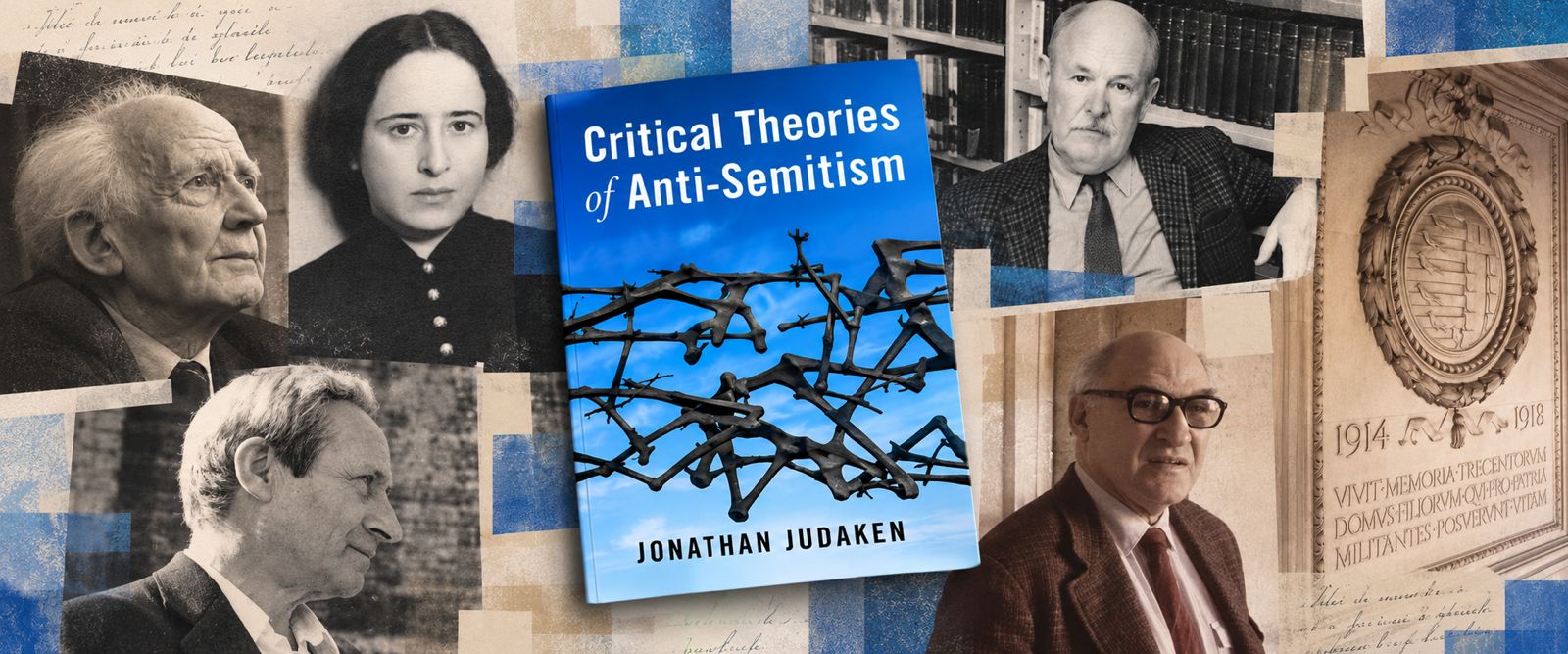
The disaffection between the Jews and the left has been long in the offing. The chagrin d’amour–stemming from the rise of ‘intersectionality’ and sundry forms of race-essentialism—has in the last three years devolved into an acrimonious separation. Before the divorce decree can be finalized, Jonathan Judaken seems intent on saving the doomed union. In his Critical Theories of Antisemitism, released by Columbia University Press in June 2024, the scholar of French intellectual history takes measures that are less than heroic.
The volume’s first pages reveal it to be more partisan manifesto than academic monograph. Antisemitism, the author informs us, must be reworked because the activist left cannot incorporate the concept into its ‘antiracist’ framework. Scholars of antisemitism bear much of the blame for this state of affairs, having, per Judaken, walled themselves off in a ghetto of “exceptionalism, eternalism, teleology, apologetics, and theoretical naivété.” The solution lies in embracing “a history of enlaced pasts” in which studies of antisemitism engage with “colonialism, immigration, and xenophobia”; decenter themselves vis-a-vis “Islamophobia, Negrophobia, homophobia, and xenophobia”; and draw succor from the “cognate areas, such as critical race, postcolonial, and decolonize theorizing.” Attempting to expand the canon of antisemitism and critical studies, Judaken probes the writings of seven figures or groups: Jean-Paul Sartre, the Frankfurt School. Hannah Arendt, Talcott Parsons and Zygmunt Bauman, Jean-Francois Lyotard, Leon Poliakov, and George Mosse.
According to Judaken, a professor at Washington University in St. Louis, ’antisemitism’ – which has tended to supplant ‘anti-Semitism’ as a term of art – suffers from Jewish exceptionalism.
Before delving into each of these cases, Judaken makes his most ambitious–and extravagant–conceptual argument. ’Antisemitism,’ the learned professor avers, needs to be rubbished because it sounds a false note in his anti-racist Letter to the Galatians. Scholars ought to replace it with ‘Judeophobia’-a designation supposedly free of antisemitism’s association with nineteenth century scientific racism. And shorn, too, of ‘exceptionalism.’
According to Judaken, a professor at Washington University in St. Louis, ’antisemitism’ – which has tended to supplant ‘anti-Semitism’ as a term of art – suffers from Jewish exceptionalism. Both Jews and Arabs were in the nineteenth century described and deprecated as ‘Semites.’ Resisting ‘antisemitism,’ he trumpets, “rebuffs the assertion of the unique targeting of Jews made by those who refuse to hyphenate ‘anti-Semitism.’”
Divining the author’s intention here proves elusive. The most charitable reading would have him argue that “antisemitism” should be rendered as “anti-Semitism” in order to underscore how hatred of Jews has often depicted them as ‘Asiatic refugees’ or the kith and kin of Arabs. A more disturbing interpretation might see his move here as a sop to Arab Muslims who plot a semantic escape from charges of antisemitism in declaring themselves “Semites, too.”
Whatever the case, this maneuver elides the distinction between Semitologists and professional antisemites. Figures such as Ernest Renan did couch their antisemitic (i.e., anti-Jewish) beliefs in the context of a broader study of Near Eastern tongues and cultures, including Hebrew and the Jews. But professional antisemites, Wilhelm Marr and Lanz Liebenfels inter alia, never cared about other ‘Semitic’ groups–Armenians and Arabs occur but scarcely in their corpus. Marr’s antisemitismus transmuted a descriptive term designating Near Eastern languages and cultures into a normative term exclusively denigrating Jews. Dilating on some Orientalists’ deprecation of Jews and Arabs as ‘Semites’ is to ignore the lexical and conceptual innovation of the antisemites.
Critical Theories of Antisemitism procession of stumbles continues its march. Take, for example, the assertion that ‘Judeophobia’ is less determined than ‘antisemitism.’ The designation- favored no doubt because it can be rattled off in a litany including Islamophobia, Negrophobia, homophobia, et al.-is no less a coinage of its time and place than ‘antisemitism.’ ‘Judeophobia,’ as Judaken acknowledges elsewhere, first appeared in Leon Pinker’s Autoemancipation (1882), a Zionist appeal for Jews to escape the aberrant condition of dispersion in an age of nation-states. Pinsker did not draw solely on his career as a doctor in employing medical terminology, but also on the positivist trend of the time in which social ills were compared to the organic defects and the sociologist was positioned as a healer of society. Ditto for Judaken’s frequent and disturbing analogizing of antisemitism to “an autoimmunitary disease.”
In the same introduction, he asserts that “it was not until the rise of the Nazis that scholars fully turned from focusing on Jews and Judaism as the objects of condescension toward the subjects who castigated them in an effort to offer a critical analysis of what accounted for anti-Semitism.” Judaken’s statement would come as a surprise to Saul Ascher, the second generation Berlin maskil1 who raised the alarm about the connection between antisemitism, Volkism2, and anti-rationalism in his 1815 broadside, Germanomania. Bernard Lazare, too, might find this assertion bewildering. Lazare, Dreyfus’ champion of the first hour, published a landmark investigation into antisemitism in 1894 that concluded “the causes of antisemitism… exist not because of the Jew alone, nor because of his neighbors alone, but principally because of prevailing social conditions.” Inquiries into the character of the antisemite is a genre as old as emancipation itself.
The political nature of the oeuvre bleeds through in the introduction. Judaken posits an equivalence between left-wing antisemites and his opponents in Jewish studies, faulting “on one side” those who cite “the theory of intersectionality to represent Jews as the embodiment of power and privilege, preempting their inclusion in antiracist struggles” and those on the “other side” who “insist on the connections of Judeophobia and Islamophobia, Negrophobia, homophobia, and xenophobia.” He likens “the demonization of Jews… in the Islamic world” to “anti-Arab racism [among] Jews.” This is the academic and historical correlate to post-October 7 pronouncements denouncing “antisemitism, Islamophobia, and all forms of racism”–the facts on the ground in both cases be damned. He also warns that it is a “problem” to call out comparisons of Israel to the Third Reich as antisemitic “since analogies to the Nazis are commonplace on both sides of the Israeli-Palestinian conflict.” The thrust of these comments is that descriptions of antisemitism must be jury-rigged to suit the usages of the activist left (for whom defaming Israel as the heir of the Nazi regime has become axiomatic).
The author reaches the summit of his explanatory powers in discussing Sartre’s treatment of antisemitism. His overview of Anti-Semite and Jew, examination of the figure of the Jew in Sartrean existentialism, and elucidation of Sartre’s general theories of racism prove felicitous. Praising Sartre’s “multidirectional antiracism,” Judaken–whose first book was titled Jean-Paul Sartre and the Jewish Question—passes over the obvious conclusions from the evidence he himself adduces. Sartre’s ‘multidirectional antiracism’ was panned by the post-colonial intellectuals he courted, among them Edward Said and Frantz Fanon’s widow, Josie. Said attributed the existentialist titan’s support of the Jewish state to him being “afraid of seeming antisemitic” or feeling “guilt about the Holocaust.” Josie Fanon demanded that Sartre’s preface to The Wretched of the Earth be excised from future print editions. Despite Sartre’s anti-colonial bona fides and concern for Arab immigrants in France, the slightest expression of sympathy for Jewish national aspirations transformed him into persona non grata. Anti-Zionism was–and is-a litmus test for entrance into the subaltern pantheon.
Judaken’s assessment of Hannah Arendt is impaired by an omission of critical facts. Characterizing the emigré philosopher as a ‘self-hating’ Jew, he avers, is simplistic and vituperative. No matter the historiographic errors of The Origins of Totalitarianism and Eichmann in Jerusalem, both works have proven generative. Her “interactionist” account of antisemitism, despite the risk of victim-blaming, does protect the field against essentialism and restores agency to both perpetrators and targets.
Critical Theories in Antisemitism is itself an ideological construction–to prevent a schism between the Jews and the left.
Fair enough. But Judaken does not leave it there. He transfers the Arendtian mantle to Judith Butler, whose “principled anti-Zionism” tracks on the same lines as Arendt’s critique of Israel. Rather than castigating them as “self-hating Jews,” the detractors of both women should understand them as “conscious pariahs,” itself a post-emancipation Jewish persona. But here is the rub: while the charge of self-hatred is indeed crude, Arendt did traffic in antisemitic motifs and rhetoric. Reporting Eichmann in Jerusalem, she sketched the courthouse scene as such in a private letter: “On top, the judges, the best of German Jewry. Below them, the prosecuting attorneys, Galicians, but still Europeans. Everything is organized by a police force that gives me the creeps, speaks only Hebrew, and looks Arabic…[T]hey would obey any order. And outside the doors, the oriental mob, as if one were in Istanbul or some other half-Asiatic country. In addition, and very visible in Jerusalem, the peies and caftan Jews, who make life impossible for all the reasonable people here.” Vindicating Butler via Arendt is a rather dubious stratagem to say the least.
The trend of dropping inconvenient facts continues in the author’s treatment of Leon Poliakov. The pioneering historian of the Holocaust and antisemitism penned the first great chronicle of European Jewry’s destruction, Harvest of Hate (published in the French in 1951 as Le breviaire de la haine). Poliakov, whose volume laid down many of the theses about the Vichy Regime and the Holocaust that Robert Paxton and Michael Marrus would flesh out two decades later, devoted the latter stretch of his career to a multi-volume history of antisemitism in the West and the Islamic world.
The reader of Critical Theories in Antisemitism could easily forget about this research into Arab-Muslim antisemitism. The author mentions the second volume of the French historian’s History of Antisemitism, From Mohammad to the Marranos, in a hurried and parenthetical manner. He spends most of the chapter engaging with Poliakov’s theories on antisemitism in the Western tradition. This is no coincidence, for in Critical Theories of Antisemitism, Arab-Muslim antisemitism appears mostly as a Western import. He ventures that “institutionalized discrimination in Europe… may result in attacks on Jews” and that starting in the thirties “the demonization of Jews became more common in the Islamic world, drawing on the European anti-semitic arsenal.” Judaken acknowledges the existence of “Islamic anti-Judaism,” but for him the active ingredient in Arab-Muslim antisemitism seems to be transplanted.
Judaken demonstrates a lack of self-awareness in his analyses of Poliakov. The author implies that the French historian’s conception of antisemitism as a veiled form of anti-Christianity was a pander to Catholic intellectuals like Jacques Maritain and Francois Mauriac. Jewish, Catholic, and Protestant luminaries’ articulation of a shared Judeo-Christian civilization in the face of Nazi antisemitism is an ideological construction, in which Poliakov might have participated for strategic reasons. But Critical Theories in Antisemitism is itself an ideological construction–to prevent a schism between the Jews and the left–and one whose lineaments show far more than Harvest of Hate’s.
Another problematic aspect of the French historian’s legacy–his connecting the dots in the seventies between antisemitism and anti-Zionism–is not so much discussed as summarily dismissed. Judaken alleges that Poliakov–the purported originator of the ‘new antisemitism’ theory–leaves no room for “evidence based criticism of Israel.” No quotations from De l’antisemitisme a l’antisionisme are produced to sustain this charge.
The profile of George Mosse demonstrates substantive engagement with the cultural historian’s corpus. Judaken ties Mosse’s early-career monographs on sixteenth and seventeenth century England to the themes developed in his later oeuvre, notably The Crisis of German Ideology and Toward the Final Solution. He also highlights the central concerns of Mosse’s works, among them the power of middlebrow and popular culture, pre-rational and irrational drives, and the rituals and pageantry of nationalism in shaping fascism.
Judaken’s “multidirectional antiracism” amounts to nothing more than an ecumenical scapegoat theory, and an appeal for society’s various Others–Jews, Muslims, blacks, etc.–to assemble behind the same barricade.
Mosse’s account of race-hate, elaborated in the America of the sixties and seventies, tends to emphasize the similarities between anti-black racism and antisemitism. Judaken vaunts the Mossean pairing of blacks and Jews, but this rates as one of the weaker points of the cultural historian’s compendious and magisterial index. Mosse and Judaken ought to have paid greater attention to Leon Poliakov’s delineation of anti-black racism and antisemitism. Poliakov, an interlocutor and peer whom Mosse cited, observed that anti-black racism denigrated its objects as animals–members of the lowest rung on the chain of humanity–while antisemitism dramatized the Jew as fleshly embodiment of Lucifer–devious, resourceful, super-human.
Billed at the outset as a pathbreaking inquiry into “post-Holocaust Judeophobia,” Critical Theories in Antisemitism reveals its paucity in its conclusion. “Authoritarians personalize social problems by demonizing weak and vulnerable populations,” Judaken sermonizes. We must à la Sartre combat with equal fervor the accusation that “Zionism is racism” and “the global apartheid of the new racism that targets immigrants, and other minoritized [sic], disempowered people.” “Critical theory,” he sums up, “illuminates a path beyond the reductive binaries and allows us to properly locate the global threats that we all must face together.” The author’s “multidirectional antiracism” amounts to nothing more than an ecumenical scapegoat theory, and an appeal for society’s various Others–Jews, Muslims, blacks, etc.–to assemble behind the same barricade.
Judaken might be waiting there a while. His overtures to the radical left were rebuffed in an appraisal of his book printed in the Los Angeles Review of Books. Poetess Safa Khatib dressed him down for his “lack of imagination,”“[commitment] to the exclusion of non-European historical frameworks,” and “distortion of Levantine history.” All of this was code for Judaken’s failure to fully disavow Zionism.
Critical Theories in Antisemitism could achieve the status of reference work among some Jews–those ready to barter a toehold on the Western left against their own dignity. The tome does indeed merit a read, just not as a contribution to the academic literature of antisemitism studies. Instead, one ought to examine it as a primary document in the tortuous and tormented history of integration, and the elusive dream of dissolution into a majority society.
- The term “maskil” (Hebrew: משכיל, plural: maskilim) refers to a supporter or representative of the Haskalah, the Jewish Enlightenment that developed in Europe beginning in the second half of the 18th century, particularly in German-speaking and Eastern European communities. ↩︎
- Volkism (German völkisch, from Volk, “people”) refers to a set of nationalist, ethnocultural, and often racist movements that emerged in the German-speaking world in the late 19th century and were particularly influential through the 1930s. ↩︎