Bitter Love. Israel or the Shores of Intimacy (3/4)
Episode 3: Shmulik at the Checkpoint
A first adult trip to Israel should allow one to move beyond maps, books, and preconceived notions. In Jerusalem, a meeting with Daniela, an activist with Mahsom Watch, leads the narrator from the Hebrew University—still marked by the 2002 attack—to the West Bank checkpoints. Palestinian reality ceases to be a cartographic abstraction: it becomes waiting, humiliation, blocked roads, but also unease in the face of the limits of even the best-intentioned activism.
I want my first trip as an adult to be that of an informed observer, not just someone enjoying the beach and the scenery. “Go beyond the postcard.” So I set out to meet the right people: those fighting against the occupation and who are committed to building or sustaining Jewish-Arab relations. I crisscross the country, attend a lecture by Anarchists Against the Wall, and visit the Jewish-Arab village of Neve Shalom–Wahat as-Salam (on the recommendation of left-wing Catholics in Grenoble). A friend of my parents’ gives me the number of a woman named Daniela. He mentioned that bringing her two bars of chocolate from France would make her happy. She is three times my age. Once in Jerusalem, I call her without much enthusiasm , resigned to meeting a grandmother—far removed from my fantasy of flirting with a student involved in some small activist group or another. She suggests we meet at the library of the Hebrew University of Jerusalem, where she is in charge of the Italian and French collections.
I park my little rental car and explore the campus perched atop the hill, with its breathtaking view of the desert. On the fourth floor, I find myself amid the shelves of Latin languages. I enter a small office with faded wallpaper, its walls adorned with old posters from the Committee to Save Venice and the Avignon Festival. There are also a few issues of the Nouvel Observateur. “Is that you, Samuel?” In her early sixties, with short, curly gray hair, Daniela smiles at me. Born in the early 1940s in Mandatory Palestine, she comes from an Orthodox Polish family. Divorced, she no longer covers her hair. In the spring of 2004, she takes me to lunch at the cafeteria. In her sing-song voice, she tells me about her work, her political activism, and her tough love for Israel. I can’t remember how the topic of her wanting to call me Shmulik from now on—as a way of adopting me—came up in the conversation. Yet, something made me feel restless and uneasy as I ate my salmon steak and rice. She noticed my unease. After placing our lunch trays on the rolling carts, we left the Frank Sinatra cafeteria. My eyes squinted against the brilliant light reflected by the Jerusalem stone.. Softly, she says: “Yes, it happened right here. I didn’t tell you before because you would have been afraid.”
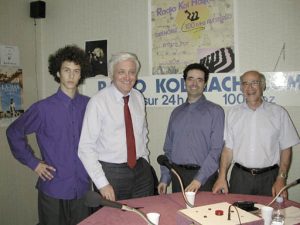
Two years earlier, a bomb planted by a Palestinian employee sympathetic to Hamas had killed several students, including a Frenchman, David Gritz. The university, founded in 1925 with the support of Albert Einstein and Sigmund Freud, became a target. David Gritz’s death has come to mean much more than just his death. It represents the attack itself, but also the flesh-and-blood connection between French Jews and Israel. Many Jews—myself included, though it wasn’t obvious at first—can say to themselves: it could have been me that day in the cafeteria; it could have been a cousin, a friend, or an acquaintance from the Scouts or Hebrew school. By attacking that place, Hamas declared war on all of us—war because we wanted to learn Hebrew, regardless of our views on the conflict or on Israel. When I criticize Israel and its military might, a little voice tells me: “You didn’t experience the terror that day at the Hebrew University, so don’t judge as if you were still pontificating on the radio.”
Daniela is active with Machsom Watch, a women’s organization whose members go—sometimes at dawn—to the military checkpoints (called Machsom in Hebrew) in the West Bank to document the restrictions on freedom and the humiliations endured by Palestinians. She invites me to join her group a few days later.
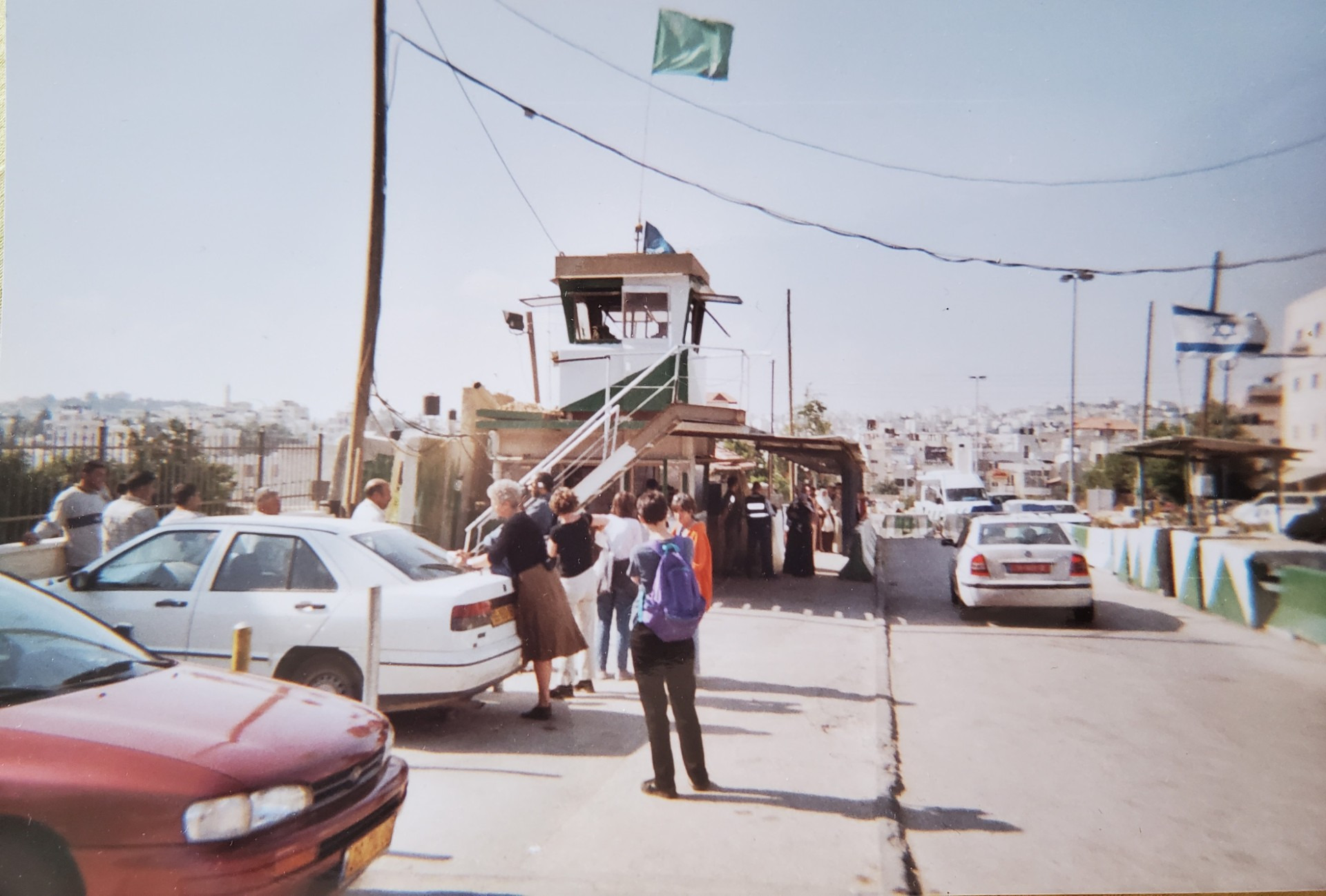
Just a few minutes’ drive from Jerusalem, we’re in the West Bank. We pass Palestinian villages with their small white buildings with flat roofs and water cisterns, and spiffy Israeli settlements with their tidy red roofs. The separation wall, which was then part of the policy to combat suicide bombings, had been under construction for two years. Sections of concrete stretch for hundreds of meters, blocking the landscape, but in many places, the barrier is not yet complete. As we approach a large military checkpoint, Qalandia, we pull over to the side of the road and walk the rest of the way to meet up with the group of women. There are about ten of them, ranging in age from 50 to 70—they could all be my mother. Each one kisses the others and then greets me. It’s understood that I’ll stay a little in the background. They walk toward the checkpoint that Palestinians must pass through: concrete blocks, metal gates, a few soldiers up front, and others in a guardhouse. Daniela’s group greets them in Hebrew. A few dozen Palestinians are waiting patiently, identification documents in hand. The Oslo peace process has fragmented Palestinian territory into a palette of colors like Elmer the patchwork elephant: major Palestinian cities in Area A, under Palestinian self-rule and thus without any Israeli presence (generally dark green on maps), Area B under mixed control, where Palestinians manage civil affairs and Israel has complete military freedom (lighter green), and Area C, under full Israeli control, where the settlements, the Jordan Valley, and the border with Jordan are located. This last section, often desert, is marked in yellow. I’ve spent hundreds of hours in my apartment in Grenoble, studying Philippe Rekacewicz’s maps from Le Monde diplomatique, tracing my finger along the Green Line, the outlines of potential Israeli withdrawals, and the discussions about what 1% of the West Bank represents. I have in mind the shape of the Jericho Autonomous Zone, which resembles a strange seahorse. These agreements, these colored zones, and these percentages thus embodied the promise that my adult life would unfold with, in the distance, an Israel at peace with an independent Palestine.
The group of women strikes up a conversation with the Palestinians: How long have you been waiting? Are there any medical emergencies? Did the soldiers tell you why only one turnstile is open? Have you been subjected to intimidation or unjustified refusals to let you through?
The Palestinians respond in Hebrew and point out that the Mahsom Watch activists are unable to do the same in Arabic. At times, they negotiate with the soldiers if the wait seems unjustified, call higher-ups in the military—with whom they’ve built relationships over the years—and then step back a bit to allow the soldiers to let certain Palestinians through without losing face. They photograph the situations, document new blocked access points: here, three stone blocks block a road once accessible to Palestinians; barbed wire hinders access to a grazing area. All of this will feed into the endless maps of the occupation. The afternoon passes.
I watch, unsure of what to make of it all. Similar small groups gather from Tel Aviv or Jerusalem several times a week and make the rounds of the major checkpoints. Daniela forces me to face this simple and often forgotten reality: if I were to apply for Israeli citizenship, I would automatically have more rights than all the Palestinians I see at the checkpoints.
I think back to my scribbles on maps, imagining the outlines of a possible future Palestinian state. Serious abstractions, detached from the physical world. For those standing before me, a line drawn slightly above or slightly below—a border between their home and that of the Israelis—means sealing the fate of their children’s school, a hill with olive trees and pastures, a valley, the memory of parents who were refugees.
But who are we trying to help here? Ensuring respect for Palestinian rights or protecting the souls of soldiers caught up in the machinery of the occupation? “You know, Shmulik, a while back, some women from Machsom Watch baked cakes and brought them here.Not for the Palestinian women and children waiting in the sun! No, for the soldiers! Because deep down, we see our own sons in them. The discussion was very heated, because we’re not here to be their nannies—we’re a human rights NGO.”
On every visit, I tag along Daniela for one or two afternoons in the territories. A young man, observant and admiring of an all-female group that works primarily with male soldiers. Why do I keep going? To confront reality? To learn from her? So that I can talk about it—and perhaps even boast about it—when I return to France?
These excursions are repetitive and far from enjoyable. I feel out of place.
Gradually, after a trip to the occupied territories, Daniela invites me to her home for coffee or a Shabbat meal. She lives in Katamon, a modern religious neighborhood in West Jerusalem. Life shifts into a serene and complete calm starting Friday late . This world of serene Orthodoxy is unfamiliar to me. I’d been stuck with the militant religious types in the Scouts who made me snicker with their debates over whether or not to pre-cut toilet paper for Shabbat. I mocked them with the self-righteousness of progress in the face of superstition, invoking Amos Guitaï’s movie Kadosh. Shabbat with the Scouts was a time apart—pleasant and also a glimpse into a previously unknown eroticism—but I struggled to shake off the sense of heaviness. In Jerusalem,
I discovered that observing strict rules can bring meaning and a much-needed sense of comfort. Restriction sets one free. Without a phone or the internet for 24 hours, I wandered among the imposing Ottoman houses whose Arab inhabitants had fled or been driven out in 1948. But I can’t show up empty-handed in Katamon. From my very first visit, Daniela asked me for Lindt chocolate, including at least one bar with almonds. One day, at the corner convenience store—where I might run into historian Zeev Sternhell in sandals and shorts—I find the same bars. I think I’ve gotten off easy and fulfilled my obligation. Returning a few months later, I arrive with my hands in my pockets. Daniela is furious. “But I’m going to get some for you today right next door!” She gets annoyed as she puts away the groceries, then fixes me with a piercing stare: “That’s not the same thing at all. How can you pretend not to understand?” She’s right. The effort of bringing something back on a plane—that’s what makes all the difference. It doesn’t matter that the cocoa is the same but comes in Hebrew packaging. It’s the fact that it comes from France that counts and shows that I’m doing something for her. That evening, before going to bed, she says to me: “Are you mad at yourself? Then tomorrow will be better—that’s what love is.” The hatchet is buried in the early morning, and we can once again share roasted almonds or a huge yellow-and-green grapefruit.
Samuel Ghiles-Meilhac
Samuel Ghiles-Meilhac holds a Ph.D. in sociology and teaches at Sciences Po Paris. He is the author of "Le CRIF De la résistance juive à la tentation du lobby de 1943 à nos jours" [The CRIF: From the Jewish Resistance to the Temptation of the Lobby, 1943 to the Present] (Robert Laffont, 2011) and "Le Monde diplomatique et Israël Histoire moderne de l'Etat juif à travers un journal de référence" [Le Monde diplomatique and Israel: A Modern History of the Jewish State Through a Leading Newspaper] (Le Manuscrit, 2006).