From the Imaginary Jew to the Non-Existent Jew
Excerpts from A Brief History of Antisemitic Beliefs and Prejudices (Seuil, April 2026)
In A Brief History of Antisemitic Beliefs and Prejudices, which was just published in France, Pierre Savy and Lisa Vapné offer a synthesis of the long history of fantasies, stereotypes, and hostilities directed against Jews. The authors trace the circulation of a dozen prominent motifs from antiquity to the contemporary era, examining whether or not they stand out within the broader context of racist and antisemitic discourse. The excerpt we are publishing in an exclusive English translation explores the paradox of an imaginative frenzy that cannot help but produce fictional Jews, as if the antisemitic person could not do without those he would like to see disappear.
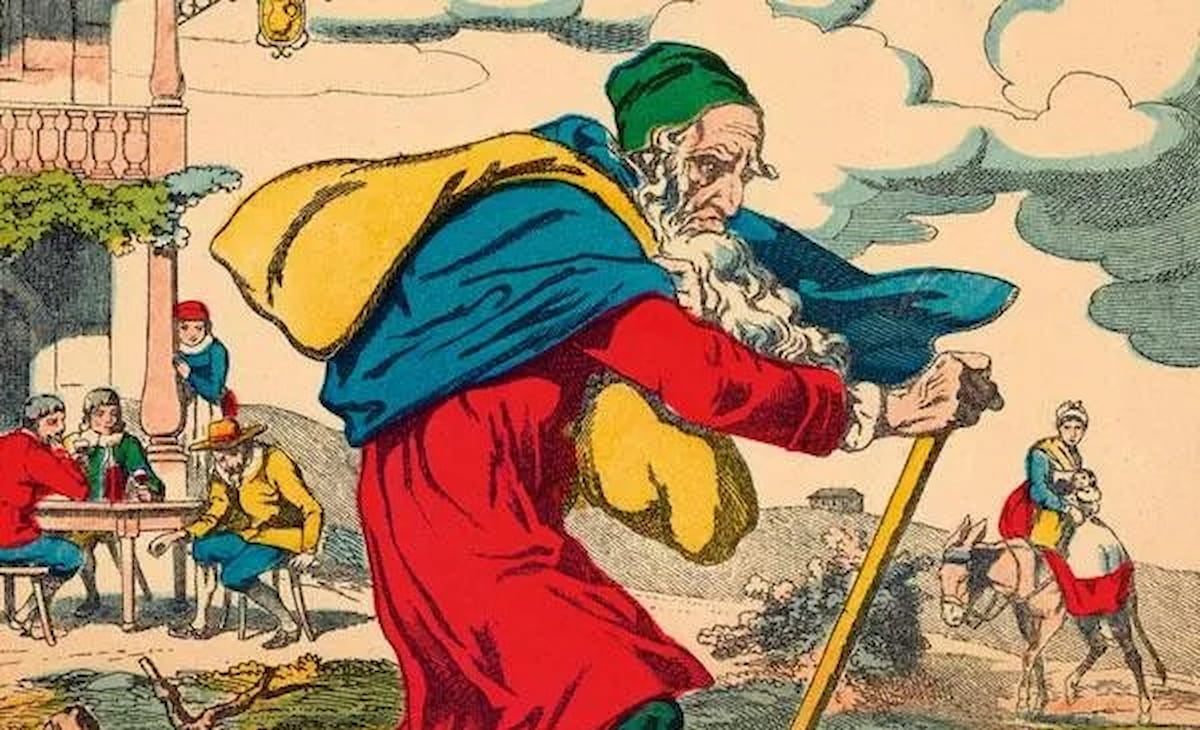
We have just traced the history of ideas that have circulated since antiquity, the medieval period, and even the 19th century, each expressing, in its own way, hostility toward Jews. These ideas feed off one another and make one another possible; they are sometimes driven by one another: without the accusation of deicide, there would have been no accusation of treason; without the accusation of misanthropy, the accusation of a conspiracy against humanity would not be possible; and so on. The machine seems to have run amok.
Writing a history of antisemitic beliefs and prejudices therefore means constructing, from extremely diverse and sometimes even contradictory sources, the portrait of a monstrous Jew who, at once, is said to have killed Jesus, to hate his fellow man, plots against them, is lecherous and greedy, has a tail and horns, does not love his homeland and, indeed, has none, except perhaps in Zion, but who nevertheless possesses some talent for music and some intelligence, however malevolent. No one has ever met such a man—a mosaic of antisemitic beliefs and prejudices—and for good reason: he does not exist. He does not exist, even if some unpleasant traits may be found among Jews, they should be allowed the right to have as many flaws as the rest of humanity. He does not exist except, perhaps, in the minds of the most fanatical antisemites.

From the end of the Middle Ages onward, hostility grew stronger and flourished, even in the absence of Jews. As Poliakov wrote, “if the Jew no longer exists, he is invented, and the Christian population, while encountering Jews less and less in daily life, is increasingly haunted by their image, which it finds in its readings and glimpses on its monuments.” When Shakespeare created his character Shylock, in a plot set in Venice, he had never encountered real Jews. It is therefore to a fictional character that we owe the most famous embodiment of the stereotype linking Jews to money—before the Rothschild family took on that role. As we can see: antisemitic prejudices have a life of their own; they exist in the presence of Jews and, better yet, in their absence, as fantasies without Jews, for we are compelled to imagine what we do not see. “Antisemitism without Jews” is a pertinent expression, one that crops up here and there in essays or history books and reminds us that antisemitic prejudices primarily concern fictional Jews, even if, and this is the crux of the problem, their consequences can indeed affect real Jews.
These real Jews form a very small people, by the very admission of the God of the Bible (Deuteronomy 7:7). Some are tempted to see in the survival of this ancient and small group a kind of miracle, the result of divine protection. But what a strange protection, one that involves so much suffering! And, above all, miracles and divine protection are not tools available to the historian for explanation. In any case, while complex factors explain the Jews’ persistence despite everything, this must not obscure the opposite reality: the dwindling of the Jewish people. One might estimate that there are roughly as many Jews in the world today as there were a century ago: a remarkable resilience, which would have allowed them to return to pre-Shoah levels, during which 40% of the world’s Jewish population was murdered? Not so: at the same time, over the past century, the world’s population has more than quadrupled. Although the Nazi plan for total elimination failed, this figure reveals a considerable decline, in relative terms, rather than a stable demographic level. Three factors explain this decline: extermination, assimilation, and the fact that most Jews have lived and continue to live in the Western world, which has already completed its demographic transition. The possibility of a world—not one without Jews, but one where the Jewish presence is far rarer and more concentrated than it has been since the Diaspora two millennia ago—is therefore very real and has even already been partially realized. No matter how often we repeat that there are sometimes thriving Jewish communities in a thousand different places, from Argentina to Germany, from Hong Kong to the United Kingdom, etc., the fact remains that, except in Israel, this presence is very weak, even negligible—about 1.7% of the population in the United States, less than 1% everywhere else.
Antisemitic prejudices have a life of their own; they exist in the presence of Jews and, better yet, in their absence, as fantasies without Jews, for one is compelled to imagine what one does not see.
We would like to provide a few more figures, to show how many actual Jews there were in each country at the time when fictional Jews were hated, to note that Jews in France were few in number during the Dreyfus Affair, or that those in Kielce, Poland, numbered only a handful before the pogrom that targeted them on July 4, 1946; we would like to point out that Jews today represent only 0.2% of the world’s population, that there are almost no Jews left in the Arab world or in Iran, and that their presence appears to be residual in many countries where it was once so significant (Turkey, the Netherlands, Poland, and the former Soviet space, etc.), and thus demonstrate that antisemites devote a great deal of energy to hating such a small population. But in doing so, we risk falling into our own trap, for reminding people that Jews are few in number is a weak argument against antisemitic individuals, who would immediately retort that Jews carry a lot of weight for such a small people—which is suspicious—or that they may seem few in number but that is without accounting for their invisible presence—in short, that, as Drumont wrote, “in various forms and different disguises, the Jew is in reality everywhere.” Many fantasies that overestimate the number of actual Jews obscure the objective fact of their numerical weakness.
Fictional Jews, untraceable Jews, imagined or imaginary Jews, Jews who have left or been driven out, Jews who no longer exist because they have been exterminated, rare Jews: all these figures point to the same possibility of the Jews’ nonexistence, which is a sort of culmination of the antisemitic fantasy, a possibility that would be both a dream and a nightmare for one who, admittedly, dreams of a Judenrein world, without Jews, but who, at the same time, thinks ceaselessly of this despised people and, at times, lives only by this obsession. The juxtaposition of a number of expressions revolving around this idea of the non-existence of Jews produces an effect that is disturbing to say the least: “There are no longer Jews or Greeks” (Paul of Tarsus, Saint Paul to Christians). “Jewish emancipation consists in emancipating humanity from Judaism” (Karl Marx). “It is the antisemitic person who makes the Jew” (Jean-Paul Sartre). “The Jews have disappeared” and “Palestinians is the name of the true Jews” (Alain Badiou), etc. They are sometimes to be understood in a purely theological sense, or supposedly philosophical, and they sometimes express a clumsy defense of the Jews: one must therefore be careful not to confuse them with one another. But all of them refer to the fact—examined from diverse and often highly conflicting perspectives in a fairly large number of books written some twenty years ago—that Jews clearly stand in the way of a certain conception of the world as open and indistinct, of society as unlimited and totalizing, and of man as universal and, so to speak, without qualities: the stubborn Jewish singularity, this fidelity consisting in “remaining Jewish” according to Leo Strauss’s famous expression, is intolerable to this conception.
Jews clearly stand in the way of a certain conception of the world as open and indistinct, of society as unlimited and totalizing, and of man as universal and, so to speak, without qualities.
Our aim here is not, as we have already noted, to propose a new general theory of antisemitism that would account for its motivations and, above all, its causes, or even its root cause. This last question—that of the cause—is often raised. It is a dizzying one. Why the Jews? There are several answers, and one must, to begin with, point out that Jews are not the only human groups subject to negative beliefs and prejudices, sometimes deadly ones. Other ethnic groups are or have been the targets of terrible violence. There have been other genocides. And even other groups, constituted differently—such as women—who were not, for good reason, ostracized in the same way, are victims of beliefs, prejudices, and often deadly violence. This damning observation must not prevent us from taking a broad and attentive look at the specificities of all these antisemitic beliefs and prejudices we have mentioned.
It seems to us, first of all, that among them, one has played a role whose importance could hardly be overstated: deicide. This places Jews at the very heart of Christian identity, inevitably, and thus even when there are no longer any actual Jews: this ontological and necessarily complex (though not necessarily hateful, let us be clear) link between Judaism and Christianity (and Islam, consequently) also accounts for the “antisemitism without Jews” we just mentioned. Deicide, then, or more broadly this intimate link with a religious system of immense weight, Christianity: this is the most important weapon in this antisemitic arsenal, but not the only one. For, and this is the second point we wish to present here, this arsenal is vast (it has been accumulating and reactivated for some two thousand years, often over very long periods), and the cumulative impact of its consequences is terrifying, like a snowball effect. There are countless sources, resources, themes, authors, and antisemitic motifs; their quantity, consistency, and variety are considerable, providing an inexhaustible fuel for antisemitic hatred. This arsenal ultimately proves itself: if there are so many things, it must be that there is something to it. This reasoning is not really reasoning, but many antisemitic individuals adopt it as their own.

It remains to be understood why these antisemitic beliefs and prejudices, overall, beyond all that differentiates them, exert such a strong pull. In a lecture delivered in 1961, the German Jewish philosopher Max Horkheimer offered a pessimistic reflection on the prejudice of hatred, which he described as “unshakeable, because it allows the subject to be evil while judging himself to be good.” Added to this moral dimension is a sense of self-worth that is automatically reinforced by collective prejudice: Horkheimer notes that “negative prejudice is one and the same as positive prejudice,” in the sense that one implies the other, that they are two sides of the same coin. When I speak ill of others, I elevate my own people (and, thereby, myself): like any racial prejudice, antisemitism implicitly elevates me; it is good, especially in times of crisis and doubt; it inflates my ego. This is the first benefit provided by negative racist prejudice (and not just by antisemitic prejudice, for it is true that, despite their specificities, the mechanisms of prejudice echo one another).
What other benefits exist? The explanation for virtually all the misfortunes of the day (“it’s the Jews’ fault”) is another, major one: attributing misfortunes—my own, in particular—to a group is a comfortable process, because it possesses an explanatory power that is both potent and simple, and because it perfectly absolves one of guilt. Something powerful is at stake around the concept of blame, this sense of guilt, this status of victims: it seems to us that antisemitic hatred offers the benefits of a kind of pleasure, particularly through its fantastically vindictive nature—against Jewish “misanthropy,” against those innocent Jewish victims whose memory haunts the West. Nothing beats, then, reversing the roles and incriminating the victims. We know the famous and sadly timely words spoken by Vladimir Jankélévitch in 1971: “What if the Jews were Nazis themselves? That would be wonderful. ” The construction, through beliefs and prejudices, of a fantastical, even mythological, figure of the Jew—one that legitimizes and authorizes hatred while erasing past wrongs—is not the least of the poisonous charms of antisemitism. Let us hope that understanding its main motives and the primary reasons for their appeal can help us better combat them.
Pierre Savy et Lisa Vapné, Brève histoire des croyances et préjugés antisémites, Seuil, 2026, p. 241–251

Lisa Vapné