They know they don’t want to know: that is the conclusion that must be drawn after two recent cases brought the issue of left-wing antisemitism back to the forefront of public debate in France. Both cases concerned the university, a place of learning. When Julien Théry, a history professor in France and author of a text striving to demonstrate that left-wing antisemitism does not exist and never has existed, circulated a list of names, the vast majority of whom were Jewish, of “genocidal figures to be boycotted under all circumstances”, the outcry was immediate: Hold on, he just copied the names from a petition! Admittedly, he did so by compiling a list and exposing each of the individuals named to public condemnation, but still. Until a cartoon emerged from the depths of his account, whose antisemitic nature was so blatant this time that even his defenders had to look away – though not all of them, as the union that had initially supported him had no choice but to condemn him. As for the other case, it encompasses this phenomenon and many others: it concerns the investigation into antisemitism at universities commissioned by the Minister of Higher Education from a research center specializing in opinion polls. Here too, there is a barrage of criticism. On this subject, antisemitism, too many issues are at stake for the desire to know not to be suspected of wanting to do something other than know – to control, coerce, subjugate, etc. For everyone’s peace of mind, it would be better not to know. And to reassure ourselves by believing we know, as the professor – who was punished, but for what exactly? – rightly demonstrated that left-wing antisemitism “does not exist”…
Reflexivity, on this point, therefore struggles to find its way. The difficulty is that legitimate concerns are being raised here: for academic freedom, which is undeniably threatened by a noisy political sphere where reactionary arguments are constantly growing; for the limitations of opinion polls, long identified by the social sciences, which nevertheless strive to control their biases and turn them into usable data. These critical elements cannot be ignored, especially in a situation where the argument – which is indeed antisemitic – of state philosemitism is gaining momentum and is being fueled by certain sections of the left. However, being concerned about these elements is not the same as using them as a parade, a justification for denying reflexivity. There is a huge gap between acknowledging that the fight against antisemitism is being exploited by actors with questionable intentions – are even clearly contributing to the current reactionary shift – and refusing to consider the phenomenon in its reality. To leap over it is an irresponsible intellectual gesture, for which the interpretation of October 7 as devoid of any antisemitism provided the model. The philosopher Bruno Karsenti offers an analysis of this gesture in K. Questioning the difficulties raised today by the fight against antisemitism, and the screens that stand between the European gaze and this issue, he highlights the specificity of the current phenomenon: beneath the denial lies complacency towards a powerful rejection of what Jews actually represent in the current situation.
Love is often a series of failures at first. And, in this repetition, the issues that have been passed down to us play a large part. Trancher (Slicing), Sophie Engel’s one-woman show offers an intimate investigation into the relationship between Judaism and romantic relationships, between the desire for emancipation and the injunction to perpetuate. Maëlle Partouche spoke with the director and playwright for K. about the monsters of the past she sets out to flush out and how questions related to Jewish identity resonate today with the status of women.
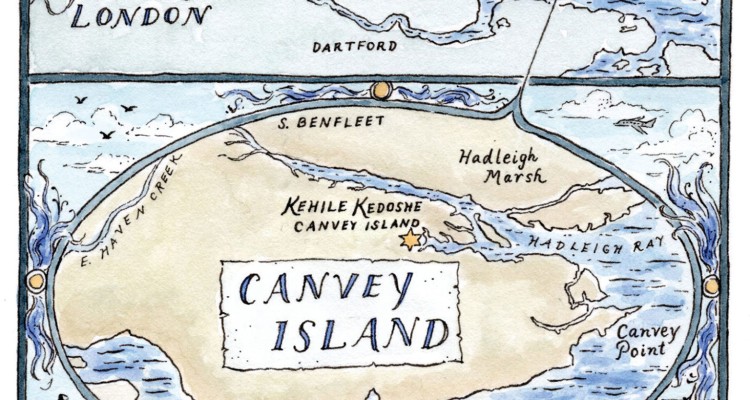
Lastly, we revisit one of the riveting postcards by Anshel Pfeffer. For some years now, young Orthodox families have been leaving London for Canvey Island, where real estate prices allow them to settle. Thus was born the community of Kehile Kedoshe, which seems to integrate perfectly alongside an aging native Tory and pro-Brexit population: “One of the local councilors told me that we’ve finally brought diversity to Canvey,” said Mr. Friedman, one of the leaders of the community. Originally published in the American journal Sapir, this British postcard is both touching and exotic.