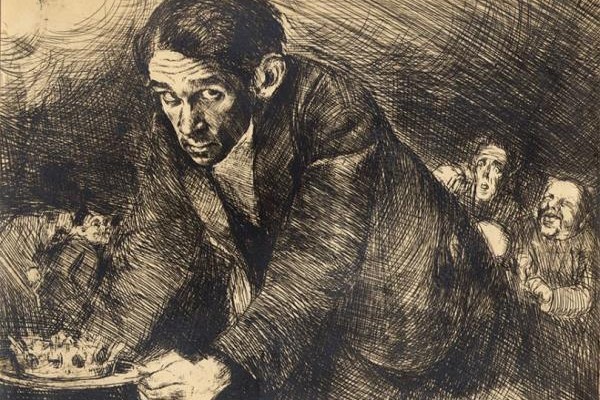
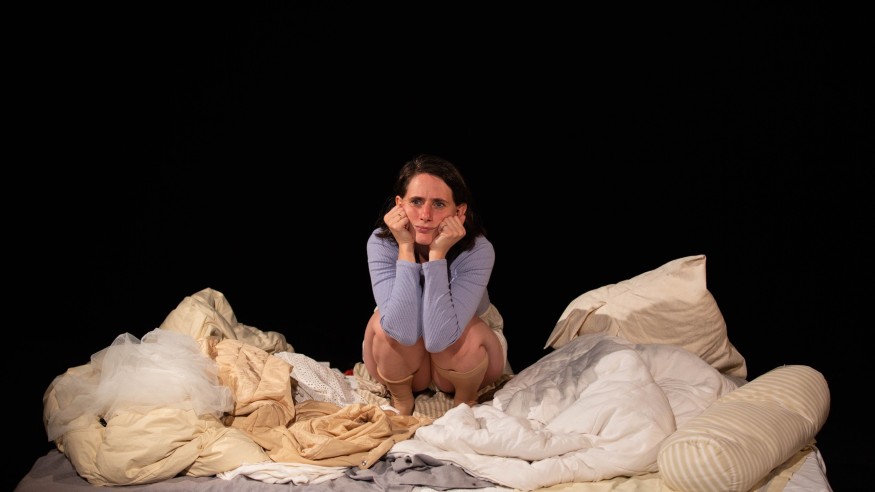
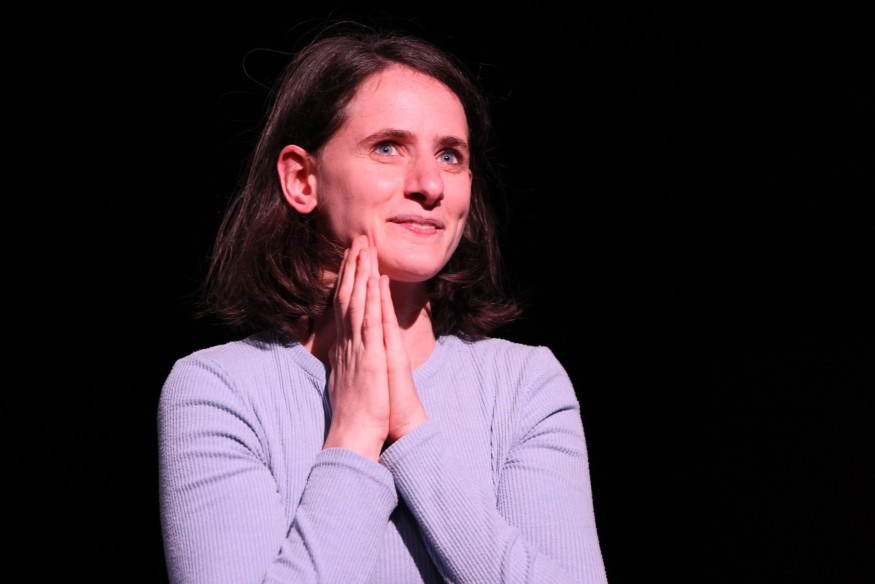
Yet another breakup prompts Sophie to put on her mask and arm herself with a crossbow to go find the sea monster that has been haunting her since she entered adulthood and preventing her from blossoming as an emancipated Jewish woman. This monster is none other than the sum of her fears, her family heritage, and her inner contradictions: everything that, since childhood, has shaped the way she loves – sometimes in spite of herself. Among these legacies is a persistent injunction: to love “within the group”, to be in a relationship with a Jewish man. Slicing (Trancher), a one-woman show in which she plays the main character, is Sophie Engel’s first play. Both funny and cathartic, it questions the place of religion in romantic relationships.
Maëlle Partouche: For your first staged play, you bring a “big piece” of yourself and your history to the table. How did the Slicing project come about?
Sophie Engel: For several years, I had wanted to explore religion on stage. Beyond my personal sensibilities and my own journey, I felt that religion was underrepresented given the place it occupies in society. It seemed to me that we heard a lot about religion, but that, paradoxically, it was rarely explored or questioned, especially by people who had intimate experience with it.
Even more so in theater, the relationship to religion is one of the great absentees from the stage. During my year as an associate artist at the Comédie de Reims, I had the opportunity to take a first step in this direction by commissioning my friend, the author Guillaume Poix. He wrote a beautiful text entitled “Who to believe?”. It is a solo piece on religion, but Catholicism, and therefore his text deals primarily with the question of faith and the fascination with saints. This is very far removed from Judaism… It was the first step in my process because we had discussed it at length. The result was a text that traveled far and wide. The writing process gave rise to a character who became increasingly detached from my own experience. Then I spent a week working at the table with Héléna Sadowy, the co-director of Slicing. Working with her allowed me to really question the text and how I could convey what I had to say on stage.
There are many Jewish audience members in the theater who, after the performance, feel the need to share their own experiences with me.
M.P.: Religion is a subject that is rarely dealt with in theater today, and I wonder if this is because we are afraid of weighing down the audience in a context where it is perceived as the cause of many tensions. However, this is not at all how it is approached in your show. We even laugh heartily throughout the play! Was this the desired effect?
S.E.: I was keen to play with the artifices of staging. I wanted to distance myself from the story to make room for the theatrical dimension, particularly with the sea monster, which symbolizes the deep anxiety that kept resurfacing and leading me to failure in my romantic relationships. I used the monster to tell the story of a character who is grappling with questions about her religious heritage and her choice of lover. Héléna and I sought to distance ourselves from anything that might be a very realistic confession. It is the codes of the stage that allow us to embody our ghosts and anxieties without losing our sense of humor, of course!
I realized that what should be the end, this umpteenth breakup, is in fact the opening of the show. Here, I’m making a direct reference to Bridget Jones! Not everyone gets the humor of the beginning, despite the ridiculousness of the protagonist lying in bed, completely depressed, eating ice cream, the floor littered with dirty tissues… It was really meant to signify the distance from this pathetic character with whom I clearly share a closeness. And it’s true that some people, who often know few Jews and are therefore unfamiliar with these issues, came to see me after the play to share their compassion for what I had experienced. Paradoxically, even while writing Slicing, I never saw it as something “hard” that I simply endured.
Moreover, there are also many Jewish spectators in the audience who, after the performance, need to confide in me about their own experiences. And that, for me, is the flavor of the Jewish religion! Everyone has a particular story, knows someone who has been in the same situation of loving a non-Jew, and so on. So often, these are Jewish people who married a Jewish woman in their first marriage and then a non-Jewish woman in their second, but still, they went to the liberal synagogue so that their children could celebrate the holidays… In short, I feel that this text speaks to many people. We always wonder how best to compromise and succeed in taking a third path that allows us to remain on the inherited path while inscribing our freedom into it.
Every Jew feels that they could always do more. And if Jewish identity is forever incomplete, then surely everyone can, at some point, feel like they are someone else’s Rasha.
M.P.: Slicing is in two parts: first, you ask yourself what it means to you to be Jewish before confiding and sharing your many romantic stories – and disappointments – with Jewish and non-Jewish men. In fact, throughout the play, you embody Rasha, the naughty child of Passover, with whom you compare yourself.
S.E.: To begin with, I would say that my Jewish identity is primarily expressed through my relationship with the text and the holidays, but then it quickly turns into a form of questioning. I use the comparison with Rasha, who questions the rules by using the second person plural: ” Why are you doing that?“ and who, in fact, extracts himself from the group. This impression is the source of a deep sense of guilt in me. A very strong guilt linked to the history of my family, marked by the Shoah, who fled through Poland and Germany. I repeat this phrase, which I believe I read in Günther Anders: ”You are the rest of the rest of the rest.” I find that all these dead Jews, whose culture we have inherited, create a tremendous amount of guilt when, like me, we don’t feel capable of perpetuating the tradition. And so yes, I also wonder if there are people who don’t feel so torn, who feel that everything is aligned with themselves.
On the other hand, we know that there are 613 mitzvot (rules) in Judaism and that it is virtually impossible to observe all 613 mitzvot, which means that every Jew is an incomplete Jew. One of the consequences of this is that every Jew feels that they could always do more. And if Jewish identity is forever incomplete, then surely everyone can, at some point, feel like they are someone else’s Rasha.
MP: I really like that idea! Especially since in Slicing, the idea is not so much to break with one’s heritage. On the contrary, I see it more as a quest for balance, even if the title might suggest the opposite.
S.E.: Initially, the intention of the title was that of choice. The choice of love being one where there can be no alternation. In any case, that’s how I experienced things. There comes a time when you have to make a decision and, therefore, make a choice. I liked the violence of the verb. In the act of choosing, you have to cut something out, and in choosing, there is what you choose, but there is also what you give up. The violence of the word directly echoed the fact that in romantic choices, we often find ourselves in very complex situations where we have to give something up. We are forced to cut back on our expectations, on the projections we have made about ourselves. So it’s a decision made with renunciation or a decision made with loss.
And in this sense, the text is quite one-sided – something for which I have been criticized. This is mainly because, with the exception of a digression in which I consider the point of view of one of the ex-boyfriends, I do not give a voice to the men who have marked my character’s love life. However, I wrote Slicing with an idea of dialectics in mind. The essentialization of the characters mentioned is primarily a theatrical device. It’s even meant to be humorous.
M.P.: Yes, and the character is no exception since, as she says every time she gets dumped, she finds herself “alone like an idiot, like a fool.”
S.E.: Exactly! I understand that I could be criticized for a form of binary thinking, but it seemed to me that if I started to present the nuances of each relationship, I would end up not saying much about myself and the duality I was confronted with. That’s why I fully embrace this binary thinking, because that’s precisely what I wanted to talk about in this text. I’m not talking about mixed marriages or possible compromises, but rather the journey of this character torn between the injunction to marry a Jewish person. And so, in this case, the terms can only be binary because it’s either Jewish or non-Jewish. There is no other choice. My point was rather to draw a dialectic from this binary opposition between Jewish on the one hand and non-Jewish on the other. And in the end, the duality between Jewish and non-Jewish finds a way to express itself, which does not amount to either renouncing one’s Judaism or embracing it as one has received it. And it is at the end of this journey that my character envisions a way, even while being with a non-Jew, to embrace his Judaism.
If, as two audience members from the LGBT community suggested to me, Slicing must become a safe space for some Jews, like other spaces for other minorities, I will be delighted.
M.P.: Is this binary ultimately the duality that you experience and talk about throughout the play? You replay it one last time at the end of the play, when you address your parents. That’s very disturbing because at that moment, you use the term “coming out” and even “coming out as a goy (non-Jewish).
S.E.: While writing the play, I remembered the idea put forward by a writer friend who argued that, as a place where words are spoken, theatrical speech is always a form of coming out. It doesn’t matter which one, but we always come to say something in front of an audience, that is, publicly. It’s true that in the end, I’m addressing my parents, but at the same time, I’m addressing the audience and thanking them for being there to listen to me. They are called upon to bear witness.
M.P.: In fact, it’s quite provocative! I would even say that it’s more provocative than talking about a Jewish coming out , in that a goy coming out is more likely to shock both sides: the Jewish world, which expects you to continue the family line, and the secularized non-Jewish world, which may find it difficult to understand that religion can still be the source of such conflicts in people’s love lives.
S.E.: Several people have criticized my text for its completely disenchanted view of love. I understand their surprise, even though I mention first love, first sexual experiences… So it’s true that I don’t defend a romantic view of romantic relationships, but they are no less romantic! And once again, exaggerating allowed me to put some distance between my personal history and the protagonist.
Personally, I must admit that I have shared these issues very little in my circle, which is almost exclusively non-Jewish. I come from a Jewish family, but I have very few Jewish friends, which has often caused me to feel ashamed when I realized that I couldn’t escape this issue so easily. And so yes, it may even be more of a Jewish coming out because there are many people who don’t know that this issue has torn me apart so much, even though people often know that I am Jewish. But I don’t go to synagogue, I don’t celebrate holidays as much as I used to, which, without hiding it, leaves few opportunities for my Judaism to manifest itself publicly. I grew up with the idea that religion is a private matter and should remain so. I was ashamed to admit how important it was in my choice of partner and the fact that I was in a relationship with a non-Jew. So yes, I was very afraid of shocking my non-Jewish friends and family by raising this issue.
I also wonder if, as Philip Roth discusses in Portnoy’s Complaint, there might be something quasi-incestuous that we seek to avoid by leaving the group. Because deep down, what drives us to look elsewhere?
But for now, beyond my circle, my audience is still predominantly Jewish. And it’s a normal process for each show to naturally find its audience. People recommend the play to their loved ones because they know they’ve been through the same trials. And then, without falling into a form of paranoia, the current context may not be conducive to telling the story of Jewish culture. But if, as two audience members from the LGBT community suggested to me, Slicing must become a safe space for some Jews, like other spaces for other minorities, I will be delighted. Once again, while this question of “Jewish or non-Jewish” is not obvious to non-Jews, it is, on the contrary, incredibly obvious to almost all Jews! My show can also become a place to address this question without any issues of legitimacy. If Jewish people recognize themselves in this question, then so much the better.
MP: But I think that this question you’re addressing, especially by keeping Israel and the current crisis facing Jews out of it, can speak to a fairly wide audience.
SE: Yes, my idea was really to recount the moment when my character realizes that she has internalized the injunctions that were given to her from outside. And these rules, which she knew existed but which she thought she was immune to until then, suddenly affect her and even take on a major role. What was just her parents’ nonsense has become her own! So yes, I say, “I’m standing here like an idiot, like a fool”. And I continue to ask myself, “What is this story? It’s my story, it’s no longer my parents’!” It’s also a way of lifting a personal taboo. This rejection that I have put into my relationships with non-Jewish men, even though everyone around me is goy! It seems to me that this can happen to people from other minorities, for example, first-generation immigrants who grew up in France but whose families have remained attached to the rites and traditions of their country of origin.
And without addressing it directly, I also wonder if, as Philip Roth discusses in Portnoy’s Complaint, there might be something quasi-incestuous that we seek to avoid by leaving the group. Because ultimately, what drives us to look elsewhere? What makes us want to seek out someone other than ourselves and yet remain within the religious framework we have inherited? I should say right away that I don’t have the answer! And I would be quite incapable of doing so. But the theme of love and what can be shared within a couple are questions that fascinate me. Even among Jews, don’t they say, “two Jews, three synagogues”?
At one point, my character meets a Jewish boy who, on paper, is the perfect man for her to start a family with. But in reality, he is a disaster and is very far from everything she loves. Yet she tries to convince herself otherwise and claims that she will manage to “make this square fit into this circle.”
M.P.: Speaking of synagogues, according to the large-scale TéO (Trajectories and Origins) statistical survey[1] conducted in 2016 on the diversity of populations in France, Jews are the least endogamous religious minority in France, but Jewish women tend to marry Jewish men more often (76% versus 49%), which seems rather counterintuitive since, according to halacha, transmission is through the mother. The issue is not addressed in the play, but one might wonder why this character asks himself so many questions when his children will have no problem being recognized as Jewish.
S.E.: I didn’t know that! It is very surprising, indeed. But what it reminds me of is that, at least in strict law, it is the man who is responsible for prayers. Women give birth to Jewish children, but they are not always able to pass on more if they have not been taught to read the Torah or the shabbat prayers. The ritual is patriarchal and it is the man who celebrates it. This raises real questions of legitimacy – and therefore raises the question of transmission when one enters into a relationship with a non-Jew. For example, in the text, I suggest that the future child will go to his grandparents and cousins to celebrate Jewish holidays, as if I alone were unable to keep Judaism alive in my home.
That said, I feel that things are slowly changing. I am thinking, for example, of the great suffering, which I discovered very late in life, of people born to Jewish fathers and non-Jewish mothers, who learned at a very advanced age that they were not Jewish according to the law. In this sense, other movements such as the liberals, but also associations such as the French Jewish Scouts and Guides, play an important role in ensuring that religion is passed on to new generations, regardless of their background. But coming back to women, I think there is indeed a very strong issue of feeling legitimate.
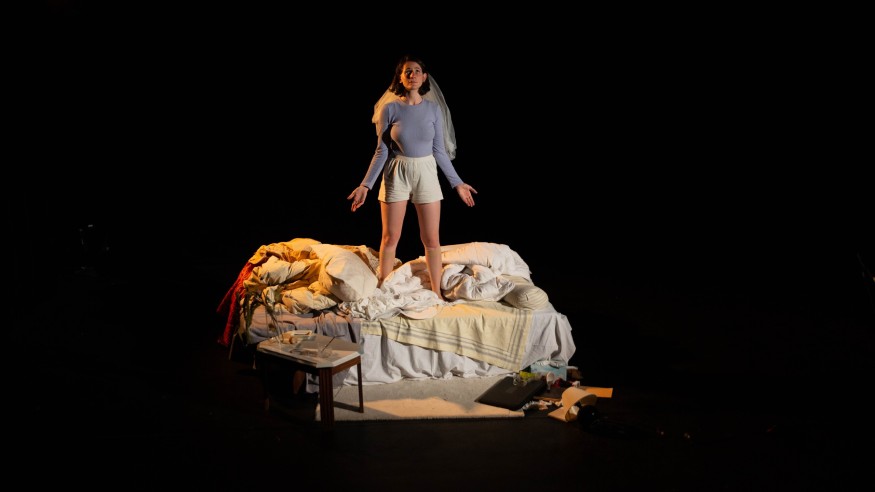
In fact, I would say that the pressure is twofold, coming from what has been passed on to us and what we are going to pass on. Perhaps this question of transmission is even more present for women, both Jewish and non-Jewish. At one point, my character meets, through a friend, a Jewish boy who, on paper, is the perfect man for her to start a family with. It’s a Shidduch (a meeting arranged with a view to marriage). But in reality, it’s a disaster and he is very far from everything she loves. In short, their date is completely chaotic. Yet she tries to convince herself otherwise and insists that she will manage to “make this square fit into this circle”. As a woman of a certain age, you can’t escape this pressure to pass on your genes. And every new encounter is accompanied by an internal calculation to determine whether the man in front of you (and I’m generalizing again because this is pressure that comes from outside) will be the father of your future children. Men have not been raised with the idea that they would be complete by having children and starting a family. The question of passing on the faith does not represent the same responsibility – or perhaps it comes later, once the children are there. So ultimately, I can understand why Jewish women are more inclined to start a family with a Jewish man.
I didn’t want to end with a happy ending that would be a celebration of mixed marriage. Personally, I don’t think these issues will ever be completely resolved.
M.P.: Ultimately, this play is a very personal one about emancipation, both in relation to your Jewish heritage and your status as a woman and even as an actress. We are very eager to know what happens next, to find out how things will turn out for this character who, until now, has had an incredibly difficult life, but always with panache!
S.E.: To begin with, I should perhaps point out that with Héléna, we initially envisaged a tragic ending in which my character found herself facing infinite loneliness. I didn’t want to end with a happy ending that would be a celebration of mixed marriage. Because in fact, my point is completely different. And I think there are some very good books that offer very profound reflections on this. I’m thinking of Nathalie Azoulai’s Toutes les vies de Théo (All the Lives of Theo) and Lucie-Anne Belgy’s Il pleut sur la parade (It’s Raining on the Parade). Personally, I don’t think these questions will ever be completely resolved. At birth, if it’s a boy, circumcision is the first ordeal, followed by the bar mitzvah… And who knows if one day I won’t return to religion at some point. For me, it’s a story that’s never over. For example, October 7 plunged me into a deep loneliness, and I sought out Jewish people who might have insights that could enlighten me.
In the end, Héléna and I opted for an ending that celebrates Judaism. I deliberately did not mention Israel in my play. I would even say that it was very deliberate because I wanted to separate Jewish identity from this political and historical context. Jewish history is marked by catastrophes, but I wanted us to be able to talk about Judaism outside of October 7 and outside of Israel. This was a way for me to remind people that Jewishness cannot be reduced to that. Precisely in order to overcome the conflation between this war and the antisemitism it produces in France, it was important to me to show that, as a Jew, my questioning could not necessarily include Israel. And then, I also wanted to celebrate a Judaism that is not just about the horrors and tragedies of history, because my attachment to my Jewish identity is really far removed from all that. We decided that we needed this text at the end, as a kind of reconciliation with Judaism.
So I’m glad that people understand my text in the most open way possible, because that’s how it was intended. I happen to be Jewish, and the Jewish religion is quite misunderstood and sometimes even viewed with suspicion. I think that this issue of passing on a minority religion can resonate with people from other groups. Ideally, but only time will tell, I would love to be able to perform this play in front of a school audience, probably high school students. It is at this pivotal moment between childhood and adulthood that these questions emerge and crystallize. And if not for oneself, then perhaps for the person one loves. If my text does not directly address the issue of mixed couples, it is also because I want to believe that it does not make much difference. If Slicing could build bridges, that would be a real success for me!
Interview conducted by Maëlle Partouche
Trancher, by Sophie Engel, will be performed for the last time in Paris at the Théâtre de la Flèche on Saturday, December 13, 2025.
Support the work of K. Click here to make your annual donation to K. Review.
Notes
| 1 | Cris Beauchemin et al., “Trajectories and Origins 2019-2020 (TeO2): presentation of a survey on the diversity of populations in France ,” Population 78, no. 1 (2023): 11-28. |